"Burke understood that true wisdom resides with the permanent things, and these he sought to commend to generations yet unborn." Interestingly, Burke was a Whig (the ancestors of the Liberals) nd not a Tory. He is still well worth reading.
From The Imaginative Conservative
By Kevin Belmonte, MA
Edmund Burke’s “gambit”—his contribution to the long conversation with posterity—has endured. Burke understood that true wisdom resides with the permanent things, and these he sought to commend to generations yet unborn.
 Gibbon admired his eloquence. Matthew Arnold likened his legacy to Shakespeare and Milton. Hazlitt judged him the greatest writer of prose in English. Coleridge called him a man of unquestioned genius. And William Wilberforce never forgot his steadfast support of the fight against the British slave trade.
In the 1930s, Churchill said that Edmund Burke stood foremost among the apostles of liberty. Fifty years later, and not long before the fall of the Berlin Wall, Ronald Reagan drew inspiration from Burke as well. America’s 40th president remembered that Burke had championed the cause of American independence—greater still, that he had written these words: “When bad men combine, the good must associate; else they will fall—one by one.”
“Those words,” said Reagan in 1986, “still ring true.”[1]
And what of the word “gambit”? Among those skilled in lexicography, it is “a remark intended to open a conversation.”[2]
Few were more skilled than Edmund Burke in the art of conversation, or the ability to expound the tenets of the conservative mind. In the two hundred years since his passing, he has cast a long shadow in the world of ideas, and speaks to us still.
* * *
Burke was a son of Ireland, a sage for all seasons. Few writers and political thinkers from the 1700s are as well remembered today. His wisdom and legacy come highly recommended to posterity. To cite but one example, books about C.S. Lewis and J.R.R. Tolkien show they thought very highly of Burke indeed.
Lewis, said former student David Bleakley in C.S. Lewis at Home in Ireland, was well aware “that he was part of a rich Irish tradition of scholarship and intellectual brilliance [and] Edmund Burke (1730-1797) was high on his list.” Lewis’s admiration, Bleakley said, centered on three things: “Burke’s command of words,” “his masterly use of the art of the pithy observation,” and Lewis’s belief that Burke was “eminently quotable.” Lewis, Bleakley concluded, “retained an interest in Burke throughout his life, and often recommended his merit when advising reading programmes.”
Diarist Roger Lancelyn Green, who knew both Lewis and Tolkien, tells us how these two famous friends were united in their admiration of Burke. On November 9, 1954, Lewis and Tolkien gathered for lunch with friends at The Eagle and Child pub.
Green was there with Lewis, Tolkien, Lewis’s brother Warren, R.B. McCallum and Gervase Matthew at “the Bird and Baby,” or “B. and B.,” as Green called it. This was the nickname for The Eagle and Child pub, and to have been at “the Bird and Baby” on this day, 72 years ago, would have been to hear “very good talk, about Tolkien’s book (The Lord of the Rings), horror comics, [and] who is the most influential and important man in various countries.” Green tells us they settled on “Burke for Ireland.”
* * *
In recent years, the distinguished scholar and biographer Dr. Richard Bourke has characterised Edmund Burke as “a towering figure in eighteenth century European politics.” He was both a central statesman—serving thirty years in the British Parliament—and an important political philosopher.
Crucially, Burke’s moral imagination was shaped by faith, and he was steeped in Anglican moral theory. “He was indeed a Christian,” Dr. Bourke has noted, “and from his Christianity he derived principles—he believed—in accords with which he could judge right action on a world stage.”
“I am attached to Christianity at large,” Burke forthrightly declared, “much from conviction; more from affection.” Elsewhere he affirmed: “I am by choice and by Taste, as well as by Education, a very attached Member of the Established Church of England.” Faith gave Burke sustaining strength, for he saw himself in “the hands of the Great Shepherd of all, on whom let us cast all our cares, for He careth for us.” So, on many Sundays, faith led him to St. Mary & All Saints Church, Beaconsfield.
* * *
Aside from his faith commitment, and how it shaped his public philosophy, Burke believed in things that remain. He held that the stock of knowledge he mined, and the reflections he contributed to the long conversation with posterity, would endure.
This conviction, we may say, was Burke’s “gambit,” a remark, as said above, intended to open a conversation. Few were more skilled in this than he, as friends like Wilberforce understood, writing—
Burke was a great man; I never could understand how he grew to be at one time so entirely neglected. He had come late into Parliament, and had time to lay in vast stores of knowledge.
The field from which he drew his illustrations was magnificent. Whenever he opened his mouth, pearls and diamonds dropped from him.
The essayist William Hazlitt put the matter even more succinctly. Burke’s writings, he said, were “calculated to make men think.”
And that is no negligible thing in the world of belles-lettres.
* * *
It’s now well over 200 years since Burke’s time. We know it as the era of the French Revolution, beheadings, “the Reign of Terror,” and the Napoleonic wars that raged across Europe—“the world turned upside down,” as one ballad then memorably described it.
Our time is also one of war, political turmoil, and much grave uncertainty. Now, as long ago, lines from Burke’s writings still retain their dire eloquence and insight.
Among them are discerning guideposts like these—
- “We are therefore never authorized to abandon our country to its fate, or to act or advise as if it had no resource. There is no reason to apprehend, because ordinary means threaten to fail, that no others can spring up. Whilst our heart is whole, it will find means, or make them. The heart of the citizen is a perennial spring of energy.”
- “When ancient opinions and rules of life are taken away, the loss cannot possibly be estimated. From that moment we have no compass to govern us; nor can we know distinctly to what port we steer.”
- “Men are qualified for civil liberty in exact proportion to their disposition to put moral chains upon their own appetites,—in proportion as their love to justice is above their rapacity,—in proportion as their soundness and sobriety of understanding is above their vanity and presumption,—in proportion as they are more disposed to listen to the counsels of the wise and good, in preference to the flattery of knaves. Society cannot exist, unless a controlling power upon will and appetite be placed somewhere; and the less of it there is within, the more there must be without. It is ordained in the eternal constitution of things, that men of intemperate minds cannot be free. Their passions forge their fetters.”
- “When bad men combine, the good must associate; else they will fall one by one, an unpitied sacrifice in a contemptible struggle.”
- “What shadows we are, and what shadows we pursue!”
Burke, as scholar Russell Kirk observed, was never taken in by the siren song of ideologies that cherished utopian illusions. He knew humanity was flawed, not perfectible—capable of pursuing great things, capable also of fomenting great ruin.
Rather, Burke’s primary commitment was to the realm of permanent things, “the permanent truths,” in T.S. Eliot’s phrase, “about man and God and life and death.” They commanded Burke’s fealty, and called forth his best efforts as a writer and thinker.
Burke, it bears repeating, was much admired by Winston Churchill—who invoked his memory in a time soon to be afflicted with coercive visions of utopia, or to call them by their real names, soft tyrannies and dictatorships. Churchill too saw permanent things under assault, and recognised a kindred spirit in Burke. His thoughts come to us from the 1927 essay “Consistency in Politics.”
“On the one hand,” Churchill wrote,
[Burke] is revealed as a foremost apostle of Liberty, on the other as the redoubtable champion of Authority. But a charge of political inconsistency applied to this life appears a mean and petty thing.
History easily discerns the reasons and forces which actuated him, and the immense changes in the problems he was facing which evoked from the same profound mind and sincere spirit these entirely contrary manifestations. His soul revolted against tyranny, whether it appeared in the aspect of a domineering Monarch and a corrupt Court and Parliamentary system, or whether, mouthing the watch-words of a non-existent liberty, it towered up against him in the dictation of a brutal mob and wicked sect.
No one can read the Burke of Liberty and the Burke of Authority without feeling that here was the same man pursuing the same ends, seeking the same ideals of society and Government, and defending them from assaults, now from one extreme, now from the other. The same danger approached the same man from different directions and in different forms, and the same man turned to face it with incomparable weapons drawn from the same armoury, used in a different quarter, but for the same purpose.
Churchill’s stirring essay proved that Burke’s gambit, his contribution to the long conversation with posterity, had endured. Not however, Burke would have said, because he possessed any special wisdom. But rather because he’d come to understand where true wisdom was to be found. It resided with the permanent things, and these he sought to commend to generations yet unborn.
It was an act of stewardship. He believed posterity would listen, ultimately, to things worth hearing—and discover the value of these things for themselves. That, at least, was the hope he cherished.
Such a hope was not misplaced, and Burke has much to say to us now. Few have ever written more richly, presciently, or eloquently. We have need of his wisdom.
It’s time we renewed our acquaintance with him.
__________
[1] see the speech “Remarks to Citizens in St. George’s Grenada,” Feb. 20, 1986. Here, Reagan quotes the following lines from Burke: “No man, who is not inflamed by vain-glory into enthusiasm, can flatter himself that his single, unsupported, desultory, unsystematic endeavours, are of power to defeat the subtle designs and united Cabals of ambitious citizens. When bad men combine, the good must associate; else they will fall, one by one, an unpitied sacrifice in a contemptible struggle.” See Edmund Burke, Select Works, vol. 1, ed. by E.J. Payne, (Oxford: At the Clarendon Press, 1874), 83.
[2] from The American Heritage Book of English Usage, (New York: Houghton Mifflin, 1996), 99.
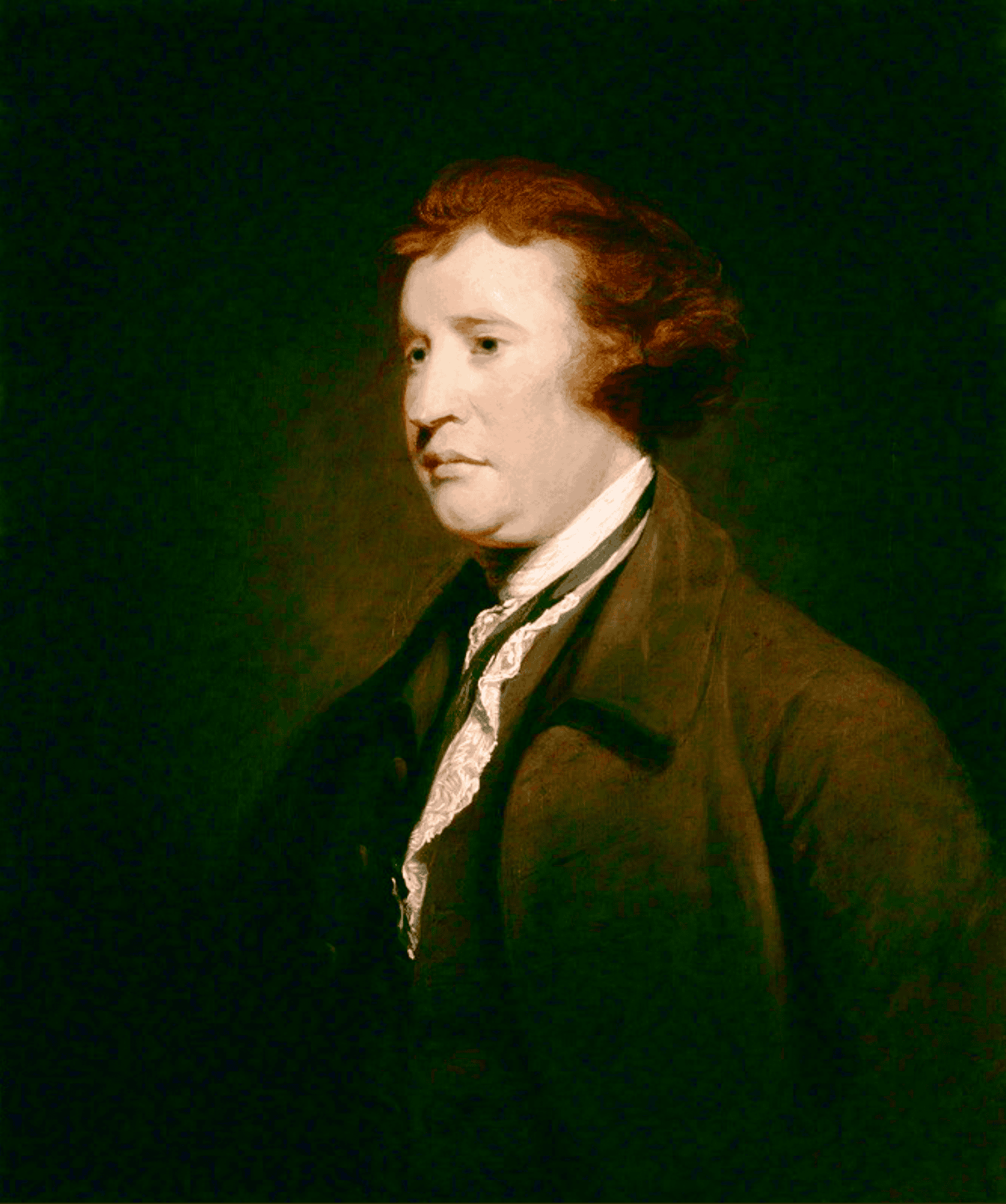
The featured image is an anonymous portrait of Edmund Burke (circa 1769 or after) by the studio of Joshua Reynolds, and is in the public domain, courtesy of Wikimedia Commons.

No comments:
Post a Comment
Comments are subject to deletion if they are not germane. I have no problem with a bit of colourful language, but blasphemy or depraved profanity will not be allowed. Attacks on the Catholic Faith will not be tolerated. Comments will be deleted that are republican (Yanks! Note the lower case 'r'!), attacks on the legitimacy of Pope Leo XIV as the Vicar of Christ, the legitimacy of the House of Windsor or of the claims of the Elder Line of the House of France, or attacks on the legitimacy of any of the currently ruling Houses of Europe.