"Whatever hells have been loosed upon the world, here in America and abroad, never forget that our ancestors, even pagan ones, called us to love and cherish that which is best."
From The Imaginative Conservative
By Bradley J. Birzer, PhD
Whatever hells have been loosed upon the world, here in America and abroad, never forget that our ancestors, even pagan ones, called us to love and cherish that which is best.
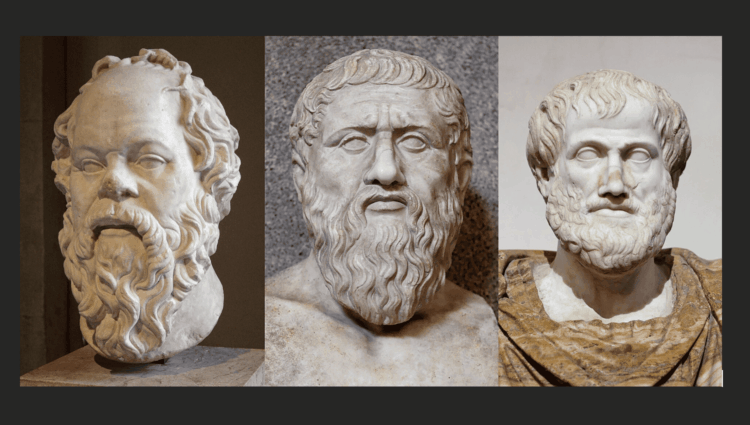 Every autumn, I have the grand privilege of teaching Socrates (the Apology, the Crito), Plato (Book VIII of the Republic, the Timaeus), and Aristotle (the Politics, Book X of the Ethics) to incoming freshmen as a part of our Hillsdale College core. And, every year, I am both elevated and humbled by what I get to teach. Truly, astounded and, to use a term from my generation, floored.
Take Socrates. After noting that he will do nothing not authorized and commanded by the god in the Apology, he notes in the Crito that we are never—under any circumstances—to do wrong in the name of a good. To do wrong, in every sense, is to taint the good and, thus, to taint our very souls. It’s an incredibly hard teaching, but one that anticipated Christ’s teachings by several centuries to “Turn the other cheek.” Though Socrates knows the justification for killing him is unjust, he believes that Athens—over time—is just and that her laws must be obeyed. In the name of the god, wisdom, and human dignity, he takes the hemlock, a martyr for the good, the true, and the beautiful.
Take Plato. Plato, especially in Book VIII of the Republic, through the mouth of Socrates, gives us a warning about the horrors, violence, and conformity necessitated by democracy. His logic is impeccable. In a democracy, all things are equal including the passions. Men resent all authority, even the law. And, they resent inequality. Thus, they choose a champion—a single man, though through the Lowest Common Denominator (we share our passions in common; not our excellences)—to rule in their place. At first, he smiles, shakes hands, and kisses babies as he redistributes the wealth. We call him something benign like a “president.” Soon, though, he fears for his life and takes bodyguards. Then, he manipulates wealth and redistributes it to make enemies as well as friends. The whole time, the mob backs him. At this point, he has changed from president to Caesar. Then, to keep the mob under his boot, he launches war after war to distract them, and though he taxes them thoroughly for such wars, they become too worried about even feeding themselves to revolt. Thus, a democracy inevitably becomes a tyranny.
For most of Western civilization we have viewed democracy as Plato viewed it, as a disaster waiting to happen, spilling into violence, chaos, and tyranny. Only in the 1820s, did the West come to make democracy something to cherish, promote, and uphold. Admittedly, I find this development not only disturbing, but incredibly dangerous to our well-being as a society.
Democracy, we must remember, is not, in actuality, a synonym of a republic, but a corruption of the republic. Every republic—by imitating the three faculties of the human person: intellect (monarchy); reason (aristocracy); and passion (democracy)—must incorporate the democratic element, just as the human person must incorporate the passions for eating or procreating, but only a fool would allow that part to govern the other parts. From the very beginning of the American republic, as so brutally noted on the first day of the Constitutional Convention in 1787, our goal was to minimize democracy as much as possible. A proper republic, therefore, incorporates elements of a democracy, but it avoids being ruled by it.
By default, then, Plato is calling us to live excellent lives, not burdened by conformity and violence, but calling us to pursue that which makes us distinctive.
Take the classical virtues, too. At one moment, without much dissent or discussion, a speaker in the Republic notes that there are four virtues (though we take virtue from the Latin vir-tu (the power of being human) rather than the Greek): prudence; justice; temperance; and fortitude. Taken together, these four, again, call us to the highest things.
We have corrupted prudence. Today, we mean the word as a caution—perhaps to watch and observe before committing oneself to an action. Nothing could be further from the classical definition, “to discern good from evil” and then choose good.
We have, for the most part, maintained the proper definition of justice, though we often think of it as revenge or vengeance, it’s more properly a form of balance. It’s classical definition, though, is “to give each person his or her due.” Again, this calls us to the highest thing. In justice, we are defined not by our lowest things, but by those things we do brilliantly and uniquely. Understood rightly, justice calls upon the community to leaven, promote, and even celebrate our excellences, each unique to us. Imagine how far this is from democracy’s dread conformity, appealing to the lowest common denominator.
We have royally corrupted temperance, especially in America, where we have somehow bizarrely connected the word to the absence of drinking alcohol. Rightly understood, temperance means to use the “created goods for good.” Let’s imagine a 200-year-old oak tree that has been felled by foul weather. As we cut it up, we can, say, make a beautiful piece of furniture, such as a desk, we can use the lumber to build houses for the homeless, or we could build a crucifix and nail someone to it. Two good uses, and one for evil. Our choice. Or, imagine the words at the consecration of the Blessed Sacrament, “Blessed are you, Lord God of all creation, for through your goodness we have received the bread we offer you: fruit of the earth and work of human hands, it will become for us the bread of life.” This represents the ultimate statement of temperance from the Christian perspective. God gives us the gift, we remake it into bread and offer it back to God, who sanctifies it and makes it the Body of Christ.
This should be our model for all aspects of creation.
The classical virtue of fortitude remains pretty much as it’s always been. Properly defined, it means to do good, no matter the cost. Here, of course, we can imagine Socrates, Cicero, Jesus, St. Perpetua, Sir Thomas More, etc., all of whom exemplified the virtue of fortitude. Again, though, we are called—even by the Greek pagans—to the highest things.
Finally, let’s take Aristotle from Book X of the Ethics. There, he notes that we do things as well as we can because we are thanking the god for the gifts he has bestowed upon us. As such, we should never do anything halfway, but give our full selves to every endeavor, knowing that to pursuit our happiness is the same as cherishing the good, the true, and the beautiful.
And, so we here we are in the America of 2026. Whatever hells have been loosed upon the world, here and abroad, never forget that our ancestors, even pagan ones, called us to love and cherish that which is best, such as a republic, not that which is low, such as a democracy. We should love that which makes us distinctive and which contributes to our human community rather than embrace that which we all possess—a fallen human nature.
__________
The featured image, uploaded by S. Perquin, is “Socrates, Plato and Aristotle; the Socratic philosophers in ancient Greece.” This file is licensed under the Creative Commons Attribution-Share Alike 4.0 International license, courtesy of Wikimedia Commons.

No comments:
Post a Comment
Comments are subject to deletion if they are not germane. I have no problem with a bit of colourful language, but blasphemy or depraved profanity will not be allowed. Attacks on the Catholic Faith will not be tolerated. Comments will be deleted that are republican (Yanks! Note the lower case 'r'!), attacks on the legitimacy of Pope Leo XIV as the Vicar of Christ, the legitimacy of the House of Windsor or of the claims of the Elder Line of the House of France, or attacks on the legitimacy of any of the currently ruling Houses of Europe.