Fr Longenecker reviews Dr Morello's new book, Mysticism, Magic and Monasteries, and interviews him. Yet another book I want to read!
From The Imaginative Conservative
By Fr Dwight Longenecker
Those who think that Christianity is just about propositional assent, or about sentimental emotivism, have already in some way made an idol. They are modern and have departed from the tradition at the deepest levels of the soul. Charity, in the Christian sense of the word, is the power infused into our souls at baptism that we might be gods, in loving union with the God of gods.
Mysticism, Magic and Monasteries, by Sebastian Morello (204 pages, Os Justi Press, 2024)
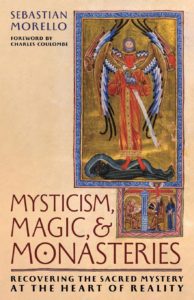
British philosopher Sebastian Morello’s book Mysticism, Magic and Monasteries is a collection of his essays— first diagnosing the malaise of our day and offering a magical, mystical, monastic manifesto as a solution.
Being a collection of essays, the book is unfortunately somewhat uneven. The first chapter offers a focused and thoroughgoing argument providing an antidote to modern heresies. Morello laments the loss of sacred places and a sense of the holy and establishes mysticism as the foundation for philosophy and a renewed Christian theology. This works well, but then he pads out the book with personal and delightfully eccentric observations about the celebration of Christmas, the hermetic concept of egregore, the need for a renewal of the Benedictine movement, and even a recommendation to engage in medieval mace-swishing as a manly morning exercise.
Although I am in general agreement with Morello’s grumbles about the modern tech world and admire his proposed solutions, I did have three quibbles. At first glance there might seem to be a glaring contradiction in his argumentation. In his second chapter, he attacks Cartesian individualism as the shaky foundation of modern scientism and relativism and all their attendant evil consequences, but his solution is a mysticism that many would view as itself highly individualistic and subjective. Morello does insist that authentic mysticism is rooted in the objective authority and the historic traditions of Catholic spirituality, but a chapter clarifying this possible confusion would have strengthened his argument.
Secondly, Morello is a philosopher and theologian. His diagnosis and solutions are important, but his language and writing are too often verbose and filled with jargon from his own arcane corner of academia. I fear his perceptions and solutions will be dismissed by the academics as quaintly eccentric, while at the same time they will fly high over the heads of hoi polloi.
My third quibble is connected with the second, and that is the book’s appeal to ordinary Catholics. The person in the pew may not be Morello’s intended audience, but from a pastor’s point of view in a conservative corner of the USA, I can affirm that “mysticism” is sufficiently suspect as a concept for many ordinary folks, and “magic” is even more of a red flag. These are folks who worry that the Harry Potter books tempt their children to dabble in the occult. That a conservative Catholic writer is recommending magic will be disconcerting. It is a matter of choosing the right language to communicate Morello’s important and valid message.
Morello’s essential point is that personal holiness—theosis—the transformation of the soul by the grace of the mystical life—is at the core of Christianity and that it needs to be refreshed and renewed for the church to overcome her present malaise. To move through the three stages of the spiritual life: purgative, illuminative and unitive to divinization is classic Catholic spiritual teaching, and the addition of the hermetic traditions with the confusing terminology of magic and mysticism will, it seems to me, be an unnecessary and confusing distraction for many.
Intrigued by his book, I got in touch with Dr. Morello and quizzed him further.
Dwight Longenecker: Thanks for taking the time to answer some questions. Can we begin by learning more about you? Where are you now and how did you get there?
Sebastian Morello: I grew up in the English countryside and for a time in South Africa. At sixteen years old, I left school and enrolled at an arts college where I was trained for the stage, but in my second year there I underwent an unexpected religious experience which drew me away from dramaturgical ambitions and into a spiritual enquiry that has lasted for the rest of my life.
After I obtained my diploma in theatrical arts, I turned down a place at a prestigious drama school. By that point, I’d become utterly gripped by questions of philosophy, comparative religion, and spirituality. I was also growing increasingly interested in exploring once more the Christianity of my childhood, from which I had since grown disengaged, and seeing whether it might be considered anew with adult eyes.
Later, I considered entering a theological college to train for the Anglican ministry, but the more I learned about the Church of England the less legitimate it seemed. Somewhat confused, but animated by a great hunger for God, I travelled to Asia in search of new answers. I took up life as a wanderer, visiting temples and monasteries throughout the subcontinent.
It was first in Nepal and then later in south India, that I encountered the Catholic Church. I became friendly with a monastery of French monks outside Pondicherry who catechized me and received me into full communion. On my return to England I spent time with numerous religious congregations exploring whether to become a monk, friar, or join a society of missionaries, but nothing suited me.
Sometime in my mid-twenties I pursued a distance learning bachelor’s degree in philosophy. During those five years of part-time study, I also met the woman who became my wife. She was very patient with me and gave me the time I needed to continue my studies, even as one child after another grew our family.
It was also during that period that I was introduced to the philosopher Roger Scruton, who invited me to enroll as his student on his MA program at Buckingham University on completion of my BA. Upon completing MA research, Roger proposed that I become his PhD student, which I did, though sadly he died of cancer in the final year of my doctoral research. During my studies, I began writing books, the initial ones being The World as God’s Icon and Conservatism and Grace.
By my early thirties I’d attained three degrees. Our family grew, and I supported my wife and children as a full-time author and journalist, while also writing more academic works. Then I was invited to take up the newly established Wolfgang Smith Chair in Philosophy at St Mary’s University, London, which is my current position.
DL: Your book Mysticism, Magic, and Monasteries has an intriguing—controversial—title. What should intrigue us about it and what might be controversial?
SM: I think modernity is not so much an historical epoch as an epistemic paradigm. That paradigm is complex, but is grounded in assumptions which are fundamentally false. Those assumptions concern the pre-social subject or ‘self’, the mechanical universe, the purposeless and meaninglessness of being, the private nature of religion, and the reduction of the Creator-creation relation to either propositionalism or sentimentalism.
We have become enmeshed in these errors because of a certain corruption of the mind which is deeply connected with the subordination of all public realities to the prejudices of rationalism. Concurrently, we intuit that rationalism truncates the mind, and so we instinctively seek to check it with sentimentalism, and between these two fragmented mental dispositions we oscillate like foundering ships in a tempest. This terrible state of affairs is one in which the Church is far more entangled than many of the faithful realize.
I think the really controversial aspect of my book concerns my solutions: mysticism, magic, and monasteries. My view is that the Church’s faithful must re-root themselves in their own mystical tradition, for the end for which the Christian life exists is intimacy with God, first here below and forever in the next life.
I think we’ll struggle to retrieve our own mystical tradition as something lived unless we adopt pre-modern forms of cognition, which is where magic comes in. With regard to magic, I focus specifically on the Hermetic tradition celebrated by such Christian authorities as Lactantius, St Clement of Alexandria, Tertullian, St Justin Martyr, and St Cyril of Alexandria, to St Albert the Great in the medieval period and many thinkers since.
An important recent defender of the Catholic reception of the Hermetic tradition is Valentin Tomberg, whose thought plays a prominent role in my book.
But all such recovery of our mystical tradition must become deeply embodied in routine, locality, and persons; that’s where monasticism is so crucial.
In the West, the monastic charism of the Church has gradually ebbed. Nonetheless, constant prayer, the mystery of personal consecration, and the centuries-long sanctification of unique places and territories should be at the very heart of what it means to make the Church present and render this world pleasing to God. That’s what monasteries achieved so well.
DL: Your book is published by staunch advocate for the Traditional Latin Mass, Peter Kwasniewski. Shall we suppose that traditionalist Catholics are dabbling in the dark arts? Seances after Solemn Mass? Crystal Balls and Ouija boards? Harry Potter meets the Paternoster?
SM: My proposal has nothing to do with what people today call the ‘dark occult’. Those who have suggested that I’m trying to promulgate such a thing have either not read my book or their a priori agenda has prevented them from attending to its content.
On the other hand, there are aspects of our own spiritual tradition that, on account of rationalist leanings, many Catholics would dismiss as ‘new age’. These aspects, however, are really very deep in our spiritual heritage. Whether it’s the crystal healing methods taught by Saints Hildegard and Albert, or incubatory mysticism, or astrology (understood as prognostication and therapeia rather than condemned divination), many modern-day Catholics might be inclined to dismiss or even denounce what the saints themselves celebrated. So, I suppose I take a ‘revisionist’ attitude towards these forgotten aspects of our own spiritual inheritance and I accept that this may be misunderstood and be controversial.
You might say that the general stance of traditionalists like Peter, me, and many others who are attached to the ancient liturgy, is that we’re also traditionalist in ways that go beyond the liturgy. Speaking for myself alone, I just don’t think you can pick and choose when it comes to the Church’s tradition. You have to try to receive the whole tradition, celebrating that all of it belongs to our repertoire as Catholics.
In the face of the revolutionary upheaval and confusion in the church, people like me propose a radical traditionalism in the etymological sense; that is, we propose going deep, deep, deep to the roots of our tradition of sacramental and mystical transformation. Such transformation, after all, is the whole point of the Church. As St Athanasius put it, ‘God became man that we might become gods’.
DL: So what exactly do you and writers like Michael Martin mean by “magic”?
SM: I can tell you what I mean by ‘magic’. Of course, magic can mean something negative, when used as a synonym for sorcery or demon-conjuring. But in the Western tradition, there have always been many distinctions available when using the word, the most basic being the distinction between theurgia and goetia. The former refers to ritual connectivity with God for the purpose of uniting the practitioner’s will with the divine will; the latter in most cases means witchcraft, which is why certain saints adopted and developed the term theurgia—and it is this divine magic that I’m interested in.
That, though, is only one side of magic, the participatory side. There is also the emanatory aspect of magic, to which the participatory aspect is a response. When, for example, people say that they had some experience that was ‘magical’, or that they went out walking and the landscape seemed ‘magical’ to them, they are speaking analogically but not metaphorically or equivocally. This was one of the great insights of the Neoplatonist philosopher Iamblichus, namely that undergirding all creation is God’s vivifying agency, which is the power called magic.
Our magical acts are a response, a mode of participation, to His divine and creative magic. This is precisely why even a pagan like Iamblichus distinguishes between theurgy and the sorcery of wicked conjurers: the latter’s acts are not a participation in divine magic, but a cooperation with those spirits who are in rebellion against it.
Nonetheless, I think it’s crucial to understand that all magic is futile or even dangerous while it remains purely natural, for all nature is under Satan’s principality. That is why we need the divine theurgy of Christ, which is perfect and blameless, to participate in the proper, nuptial creation-Creator relation. That is one way to think about the sacred liturgy of the Church.
DL: How do you define mysticism and how is it possible in the age of the machine?
SM: Mysticism is easily defined. It is the process by which we cooperate with God’s transformation of our nature, that we might become holy and enjoy loving union with Him. That is the purpose of the whole Christian mystery. The great danger for Christians is not that they might lose their faith in the ‘age of the machine’, as you put it, but rather that they will transpose the habits of machine-modernity into their lives of faith, and thereby pollute the Christian mystery until it ceases to be the true religion of Christ.
Those who think that Christianity is just about propositional assent, or about sentimental emotivism, have already in some way made an idol. Epistemically, they are modern, and have departed from the tradition at the deepest levels of the soul. Charity, in the Christian sense of the word, is the power infused into our souls at baptism that we might be gods, in loving union with the God of gods.
DL: Most monasteries are dwindling. The religious life is shrinking. Are you calling for a resurgence of traditional monasticism or some other kind of monastic renewal? Do tell.
SM: I very much believe that the Church needs to recover its own purpose and hence necessarily turn away from ridiculous obsessions like punishing traditionalists or blessing homosexuals or giving communion to ‘remarried’ divorcees or worshipping Amazonian goddesses, or any of the other stupid stunts its senior members have been up to lately. These follies have greatly undermined the Church’s authority. Having given up such senseless preoccupations, the Church’s life must be re-centred on its own spousal identity in relation to the Lord. That spousal identity is most explicitly lived in the consecrated lives of religious. And thus, I am convinced that the Church will not find its centre of gravity, so to speak, if it does not move away from the clerical culture that has been in the ascendent certainly since Trent, and move towards a more monastic culture centred on sanctification and self-oblation.
So yes, I think the Church’s government needs to give up its silly obsessions, and the incumbents of its offices need to grow up a bit, so the faithful can see these people as spiritual fathers once more. But ultimately, it’s the monastic charism of the Church that needs to be fostered. Lasting houses of prayer and sanctification will be essential for the spiritual survival of the faithful as nihilistic modernity continues to intensify and accelerate.
The Roman Empire was largely baptized due to the rise of monasticism; later the Christendom that emerged out of the so-called Dark Ages also unfolded out of the monasteries. And however we are to make Christ known as we emerge from the rubble of a world fully corroded by modernity, you can be sure it will be bound up with men and women who love the Lord and choose to devote their whole lives to Him in consecration and self-oblation.
DL: The technological revolution is swamping us and there seems to be no stopping the onward march of AI, robots, and automation. Have you any practical advice for Catholics in the pew at what seems to be a pivotal point in history?
SM: It seems obvious to me that what we should have been doing, and have not been doing, is subjecting the development of AI technology to a mature moral critique.
AI technologies will likely appear to become more and more like us, confusing in the minds of many the distinction between man and machine. But I think the greater danger is that this distinction will become confused as we begin to imitate the machines. You see, technologies of this kind have a remarkable ability to truncate the human mind and restrict our cognition to what they can do, as we grow increasingly reliant on them. That is how we become enslaved by technologies that were intended, or purportedly intended, to serve us.
Noting this danger, it is important to listen to what AI developers are themselves saying about how we should respond to the rise of these novel technologies. Many—and I mean, very many—of them are saying, ‘Look, if you want your children to have a future, send them off to study the liberal arts, or get a classical humanities education, or study philosophy or theology’. Why do they say this? Because AI is in fact delineating the difference between information-generation and wisdom, pattern-recognition and insight, fact-collation and understanding. In each case, only a rational organism with a living and active mind can enjoy the latter.
Now, in some ways, AI is in fact showing us what it really is to be human, and what it might mean to reclaim our humanity amid these technologies that threaten it. I’m not saying that the rise of AI is a reason to be optimistic—far from it—but it doesn’t have to be a reason for undiluted despair either.
In terms of practical advice, I think people should do the things that make them truly human, and embodied, and wise—the things that a machine can never be. What are those things? I want to say to young people: read old books; recite poetry to your friends and family; learn a difficult and admirable skill like hunting, gardening, sculpturing, or Kung Fu; grow and eat healthy food; make your own medicines from a herb garden you’ve cultivated yourself; brew beer; grow in the love of trees, plants, animals, and learn their names; go for long hikes and rediscover that you’re contiguous with the rest of creation, whose purpose is to glorify God; and to that end, pray, fast, go to church, and become someone who offers his life in worship to his Creator. I’m sure there are many other things one might do, but that’s not a bad list. All such suggestions will intensify one’s humanity and help to rescue it from machine-modernity.
Progressives and liberals, paraphrasing Mahatma Gandhi, like to say: ‘Be the change you want to see in the world’. Well, there is a very traditionalist interpretation of that aphorism as well. For really, in my view, the challenge is to embody your own civilization amid the ever-multiplying forces that seek to erode it—to be the thing you want to see in the world.
And if you become such a person—an incarnation of your own spiritual and civilizational inheritance—you will have created for yourself a life that limits the encroachment of new and alarming technologies.
__________
The featured image is “Representation of the first vision of Hildegard von Bingen in in Liber divinorum operum,” and is in the public domain, courtesy of Wikimedia Commons.

No comments:
Post a Comment
Comments are subject to deletion if they are not germane. I have no problem with a bit of colourful language, but blasphemy or depraved profanity will not be allowed. Attacks on the Catholic Faith will not be tolerated. Comments will be deleted that are republican (Yanks! Note the lower case 'r'!), attacks on the legitimacy of Pope Leo XIV as the Vicar of Christ, the legitimacy of the House of Windsor or of the claims of the Elder Line of the House of France, or attacks on the legitimacy of any of the currently ruling Houses of Europe.