From The Imaginative Conservative
By Joseph Pearce
Good things will not be extinguished in heaven; they will be perfected. New things will be made in heaven by perfect human artists, whose perfect imagination will be alive with the Perfect Life and the Perfect Creativity of God.
 The graduate student at the University of Oxford with whom I’ve been corresponding about Tolkien’s mystical musings on the union of joy and sorrow (see my essay “Tolkien on Joy and Sorrow”) is also fascinated by Tolkien’s apparent suggestion that we might find fictional characters in paradise. Here is the question he asks: “Is there any way of reading Tolkien to say that we will somehow encounter in heaven the fictional characters we have loved in this life?”
“Unfortunately,” my Oxford friend continues, “this feels like metaphysical nonsense and so I assume that’s not what Tolkien is saying, and yet… I do feel a sense of sadness over the thought that I will never get to meet Aragorn, or Asterix, or Biggles. The question first came to me several years ago when I was reading ‘On Fairy Stories’ as well as Lewis’s ‘Myth Became Fact’. Then a couple of years back I saw Dr. Ben Reinhard’s discussion with Matt Fradd, where he discussed ‘Leaf by Niggle’ and ‘On Fairy Stories’, and I got the chills when he seemed to hint that for Tolkien we might one day meet our fictional heroes in God… or something of that sort.”
My Oxford interlocutor then asked for any insights I might be able to offer on this question.
The root of the idea, or the root of the problem, if it is indeed “metaphysical nonsense”, might be found in the writings of G.K. Chesterton, which exerted a great influence on Tolkien and Lewis. In his book on Charles Dickens, Chesterton wrote that “all roads point at last to an ultimate inn, where we shall meet Dickens and all his characters: and when we drink again it shall be from the great flagons in the tavern at the end of the world”. This seems an enchanting idea until we think a little more about what Chesterton is actually saying. Would we really want to meet all of Dickens’ characters? Would we want to drink flagons of ale with Bill Sikes, the psychopathic monster of Oliver Twist, and would we want to be drinking in the sort of tavern which Bill Sikes frequents? Similarly, would we want to find ourselves sitting at the same table as Madame Defarge, the psychopathic monster of A Tale of Two Cities, who sits sadistically by the guillotine during executions, knitting an infernal web of vengeance?
To be fair to Chesterton, the vision he presents is not so much heavenly as apocalyptic. He is not speaking of the ultimate inn beyond the end of the world but of an ultimate inn at the end of the world. Remembering that the word apocalypse means revelation, Chesterton presents an apocalyptic scene in which the fruits of the human imagination will come alive in our presence. Irrespective of whether Tolkien and Lewis were aware of these famous lines of Chesterton, we find something similar in their own writings.
Tolkien wrote extensively about the eternal significance of the human imagination and human creativity in three of his works: His essay/lecture “On Fairy-Stories”; his short story or parable, “Leaf By Niggle”; and his marvelous poem, “Mythopoeia”.
In the essay “On Fairy-Stories” Tolkien defines “imagination” as the ability to form mental images of things not actually present and as “the power of giving to ideal creations the inner consistency of reality”. Imagination is, therefore, inseparable from creativity. Tolkien distinguishes God’s Creation from human sub-creation. God creates creatures from nothing, ex nihilo, whereas we sub-create things from other things that already exist. Nonetheless, and this is crucial, the imagination is a mark of the uniqueness of God’s image in Man. The imago Dei and the imagination are inseparable. They are one. Through the imagination, man is a creator, like God. If the imagination is a manifestation of God’s image in us, the imago Dei, it manifests our very divine essence and will be with us in heaven. Tolkien expresses this wonderfully in “Mythopoeia”:
Salvation changes not, nor yet destroys,
garden nor gardener, children nor their toys.
Evil it will not see, for evil lies
not in God’s picture but in crooked eyes,
not in the source but in malicious choice,
and not in sound but in the tuneless voice.
In Paradise they look no more awry;
and though they make anew, they make no lie.
Be sure they still will make, not being dead,
and poets shall have flames upon their head,
and harps whereon their faultless fingers fall:
there each shall choose for ever from the All.
Good things will not be extinguished in heaven; they will be perfected. New things will be made in heaven by perfect human artists, whose perfect imagination will be alive with the Perfect Life and the Perfect Creativity of God. In His Presence the imagination will be creatively alive in ways that are beyond the ability of our present broken imaginations to conceive or perceive.
Does this mean that there might be perfect hobbits in heaven beyond the power of the Ring or any other evil? It might seem hard to fathom or difficult to believe but how can we know for sure? The answer might be found, however, in the words and wisdom of C.S. Lewis. At the end of The Last Battle, after the children have died and gone to heaven, we are told “most truly… that they lived happily ever after”. But heaven is better than that. It’s better than living happily ever after; it’s living happier and happier ever after:
[F]or them it was only the beginning of the real story. All their life in this world and all their adventures in Narnia had only been the cover and the title page: now at last they were beginning Chapter One of the Great Story which no one on earth has read: which goes on forever: in which every chapter is better than the one before.
In heaven, we will be perfected. We will love perfectly, reason perfectly, imagine perfectly and create perfectly. This will mean presumably that we will no longer seek the imperfect things of this world, including imperfect figments of the imagination, such as hobbits. These are things that belong to the cover and the title page of the Great Story. As for the heavenly Story itself, “eye hath not seen, nor ear heard, neither have entered into the heart of man, the things which God hath prepared for them that love him”.
_________
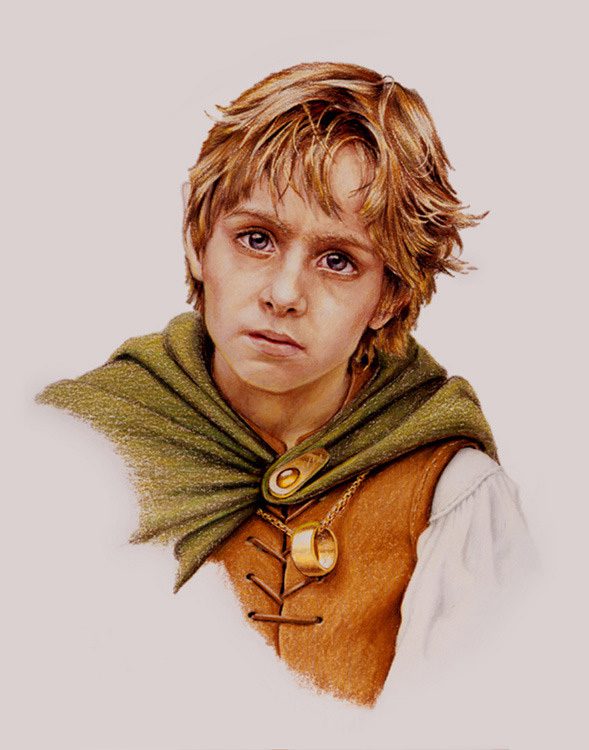
The featured image, uploaded by markferrari.com, is “Frodo Baggins by Mark J. Ferrari.” This file is licensed under the Creative Commons Attribution-Share Alike 4.0 International license, courtesy of Wikimedia Commons.


No comments:
Post a Comment
Comments are subject to deletion if they are not germane. I have no problem with a bit of colourful language, but blasphemy or depraved profanity will not be allowed. Attacks on the Catholic Faith will not be tolerated. Comments will be deleted that are republican (Yanks! Note the lower case 'r'!), attacks on the legitimacy of Pope Leo XIV as the Vicar of Christ, the legitimacy of the House of Windsor or of the claims of the Elder Line of the House of France, or attacks on the legitimacy of any of the currently ruling Houses of Europe.