“Christian joy which produces tears because it is qualitatively so like sorrow, because it comes from those places where Joy and Sorrow are at one, reconciled, as selfishness and altruism are lost in Love.” ~ JRRT, Letter 89
From The Imaginative Conservative
By Joseph Pearce
 I’ve recently been in correspondence with a graduate student at the University of Oxford with respect to some mystical insights that Tolkien shares about joy and sorrow in one of his letters.
In Letter 89 in Tolkien’s published Letters, Tolkien writes that the Resurrection “produces that essential emotion: Christian joy which produces tears because it is qualitatively so like sorrow, because it comes from those places where Joy and Sorrow are at one, reconciled, as selfishness and altruism are lost in Love.”
My correspondent expressed fascination at Tolkien’s suggestion that joy and sorrow are somehow two sides of the same coin, adding that Tolkien’s insight seems to have a lot of relevance for building a Christian theodicy.
Grappling with this mystical assertion that joy and sorrow “are at one” and that they are reconciled in love, my initial response was one of unease. Isn’t joy the absence of sorrow? Isn’t sorrow a form of suffering? If suffering is a consequence of evil, isn’t it dualistic to suggest that joy and sorrow are two sides of the same coin? Joy and sorrow. Good and evil. Two sides of the same coin. Dualism.
But wait a minute. Let’s pause for further thought.
We know from Scripture, and especially from the Gospel, that the acceptance of suffering is an act of love. No, it’s more than that. It’s the quintessence of love itself. It is the taking up of the Cross; it is the laying down of our lives for others; it is dying to ourselves; it is dying for others, even for our enemies. This is what Love Himself does when He takes up His own Cross and dies for us.
This is all very well but it only scratches the surface of the mystery.
We can understand why such suffering is necessary in a Fallen cosmos, broken by sin and in need of healing and reconciliation with God. But what about heaven? And what about that which is deeper than heaven itself? What about God? Is God the ultimate place where “Joy and Sorrow are at one, reconciled, as selfishness and altruism are lost in Love”? Does the Triune God feel only joy or does He also feel sorrow? And if sorrow is a form of suffering, does this mean that the Holy Trinity suffers? Is this why the wounds of Christ are not erased in heaven but are glorified? But aren’t the glorified wounds, the marks of love, merely an eternal sign of God’s victory over death and suffering? Surely the glorified wounds of Christ are not painful. They signify the victory over pain. So whence sorrow? What place does it have in heaven? What place does it have in the Godhead?
Its place has to be in the place where love triumphs over death, where goodness triumphs over evil, where truth triumphs over falsehood, where beauty triumphs over ugliness. That place is in the union of the Resurrection with the Crucifixion. The joy of the Resurrection is at one with the sorrow of the Crucifixion because the Resurrection is united to the Crucifixion. Christ cannot be resurrected from the dead unless He has first died. Joy and sorrow embrace in the Person of Christ. And since the Son is united with the other two Persons of the Holy Trinity, joy and sorrow must be embraced by the Trinity itself.
Perhaps Tolkien is right, or as right as anyone can be when contemplating these mysteries. Perhaps joy and sorrow are at one. Perhaps they are reconciled in the holiest of all communions, which is the Holy Communion of the Three Persons of the Most Holy Trinity. Perhaps….
_________
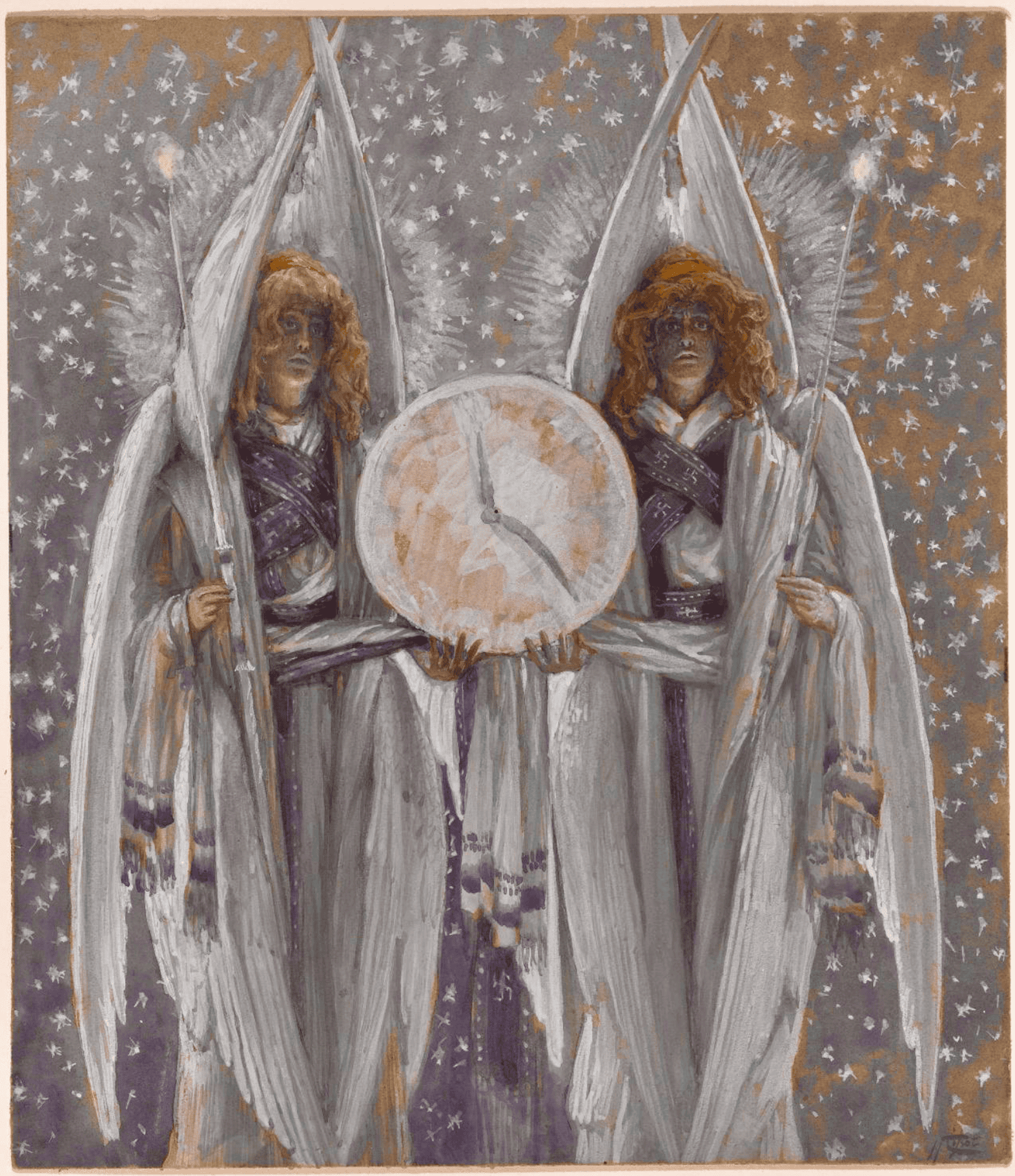
The featured image is “Angels Holding a Dial Indicating the Different Hours of the Acts of the Passion” (between 1886 and 1894), by James Tissot, and is in the public domain, courtesy of Wikimedia Commons.


No comments:
Post a Comment
Comments are subject to deletion if they are not germane. I have no problem with a bit of colourful language, but blasphemy or depraved profanity will not be allowed. Attacks on the Catholic Faith will not be tolerated. Comments will be deleted that are republican (Yanks! Note the lower case 'r'!), attacks on the legitimacy of Pope Leo XIV as the Vicar of Christ, the legitimacy of the House of Windsor or of the claims of the Elder Line of the House of France, or attacks on the legitimacy of any of the currently ruling Houses of Europe.