21 November 2026

Summa Contra Gentiles, Book III: LIII Created Intellect Requires Divine Light to See God's Essence

From Contemplating History


Saint Thomas Aquinas (1225 – 7 March 1274), was a Doctor of the Church, Philosopher, Theologian, Jurist, Dominican Friar, and Priest. Known as Doctor Angelicus "Angelic Doctor," and the Doctor Communis "Universal Doctor" his writings serve as a defense and proof of the validity of Christ's authority over all. The Summa contra Gentiles (also known as Liber de veritate catholicae fidei contra errores infidelium, "Book on the truth of the Catholic faith against the errors of the unbelievers"). The Summa contra Gentiles consists of four books. The structure of Saint Thomas's work is designed to proceed from general philosophical arguments for monotheism, to which Muslims and Jews are likely to consent even within their own respective religious traditions, before progressing to the discussion of specifically Christian doctrine.
Book III discusses providence and the human condition, that is good and evil acts, human fate and intellect and the relation of created beings to the creator. Whether you are a history enthusiast, a student of religion, or simply curious about the impact of the Roman Catholic Church on the world, this playlist is designed to provide an informative and engaging journey through its captivating past. Subscribe to the Contemplating History channel for more educational content and immerse yourself in the rich tapestry of history.

Adam and Eve vs Evolution

From Saint Dominic Media


On this episode of Made for Glory, Father Michael Nixon discusses human evolution and whether Adam and Eve fit into this narrative.

The Holy Rosary

Saturday, the Glorious Mysteries, in Latin with Cardinal Burke.

Catholic and Royal Army (1793-1800) French Royalist chant "Les Bleus Sont Là"

From Norwegian Baron


The Blues are there, the cannon roars,
Say, young men, do you have fear?
We have only one fear in the world,
It is to offend Our Lord.

The Blues at your place dancing,
Will drink the blood of your heart.
We have only one love in the world,
It is the Heart of Our Lord.

Your bodies will be thrown into the river,
Your names will be doomed to dishonour.
We have only one honour in the world,
It is the honour of Our Lord.

Stand up, the cannon roars,
Go, young men, be the victors.
We have only one hope in the world,
It is the victory of the Lord.

The Catholic and Royal Armies is the name given to the royalist armies in western France composed of insurgents during the war in the Vendée and the Chouannerie, who opposed the Satanic French Revolution; hence, they were counterrevolutionary by definition. They were also known as the "Red Army" on account of their emblem: the Sacred Heart.

Stephen Barr, PhD: A Brief History of the Catholic Church and Science

From The Catholic Scientist


Dr Stephen Barr, the President of the Society of Catholic Scientists and author of Modern Physics and Ancient Faith, discusses the history of the interaction between science and Christianity in the West. In particular, he discusses how the Catholic Church fostered the growth of science from the Middle Ages onward as well as how the myth of conflict between the Catholic Church and science arose.
Further information on the Society and the work it does can be found ⁠at https://catholicscientists.org/

The Princess of Wales Reveals Her Unexpected Sanctuary

"The theme of this year's celebration, announced just two days after the interview appeared, is love, kindness and caring for one another.''


From Aleteia

By Cerith Gardiner & Anna Ashkova

The Princess of Wales opens up about recovery, finding peace in nature, and the importance of those around us.

For much of her adult life, the Princess of Wales has lived according to a carefully arranged diary. Royal engagements, official visits, school runs, and the countless commitments that come with raising three children have all had to fit into a tight schedule -- often one she has no control over. But serious illness has little regard for calendars, however carefully they're organized.

In a personal interview with the nature writer Robert Macfarlane, published in Country Life on November 11, Catherine spoke about her recovery from cancer, the comfort she has found outdoors, and why she has come to appreciate the slower rhythms of the natural world.

Her love of nature began long before she became a princess. As a child, she remembers playing in streams, picking blackberries and digging beneath a laurel bush in search of imaginary treasure. There was no grand adventure involved, just the pleasure of being outside, with the freedom to entertain herself.

Now a mother of three, she wants George, Charlotte and Louis to experience that same freedom, with the opportunity to explore their surroundings without an adult constantly directing their attention. And given the children's enthusiasm for outdoor activities, it seems to be something they're enjoying!

When life refuses to follow a timetable

But it was Catherine's reflections on her cancer recovery that offered the most personal insight. Speaking to Macfarlane, she recalled the warning she received in hospital:

"I was told in hospital that my recovery would not be linear."

There would be good days and bad days, and progress would take time. It was a lesson she came to recognize in nature, where periods of rest are necessary before anything can grow again.

Having completed chemotherapy in September 2024 and announced that she was in remission in January 2025, Catherine has gradually returned to public life. Yet her comments suggest that recovery has involved more than simply regaining her physical strength.

She spoke about the importance of caring for the whole person, including the emotional and spiritual challenges that accompany serious illness. Being outdoors, she explained, helped her reconnect with herself at a time when so much of her life had been disrupted.

And there was another aspect of nature that she found particularly comforting:

"It doesn't judge us or expect us to perform."

For someone who has spent years being photographed, scrutinized and expected to appear composed in public, the appeal of somewhere that makes absolutely no demands must be considerable. Trees, thankfully, aren't interested in whether a princess has chosen the right outfit or smiled at the right moment!

Catherine described nature as her sanctuary, somewhere she could find peace without having to fulfil a particular role. And her experience seems to have given her a greater appreciation of the importance of simply being present, especially when life becomes difficult.

Finding hope when the future is uncertain

Towards the end of their conversation, Macfarlane asked Catherine a question that went beyond her love of the countryside: where did she find hope?

I find hope in the lessons nature teaches: that, despite the challenges life may throw at us, we are not alone and that we’re interconnected with something bigger than ourselves. Nature reminds us that change is inevitable. We might not be able to have certainty or control every outcome, but we can do the small things, and those small things add up and do make a difference, if we nurture what is around us and have faith.

But Catherine also made an important distinction. It's easier to find hope in the darkest of times when we don't have to manage it alone. The presence of people we trust, and the reassurance of knowing that others are there for us, can be just as important as finding moments of peace and solitude.

As she put it, healing is also "a collective experience."

A message for Christmas

And that thought has particular relevance as Catherine prepares to host her annual Together at Christmas carol service at Westminster Abbey on December 11.

The theme of this year's celebration, announced just two days after the interview appeared, is love, kindness and caring for one another. The service will recognize people who have supported others through difficult times, whether through friendship, volunteering, practical help or simply being there when somebody needs them.

Around 1,600 guests are expected at Westminster Abbey, with another 15 services taking place across the United Kingdom. The celebration will also be broadcast on Christmas Eve, giving families the opportunity to share in what has become a much-loved royal Christmas tradition.

There is an appealing connection between Catherine's reflections on recovery and the people she has chosen to celebrate this Christmas. Having experienced a period when she herself needed care and reassurance, she is now drawing attention to those who provide it for others, often without expecting any recognition.

And perhaps her most useful observation is that hope doesn't require us to have everything worked out. After all, most families know that life rarely goes according to plan, particularly when illness enters the picture. What matters is having people beside us while we find our way through it.

It's a fitting message for Advent, when Christians prepare for Christmas with its promise of hope, even in uncertain times. And it seems especially appropriate coming from a princess who has discovered that, sometimes, the best thing we can do is accept that life needs to move at its own pace.

Apostolic Succession And Communion With Christ | Leo XIII

The US Bishops Signal They May Loosen Restrictions on the TLM

Apostolic Succession and Communion With Christ | Leo XIII

The US Bishops Signal They May Loosen Restrictions on the TLM

Cardinal Prays St Michael Prayer on TV and Demonic Voices Scream in Anguish


Cardinal Simoni prays the St Michael prayer in Latin during a televised Mass, and demonic voices are picked up on the microphones, screaming in anguish.

Everything You Got Wrong About Medieval People

From Modern History TV


Explore the daily realities of life in the Middle Ages by examining myths regarding hygiene, diet, and architectural design. Modern History TV highlights how archaeological evidence and historical records reveal a society more sophisticated and cleaner than often portrayed.

Jason Kingsley, CBE, the Modern Knight, busts some of the most popular and wrong medieval myths that he's encountered. Medieval people were not short. Did medieval people wash?

Traditional Catholic Morning Prayers in English | November


Traditional Catholic morning prayers to lay a strong foundation for the rest of your day! The month of November is dedicated to the Holy Souls in Purgatory. I hope these prayers increase your devotion to Our Lord and draw us closer to Him, Jesus Christ. Begin each day with morning prayer! This video is a compilation of many traditional evening prayers Catholics say, and should not be considered a replacement for those who have an obligation to pray the Divine Office morning prayers.

Why Is Christ the King in October on One Catholic Calendar and November on Another (See Note)

From Totus Catholica


On October 25th, 2026, Catholics using the older Roman calendar celebrated the feast of Christ the King. On November 22nd, Catholics following the revised Roman calendar will celebrate the same feast. Why is Christ the King in October on one Catholic calendar and November on another? The answer begins with two popes, two decisions, and a question that still matters: what does it mean to say that Jesus reigns over the world today? In this Catholic history documentary, I trace Pope Pius XI's original response to secularism and Pope Paul VI's later liturgical reform. Behind the dates stands the ancient hope of Israel: a king from David's line whose kingdom will never end, fulfilled in Jesus Christ. We examine whether the calendar change diminished the social kingship of Christ or emphasized his final victory, and why Catholic teaching holds both truths together. The October date stands just before All Saints, where the Church honors those who share in the victory of their King. The November placement turns our eyes toward Advent and his return in glory. The feast is more than a calendar debate. It asks us to bring our decisions, our treatment of others, and our worship at Mass under the reign of Christ. In this video: • Why the traditional Roman calendar celebrates Christ the King in October • Why the revised Catholic calendar places the solemnity in November • What Quas Primas teaches about Christ's authority over society • How Vatican II and the Catechism connect his present reign to his return • Why both dates challenge Catholics to live their faith ⏱ CHAPTERS 0:00 Christ the King: October or November? 0:52 Why Pope Pius XI Created the Feast 2:19 What the Bible Says About Christ's Kingship 4:26 Why the Original Feast Fell in October 5:02 Why the Catholic Calendar Changed 7:22 Catechism: Christ Reigns Now and Forever 8:46 Did the Change Weaken Social Kingship? 📖 SCRIPTURE REFERENCED • Luke 1:32,33: Jesus inherits David's throne and reigns forever. • Matthew 28:18: the risen Christ possesses all authority. • John 18:36: Christ's kingdom is not of worldly origin. • 1 Corinthians 15:20-26: Christ reigns until death is defeated. • Matthew 25:31-46: the King judges the nations and calls us to mercy. ⛪ FROM THE CHURCH FATHERS & THE CATECHISM • St. Cyril of Alexandria (5th century): Christ's dominion belongs to him by nature, as cited in Quas Primas, 13. • CCC 668-671: Christ already reigns as Lord of history, yet his kingdom awaits its full manifestation. 📜 SOURCES & FURTHER READING • Pius XI, Quas Primas (1925): https://www.vatican.va/content/pius-x... • Paul VI, Mysterii Paschalis (1969): https://www.vatican.va/content/paul-v... • John Paul II, Angelus (2002): https://www.vatican.va/content/john-p... • Vatican II, Dignitatis Humanae, 1: https://www.vatican.va/archive/hist_c... 🔗 EXPLORE MORE 🌍 Website: https://totuscatholica.org/ Rosary Guide: https://totuscatholica.org/rosary ✉️ Contact: https://totuscatholica.org/contact 🔍 Examination of Conscience: https://catholicexaminationofconscien... 📚 Free eBooks: https://buymeacoffee.com/totuscatholi... 👥 Become a Totus Insider: https://buymeacoffee.com/totuscatholi...

Note ~ Paul VI did not just change the date; he even changed the name! He replaced the Feast of Christ the King with an entirely new "solemnity", changing the entire meaning of the Feast. I've written a whole post explaining the differences and comparing the prayers of the two, which you can read here.

Was Mary a “Temple Virgin” When She Was a Child?

Today is the Feast of the Presentation of Mary in the Temple, based on a story in The Protoevangelium of James. Mr Kosloski discusses the historicity of the Feast.


From Aleteia

By Philip Kosloski

There are various ancient accounts that place Mary's childhood at the Temple in Jerusalem, joining other girls who were also there.

November 21 is a feast in the Catholic Churches dedicated to the Presentation of the Virgin Mary in the Temple.

This event is not mentioned in the Bible, but is present in a few extra-biblical accounts that the Church recognizes.

According to Fr. Alban Butler, there was a custom of some Jewish parents at the time:

Religious parents never fail by devout prayer to consecrate their children to the divine service and love, both before and after their birth. Some amongst the Jews, not content with this general consecration of their children, offered them to God in their infancy, by the hands of the priests in the temple, to be lodged in apartments belonging to the temple, and brought up in attending the priests and Levites in the sacred ministry.

Presentation in the Temple

Furthermore, The Protoevangelium of James, an ancient text from the year 145, provides a story that is a primary basis for this feast:

And the child was two years old, and Joachim said: Let us take her up to the Temple of the Lord, that we may pay the vow that we have vowed, lest perchance the Lord send to us, and our offering be not received. And Anna said: Let us wait for the third year, in order that the child may not seek for father or mother.

And Joachim said: So let us wait. And the child was three years old...And the priest received her, and kissed her, and blessed her, saying: The Lord has magnified your name in all generations. In you, on the last of the days, the Lord will manifest His redemption to the sons of Israel. And he set her down upon the third step of the altar, and the Lord God sent grace upon her; and she danced with her feet, and all the house of Israel loved her.

And her parents went down marveling, and praising the Lord God, because the child had not turned back. And Mary was in the Temple of the Lord as if she were a dove that dwelt there, and she received food from the hand of an angel.

Modern historians continue to debate the authenticity of these documents and whether there was ever a tradition of "Temple virgins" who served the Levites at the Temple in Jerusalem.

For Catholics, this event is not part of the deposit of faith, as it is not contained in the Bible and is not a necessary event for our salvation.

It's certainly possible that Mary lived in the Temple during her childhood, but if she didn't, it wouldn't change anything about our faith.

The key fact is that Mary was a virgin and she conceived Jesus in her womb through the power of the Holy Spirit. That is what we need to know and believe. All of these extra-biblical accounts simply help us ponder what Mary's hidden life was like that is not included in the Bible.

20 November 2026

The Real Reason Protestants Reject Purgatory

From I Miss Christendom

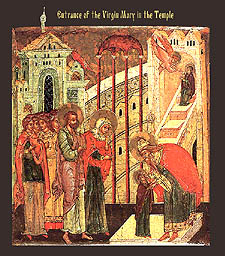
Feast of the Presentation of the Blessed Virgin Mary ~ A Bi-Ritual Feast

The Feast of the Presentation of the Blessed Virgin Mary is kept in both East and West today. Here is the story from both traditions.

From the East:


According to Holy Tradition, the Entry of the Most Holy Theotokos into the Temple took place in the following manner. The parents of the Virgin Mary, Saints Joachim and Anna, praying for an end to their childlessness, vowed that if a child were born to them, they would dedicate it to the service of God.

When the Most Holy Virgin reached the age of three, the holy parents decided to fulfil their vow. They gathered together their relatives and acquaintances and dressed the All-Pure Virgin in Her finest clothes. Singing sacred songs and with lighted candles in their hands, virgins escorted Her to the Temple (Ps. 44/45:14-15). There the High Priest and several priests met the handmaiden of God. In the Temple, fifteen high steps led to the sanctuary, which only the priests and High Priest could enter. (Because they recited a Psalm on each step, Psalms 119/120-133/134 are called “Psalms of Ascent.”) The child Mary, so it seemed, could not make it up this stairway. But just as they placed Her on the first step, strengthened by the power of God, She quickly went up the remaining steps and ascended to the highest one. Then the High Priest, through inspiration from above, led the Most Holy Virgin into the Holy of Holies, where only the High Priest entered once a year to offer a purifying sacrifice of blood. Therefore, all those present in the Temple were astonished at this most unusual occurrence.

After entrusting their child to the Heavenly Father, Joachim and Anna returned home. The All-Holy Virgin remained in the quarters for virgins near the Temple. According to the testimony of Holy Scripture (Exodus 38; 1 Kings 1: 28; Luke 2: 37), and also the historian Josephus Flavius, there were many living quarters around the Temple, in which those who were dedicated to the service of God dwelt.

The earthly life of the Most Holy Theotokos from Her infancy until She was taken up to Heaven is shrouded in deep mystery. Her life at the Jerusalem Temple was also a secret. “If anyone were to ask me,” said Saint Jerome, “how the Most Holy Virgin spent the time of Her youth, I would answer that that is known to God Himself and the Archangel Gabriel, Her constant guardian.”

But there are accounts in Church Tradition, that during the All-Pure Virgin’s stay at the Temple, She grew up in a community of pious virgins, diligently read the Holy Scripture, occupied Herself with handicrafts, prayed constantly, and grew in love for God. From ancient times, the Church has celebrated the Feast of the Entry of the Most Holy Theotokos into the Temple. Indications that the Feast was observed in the first centuries of Christianity are found in the traditions of Palestinian Christians, which say that the holy Empress Helen (May 21) built a church in honor of the Entry of the Most Holy Theotokos into the Temple.

Saint Gregory of Nyssa, in the fourth century, also mentions this Feast. In the eighth century Saints Germanus and Tarasius, Patriarchs of Constantinople, delivered sermons on the Feast of the Entry.

The Feast of the Entry of the Most Holy Theotokos into the Temple foretells God’s blessing for the human race, the preaching of salvation, the promise of the coming of Christ.

DISCOURSE ON THE FEAST OF THE ENTRY

OF OUR MOST PURE LADY THEOTOKOS

INTO THE HOLY OF HOLIES

by Saint Gregory Palamas, Archbishop of Thessalonica

If a tree is known by its fruit, and a good tree bears good fruit (Mt. 7:17; Luke 6:44), then is not the Mother of Goodness Itself, She who bore the Eternal Beauty, incomparably more excellent than every good, whether in this world or the world above? Therefore, the coeternal and identical Image of goodness, Preeternal, transcending all being, He Who is the preexisting and good Word of the Father, moved by His unutterable love for mankind and compassion for us, put on our image, that He might reclaim for Himself our nature which had been dragged down to uttermost Hades, so as to renew this corrupted nature and raise it to the heights of Heaven. For this purpose, He had to assume a flesh that was both new and ours, that He might refashion us from out of ourselves. Now He finds a Handmaiden perfectly suited to these needs, the supplier of Her own unsullied nature, the Ever-Virgin now hymned by us, and Whose miraculous Entrance into the Temple, into the Holy of Holies, we now celebrate. God predestined Her before the ages for the salvation and reclaiming of our kind. She was chosen, not just from the crowd, but from the ranks of the chosen of all ages, renowned for piety and understanding, and for their God-pleasing words and deeds.

In the beginning, there was one who rose up against us: the author of evil, the serpent, who dragged us into the abyss. Many reasons impelled him to rise up against us, and there are many ways by which he enslaved our nature: envy, rivalry, hatred, injustice, treachery, slyness, etc. In addition to all this, he also has within him the power of bringing death, which he himself engendered, being the first to fall away from true life.

The author of evil was jealous of Adam when he saw him being led from earth to Heaven, from which he was justly cast down. Filled with envy, he pounced upon Adam with a terrible ferocity, and even wished to clothe him with the garb of death. Envy is not only the begetter of hatred, but also of murder, which this truly man-hating serpent brought about in us. For he wanted to be master over the earth-born for the ruin of that which was created in the image and likeness of God. Since he was not bold enough to make a face to face attack, he resorted to cunning and deceit. This truly terrible and malicious plotter pretended to be a friend and useful adviser by assuming the physical form of a serpent and stealthily took their position. By his God-opposing advice, he instils in man his own death-bearing power, like a venomous poison.

If Adam had been sufficiently strong to keep the divine commandment, then he would have shown himself the vanquisher of his enemy and withstood his deathly attack. But since he voluntarily gave in to sin, he was defeated and was made a sinner. Since he is the root of our race, he has produced us as death-bearing shoots. So, it was necessary for us, if he were to fight back against his defeat and to claim victory, to rid himself of the death-bearing venomous poison in his soul and body, and to absorb life, eternal and indestructible life.

It was necessary for us to have a new root for our race, a new Adam, not just one Who would be sinless and invincible, but one Who also would be able to forgive sins and set free from punishment those subject to it. And not only would He have life in Himself, but also the capacity to restore to life, so that He could grant to those who cleave to Him and are related to Him by race both life and the forgiveness of their sins, restoring to life not only those who came after Him, but also those who already had died before Him. Therefore, Saint Paul, that great trumpet of the Holy Spirit, exclaims, “the first man Adam was made a living soul, the last Adam was made a quickening spirit” (1 Cor. 15:45).

Except for God, there is no one who is without sin, or life-creating, or able to remit sin. Therefore, the new Adam must be not only Man, but also God. He is at the same time life, wisdom, truth, love, and mercy, and every other good thing so that He might renew the old Adam and restore him to life through mercy, wisdom and righteousness. These are the opposites of the things which the author of evil used to bring about our ageing and death.

As the slayer of mankind raised himself against us with envy and hatred, so the Source of life was lifted up [on the Cross] because of His immeasurable goodness and love for mankind. He intensely desired the salvation of His creature, i.e., that His creature would be restored by Himself. In contrast to this, the author of evil wanted to bring God’s creature to ruin, and thereby put mankind under his own power, and tyrannically to afflict us. And just as he achieved the conquest and the fall of mankind by means of injustice and cunning, by deceit and his trickery, so has the Liberator brought about the defeat of the author of evil, and the restoration of His own creature with truth, justice and wisdom.

It was a deed of perfect justice that our nature, which was voluntarily enslaved and struck down, should again enter the struggle for victory and cast off its voluntary enslavement. Therefore, God deigned to receive our nature from us, hypostatically uniting with it in a marvellous way. But it was impossible to unite that Most High Nature, Whose purity is incomprehensible for human reason, to a sinful nature before it had been purified. Therefore, for the conception and birth of the Bestower of purity, a perfectly spotless and Most Pure Virgin was required.

Today we celebrate the memory of those things that contributed, if only once, to the Incarnation. He Who is God by nature, the Co-unoriginate and Coeternal Word and Son of the Transcendent Father, becomes the Son of Man, the Son of the Ever-Virgin. “Jesus Christ the same yesterday and today, and forever” (Heb. 13:8), immutable in His divinity and blameless in His humanity, He alone, as the Prophet Isaiah prophesied, “practiced no iniquity, nor deceit with His lips” (Is. 53: 9). He alone was not brought forth in iniquity, nor was He conceived in sin, in contrast to what the Prophet David says concerning himself and every other man (Ps. 50/51: 5). Even in what He assumes, He is perfectly pure and has no need to be cleansed Himself. But for our sake, He accepted purification, suffering, death and resurrection, that He might transmit them to us.

God is born of the spotless and Holy Virgin, or better to say, of the Most Pure and All-Holy Virgin. She is above every fleshly defilement, and even above every impure thought. Her conceiving resulted not from fleshly lust, but by the overshadowing of the Most Holy Spirit. Such desire being utterly alien to Her, it is through prayer and spiritual readiness that She declared to the angel: “Behold the handmaiden of the Lord; be it unto Me according to thy word” (Luke 1:38), and that She conceived and gave birth. So, in order to render the Virgin worthy of this sublime purpose, God marked this ever-virgin Daughter now praised by us, from before the ages, and from eternity, choosing Her from out of His elect.

Turn your attention then, to where this choice began. From the sons of Adam God chose the wondrous Seth, who showed himself a living heaven through his becoming behaviour, and through the beauty of his virtues. That is why he was chosen, and from whom the Virgin would blossom as the divinely fitting chariot of God. She was needed to give birth and to summon the earth-born to heavenly sonship. For this reason, also all the lineage of Seth were called “sons of God,” because from this lineage a son of man would be born the Son of God. The name Seth signifies a rising or resurrection, or more specifically, it signifies the Lord, Who promises and gives immortal life to all who believe in Him.

And how precisely exact is this parallel! Seth was born of Eve, as she herself said, in place of Abel, whom Cain killed through jealousy (Gen. 4:25); and Christ, the Son of the Virgin, was born for us in place of Adam, whom the author of evil also killed through jealousy. But Seth did not resurrect Abel, since he was only a type of the resurrection. But our Lord Jesus Christ resurrected Adam since He is the very Life and the Resurrection of the earth-born, for whose sake the descendants of Seth are granted divine adoption through hope, and are called the children of God. It was because of this hope that they were called sons of God, as is evident from the one who was first called so, the successor in the choice. This was Enos, the son of Seth, who as Moses wrote, first hoped to call on the Name of the Lord (Gen. 4:26).

In this manner, the choice of the future Mother of God, beginning with the very sons of Adam and proceeding through all the generations of time, through the Providence of God, passes to the Prophet-king David and the successors of his kingdom and lineage. When the chosen time had come, then from the house and posterity of David, Joachim and Anna are chosen by God. Though they were childless, they were by their virtuous life and good disposition the finest of all those descended from the line of David. In prayer, they besought God to deliver them from their childlessness and promised to dedicate their child to God from its infancy. By God Himself, the Mother of God was proclaimed and given to them as a child so that from such virtuous parents the all-virtuous child would be raised. So in this manner, chastity joined with prayer came to fruition by producing the Mother of virginity, giving birth in the flesh to Him Who was born of God the Father before the ages.

Now, when Righteous Joachim and Anna saw that they had been granted their wish and that the divine promise to them was realized in fact, then they on their part, as true lovers of God, hastened to fulfill their vow given to God as soon as the child had been weaned from milk. They have now led this truly sanctified child of God, now the Mother of God, this Virgin into the Temple of God. And She, being filled with Divine gifts even at such a tender age, ... She, rather than others, determined what was being done over Her. In Her manner She showed that She was not so much presented into the Temple, but that She Herself entered into the service of God of her own accord, as if she had wings, striving towards this sacred and divine love. She considered it desirable and fitting that she should enter into the Temple and dwell in the Holy of Holies.

Therefore, the High Priest, seeing that this child, more than anyone else, had divine grace within Her, wished to set Her within the Holy of Holies. He convinced everyone present to welcome this since God had advanced it and approved it. Through His angel, God assisted the Virgin and sent Her mystical food, with which She was strengthened in nature, while in body She was brought to maturity and was made purer and more exalted than the angels, having the Heavenly spirits as servants. She was led into the Holy of Holies not just once but was accepted by God to dwell there with Him during Her youth so that through Her, the Heavenly Abodes might be opened and given for an eternal habitation to those who believe in Her miraculous birth-giving.

So it is, and this is why She, from the beginning of time, was chosen from among the chosen. She Who is manifest as the Holy of Holies, Who has a body even purer than the spirits purified by virtue, is capable of receiving ... the Hypostatic Word of the Unoriginate Father. Today the Ever-Virgin Mary, like a Treasure of God, is stored in the Holy of Holies, so that in due time, (as it later came to pass) She would serve for the enrichment of, and an ornament for, all the world. Therefore, Christ God also glorifies His Mother, both before, and also after His birth.

We who understand the salvation begun for our sake through the Most Holy Virgin, give Her thanks and praise according to our ability. And truly, if the grateful woman (of whom the Gospel tells us), after hearing the saving words of the Lord, blessed and thanked His Mother, raising her voice above the din of the crowd and saying to Christ, “Blessed is the womb that bore Thee, and the paps Thou hast sucked” (Luke 11:27), then we who have the words of eternal life written out for us, and not only the words, but also the miracles and the Passion, and the raising of our nature from death, and its ascent from earth to Heaven, and the promise of immortal life and unfailing salvation, then how shall we not unceasingly hymn and bless the Mother of the Author of our Salvation and the Giver of Life, celebrating Her conception and birth, and now Her Entry into the Holy of Holies?

Now, brethren, let us remove ourselves from earthly to celestial things. Let us change our path from the flesh to the spirit. Let us change our desire from temporal things to those that endure. Let us scorn fleshly delights, which serve as allurements for the soul and soon pass away. Let us desire spiritual gifts, which remain undiminished. Let us turn our reason and our attention from earthly concerns and raise them to the inaccessible places of Heaven, to the Holy of Holies, where the Mother of God now resides.

Therefore, in such manner, our songs and prayers to Her will gain entry, and thus through her mediation, we shall be heirs of the everlasting blessings to come, through the grace and love for mankind of Him Who was born of Her for our sake, our Lord Jesus Christ, to Whom be glory, honour and worship, together with His Unoriginate Father and His Coeternal and Life-Creating Spirit, now and ever and unto ages of ages. Amen.

Troparion — Tone 4

Today is the prelude of the goodwill of God, / of the preaching of the salvation of mankind. / The Virgin appears in the temple of God, / in anticipation proclaiming Christ to all. / Let us rejoice / and sing to her: / "Rejoice, O Fulfillment of the Creator's dispensation."

Kontakion — Tone 4

The most pure Temple of the Savior; / the precious Chamber and Virgin; / the sacred Treasure of the glory of God, / is presented today to the house of the Lord. / She brings with her the grace of the Spirit, / therefore, the angels of God praise her: / “Truly this woman is the abode of heaven.”

From the West:


The Protoevangel of James, the Gospel of Pseudo-Matthew, the Gospel of the Nativity of Mary, and other apocryphal writings (Walker, "Apocryph. Gosp.", Edinburgh, 1873) relate that Mary, at the age of three, was brought by her parents to the Temple, in fulfillment of a vow, there to be educated. The corresponding feast originated in the Orient, probably in Syria, the home of the apocrypha. Card. Pitra (Anal. Spici. Solesmensi, p. 265) has published a great canon (liturgical poem) in Greek for this feast, composed by some "Georgios" about the seventh or eighth century. The feast is missing in the earlier Menology of Constantinople (eighth century); it is found, however, in the liturgical documents of the eleventh century, like the "Calend. Ostromiranum" (Martinow, "Annus græco-slav.", 329) and the Menology of Basil II (e'ísodos tes panagías Theotókon). It appears in the constitution of Manuel Comnenos (1166) as a fully recognized festival during which the law courts did not sit. In the West it was introduced by a French nobleman, Philippe de Mazières, Chancellor of the King of Cyprus, who spent some time at Avignon during the pontificate of Gregory XI. It was celebrated in the presence of the cardinals (1372) with an office accommodated from the office chanted by the Greeks. In 1373 it was adopted in the royal chapel at Paris, 1418 at Metz, 1420 at Cologne. Pius II granted (1460) the feast with a vigil to the Duke of Saxony. It was taken up by many dioceses, but at the end of the Middle Ages, it was still missing in many calendars (Grotefend, "Zeitrechnung", III, 137). At Toledo it was assigned (1500) by Cardinal Ximenes to 30 September. Sixtus IV received it into the Roman Breviary, Pius V struck it from the calendar, but Sixtus V took it up a second time (1 September, 1585). In the province of Venice it is a double of the second class with an octave (1680); the Passionists and Sulpicians keep it as a double of the first class; the Servites, Redemptorists, Carmelites, Mercedarians, and others as a double of the second with an octave. In the Roman Calendar it is a major double. The Greeks keep it for five days. In some German dioceses, under the title "Illatio", it was kept 26 November (Grotefend, III, 137).

KELLNER, Heortologie (Freiburg, 1901); NILLES, Kal. Man. (Innsbruck, 1897); HOLWECK, Fasti Mariani (Freiburg, 1892).


Generalísimo Franco & Christ the King

Franco did his best to establish the Social Reign of Christ the King in Spain, but the Conciliar Church didn't approve, so Spain is a secular state today.


From One Peter Five

By General de división Juan Chicharro Ortega, Royal Spanish Marine Infantry

"Spain prostrates itself today in reverence before this throne of Your goodness"

In the summer of 1936, as the Spanish Civil War erupted, a wave of anticlerical violence known as the Red Terror swept through the Republican-controlled zones. Between 1936 and 1937, this persecution targeted the Catholic Church with particular ferocity. Thirteen bishops were murdered, along with thousands of priests, religious brothers and sisters, and countless lay Catholics. Reliable historical tallies place the number of clergy killed at approximately 6,832: 13 bishops, more than 4,180 diocesan priests and seminarians, over 2,360 male religious, and nearly 300 nuns. Many suffered torture, humiliation, and desecration before death. Hundreds of churches, convents, and monasteries were burned, looted, or converted into warehouses, stables, or political headquarters. Sacred images were smashed, tabernacles emptied, and liturgical objects melted down or publicly mocked.

The scale and intensity of the attacks marked one of the most severe episodes of religious persecution in modern Western history. In some dioceses, the death toll among the clergy reached catastrophic levels—nearly 90 percent in Barbastro, for example. The violence was not limited to the ordained; thousands of ordinary Catholic laypeople were also executed, often for their faith or for assisting priests and religious. Churches that had stood for centuries as centers of Spanish community life were reduced to ruins or emptied of their religious purpose.

Against this background of chaos and bloodshed, the Nationalist forces under General Francisco Franco eventually prevailed. By 1939, the war had ended and Franco’s government restored public order across Spain. The Catholic Church, both in Spain and at the Vatican, recognized the significance of this outcome. Spanish bishops had already described the conflict in terms of a defensive struggle for the Faith.

The Holy See’s response was particularly significant. On April 1, 1939, Pope Pius XII sent a telegram directly to Generalísimo Franco, congratulating him on what the Pope described as the “deseada victoria católica [de] España” (the long-desired Catholic victory in Spain). The Pope expressed his hope that Spain, having attained peace, would renew its historic Christian traditions, and concluded by imparting his Apostolic Blessing upon Franco and the Spanish people.[1]

Fifteen days later, on April 16, 1939, Pius XII delivered his radio message “Con Immenso Gozo” to the faithful of Spain. 

With great joy We address you, most dear children of Catholic Spain, to express to you our fatherly congratulations for the gift of peace and of victory, with which God has deemed worthy to crown the Christian heroism of your faith and charity, tried in so many and so generous sufferings.[2] 

He further acknowledged the Christian sentiments demonstrated by the Head of State and explicitly referred to the principles of pacification proclaimed by the Generalísimo.² The Spanish hierarchy viewed the end of the Republican zone’s anticlerical campaign as the lifting of an existential threat to the Church.

Franco himself publicly identified Spain’s national identity with its Catholic inheritance. This was not merely a political expression. On May 30, 1969, at Cerro de los Ángeles, he personally renewed Spain’s consecration to the Sacred Heart of Jesus, marking the fiftieth anniversary of the original consecration by King Alfonso XIII in 1919.

In the prayer he delivered on that occasion, Franco addressed Christ as “Rey de reyes y Señor de los que dominan” (King of kings and Lord of those who rule). He subsequently declared:

España, pueblo de tu herencia y de tus predilecciones, se postra hoy reverente ante este Trono de tus bondades (Spain, the people of Your inheritance and predilection, prostrates itself today in reverence before this throne of Your goodness).[3]

The significance of this declaration is unmistakable: Franco publicly placed Spain’s national life, its governing institutions, and its historic Catholic identity within the framework of Christ’s universal kingship.

That tradition reached back to the Visigothic king Reccared (Recaredo), who in 589 formally renounced Arianism and embraced Catholicism at the Third Council of Toledo, uniting the kingdom under the Catholic faith. From that moment, the Church and the Spanish people were bound together through the Reconquista, the Golden Age, and the centuries that followed. Franco sought to recover and reaffirm this inheritance after the upheavals of the Second Republic and the Civil War.

Throughout his long tenure, he acted as a determined defender of traditional Spanish Catholicism. Religious education returned to the schools. The Church regained legal privileges and a central role in public life. Civil marriage and divorce laws introduced under the Republic were reversed. Seminaries were rebuilt and expanded. Public processions, feast days, and the visible presence of the Church were restored. Franco’s regime promoted a vision of Spain as a Catholic nation whose historic mission and cultural continuity rested on the faith that Reccared had made official more than thirteen centuries earlier.

The Red Terror had demonstrated how quickly that heritage could be attacked when revolutionary forces held power. The restoration that followed the Nationalist victory halted the destruction, returned stability to religious life, and allowed the Church to recover. For the Spanish hierarchy and for many Catholics who had lived through the persecutions of 1936–37, Franco’s victory represented not only a military success but the recovery of the Catholic order that had defined Spain since the days of Reccared.

In the decades that followed, that restored relationship between Church and state shaped the country’s public life, education, and national self-understanding. The events of those years remain a stark reminder of the vulnerability of religious institutions in times of ideological upheaval and of the determination required to rebuild what had been nearly erased.


[1] Pius XII, telegram to Generalísimo Francisco Franco, April 1, 1939, “Telegramas de Su Santidad el Papa Pío XII y el Generalísimo Franco con motivo del fin de la guerra,” Boletín Eclesiástico del Arzobispado de Toledo 95, no. 4 (April 1, 1939): 129.

[2] Pius XII, Radio Message “Con Immenso Gozo,” To the Spanish Faithful “Radiomensaje de Su Santidad Pío XII a los fieles de España,” April 16, 1939, Acta Apostolicae Sedis 31 (1939): 151–54.

[3] Francisco Franco, “Oración de renovación de la consagración de España al Sagrado Corazón de Jesús,” delivered at Cerro de los Ángeles, Getafe, May 30, 1969, transcript reproduced in Fundación Nacional Francisco Franco, “Oración de la Consagración de España al Corazón de Jesús (30-V-1919).