"...he went to the gallows a repentant Catholic. If there is hope for men such as he, then there is hope for all of us." O Mary conceived without sin, pray for us who have recourse to thee.

From Crisis
By Darrick Taylor, PhD
“Wild” Bill Longley was more a cold-blooded killer than the gunfighter of legend, yet he went to the gallows a repentant Catholic. If there is hope for men such as he, then there is hope for all of us.
When I was a boy my parents always had books around. They had bookshelves just outside their bedroom on the second floor of our home. In that bookcase, they had a complete set of the Funk & Wagnalls Encyclopedia, which I used to dip into whenever the mood struck me. They had an old book of famous paintings which I used to like to browse from time to time. It had some wonderful paintings by Anthony Van Dyck. But my favorite books to read from those bookshelves were the two sets of Time-Life books that dealt with historical subjects dear to my father’s heart. These were the Civil War, which was handsomely bound in a silver cover filled with photos and basic information about battles, troop movements, and other things that would excite a young boy; and then there was the set on the Old West, the cowboys, gunfighters, Indians, and cattle rustlers that have become famous because of Hollywood. Bound with a soft brown cover with photos taken from the 19th century, these books were a gateway to another world for me.
Like a lot of young men I romanticized outlaws and gunfighters because they seemed so daring, so bold, and seemed to get away, well, with murder. I read about Billy the Kid, and Butch Cassidy and the Sundance Kid, as well as a host of other famous or infamous gunfighters from the Old West. But one always stuck in my memory, because of the book’s description of how he died. In 1878, authorities in Texas executed “Wild” Bill Longley for committing what he claimed were more than thirty murders. Several newspaper accounts described how he went to his death on the day of his execution. According to these accounts, Longley asked for forgiveness and repented his crimes. Then looking out over the crowd, his last words were “I see a good many enemies around me, and mighty few friends.” With that they put the noose around his neck, and he dropped through the trap door and thus ended the life of Bill Longley.
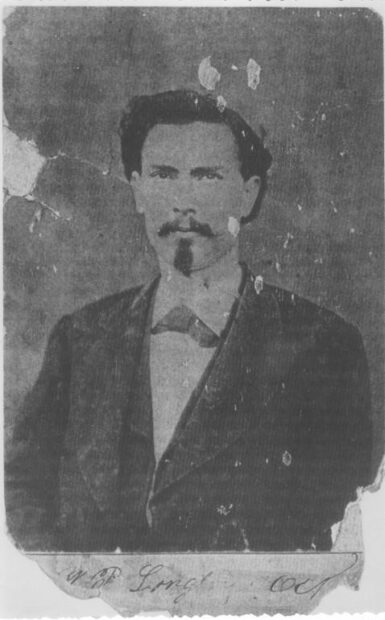
He was born in Texas in 1851 to devout Methodist parents. Most accounts of his life stress the importance of the Civil War. Longley was born in 1851 and came of age in Texas during that conflict, and like many young men of the age was bitter at the outcome of the war in which he did not fight. He “broke bad” in his teens and became a cattle thief and robber, before later on graduating to murder. His claim that he killed more than thirty men was almost certainly an exaggeration, and some have suggested the number was closer to six or seven men. Moreover, his choice of targets speaks to a depraved character. His documented killing sprees often occurred during attempts to steal cattle, but he also killed several men apparently because they were freed slaves. He perpetrated most of his documented murders against unarmed men or ambushed them unawares, and only one of them could you characterize as an actual gunfight. He was handy with a gun, however: in the 1870s he left Texas to avoid capture and briefly joined the U.S. Army and was known to be an excellent shot. That part of the myth is true.
Eventually, the law caught up to him in 1877, and a Texas court convicted him of murder. Longley cried foul because another famous contemporary outlaw and murderer, John Wesley Hardin, who really did kill nearly thirty people, was only given a long prison sentence rather than the death penalty. (Hardin was the inspiration for Bob Dylan’s song “John Wesley Harding,” which Dylan misspelled. Ironically, Hardin himself would be shot dead in an El Paso saloon in 1895.) Longley’s case became something of a cause célèbre throughout the country as he tried to procure a stay of execution from the governor of Texas. People wrote to the governor in support of Longley from all across the country, including his uncle, Alexander “Pres” Longley, who was a famous author and poet of the time, and wrote a letter to President Rutherford B. Hayes seeking a pardon for Bill, but to no avail.
Though Longley grew up in a religious household, obviously the Christian instruction of his father did not take. But there were several churches in the city of Galveston, Texas, near the county jail where authorities held Longley prior to his execution. In those days, a Presbyterian church was located across the street from the county jail where he spent much of his final year. But catty-corner from the prison itself was also the Catholic Cathedral of St. Mary. It is not clear why, since Protestant parents raised him, but he chose baptism in the Catholic Church before his execution, though perhaps the efforts of the priest who ministered to him his last days had something to do with it.
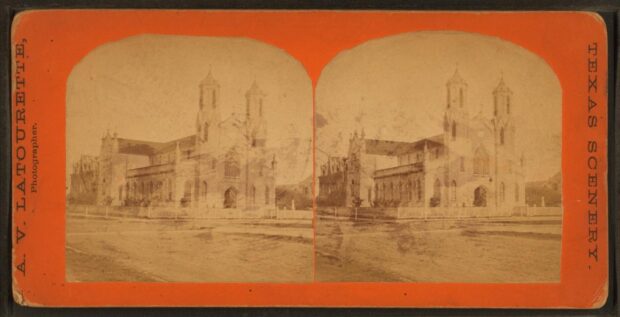
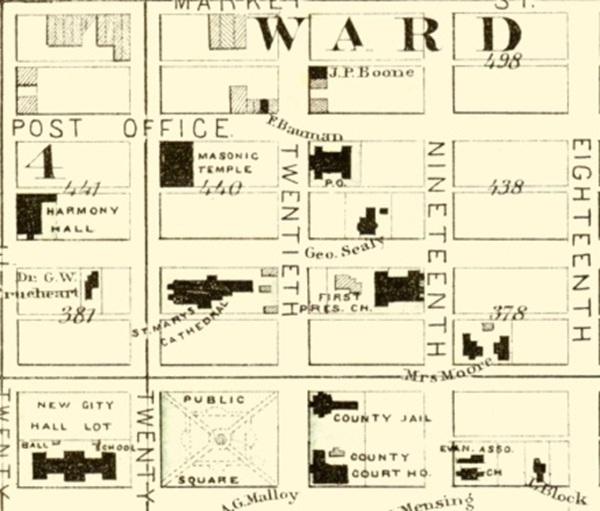
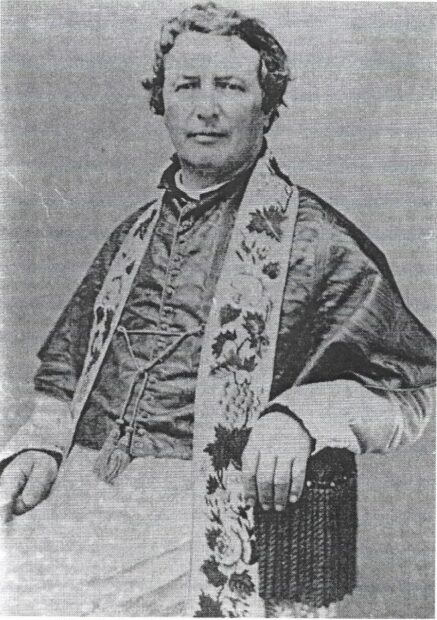
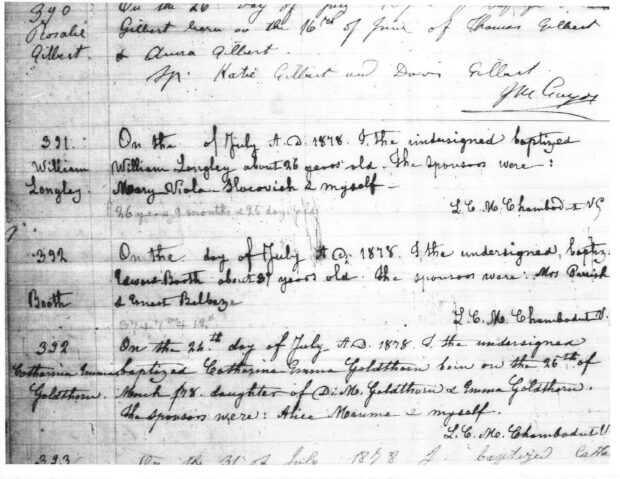
Father Louis Claude Marie Chambodut came to the United States from France in 1847, and was ordained in New Orleans, before becoming vicar general of the diocese of Texas around 1851. Fr. Chambodut was an ardent Confederate, who blessed the banners of Texas regiments in the Galveston Cathedral before they left for Virginia, where they became part of the Army of Northern Virginia. One company that made up those regiments was composed of former French settlers descended from veterans of Napoleon’s army, who had settled in Texas, and who were very fond of Fr. Chambodut. It was Fr. Chambodut who baptized Longley in Galveston, at the Cathedral on July 4 (of all days), 1878, three months before his execution.
However, when it became clear that his many appeals would not succeed, Longley began to regret having spread the myth of the gunfighter and retracted his statements that he had killed thirty-two men and said that he killed only eight. Letters in the Texas State Archive from Longley to his brother reveal his growing remorse at the crimes he had committed. “My first step was disobedience,” he wrote his brother, “next whisky drinking; next, carrying pistols; next, gambling, and then murder, and I suppose the next step will be the gallows.” By the time his last appeal failed, Longley was at peace with his fate, telling his brother the night before his execution that “I don’t dread this at all. Tomorrow this time I will be in a much better place.”
Near the scaffold, Longley sat chomping a cigar until the executioners were ready, and at 2:15 p.m. he mounted the scaffold. After the deputies read the death warrant, he threw away his cigar and briefly addressed the crowd:
Well, I haven’t got much to say. I have got to die. I see a good many enemies around me, and mighty few friends. I hope to God you will all forgive me; I will forgive you. I hate to die, of course; any man hates to die, but I have learned this by taking the lives of men who loved life as well as I do. If I have any friends here, I hope they will do nothing to avenge my death; if they wish to help me, let them pray for me. I hear that my brother is in the crowd. I hope he ain’t, but if he is, I hope he will not take anybody’s life to avenge mine. I have done enough of that. I deserve this fate. It’s a debt I owe for my wild, reckless life. When it is paid it will be all over with. I hope you will all forgive me; I will forgive you; whether you do or not, may God forgive me. I have nothing more to say.
Longley then kissed Fathers Spillard and Querat on the cheek, and in some accounts even the sheriff, who was his friend. Before they covered his head with the black cap, he said to the crowd, “Good-bye everybody.” The executioners then cut the rope holding the weight keeping the noose up, and Longley fell through the opening in the gallows. Longley moaned several times, trying to raise his arms, but he slowly strangled to death. After 11 minutes three doctors at the execution pronounced him dead. Sheriff James Madison Brown then placed the body in a coffin and took it to the town cemetery and buried Longley there.
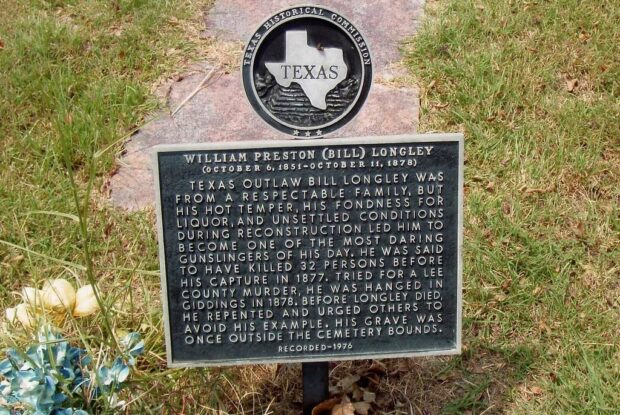
It might seem incredible that a man like Longley, who led such a wicked life, could really repent of his sins. After all, he only did so when faced with his own demise, and we have all known people who refused to admit to the sins they have committed, right to the end of their days. But that he did seek out the Church in his final hours, and faced that death with dignity, at least outwardly expressing hope in Christ, gives us reason to think he did. God alone knows the truth. But his story recalls to us why we seek out the Church, and ultimately, Christ the Son of God. Like William Longley, we need forgiveness and reconciliation too, and if there is hope for men such as he, then there is hope for all of us as well.
O Mary conceived without sin, pray for us who have recourse to thee.

No comments:
Post a Comment
Comments are subject to deletion if they are not germane. I have no problem with a bit of colourful language, but blasphemy or depraved profanity will not be allowed. Attacks on the Catholic Faith will not be tolerated. Comments will be deleted that are republican (Yanks! Note the lower case 'r'!), attacks on the legitimacy of Pope Leo XIV as the Vicar of Christ, the legitimacy of the House of Windsor or of the claims of the Elder Line of the House of France, or attacks on the legitimacy of any of the currently ruling Houses of Europe.