From My Book of the Church's Year, by Enid M. Chadwick; Forward by Peter Kwasniweski, PhD.

And, this was under a self-proclaimed "devout Catholic!" President! How is it different from a Godless President, actively persecuting the Church?

The report was released yesterday; it is a massive nearly 600-page document on just how targeted all believing Christians were by the Biden Administration, and Traditional Catholics are at the center of it:
Key Finding 2: The Biden Federal Bureau of Investigation (FBI) investigated, monitored,tracked, and scrutinized traditional Catholics who had engaged in no criminal misconduct. FBI’s Richmond, Virginia, Field Office was at the forefront of this effort. It justified its actions through misplaced reliance on baseless allegations from the Southern Poverty Law Center and the religious affiliation of a single law enforcement target who happened to identify himself as a “radical traditional Catholic.” In response, the Richmond Field Office conducted a low-level investigation of the target’s local church and began to consider traditional Catholics as potential violent extremists or domestic terrorists based on their preferred popes, devotion to the Traditional Latin Mass, and views on abortion, immigration, and human sexuality. (p. ii)
An image from the report at the time:

The persecution of nuns was relentless as well.
The full report is available here. The DOJ press release is here.
From The Imaginative Conservative
By Fr John A. Ryan (R+I+P), STD
For the wage-earner of today, access to the resources of nature can be had only through wages. This means that the industrial community in which he lives, and for which he labors, shall provide him with the requisites of a decent livelihood in the form of living wages.
 When we consider man’s position in relation to the bounty of nature, we are led to accept three fundamental principles. The first may be thus stated: Since the earth was intended by God for the support of all persons, all have essentially equal claims upon it, and essentially equal rights of access to its benefits. On the one hand, God has not declared that any of His children have superior or exceptional claims to the earth. On the other hand, all persons are made in the image and likeness of God, composed of the same kind of body and soul, affected by the same needs, and destined for the same end. Therefore they are all equally important in His sight. They are all equally persons, endowed with intrinsic worth and dignity, ends in themselves, not instruments to the welfare of others. Hence they stand upon an essentially equal footing with regard to the animal, plant, and mineral bounty of the earth. This bounty is a common gift, possession, heritage. The moral claims upon it held by these equal human persons are essentially equal. No man can vindicate for himself a superior claim on the basis of anything that he finds in himself, in nature or in the designs of nature’s God.
Nevertheless, this equal right of access to the earth is not absolute. It is conditioned upon labor, upon the expenditure of useful and fruitful energy. As a rule, the good things of the earth are obtained in adequate form and quantity only at the cost of considerable exertion. And this exertion is for the most part irksome, of such a nature that men will not perform it except under the compulsion of some less agreeable alternative. The labor to which the earth yields up her treasures is not put forth spontaneously and automatically. Therefore, the equal and inherent right of men to possess the earth and utilize its benefits becomes actually valid only when they are willing to expend productive energy and labor. This is the second fundamental principle.
Obviously we are speaking here of the original rights of men to the earth, not of those rights which they have acquired through the possession of private property. The rights in question are those which inhere in all men, whether or not they are private owners.
From the two principles of equal right of access to the earth, and universal obligation to perform a reasonable amount of useful labor, follows a third fundamental principle. It is that men who at any time or in any way control the resources of the earth are morally bound to permit others to have access thereto on reasonable terms. Men who are willing to work must be enabled to make real and actual their original and equal right of access to the common bounty of nature. For the right to subsist from the earth implies the right actually to participate in its benefits on reasonable conditions and through reasonable arrangements. Otherwise the former right is a delusion. To refuse any man reasonable facilities to exercise his basic right of living from the common bounty by his labor is to treat this right as non-existent. Such conduct by the men who are in possession implies a belief that their rights to the gifts of God are inherently superior to the right of the person whom they exclude. This position is utterly untenable. It is on exactly the same basis as would be the claim of a strong man to deprive a weak one of liberty. The right to freedom of movement is not more certain nor more indestructible than the right of access on reasonable terms to the bounty of the earth. Were a community to imprison an innocent man it would not violate his rights more vitally than does the proprietor or the corporation that deprives him of reasonable access to the resources of nature. In both cases the good that he seeks is a common gift of God.
This, then, is the moral basis underlying the laborer’s right to a living wage. Like all other men, he has an indestructible right of access to the goods of the earth on reasonable terms. Obviously, the conditional clause, “on reasonable terms,” is of very great importance. Neither the laborer nor anyone else has a right of direct and unconditional access to those portions of the earth that have rightly become the property of others. Such a claim would be the height of unreason. The laborer’s right to participate in the common heritage must be actualized in such a way as not to interfere with the equally valid rights of others. The laborer’s right must be satisfied with due regard to existing acquired rights and the existing form of industrial organization.
From this principle to the principle that the laborer has a right to a living wage, the transition is logical and certain. Pope Leo XIII declared that the laborer’s right to a living wage arises from the fact that his wage is his only means of livelihood. Owing to the manner in which the goods of the earth have been divided and appropriated in the present organization of industrial society, the wage-earner has no way of exercising his original and equal right of access to the earth except through the sale of his labor in return for wages. An occasional worker might get a livelihood by cultivating a piece of land, but the cost is so great that only those can defray it who are already receiving more than living wages. If such an opportunity and alternative were general, the living wage would not be a practical question. Men would not hire themselves out for less than that amount when they could obtain a decent livelihood by employing themselves on a piece of land. To assure a laborer that if he does not like to work for less than living wages, he can fall back upon his right of access to the earth by taking up a piece of land, is but to mock him. Such access as he has is evidently not access on reasonable terms.
For the wage-earner of today, therefore, access to the resources of nature can be had only through wages. The men who have appropriated the goods and opportunities of the earth have shut him out from any other way of entering upon his natural heritage. Therefore they are morally bound to use and administer these goods in such a way that his right shall not be violated and his access to the resources of nature not rendered unreasonably difficult. This means that the industrial community in which he lives, and for which he labors, shall provide him with the requisites of a decent livelihood in the form of living wages. On the one hand, the worker has performed a reasonable amount of labor; on the other hand, the industrial community is the beneficiary of his services. In the product which he has created the community has the wherewith to pay him living wages. To refuse him this amount of remuneration is surely to deprive him of access to the earth and to a livelihood on reasonable terms.
It is assumed here that the laborer’s product is sufficiently large to provide this much remuneration, and that the employer would rather pay it than go without the laborer’s services. The case in which the product falls short of this sufficiency will be considered presently. If the employer does not think the laborer worth a living wage, he has a right to discharge him. Otherwise the employer would be treated unreasonably. But when the employer regards the employee as worth a living wage, but refuses to pay it merely because the laborer is economically constrained to work for less, he is surely treating the latter unreasonably. He is depriving the laborer of access to the goods of the earth on reasonable terms. In the striking words of Pope Leo XIII, he is making the laborer “the victim of force and injustice.”
_________
This essay is a chapter from “A Living Wage,” in The Church and Labor. Republished with gracious permission from Cluny Media.
The featured image is “Arbeiterkammer” (1925), by Wilhelm Thöny, and is in the public domain, courtesy of Wikimedia Commons.

Consider first, that as God is our first beginning, forasmuch as we are made by him, so is he also our last end, because we are made for him, and, therefore, as we ought to begin the day with him, by morning prayer, so we ought to end the day in his company, by evening prayer. Morning and evening prayer are like the two daily meals of the soul, that ought not upon any account to be omitted, lest the soul should languish and grow sick for want of her daily food; and if upon any occasion we are hindered from taking these meals at their usual times, we ought to observe what we practise with regard to our bodily’ meals, that is, we must proceed to take them afterwards at the first opportunity. Moreover, as we make it our care that our families and such as are under our charge should not want their daily corporal sustenance, so we ought much more to make it our care that their souls may not starve for want of our assembling them to prayer, or seeing that they are regular in this daily exercise.
Consider 2ndly, that one of the principal businesses of the evening exercise is the daily examination of conscience, which may be made in this manner:
1. Place thyself in the presence of God, bow thyself down and adore him, and give him thanks for all he has done that day for thee and for the whole world.
2.Earnestly beg his light and grace, that thou mayest discover all thy sins and be heartily sorry far them.
3. Endeavour to call to mind how thou hast spent the day from morning till night; what care thou hast taken to discharge thyself well both of the common duties of a Christian, and of the particular duties of thy station or calling; and especially how thou hast behaved thyself with regard to thy customary failings and thy predominant passions.
4. Endeavour to be heartily sorry for all the sins of the day, and for all the sins of thy whole life, known or unknown; go in spirit to the feet of Christ, to make an humble confession of them to him, and implore his mercy.
5. Resolve upon a serious and thorough amendment for the future; determine to begin from that very hour a new life, and think upon the means of accomplishing it. O! how happy are those souls that labour in this manner every night to wash away their sins with penitential tears, and that never venture to lie down to rest under the guilt of sin! Unhappy they who, for want of this precaution, expose themselves every night to the evident danger of dying in their sins, and even finding themselves in hell before morning.
Consider 3rdly, that in order to end the day well, we ought every night to endeavour to put ourselves as much as possible in the condition in which we should be glad to be found at the hour of our death. And therefore, besides offering up to God every night the sacrifice of a contrite and humble heart, for all the sins of our life, the Christian should also think seriously of his last end, and dispose himself for it by acts of a lively faith, and of an entire confidence in his redeemer; by a perfect oblation and resignation of himself to the holy will of God, and by aspiring to an eternal union with him, and in the meantime hiding himself with great affection in the sacred wounds of Jesus Christ, and there composing himself to rest. See, my soul, thou never forget this practice.
Conclude never to neglect any part of this evening exercise, and to see that it be not neglected by any under thy care. A religious performance of this duty will be a great means to secure to thy soul a happy death.


%20(2).jpg)
MAY 1st
LABOUR DAY
.jpg)
1 May. 31 Aug. 31 Dec.
We have written this Rule, in order that, by observing it in Monasteries, we may shew ourselves to have some degree of goodness of life, and a beginning of holiness. But for him who would hasten to the perfection of religion, there are the teachings of the holy Fathers, the following whereof bringeth a man to the height of perfection. For what page or what word is there in the divinely inspired books of the Old and New Testaments, that is not a most unerring rule for human life? Or what book of the holy Catholic Fathers doth not loudly proclaim how we may by a straight course reach our Creator? Moreover, the Conferences of the Fathers, their Institutes and their Lives, and the Rule of our holy Father Basil - what are these but the instruments whereby well-living and obedient monks attain to virtue? But to us, who are slothful and negligent and of evil lives, they are cause for shame and confusion. Whoever, therefore, thou art that hasteneth to thy heavenly country, fulfil by the help of Christ this least of Rules which we have written for beginners; and then at length thou shalt arrive, under God’s protection, at the lofty summits of doctrine and virtue of which we have spoken above.
%20(1)%20(2)%20(2).jpg)
Saint Thomas Aquinas (1225 – 7 March 1274), was a Doctor of the Church, Philosopher, Theologian, Jurist, Dominican Friar, and Priest. Known as Doctor Angelicus "Angelic Doctor," and the Doctor Communis "Universal Doctor" his writings serve as a defense and proof of the validity of Christ's authority over all. The Summa contra Gentiles (also known as Liber de veritate catholicae fidei contra errores infidelium, "Book on the truth of the Catholic faith against the errors of the unbelievers"). The Summa contra Gentiles consists of four books. The structure of Saint Thomas's work is designed to proceed from general philosophical arguments for monotheism, to which Muslims and Jews are likely to consent even within their own respective religious traditions, before progressing to the discussion of specifically Christian doctrine. Book I begins with general questions of truth and natural reason, and from chapter 10 investigates the concept of a monotheistic God. Chapters 10 to 13 are concerned with the existence of God, followed by a detailed investigation of God's properties (chapters 14 to 102). When demonstrating a Truth about God which can be known through reason, St. Thomas gives multiple arguments, each proving the same Truth in a different way. Whether you are a history enthusiast, a student of religion, or simply curious about the impact of the Roman Catholic Church on the world, this playlist is designed to provide an informative and engaging journey through its captivating past. Subscribe to the Contemplating History channel for more educational content and immerse yourself in the rich tapestry of history.
This is horrifying news! What happened to the "NewSpringtime", to the wave of vocations that VII was going to bring? Convents are closing all over the world (except Traditional ones).

From Aleteia
By Mathilde De Robien
The six remaining cloistered Carmelite nuns in Jonquières, France, are closing their historic community, ending a 400-year legacy of prayer ... and martyrdom.It's a sad consequence of the lack of religious vocations. Bishop Jacques Benoit-Gonnin of Beauvais, Noyon, and Senlis (France) announced on April 21 the closure of the Compiègne Carmelite community, located some six miles from the original site, in Jonquières, since 1992.
"As age advances, numbers decrease, vocations are slow in coming, and external reinforcements are impossible to find, our Carmelite Sisters of Compiègne have decided to close their community," the bishop explained. Six nuns currently remain at the monastery. They will leave gradually over the coming months.
The Carmel of the Annunciation, founded in Compiègne in 1641 and following the Rule of St. Teresa of Avila, was the 53rd foundation in France at the time. It had a unique impact, giving the Church 16 holy martyrs.
These 16 nuns were expelled from their monastery during the French Revolution and guillotined in Paris on July 17, 1794, out of hatred for the faith.
For over 18 months leading up to their death, they made a daily act of consecration, offering their lives to God so that peace might be restored to the Church and the state.
They are known world-wide thanks largely to Georges Bernanos’ play and Francis Poulenc’s opera Dialogue of the Carmelites.
Pope Francis approved their equipollent canonization on December 18, 2024. On May 8 of last year (the day Pope Leo was being elected), a thanksgiving celebration for their canonization took place in Compiègne.
Later, on September 13, Mass was celebrated at Notre-Dame Cathedral in Paris, followed by a procession retracing the route of the carts that carried them to the guillotine. A plaque where they were martyred is visible today.

A brief attempt to restore the Compiègne Carmel in 1835 was short-lived. Finally, on January 18, 1867, a few nuns from the Carmel in Troyes settled on Saint-Lazare Street in Compiègne. The monastery's construction took 16 years, lasting from 1872 until the chapel's inauguration in 1888. By 1992, with the building aging, the nuns sold the monastery and built a new one in Jonquières, a small village about six miles from Compiègne.
Father Yann Deswarte served as vicar of the Holy Carmelites of Compiègne parish for seven years before leaving last September to join the Society of St. John Vianney in Ars. He shared both his sadness over the nuns' departure and his lasting hope.
"It's sad because it's the end of an era, but I find it beautiful that the Lord allowed the canonization of the Carmelites before they leave. It's a form of fulfillment, and the Lord will bear fruit," he noted.
Father Deswarte celebrated Mass at the Carmel once a week and regularly entrusted the parish's prayer intentions to the community.
"I truly have this conviction that the Carmelites carried our parish in prayer and that everything we managed to do bore fruit thanks to the Carmelites' prayer. There’s real sadness and at the same time hope, because from now on the Carmelite saints will take over!" he added.
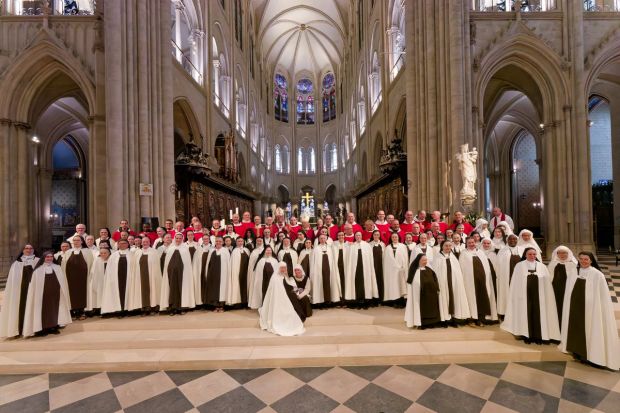
Bishop Benoit-Gonnin also highlighted the community's immense fruitfulness. "Those who joined them in Jonquières, those who visited them or walked alongside them, know the fruits borne by their silent witness, their faithful prayer, and their hearts open to the intentions entrusted to them," he pointed out. "Their presence and their witness will continue to inspire many."
"The Carmelites' message is a message of peace," noted Baudouin Gérard, president of the Friends of the Carmelite Saints of Compiègne. "The association will try to do everything to perpetuate this message." This message has resonated particularly strongly since the canonization of the 16 martyrs.
"To foster devotion, we organized pilgrimages and conferences with the Carmel, and entire buses came from Paris. All of this was a huge surge of faith and a path of peace," Gérard explained. "Sister Alix-Anne, who was the community's prioress, always said that it was absolutely necessary for the 16 Carmelites to be canonized, because the message '[may] peace be restored to the Church and the state' is more relevant than ever today," the association's president added.
A memorial dedicated to the 16 martyred Carmelites is located in Jonquières, drawing many pilgrims eager to learn more about the saints. It includes the church crypt where relics are kept. There’s also a memorial room displaying manuscripts and objects the martyr-nuns used in their prayer life.
What is Gérard's hope for the future? "The association would of course like not to deconsecrate the site, and to keep the crypt, which attracts many people. These are questions that will be debated with the Carmelite Order, the Federation of Carmelites, and the diocese," he explained.
"I personally think that this place could host another religious community or a faith-based retirement home, and who knows? Another Carmel could branch out and settle there in the coming years."

.jpg)

.jpg)