Nolan's film is certainly getting mixed reviews, to say the least! From at least one commentator refusing to see it to Dr Carpenter faulting it for being "too Christian".
From The Imaginative Conservative
By John B. Carpenter, PhD
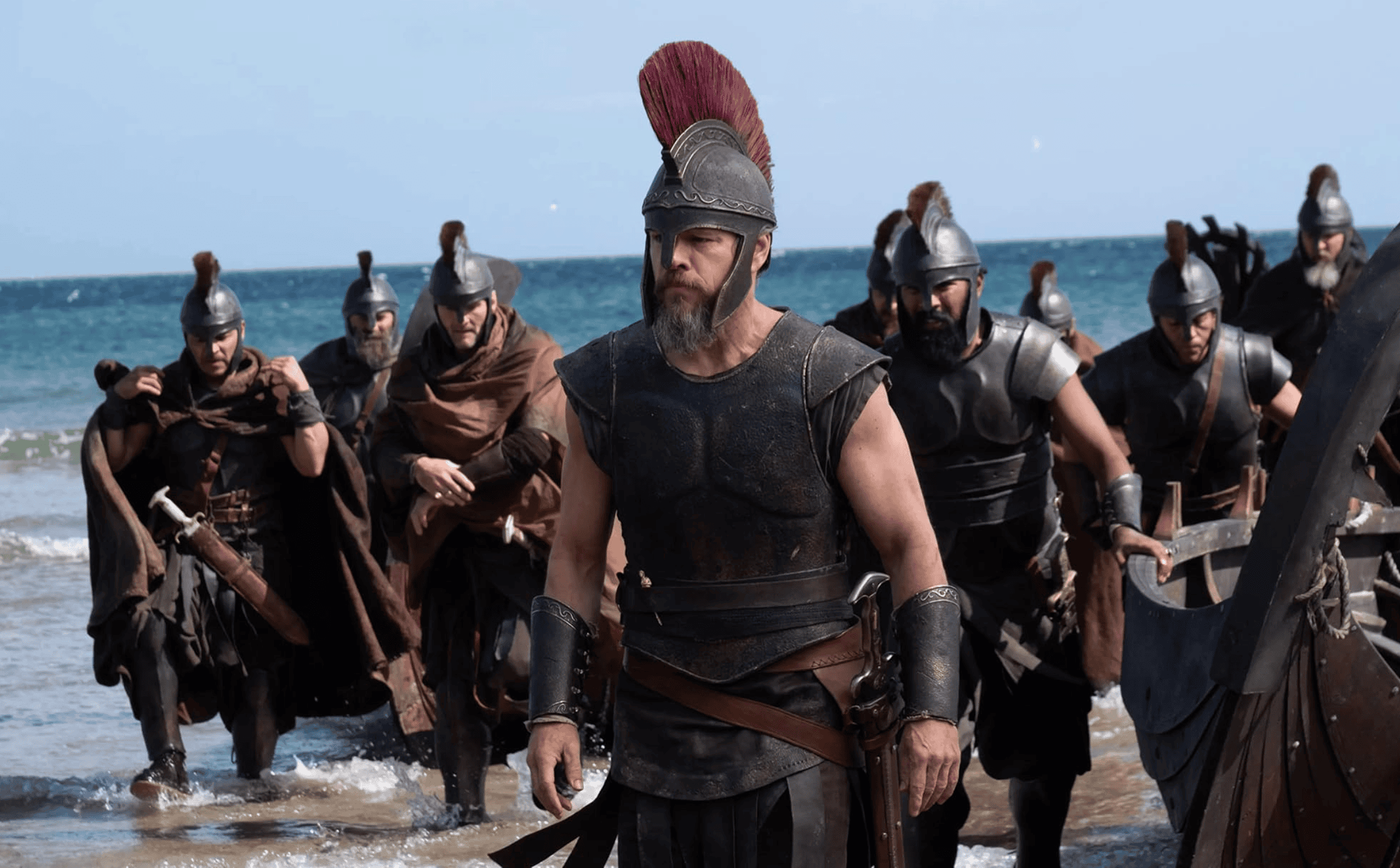 The problem with Christopher Nolan’s The Odyssey is, ironically, that it is too Christian. Despite the hubbub from some online conservatives screaming about how “woke” it is (usually before seeing it), the real deficiency of the movie is that it whitewashes the barbarity of the ancient world. It makes Odysseus seem like a Christian, at least ethically.
Nolan invented a principle, shared by all in his version of the ancient world, he called “Zeus’ law”: treat every person as you’d like to be treated because they might be a god in disguise. It’s an amplification of the real Greek ethic of “xenia”: hospitality to the traveling stranger, for exactly the reason Nolan gives. But it is stretched so far that it practically serves as the Christian Golden Rule. In defiant counterpoint to the reactionary pre-critics calling for a boycott of a movie they hadn’t seen, other Christian and conservative commentators celebrate Nolan’s Christianization of The Odyssey. I don’t.
Nolan’s mistake is not that he discovers virtue in pagan Greece; Homer knew genuine virtue. It is that Nolan collapses Homeric xenia—a reciprocal and divinely policed code of guest-friendship—into universal charity and gives Odysseus the guilt of a Christian conscience. The film thereby allows modern viewers to enjoy Christian moral intuitions while forgetting the faith that formed them.
By portraying Odysseus as governed by a BC Golden Rule foreign to Homeric heroic culture, Nolan subtly suggests that the ancient world was not so different from our own; that the moral order was essentially the same; and thus, by only one more logical step, that Christianity did not make any radical changes but was just the latest religious dress on the same spiritual body. Hence, the viewer could conclude: Jesus made no real difference; He only changed the mythology behind the same ethics. Nothing could be further from the truth.
The Odyssey should be portrayed in all its classical barbarity, not because the original poem is too much a part of our cultural canon to be altered, as Elon Musk has suggested. Nah. Modern artists are free to wield their artistic license on mythology or fiction. Only, they had better improve it. And Nolan may indeed have produced an improved, cinematic version of Homer’s poem. It is beautifully crafted, as Nolan’s films invariably are; the acting is superb, especially Matt Damon’s performance. The moral lessons in Nolan’s film are better than in Homer’s poem. And that’s the problem. Nolan’s world before Christ, which was actually cruel and murderous, is rendered too much like ours.
A better take would have resembled what Mel Gibson did with Apocalypto. He drowned the viewer in the brutality of pre-Christian – in the sense of before being transformed by Christianity – Maya “civilization,” if a culture that cuts the hearts out of living human beings for its cult can be called a “civilization.” Then, at the conclusion, we see a Spanish shore party, rowing toward land, with a cross hoisted, a picture of whence came our true civilization.
Nolan Christianized The Odyssey and, in so doing, improved it as a moral piece of art but confused the viewer about where our morality came from. We Westerners need to face the fact that before Christ, our “civilization” was not head and shoulders better than the Maya. Even The Odyssey shows we were making human sacrifices too, though perhaps not on the scale of the Maya. Western culture, BC, is not really great and certainly not good. Sure, we had some brilliant philosophers and artists — Socrates, Plato, Aristotle, Virgil and Horace — Olympic Games, scientists who reasoned that the earth was spherical and calculated its circumference with remarkable accuracy, and some steps toward democracy and republican government. We had some impressive accomplishments. But absent Christianity, our culture was savage and debased. A side-by-side comparison of pre-Christian Western civilization and traditional Chinese civilization, with China’s inventions of printing centuries before Gutenberg, gunpowder, paper, and the compass, and its philosophers like Confucius, would put China on top. China’s counterpart to the Odyssey, Journey to the West, featuring the Monkey King Sun Wukong, is arguably more entertaining than The Odyssey’s stuffiness. The West, minus Christ, is not best. Christianity was the decisive force that civilized the West. It restrained its cruelty, gave moral purpose to its venturesome spirit, disciplined its peoples, and helped form a civilization that was not merely powerful but, at its best, good—something the aspirations of Aristotle or Marcus Aurelius could not accomplish by themselves.
The problem with Nolan’s movie is that he makes it harder to see that. Unwary viewers will think the morality they take for granted can be taken for granted; that it is just innate to society. Sure, Romans 2:14–15 tells us that people have some of God’s law written on their hearts. But we’re not talking about individuals but cultures. A good culture, as the name implies, cultivates that law and grows moral people and nations. Before Christ, there were moral individuals aplenty. But there were no truly moral cultures, including ancient Greece. Forgetting that fact is one step to losing it. This brings us to Nolan’s casting of a woman, Elliot (formerly Ellen) Page, who thinks she is a man, to play a Greek soldier. It’s a small role, but it mars the film. She appears like a somewhat effeminate teenage boy. Was Nolan trying to send a transgender message? Probably not. Most likely, he was echoing the moral universe of Hollywood in which he is immersed, one where transgenderism is celebrated as the new civil rights movement. So, wanting to be loyal to actors with whom he had previously worked, Nolan stuck Page in where he thought she would make sense: as a he.
As the Christian influence fades from our culture, beginning first among the elite in academia and the arts, like Nolan, they lose the moral sense of why mutilating oneself to try the impossible leap of crossing sexes, as Page has done, is wrong and shouldn’t be celebrated or even accepted. Nolan should know what happens when the Christian ethic is gone. What happens? We get a world much like the one he sanitized for his version of The Odyssey.
__________
The featured image is courtesy of IMDb.

No comments:
Post a Comment
Comments are subject to deletion if they are not germane. I have no problem with a bit of colourful language, but blasphemy or depraved profanity will not be allowed. Attacks on the Catholic Faith will not be tolerated. Comments will be deleted that are republican (Yanks! Note the lower case 'r'!), attacks on the legitimacy of Pope Leo XIV as the Vicar of Christ, the legitimacy of the House of Windsor or of the claims of the Elder Line of the House of France, or attacks on the legitimacy of any of the currently ruling Houses of Europe.