"Dr James, who has a PhD on Shakespeare’s dramaturgy ... describes the film, which was released earlier this year, as “a parody of Shakespearean academia”."
From The Imaginative Conservative
By Joseph Pearce
Shakespeare is certainly more alive, in the enduring life that he breathed into his work, than the dead and dying ideas of his critics. It is, therefore, a delightfully apt conceit on Dr. David A. James’ part to bring him to life to sit in jocular judgment.
Joseph Pearce in Conversation with Film-Maker, David A. James
 Shakespeare abuse is rampant. All too often, the Bard is abused by the propagandists of modern ideologies and the proponents of postmodern fads. He is subjected to feminist fulmination, queer theory, postmodern madness, decadent deconstruction, Marxist dogma and post-colonial apoplexy. Now, however, thanks to a new film, The Bard Bites Back, Shakespeare gets to answer his critics in his own voice and with his own ghostly presence. After four centuries turning in his grave at the abusive misreading of his work, he is seen returning from the grave to point an accusing finger at his critics.
The intrepid producer of The Bard Bites Back, David A. James, has resurrected the Bard of Avon to exorcise the demons that possess the realm of Shakespeare studies and Shakespeare criticism. The exorcism is an excoriation in which various schools of criticism are satirized with devastating effect through hilarious affectation. Shakespeare’s ghost, played with aplomb by John Flaus, looks on with consternation and contempt as an array of “scholars” and “experts” are lampooned through the caricaturing of their own absurd arguments. This is laugh-out-loud satire, which is almost Pythonesque in its use of reductio ad absurdum at the service of ridicule.
Dr. James, who has a PhD on Shakespeare’s dramaturgy from Monash University in Melbourne, Australia, describes The Bard Bites Back , which was released earlier this year, as “a parody of Shakespearean academia”. “It has done well in festivals,” he adds, “with sixteen nominations and four wins, so people got the joke.”
Another facet of the film is the setting of many of Shakespeare’s lines to music by Dr. James, who is also a musician. Explaining that he had “always been thrilled by Shakespeare’s musicality”, he continues:
“This project began as a musical idea. I am a jazz musician and had spent years poring over Shakespeare’s texts and noticed something. The techniques of emphasis and pacing used for playing melody in jazz are the same as the techniques used in performing Shakespeare.
“I set out to write music that actually matched the beauties of Shakespeare’s language, rather than something imposed, and to explore the interplay between improvisers and actors. I have recorded two CDs but found that the jazz world was not terribly interested. So I decided to write a play, which has been performed, but that, too, was difficult to take further. Then I realised that I could make a film. I had the music, with videos, and I had the actors. That is how it came into being.”
As for the satirical dimension, Dr. James had become acquainted with many of the big debates in academic circles during his work on the doctorate, describing some of them as “extremely entertaining”. Having a background in writing satire, he wrote a script “that poked a little fun at some of the follies, which I am sure Shakespeare would have loved”.
The next stroke of genius was to resurrect the Bard so that he could enjoy the joke at his critics’ expense. “I often wonder how Shakespeare would have reacted to his post-mortem fame,” Dr. James explains. “My guess is that the world flooded into Shakespeare to such an extent that he joyed in life itself, in Being. Which is what the film is trying to say and why Shakespeare continually talks about breath, the act of being alive.”
Shakespeare is certainly more alive, in the enduring life that he breathed into his work, than the dead and dying ideas of his critics. It is, therefore, a delightfully apt conceit on Dr. James’ part to bring him to life to sit in jocular judgment.
Those who have enjoyed The Bard Bites Back will be pleased to know that Dr. James hopes to expand the project beyond its current length of sixty minutes. He is pondering extending it to feature length or perhaps to turn it into a two-part series. He has more music already recorded and likes the idea of introducing other ghosts such as Shakespeare’s wife, Anne Hathaway. He’s currently on the hunt for famous actors who love Shakespeare to take leading roles in the project’s further development.
Having admired The Bard Bites Back immensely, I feel a little guilty to say anything less than positive about it. Nonetheless, I do have a couple of quibbles.
The depiction of Shakespeare’s marriage as being unhappy is certainly conventional but it is not borne out by the actual factual evidence from the documentary record of his life. I outlined this documentary evidence in “Shakespeare: Saint or Sinner?”
I also winced a little at the way that Dr. James presents Shakespeare’s famous Sonnet 129: “Th’expense of spirit in a waste of shame/Is lust in action.” Placing the words of this evocative condemnation of lust and its illusions and consequences on the seductive lips of the mythical “Dark Lady”, to whom many critics believe the words were written, is dramatically engaging; it is, however, a blurring of Shakespeare’s very clear exposition of the sin in question. Had these lines been spoken by the actor playing the Bard, their meaning would have been unequivocal. Spoken alluringly and suggestively by the woman whom many believe to be the object of Shakespeare’s lust turns the lines from an evoking of lust to a provoking of it. As for the Dark Lady herself, whom Dr. James brings to life as if she were part of the Bard’s biographical confession, she is possibly nothing but a literary device, like Petrarch’s Laura, a figment of the Bard’s lucid imagination. Presuming that she is a physical fact when she’s possibly merely a metaphysical conceit is to raise an imaginary phantom, not a real life ghost.
The foregoing being said and all such quibbles being set aside, The Bard Bites Back should be celebrated for bringing the ghost of Shakespeare back to dramatic life. As with the “honest ghost” of Hamlet’s father, Shakespeare’s noble spirit returns to expose a crime, the something rotten in the state of Shakespeare scholarship, turning the travesty and tragedy that the critics have made into a comedy of their errors.
__________
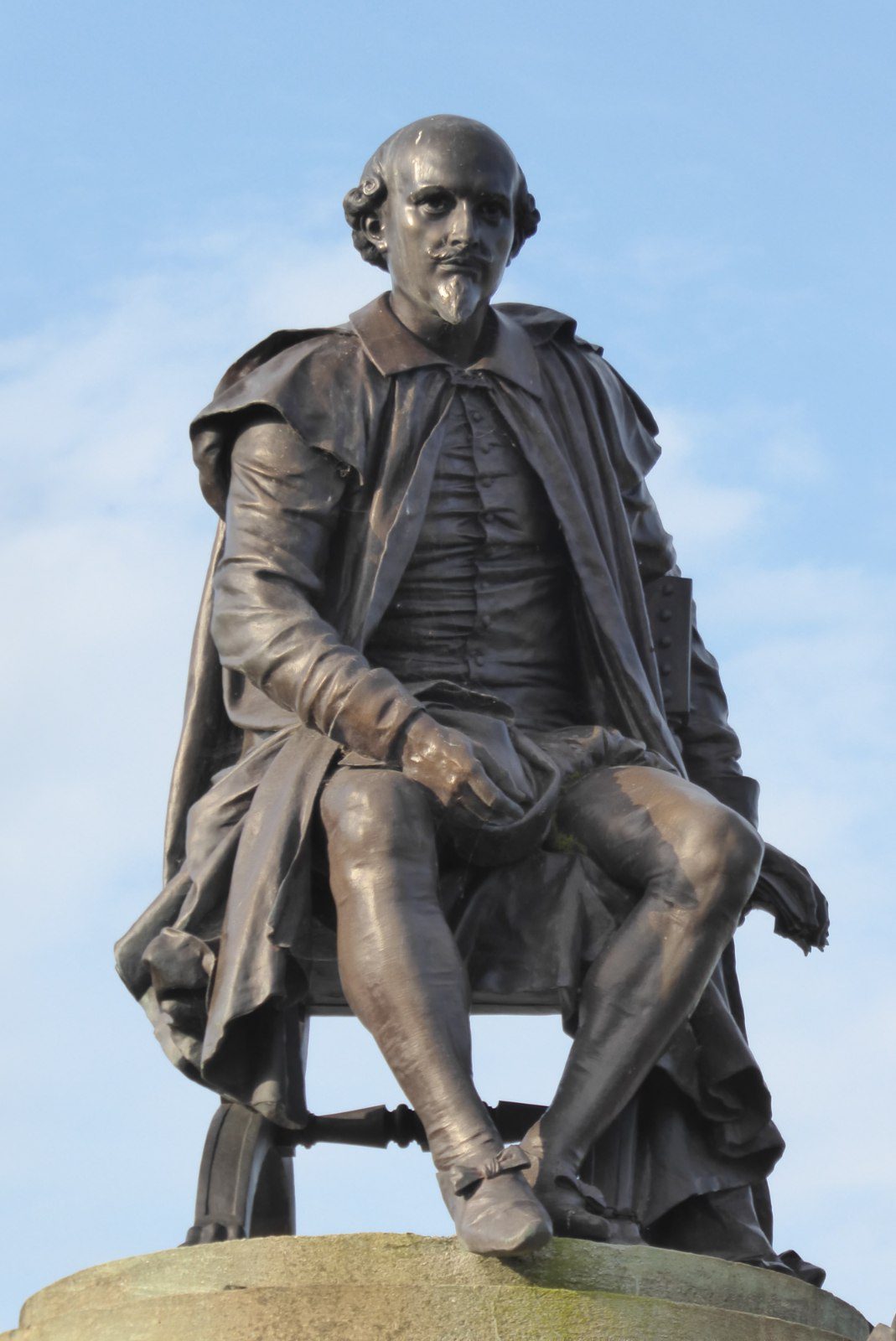
The featured image, uploaded by Philip Halling, is a photograph of the statue of William Shakespeare, in Stratford-upon-Avon. This file is licensed under the Creative Commons Attribution-Share Alike 2.0 Generic license, courtesy of Wikimedia Commons.

No comments:
Post a Comment
Comments are subject to deletion if they are not germane. I have no problem with a bit of colourful language, but blasphemy or depraved profanity will not be allowed. Attacks on the Catholic Faith will not be tolerated. Comments will be deleted that are republican (Yanks! Note the lower case 'r'!), attacks on the legitimacy of Pope Leo XIV as the Vicar of Christ, the legitimacy of the House of Windsor or of the claims of the Elder Line of the House of France, or attacks on the legitimacy of any of the currently ruling Houses of Europe.