As usual, the good Bishop speaks out in defence of the Truth.
LINK TO FULL INTERVIEW https://youtu.be/LT0FGB24l8M
As usual, the good Bishop speaks out in defence of the Truth.
LINK TO FULL INTERVIEW https://youtu.be/LT0FGB24l8M
'[T]wo-thirds of all Catholic schools in the Archdiocese have been closed forever — and 95% of those closures have occurred since Vatican II.'
From One Peter Five
By John A. Litwinski
The Second Vatican Council of the 1960s occurred at a time of great optimism and strength in the American Church. It is a bitter irony, therefore, that a Council that intended to revitalize the Church has instead overseen a massive decline in Chicago and elsewhere. News reports of church closings rarely provide a full picture of just how fully Catholicism has collapsed in what was once called the “Catholic City.” Nonetheless, the Archdiocese of Chicago’s website provides a list of all Catholic institutions that have been closed in the past century and half.
Only 20 Chicago Catholic schools were closed in the 100 years prior to Vatican II, but 390 schools have eliminated since 1965, with just 200 remaining. In other words, two thirds of all Catholic schools in the Archdiocese have been closed forever — and 95% of those closures have occurred since Vatican II.
The number of parish closings is equally sobering. Over one third of all Catholic parishes in the Archdiocese have been permanently shut down. The Archdiocese only closed 16 parishes in the century prior to Vatican II, but has shut down over 130 since then. Only about 290 churches remain open to serve a Catholic population of 2.2 million.
Demographic changes do not really explain the overall decline. While the city of Chicago has lost population since the 1950s, the total area covered by the Chicago Archdiocese (Cook and Lake counties) has increased in population. In fact, demographic changes in the past few decades should have favored a renewal of Catholicism, since Chicago’s Hispanic community has grown to around 30% of the city’s population, and there has been significant Catholic immigration from countries like the Philippines, Vietnam, and Poland. Yet the closures continue apace.
There is no doubt that Chicago is a microcosm of what has happened in the rest of Catholic America: since 1970, weekly church attendance among Catholics has dropped from 55% to around 20%; the number of priests has declined from 59,000 to about 35,000; and the number of nuns has plummeted from 160,000 to 41,000. The number of Catholics who have left the faith is even more staggering: it has increased 15-fold, from under 2 million in 1975 to around 30 million today.
If the next 50 years look anything like the last 50 years, there will no Catholic schools left in Chicago, and most of the churches open today will be closed. There will be almost no nuns and very few priests, since only 25 percent of current Chicago priests are under age 50. Catholicism in Chicago will be small, esoteric, and irrelevant to the broader world.
Yet there is a wrinkle in this history that challenges the narrative of inexorable decline. That countercurrent is the remarkable growth of traditional Catholicism in the past few decades.
In retrospect, one of the most pivotal years in the history of the Chicago Archdiocese was 1988. That year, Fr. Frank Phillips, C.R. became pastor at St. John Cantius Church. Throughout the 1980s, Cantius had been a typical dying urban church, sometimes drawing as few as 40 parishioners to Sunday mass. At the urging of Fr. Phillips, the Archdiocese chose Cantius as the site for the renewed celebration of the Traditional Latin Mass.
By any measure, Cantius has been incredibly effective at transmitting and propagating the faith. It is thereby achieving the main goal of the Second Vatican Council, as stated by Popes John XXIII, Paul VI, and John Paul II: “that the sacred deposit of Christian doctrine be guarded and taught more effectively.”
But 1988 was a much darker inflection point for other Catholic churches in Chicago. Since 1988, approximately 100 parishes have been closed in the Archdiocese. That is a remarkable collapse. Those 100 churches represent two thirds of all the churches that have ever closed in the history of the Archdiocese, dating back to the 1800s.
That is why so many are alarmed by Cardinal Cupich’s recent restrictions on the Traditional Latin Mass, which particularly affect Cantius. Our loyalty to the Cardinal and Pope is inherent, but hard questions remain. It feels like a return to 1988, and the risk of losing everything that has been built since then. The “renewed” liturgy of Vatican II, implemented at Cantius in the 1970s and 80s, already took the parish to the edge of destruction once, as it did so many other churches.[1] What reason, except irrational hope, do we have to think things will end better the second time?
There is a famous saying in American law: “the Constitution is not a suicide pact.” It means the Constitution cannot be interpreted in a way that would allow our society or government to collapse. Coincidentally, this saying arose in a 1949 case involving a Catholic priest charged for inciting a riot in Chicago.
We cannot interpret Vatican II in a way the results in the extinction, or near-extinction, of the Catholic Church in Chicago or elsewhere. Ultimately we must assess the liturgical reform by the extent to which it achieves the overarching goal of the Council: whether, in reality, the faith is being safeguarded and transmitted effectively. To quote Justice Robert Jackson, we must “temper [our] doctrinaire logic with a little practical wisdom”— lest we, in the name of the Council, destroy everything the Council hoped to accomplish.
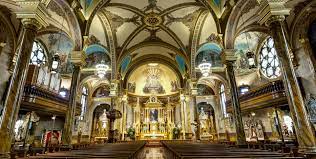
Photo: St. John Cantius nave.
—
[1] The modern Novus Ordo Mass has been regularly celebrated at Cantius since 1988, but in a much more traditional style than seen at other Chicago parishes

SYLLABUS OF PIUS IX. A series of eighty condemned propositions listing the prevalent errors that aimed at the undermining of society, morality, and religion. Every Catholic is expected to give exterior and interior assent to the condemnation of errors expressed in this syllabus.


We must always remember that Our Lord only promised that the gates of hell shall not prevail, not that the Church would not suffer persecution. Remember, too, that St Jerome said, “The whole world groaned and was amazed to find itself Arian.”
From One Peter Five
By R. Thornton

Editor’s note: as a follow up to “It’s Time to Occupy the Churches” and “Catholic Fathers: a Call to Arms,” we present this excerpt from R. Thornton, St. Ambrose: His Life, Times, and Teachings (1897), (public domain). Right now we are attacked by Marxist governments from without the Church and heretics from within. Yet Christ will vindicate us and convert our enemies: I will not fear thousands of the people surrounding me: arise, O Lord; save me, O my God (Ps. iii. 7). Let us obey the command of the Blessed Apostle: brethren, stand fast: and hold the traditions, which you have learned, whether by word or by our epistle (II Thess. ii. 14). We all must fight for our inheritance and for our children. To the heretics who hate the Latin Mass and would take our churches away, let us say what St. Ambrose says below: “The Lord forbid it me that I should give the inheritance of my fathers unto thee.” We will never stop. And we will prevail by God, or die trying.
[Empress] Justina, who had by this time forgotten, or learnt to undervalue, the loyal services of Ambrose when [Emperor] Maximus was threatening captivity and ruin, began again to display openly her enmity to him and his faith. She demanded that one of the churches in Milan should be surrendered for the use of the Arians. To grant this would have been not to make a charitable concession to the weakness of well-meaning and ignorant brethren, but to give up the authority of the great Council of Nicaea, and of that second Council at Constantinople which had reaffirmed its decisions. It would have been to allow by implication that the point at issue between Arius and Athanasius was of trifling importance, and not of the essence of Christianity. To yield up to the teachers of a half-Christian half-philosophical religionism the buildings so lately won for the preachers of Evangelical truth would have been not a laudable charity, but a culpable indiscretion, if not a surrender of a sacred trust. …Ambrose felt, and all the Catholics felt with him, that the demand must be resisted to the death.
…It was now the fifth week in Lent, 385, and it seems to have been the object of the empress to make Easter a day of triumph over the Catholics. A definite demand was made on her part, in the name of her son the emperor, for the Portian basilica, or church, outside the city walls (now called by the name of St. Victor). …The demand was made by officers of state, purporting to act for the emperor; but Ambrose replied that God’s priest could not surrender God’s temple.
On Palm Sunday the bishop had completed the earlier duties in the “old” church, and was proceeding with the Communion service, when news was brought that the Portian church had been seized, and that the state curtains, surrounding the place of honor occupied by the imperial family, had been placed there as a sign of its being in the possession of Justina; that the people were flocking to the place, and had laid hold of Castulus, an Arian presbyter, to whom they were not unlikely to do violence. Much shocked at this, he interrupted the sacred office by sending some clergy to rescue the man, and by a private prayer that no blood—save his own, if that were needful—might be shed.
Severe punishments, both by way of fine and imprisonment, were inflicted on a number of wealthy tradesmen who had taken part in the tumult, or were accused of so doing. They all professed themselves ready to suffer twice as much for their Church. The people about the court were enjoined not to appear in public, and such threats were used that a terrible persecution seemed near at hand. Again Ambrose was asked to surrender the church : again he refused. “It is not mine to give—all that is mine belongs to the poor. It is not the emperor’s, for it belongs to God.”
Troops were sent under arms to occupy the church; and it seems as if from the first the fidelity of the orthodox soldiers to their heretical mistress was more than suspected, since a contingent of Goths, who were Arians, formed part of the detachment. Ambrose passed the whole of one day, apparently Tuesday in Holy Week, in the church, dreading lest blood should be shed, so strong was the feeling of the people. At night he went home to rest, but returned to his post on the Wednesday before sunrise. He found the church surrounded with soldiers, but their behavior was quiet, and many of them made no secret of their attachment to him and the Catholic cause. The service of the day had commenced, when he learnt that another church, the “new basilica,” was filled with people, who implored him to come to them. He remained, however, where he was, and preached.
The lessons of the day were from the Book of Job, and he took occasion to speak of the Christian virtues of faith and patience, commending the people for their gentleness, so like that of Job, and their faithful reply to the imperial menaces and censures: “We do not fight, your Majesty, and we do not fear, we only make our prayer.” Then he showed how the trials that beset Job had been permitted to come upon him their pastor; the tempter had endeavored to rob him of his spiritual heritage and his spiritual children. .…
That night was passed in the church, for egress was prevented by the soldiers. Like St. Paul in prison, the brethren spent their time in reciting psalms and hymns. Next morning (Maundy Thursday) Ambrose preached on the effects of penitence, from the book of Jonah, which was read in the lessons for the day. He had scarcely concluded when the welcome news came that the soldiers were withdrawn from the churches, and the sentences passed a few days before remitted. The people, soldiers and civilians alike, testified their joy in the most lively manner. At least that Easter was to be spent in peace, though Ambrose foresaw troubles yet to come. One of the ushers of the court, Calligonus, sent him an insolent message, threatening to cut off his head for opposing the emperor. Ambrose’s reply shows how little he cared for these and similar menaces: he considered them, Theodoret says, as mere bugbears to frighten children with: “I hope you may be able to carry out your threat. I will suffer like a bishop, and you may act the part of an usher.”
He was right in supposing that the question was not yet settled. The apparent triumph of the orthodox only incensed Justina the more, just as their victory at Sirmium had done five years before. In 386 she extorted from Valentinian an edict to the effect that the Arians should be legally recognised, and, as a necessary consequence, be permitted to occupy some at least of the churches; and that it should be a capital offence to presume to oppose them, either publicly, or by presenting petitions against them. The prime mover in this matter, and no doubt the chief adviser of Justina, was a man of indifferent character and savage disposition, a Scythian by birth, named Auxentius. He was recognised by the Arians of Milan as their bishop, but for convenience, and to avoid unpopularity with the Catholics, had ceased to call himself Auxentius, since that name brought with it the recollection of the Arian predecessor of Ambrose, and adopted the name Mercurinus. The usual instructions for drawing out the edict were placed in the hands of the chief secretary, Benevolus, who, though not yet baptized, was an orthodox catechumen. He expressed unwillingness to prepare such a document, and was forthwith deprived of his office, and compelled to retire from Milan to Brescia, while a more accommodating minister was put into his place.
The empress and her adviser also induced the young emperor to send Dalmatius, one of his officers, to Ambrose, desiring him either to quit the city, or consent to meet Auxentius and dispute with him in the imperial consistory before a certain number of arbitrators or jurymen (judices) to be chosen by the two disputants. He declined to accept either alternative, and on being termed “contumacious” by Dalmatius, addressed a respectful, but firm and dignified, remonstrance to the emperor himself.
Could I be sure that my church would not be handed over to the Arians, I would gladly place myself at the disposal of your Piety; but if I alone am in your way, how is it that not my church only, but all others, are threatened with aggression?
Such was the spirited reply which Valentinian, or rather Justina, received to the demand conveyed to the intrepid bishop. Meanwhile, precautions had been taken by the Catholics to prevent the occupation of any of the sacred buildings by the Arians without the employment of force. By the direction of their pastors the people assembled in the churches, and remained in them all day and all night, relieving one another, of course, in turn, and passing the time in the recitation of psalms and the singing of hymns. Some of the latter were from the pen of Ambrose himself, and were objected to [by the Arians] as “deceiving” the people, they spoke so distinctly of the ever-blessed Trinity in Unity. We may presume the well-known “Eterna Christi munera” with its bold ring and its distinct Trinitarian doctrine, to have been one of them [Editor’s note: see Ambrosian Hymns here].
The mode adopted in reciting the Psalms was that which we term antiphonal, or alternating from side to side. This mode was copied from the practice of the Eastern Church. It was the fashion among the Jews; we find a trace of responsory chanting in Exod. XV. 21,— “Miriam answered them,” where the original language shows that “them” (masculine) refers to the men who had just uttered their choral song; and in 1 Sam. XVIII. 7, the women “answered” one another as the played; and we gather from Ezra III. 11, and Nehem. XII. 40, that it became the settled order in the second Temple. The Eastern Christians no doubt learnt this mode of reciting the Psalter from the Jewish ritual, and Ambrose, as prelate of a Church which seems to have had closer connection with Greece than other Western churches, very naturally at this conjuncture adopted the Oriental use, which continued in after-times to be that of the Church of Milan. The Milanese ritual still retains some of its original peculiarities: the general practice of antiphonal chanting has spread from northern Italy over the whole of the West.
Ambrose not only taught his flock at this time to chant the Psalms, but also instructed them from the Psalter. It is most probable that his remarks on the CXIXth Psalm were sermons delivered during this period of trouble.
The occupants of the churches, though not actually imprisoned within them, were kept in some sort of restraint by a cordon of armed men thrown round each building; and some alarm having been caused by a rumor or a fancy that these guards were likely to proceed to violence, and still more by the report that their bishop was about to comply with the Imperial request, and leave the city (an attempt to arrest him they had already defeated by a demonstration of force), Ambrose took occasion at once to calm their anxiety and to exhort them to firmness by a sermon which he addressed to them on a day, probably Palm-Sunday, when one of the New Testament lessons told of our Lord’s entry into Jerusalem, and one of those from the Old Testament was the very appropriate passage containing the account of Ahab’s dealing with Naboth of Jezreel.
I am not intending to desert you. It is my custom to show all due deference to a secular emperor, but, in such a case as the present, not to surrender. I fear neither threats nor sufferings; they are but temptations from the Evil One; and the Lord, who ‘hath need’ of us, as He had of the creature we have just read of in the lesson, will help us not to give way. Remember how Elisha’s servant, when his eyes were opened, saw the troops of angels round himself and his master; remember how the angel was sent to St. Peter in the prison. But our lot may be to suffer.
And here the preacher adds that apocryphal story of St. Peter’s last hours at Rome, so familiar to us from the striking picture of Caracci.
 |
| Christ appearing to Saint Peter on the Appian Way by Annibale Carracci (1560-1609) |
After his triumph over Simon Magus, Peter excited the jealousy of the heathen by his preaching, and was entreated by the Christians to withdraw from the city for a time, lest he should be seized and taken from them. He left Rome accordingly by night. Scarcely had he emerged from the city gate when he saw the Lord coming to meet him. Astonished, he asked, as he had once asked before, ‘Lord, whither goest Thou’ (Domine, quo vadis?) ‘I am coming,’ said the Divine Master, ‘to be crucified again.’ Peter knew that Christ could not suffer again, for in that He died, He died unto sin once, but in that He liveth, He liveth unto God. He felt that the second crucifixion must be not in His Own Person, but in the person of His servant, and forthwith returned to Rome, to glorify the Lord Jesus by his own death on the cross.
So too, it may be, the Lord requires us to suffer with Him. Come what may, our answer to the demand of Auxentius will be that of Naboth in our lesson today, ‘The Lord forbid it me that I should give the inheritance of my fathers unto thee,’ the inheritance of Dionysius, Eustorgius, Myrocles, and all the confessors and martyrs who have preceded me here. How well, too, the other lesson of today suits us in our present condition! The Jews, we read, would have bid the Lord silence the children who were uttering His praises; and He would not, but went on, and cast the worldly out of the House of God. So when we utter the praises of Christ, our heretical opponents are wroth, and threaten us with pains and death: worse than the Gadarenes who could not bear the presence of Christ, these men are furious even against His praises.
But Auxentius and his crew, who would drive out the faithful with the sword, shall feel, not the sword indeed, but the scourge of the Lord. You, brethren, know the truth that Christ is God, and will maintain it against the vile synod of Ariminum that pronounced Him a creature, and against the Arians, who are for rendering unto Caesar not the tribute due to him, which we are ready to pay to the full, but the houses of God. A faithful emperor is a son of the Church, but he is not lord over her.
With such unshaken firmness on the part of bishop and people, it is not surprising that the Imperial party perceived themselves to be in a weak minority, and gave way. The Catholics, too, met with support from an unexpected and influential quarter, such as we may imagine they did not care for, and in a form they would be disposed to deprecate. But it probably had a great effect, nevertheless.
The emperor Maximus, the usurping emperor… intimated to Valentinian his strong disapproval of the measures taken against Ambrose, and the manner in which he was being treated, recommending the emperor to follow the example and abide by the faith of his father; and hinted that unless matters in this respect were altered for the better, he himself might find it necessary to march upon Milan.
As we might expect, the persecution of the orthodox, and of Ambrose in particular, came to a sudden termination. The action of Maximus was not entirely disinterested; he wanted a cause of complaint and a pretext for war, and was guided by motives of policy quite as much as by a keen sense of justice; but one conceives a certain respect for him, not merely as having been (whether sincerely or not) a champion of the true faith, but as having been able to see the greatness of Ambrose’s character, and as having had the magnanimity to espouse the cause of one who had so freely pleaded with him and so dauntlessly withstood him.
Boris is honoured only in the Orthodox Churches, with the title 'Equal to the Apostles'.
From The Mad Monarchist (4 August 2013)


The Last Day of the Year
1. The last day of the year has come. It should be a day of reckoning and of resolution. Think of the many benefits which God has conferred on you throughout your life, but especially in the year which is now drawing to a close.




1 May. 31 Aug. 31 Dec.
We have written this Rule, in order that, by observing it in Monasteries, we may shew ourselves to have some degree of goodness of life, and a beginning of holiness. But for him who would hasten to the perfection of religion, there are the teachings of the holy Fathers, the following whereof bringeth a man to the height of perfection. For what page or what word is there in the divinely inspired books of the Old and New Testaments, that is not a most unerring rule for human life? Or what book of the holy Catholic Fathers doth not loudly proclaim how we may by a straight course reach our Creator? Moreover, the Conferences of the Fathers, their Institutes and their Lives, and the Rule of our holy Father Basil - what are these but the instruments whereby well-living and obedient monks attain to virtue? But to us, who are slothful and negligent and of evil lives, they are cause for shame and confusion. Whoever, therefore, thou art that hasteneth to thy heavenly country, fulfil by the help of Christ this least of Rules which we have written for beginners; and then at length thou shalt arrive, under God’s protection, at the lofty summits of doctrine and virtue of which we have spoken above.
