Today is the Feast of St Francis. I need to read more of Dawson if, as Dr Reinhard says, "St Francis runs like a red thread through the tapestry of Dawson’s various writings".
From The Imaginative Conservative
By Ben Reinhard, PhD
St. Francis runs like a red thread through the tapestry of Dawson’s various writings: historical, political, and sociological. What do we learn from all this?
 As a medievalist and a professor at an enthusiastically Franciscan university, it is hard to avoid the nagging sense that I should find something original to say about St. Francis in honor of the 800th anniversary of his death. It is, one might say, simply right and just. Actually drafting such a tribute, however, is another matter entirely. Despite the importance of St. Francis in my own conversion to Catholicism and despite my training and employment, I have never made a careful study of the saint’s life, writings, or Order; any attempt to advance a novel argument would be sniffed out immediately by real experts in the field for a shallow imposture. And yet, for all that and all that, it is hard to escape the fascination of St. Francis, and the tribute seems appropriate.
Happily there is another way of approaching the problem. Those who cannot gaze directly at Brother Sun can still see the shadows he casts and his reflections in pools; those who cannot study St. Francis himself can content themselves with the saint as refracted in the thought of others they have studied carefully. For me, the necessary refraction is provided by the writings of Christopher Dawson—the great medievalist and Catholic historian of the 20th century.[1]
Dawson is not, it should be admitted, ordinarily associated with St. Francis: Augustine, Newman, and even Benedict are his widely acknowledged models. No surviving record indicates that Dawson had any significant association with the friars in his life; none of Dawson’s countless books, essays, and articles has St. Francis as its primary subject.[2] Nevertheless—for those who have eyes to see—St. Francis exerts a nearly pervasive influence in Dawson’s thought. Indeed the saint makes his first appearance in the historian’s first significant essay: 1920’s “The Nature and Destiny of Man.” The essay as a whole strives to offer a comprehensive Catholic anthropology: exploring, as the title suggests, what man is and where he is going. On Dawson’s suggestion, St. Francis concretely reveals both:
Who has not felt that the life which is most truly natural—that is to say, most in harmony with man’s true being—is not the life of the man who lives by sense-instinct, but that of the saint—of St. Francis, for instance—in whom the original innocence and harmony of man with himself and with outward things seem restored?[3]
Dawson’s reasoning here is simple: if we want to truly understand human nature, we should study it at its most gloriously alive; that is, in the life of a saint. And if we want the paradigmatic saint, we should turn to St. Francis.[4]
It may admittedly seem like a stretch to conclude, from this slender evidence alone, that St. Francis holds the key to Dawson’s anthropology: his appearance in the essay is so brief that we may be tempted to view it as a simple throwaway reference, purely fortuitous. In fact, it is the beginning of a pattern that, once seen, cannot be ignored. Whenever Dawson has an especially important point to make, he turns to St. Francis to make it. And so in Dawson’s “Christianity and Sex,” St. Francis becomes the exemplar of Catholicism’s attitude towards sex and marriage, which is “fundamentally humane and friendly to life”; in his politically-focused The Modern Dilemma, St. Francis exposes the fundamental error of contemporary economists, both socialist and capitalist, by demonstrating that the deepest human flourishing has precious little to do with affluence.[5]
Though St. Francis features significantly throughout Dawson’s corpus, he is especially closely tied to three of Dawson’s most important meta-arguments. The first of these—and the one that made Dawson famous—occurs in his 1929 masterpiece Progress & Religion. This volume presents an extended argument against the modern “religion of progress” by way of ancient comparative religion: its central assertion is that, while religion is always a primary driver of cultural change, only Christianity can enable authentic human progress. The scope of Dawson’s survey is vast: from prehistoric shamanism to the twentieth century, and from China to Africa to America. For all this, and with the sole exceptions of divine revelation and the Incarnation itself, it is St. Francis who occupies the central place in the narrative. It is in the saint’s life that we see the Christian religion fully come into its own, breaking down the old walls of division and gathering all into one. In St. Francis nature and grace, matter and spirit, and even (almost) paganism and Christianity attain a perfect harmony. As Dawson has it,
The powers of nature which had been first divinized and worshipped, and then in turn rejected by man as he realized the transcendence of the spiritual, are now brought back into the world of religion, and in his great canticle of the sun, St. Francis once more celebrates the praises of Mother Earth, the bearer of fruit, who keeps and sustains us, Brother Fire, who is “fair and joyous and mighty and strong,” and all the other holy creatures of God. Thus the Franciscan attitude to nature and human life marks a turning point in the religious history of the West.[6]
Dawson’s point is, it must be confessed, strongly reminiscent of Chesterton’s famous biography, published only a few years earlier.[7] But the application of the point is entirely his own: Christianity made authentic human progress possible; St. Francis stands as the decisive inflection point in this history. Given Dawson’s high opinion the Poverello, and his belief that “spiritual integration” is “the true goal of human progress,”[8] it could hardly be otherwise.
Dawson’s “Franciscan” presentation of his second great theme—the rise of humanism—closely follows on the first. This was for Dawson a moment of world-historical importance and one of the great triumphs of the Christian religion. As with sex and money and anthropology before, everything hinges on the person St. Francis. That the saint is both the source and icon of authentic Christian humanism is a point on which Dawson was curiously insistent: this claim recurs, with little variation, throughout his decades-long career. So in “The End of an Age,” we find the true roots of the Renaissance in the “mystical humanism” of Francis; in Religion and the Rise of Western Culture, Francis is the real source of the “vital union” of courtliness and spirituality that inspires later literary developments; in “The Christian View of History,” a Franciscan idealism lies behind “the development of Western humanism.”[9] Nor is Dawson shy about extending his arguments beyond the life and career of Francis himself: insofar as Dante the poet maintains the humane synthesis modeled by St. Francis, he succeeds; Dante the historian and political philosopher fails insofar as he departs from it.[10] The rise of authentic humanism with St. Francis was much more than an important historical point for Dawson, who saw the fall of humanism as one of the precipitating crises of his age. The abandonment of humanism in the 19th century, on Dawson’s view, paved the way for the crisis of the 20th; returning to the Christian humanism tradition inaugurated by Francis was the only possible remedy. One might reasonably argue, with no fear of exaggeration, that Dawson’s entire literary career was dedicated to effecting that return.[11]
The crisis of the 20th century—the fall of traditional liberalism and its replacement first by socialism and fascism, and later by technocratic capitalism—brings us to the very heart of Dawson’s decades-long project and to the final importance of St. Francis in his thought. Anticipating the work of thinkers like Charles Taylor and Iain McGilchrist, Dawson considers the crisis of modernity as the expression of a long struggle between two irreconcilable predispositions: the bourgeois (closed, buffered, left-brain, and controlling) and the erotic (open, porous, right-brain, and receptive). The evils of modernity are laid squarely at the feet of the bourgeois spirit, which divorces “man from nature and from the life of the earth…until ultimately rural life becomes impossible and the very face of nature is changed by the destruction of the countryside and the pollution of the earth and the air and the waters.”[12] The Augustinian Dawson has little difficulty in identifying the bourgeois spirit with the City of Man—and sees, in his own age, the triumph of that city very nearly complete among capitalists and communists alike.
The only remedy, of course, is to be found in the City of God and the cultivation of the opposite spirit: the erotic. And this, naturally enough, returns us to St. Francis: “the erotic type par excellence…is the religious mystic, the ‘man of desire,’ like St. Augustine and St. Francis.”[13] Given the context of the passage and Dawson’s broadly Augustinian vision, it is no surprise to find St. Augustine offered as an example of the erotic type. But even more than the Bishop of Hippo, it is the courtly and chivalric lover of Lady Poverty who shows us the way, and who makes it “obvious that the Christian ethos is essentially antibourgeois, since it is an ethos of love.”[14]
So it is that St. Francis runs like a red thread through the tapestry of Dawson’s various writings: historical, political, and sociological. What do we learn from all this? In the first place, we gain new insights into the thought of one of the twentieth century’s most important Catholic intellectuals. We might venture to say that, if Dawson’s meta-history and social critique is thoroughly Augustinian on the theoretical level, it is St. Francis who mostly perfectly incarnates those theories in history.[15] In one way this is almost unremarkable: Dawson was hardly the first Catholic to make St. Francis, as the exemplary follower of Christ, central to his view of religion, and he would not be the last. But I suggest that St. Francis has rarely served as the lynchpin of such a penetrating and timely critique. And this brings us to a second, more pressing, conclusion we can draw from Dawson’s use of Francis. The crises Dawson identified in modernity—the oppression and displacement of the poor, environmental destruction, and the loss of rooted culture, all in the service of Mammon and the technocratic will to power—have not grown less acute in the half-century since his death. Dawson has suffered the fate of the true prophet: his prophecies came true. Because of this, predictions that were startling in his day have become almost commonplace observations in our own. But we may well wonder: if Dawson diagnosed the ills of modernity with such prescient clarity, might he also have been right about the Franciscan cure?
__________
Notes:
[1] Though most readers of The Imaginative Conservative are probably broadly familiar with Dawson and his work, a brief introduction to Dawson may be helpful for some. Dawson continues to be recognized today as one of the great Catholic historians of the twentieth century, and perhaps the greatest. In his own day, however, his star shined yet brighter. No less an authority than T. S. Eliot praised Dawson as England’s foremost intellectual; when a young Fr. Theodore Hesburgh sought to revivify Notre Dame’s Catholic curriculum, he sought to woo Dawson to campus to guide the process. Though far fewer people read Dawson today than did in the 1940s and 1950s, many millions have been exposed to his thought as it is enshrined in the writings of the authors he influenced: among them, T. S. Eliot, Frank Sheed, David Jones, J. R. R. Tolkien, and C. S. Lewis.
[2] The closest biographical connection to the Franciscans is provided by Dawson’s employment during World War I, when he worked as a teacher at the Franciscan school at Cowley. See Christina Scott, A Historian and his World: A Life of Christopher Dawson, 1889-1970 (Catholic University of America, 2024), 55. Of Dawson’s many books and articles, the only one to engage centrally with Franciscan subjects is his account of the thirteenth-century Franciscan embassies to the Great Khan. See Christopher Dawson, The Mongol Mission (Sheed and Ward, 1955).
[3] Dawson, “The Nature and Destiny of Man,” in Enquiries into Religion and Culture (Catholic University of America, 2009), 281.
[4] That Francis is for Dawson the archetypal saint is repeatedly confirmed by later writings such as The Formation of Christendom (Ignatius, 2008), 303: “The saints are seen as mirrors of the holy, patterns of the perfect Christian life: of this aspect St. Francis is an outstanding example.” See also Medieval Essays (Catholic University of America, 2002), 97-8.
[5] See Dawson, “Christianity and Sex,” in Enquiries into Religion and Culture, 238 and Dawson, The Modern Dilemma, Essays in Order 8 (Sheed and Ward, 1932), 62
[6] Dawson, Progress & Religion: An Historical Enquiry (Catholic University of America, 2001), 135.
[7] See G. K. Chesterton, St. Francis of Assisi (Doubleday, 1946), 51. “The flowers and stars have recovered their first innocence. Fire and water are felt worthy to be the brother and sister of a saint…Neither the universe nor the earth have now any longer the old sinister significance of the world. They await a new reconciliation with man, but they are already capable of being reconciled. Man has stripped from his soul the last rag of nature-worship, and can return to nature.”
[8] Dawson, Progress & Religion, 195.
[9] See Dawson, “The End of an Age,” Criterion IX (1930), 397; Religion and the Rise of Western Culture, 189; “The Christian View of History,” in Dynamics of World History, edited by John J. Mulloy (ISI, 2002). 256. Similar points are made in The Crisis of Western Education (Catholic University of America, 2010), 17, and Progress and Religion, 136.
[10] For Dawson’s account of Dante’s success as a Franciscan poet, “End of an Age,” 397 and “The Origins of the Romantic Tradition,” Criterion XI (1932), 244-7; for his failure anti-Franciscan failure, see “Christian View of History, 255-6.
[11] See Bradley J. Birzer, Sanctifying the World: The Augustinian Life and Mind of Christopher Dawson (Christendom Press, 2007), 230-33.
[12] Dawson, “Catholicism and the Bourgeois Mind,” in Dynamics of World History, 214.
[13] Dawson, “Catholicism and the Bourgeois Mind,” 217.
[14] Dawson, “Catholicism and the Bourgeois Mind,” 217.
[15] A point made, nearly explicitly, in Progress and Religion, 135. See also Dermot Quinn, “Christopher Dawson and the Catholic Idea of History,” in Eternity and Time: Christopher Dawson and the Catholic Idea of History, edited by Stratford Caldecott and John Morrill (T & T Clark, 1997), 81.
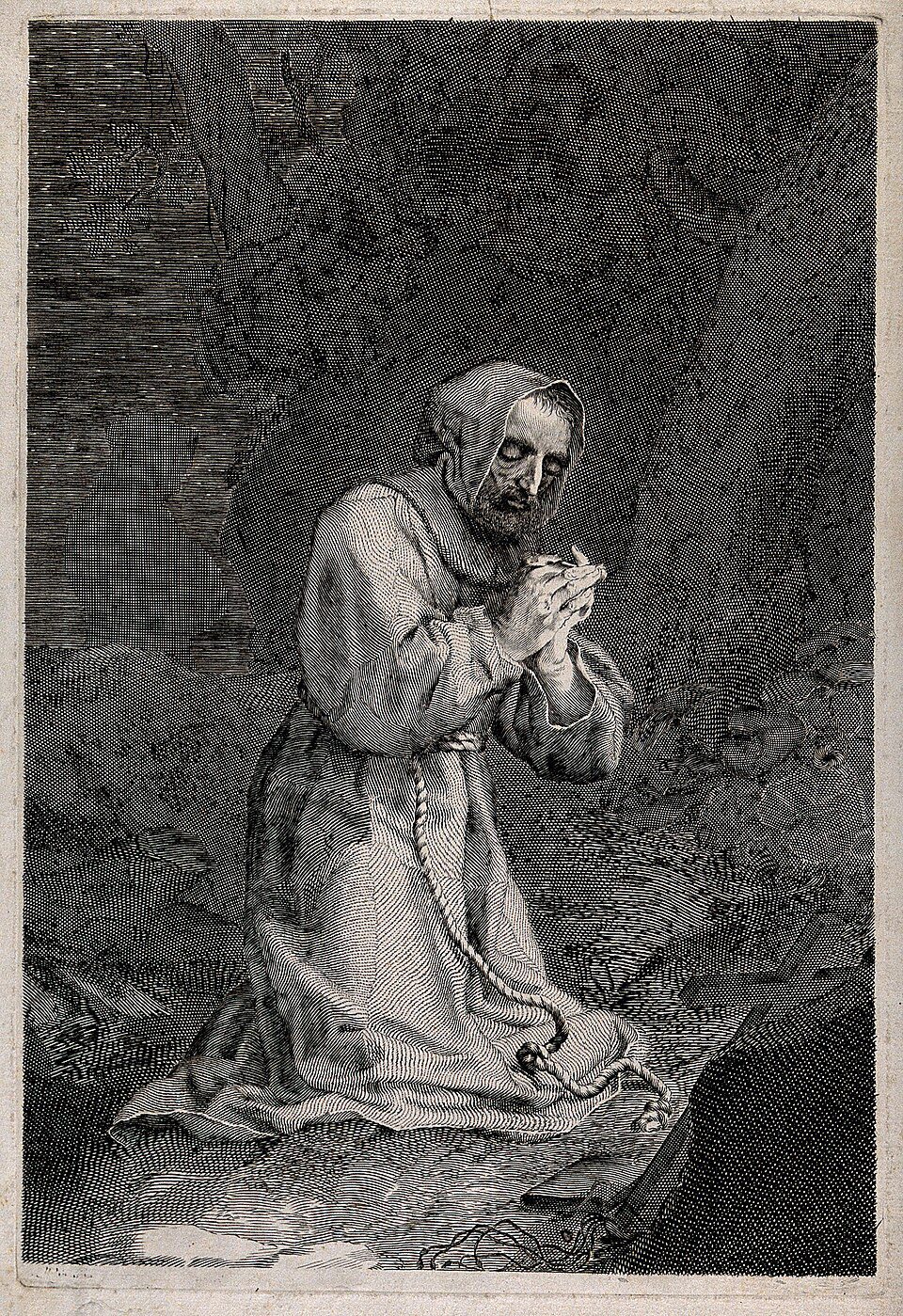
The featured image is “Saint Francis of Assisi in wilderness; kneeling in front of a crucifix.” Engraving attributed to N. Bazin after C. Mellan. Reference: 564027i. Date 1638 This file is in the public domain, courtesy of Wikimedia Commons.

No comments:
Post a Comment
Comments are subject to deletion if they are not germane. I have no problem with a bit of colourful language, but blasphemy or depraved profanity will not be allowed. Attacks on the Catholic Faith will not be tolerated. Comments will be deleted that are republican (Yanks! Note the lower case 'r'!), attacks on the legitimacy of Pope Leo XIV as the Vicar of Christ, the legitimacy of the House of Windsor or of the claims of the Elder Line of the House of France, or attacks on the legitimacy of any of the currently ruling Houses of Europe.