Dr Birzer begins a short series on the ten books that radically reoriented [his] views of the world, books that [he goes] back to time and again.
From The Imaginative Conservative
By Bradley J. Birzer, PhD
Here are the first five of ten books that radically re-oriented my views of the world, books I go back to time and again.
 The other day on X/Twitter (I’m never sure what to call it anymore), a social media friend posted that she was in the middle of reading Owen Barfield’s Poetic Diction (1928). I immediately responded that it was “a top-ten book for me. Utterly shattered my view of the world. I still read it every three or four years.” Much to my surprise, my tweet went semi-viral, garnering more than 20,000 views. Frankly, why something goes viral or not on X is an absolute mystery to me. Naturally, though, I was asked what my other nine were. And, it seemed like a great idea for an essay. So, here are the ten books that radically re-oriented my views of the world, books I go back to time and again. For the sake of a fair assessment, I’ve not listed an author more than once, even though the said author almost certainly influenced me through other books, too. But, I didn’t want a list of merely Cicero or Burke or Tolkien, etc. So, just one mention of each author, even if I include an extra book or two. Additionally, I very intentionally left out the Bible, as it would trump all over entries, especially when I think about how important the Jewish Book of Wisdom and St. John’s writings are to me. So, in alphabetical order, here are my top ten books.
1. C.S. Lewis, That Hideous Strength (and The Abolition of Man). What can I say about this book? I think it’s the finest dystopian novel of the twentieth century. Strangely, it’s often ranked as the weakest of C.S. Lewis’s space trilogy, but I find it the most compelling. I’m currently on my umpteenth reading. No book better understands the various forms and dangers of right and leftwing progressivism than does this book. While I love Brave New World, 1984, and The Handmaid’s Tale, That Hideous Strength bests them all in terms of readability and its grasp of reality, even as a fairy tale for adults. Very intentionally, it’s the novelization of Lewis’s 1943 lectures published as The Abolition of Man. In The Abolition of Man, Lewis brilliantly explains that all ideologies are truths (often important truths) exploded to madness and ripped from their contexts. As such, they become inhumane monstrosities. In That Hideous Strength, by following the Arthurian Ransom and the literally resurrected Merlin, Lewis offers a majestic view not only of what should be, but what could be, and what shouldn’t be, and what never can be. Not just about Arthur and Merlin, the book also deals gorgeously with a young and broken marriage between Mark and Jane. In the end, though, with much divine (pagan as well as Christian) intervention, the world is set aright. At least for the moment.
2. Cicero, On the Laws. Next to Socrates, Cicero is my favorite ancient figure. Like Socrates, and, of course, foreshadowing Jesus, he served as a martyr, specifically, a martyr for Republican Rome. As Russell Kirk would write, “With Cicero, so fell the Republic.” That sums up everything for me as Cicero was the great embodiment of the Republic and all the good for which it stood. On the Laws is a Platonic dialogue, featuring several men talking about the use of Reason—which connects not only man to God but men to men—as the glue that holds together the community of all good men and women across time: the Cosmopolis. As Cicero explains, man is an animal, “provident, perceptive, versatile, sharp, capable of memory, and filled with reason and judgment.” Further, Cicero so wisely notes, the tree planted by the poet—let it be an oak—lasts much longer than the tree planted by the farmer, as it represents reality across time. To be sure, Cicero offers one of the greatest explanations of man, God, reason, and myth ever given in human history.
3. Edmund Burke, Reflections on the Revolution in France. Again, what to say about this classic? As so many other scholars have noted, this is the beginning of all modern conservatism, though it set out to be a defense of law rooted in the community and in tradition, rather than an innovation of the mind and a whim of the soul. Originally delivered as speeches to Parliament opposing the wiles of the French Revolution, Burke provides a full-throated defense of the human person. Each person, according to Burke, not only longs to belong to his little platoon, but he is, critically, outfitted by the wardrobe of the moral imagination. That is, rather than our seeing one another as fallen, shrunken beings, we are outfitted as kings and queens made in the image of God, radiating His glory and His goodness.
4. J.R.R. Tolkien, The Lord of the Rings (and The Silmarillion). I can’t even begin to number how many times I’ve read The Lord of the Rings. Typically, I read it every other year, and I have all of my adult life. I first read it in the summer of 1980 after saving enough money from my lawn-mowing business and riding down to Crossroads Books in Hutchinson, Kansas, to purchase a beautiful boxset that included The Hobbit and The Lord of the Rings. From the opening moments of The Hobbit to the scouring of the Shire in The Return of the King, I was utterly riveted, and I have been ever since. To me, Tolkien did not write a fantasy novel, he wrote a myth, comparable to what Homer, Virgil, and Dante did. In The Lord of the Rings, Tolkien not only deconstructed the horrors of power, but he presented a noble and glorious vision of the human person. The story rewards repeated readings, as there’s simply so much depth to the mythology. I also include here, for the sake of argument, The Silmarillion, which, I believe, is essential to read with The Lord of the Rings. The Silmarillion offers the foundation of Tolkien’s great mythology, a history God, of the gods, of the struggles over creation, and the Elvish-subcreation of the silmarils themselves. Additionally, in The Silmarillion, we learn the critical tale, “Of Beren and Luthien,” a foreshadowing of Aragorn and Arwen in The Lord of the Rings. No coincidentally, Aragorn tells the tale of Beren and Luthien moments before the attack on Weathertop. The tale-telling serves as a form of prayer.
5. Owen Barfield, Poetic Diction. One of the Inklings—members of the group centered around C.S. Lewis and J.R.R. Tolkien between 1931 and 1949—Barfield served as the unofficial philosopher to his friends. Written as his senior thesis at Oxford, Poetic Diction was published in 1928, and it’s never been out of print since. A work of genius, Barfield convincingly argues that the imagination is our highest faculty of knowing. Poetry, loosely defined, is a way in which we see reality for the first time. Take, for example, the airplane. Every law of physics and thermodynamics already existed at the time of Adam and Eve, but it wasn’t until the Wright Brothers that someone understood how to work with those laws and make a plane. The same is true with ideas, language, words, and images. All already exist in nature, but only the poet sees them for the first time. As with the other books listed, I try to read this book every several years, as it makes the imagination real and tangible.
To be continued….
__________
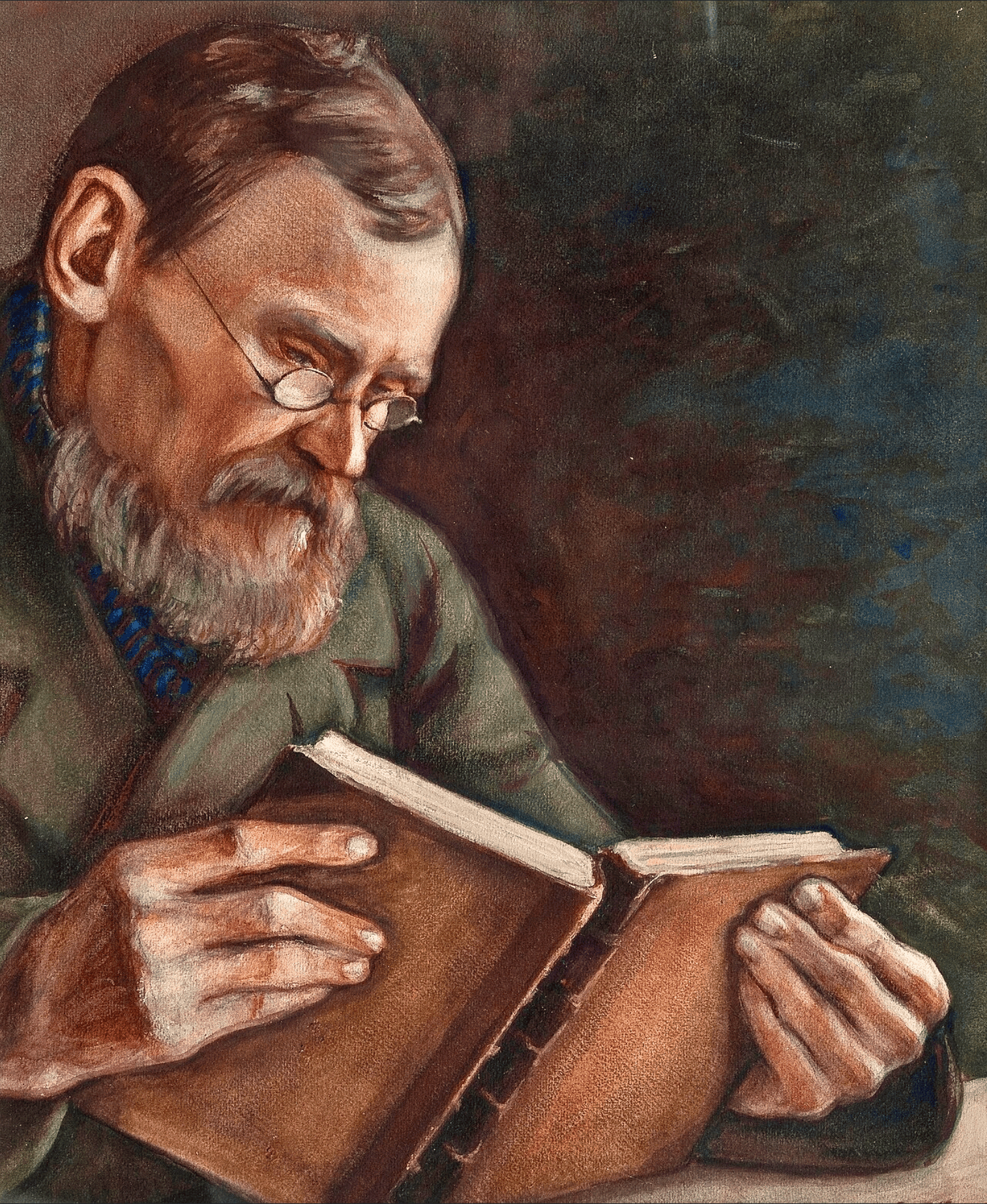
The featured image is “A Man Reading” (1897), by Väinö Hämäläinen, and is in the public domain, courtesy of Wikimedia Commons.

No comments:
Post a Comment
Comments are subject to deletion if they are not germane. I have no problem with a bit of colourful language, but blasphemy or depraved profanity will not be allowed. Attacks on the Catholic Faith will not be tolerated. Comments will be deleted that are republican (Yanks! Note the lower case 'r'!), attacks on the legitimacy of Pope Leo XIV as the Vicar of Christ, the legitimacy of the House of Windsor or of the claims of the Elder Line of the House of France, or attacks on the legitimacy of any of the currently ruling Houses of Europe.