03 April 2018

Distributism Basics-A Series of Articles

Over the next few days I shall be posting a series of articles from a blog called. Practical Distributism on 'Distributism Basics'. Here is the introductory article to the series.

From Practical Distributism


Distributism: an alternate system that subordinates economics and government to ethics and subsidiarity because they exist serve the common good.

Distributism does not advocate government "redistribution" of wealth, which many assume based on the name alone. The name refers to the idea that justice and power in both the economic and political realms should be distributed throughout society.


Distributism, also known as Distributivism, has been around as a named and distinct system for over 100 years, but remains relatively unknown because it is ignored by professional and academic economists. The basic premise of distributism is that society as a whole is better off if the means of production are privately owned by a lot of people who do the work rather than owned by a small percentage of the people. Independent, locally owned small businesses and farms are the bedrock of a strong and stable economy. Large businesses would best benefit the larger community if they were cooperatives. Local, cooperatively owned financial institutions like credit unions serve communities better than large corporate banking institutions. Distributism also advocates the devolution of government authority to the local community over the current trend of increasing the power and scope of centralized government. 


And here is the first article.

Distributism Basics: A Brief Introduction

For those people who have just heard about distributism, whether they are just curious, or doubtful, I would like to present a few articles that run through the basics in simple terms. I'd like to be able to answer some of the claims presented by our detractors, but those answers must be understood by what distributism actually is, rather than what our detractors claim it to be.

Distributism, like capitalism and socialism, is the embodiment of certain views about how economic and political structures should work within a society. It has at times been called the “Third Way” of economics and also a “middle ground” between capitalism and socialism. It is true that distributism is a different way than either capitalism or socialism, but I disagree that it stands in between the two as if it takes parts of both or tries to blend them together. In fact, a better description of the differences would place distributism on one side, and both capitalism and socialism on the other. I hope this series will help you to see how that is.

Part of the confusion that leads people to think distributism somehow tries to negotiate a middle ground between capitalism and socialism is that we make some of the same arguments against both systems. We believe in limited government and the private ownership of property, but we also believe that the government does have a role in assisting society and that the concentration of large amounts of productive property in the hands of a few private owners leads to the the exploitation of the working classes. It is understandable that, without further investigation into how we think these problems should be remedied, people would conclude that we are somewhere in between the capitalist and socialist position. I hope in this series to present a clear, easy to understand, explanation of both where we stand and how our views are very different from both capitalism and socialism.

To begin to understand distributism, we must look at the founding of the movement. In 1891, Laissez Faire capitalism had been the predominant economic model in the West for some time. Laissez Faire is a view that government should not interfere in economics, or the businesses that make the economy work, except as needed to protect property rights and the peace of society. This led to wide masses of people being impoverished by extremely low wage jobs while a few were able to become extremely wealthy. This situation led to such great dissatisfaction in Western societies as a whole, that socialism actually looked good to people. In response to this threat, Pope Leo XIII wrote an encyclical called Rerum Novarum.

Rerum Novarum did not offer a new economic system. It outlined problems with capitalism as it was being practiced, and with the proposals of socialism. It urged that these problems be addressed and presented the principles that should guide how to address them. It should be noted that, while the principles outlined were in keeping with the Gospel message, one should not expect otherwise from a pope, the philosophical view that served as the foundation was not exclusively Christian in nature. (See: Is Distributism Catholic?)

In response to this call to resolve the problems evident in the Laissez Faire capitalism, and hoping to convince people who were considering socialism to consider another alternative, a group of Englishmen, led by G. K. Chesterton and Hilaire Belloc, started the distributist movement. In formulating their ideas, they looked to history to see where the injustices of the prevailing capitalist system crept in, they also looked further to see what was being done to avoid those injustices before then. 

Distributists were not alone in the effort to address the problems of Laissez Faire capitalism. The socialist movement of the time was an effort to do the same. Even within the realm of capitalists, there were those who thought things needed to change. A capitalist economist named John Maynard Keynes sought to address the problems by altering the capitalist system itself. Keynes proposed more government intervention in economic and social matters while leaving the concentration of productive capital in place. To alleviate the impoverished state of the working classes, the government would tax the wealthy to fund programs to support the workers.

In the end, most countries adopted the modified version of capitalism proposed by Keynes and some adopted socialism. I will discuss some specifics about these in subsequent articles. Although the Keynesian system seemed to address the problems of Laissez Faire capitalism, in truth, it only worked by keeping the fundamentally unjust elements of that system in place. This prompted Pope Pius XI to write Quadragesimo Anno in 1931. Quadragesimo Anno was a follow-up to Rerum Novarum in which Pius XI discussed in greater detail why these systems are fundamentally flawed as solutions to the original problems addressed by Leo XIII.

Various forms of capitalism and socialism have been attempted in the last century, and they have all repeatedly failed. Many people are wondering what else can be done. The proposals of the distributists have been disregarded by professional and academic economists, leaving the average citizen unaware that they even existed. Many people are increasingly despairing of the possibility of finding a real solution to our economic and political problems because it seems to them that all of the options have been tried. 

In the last several decades, the involvement of government in economics has expanded exponentially as more and more government programs to support the working classes and the poor have been implemented. The modern Libertarian economists (primarily of the “Austrian school”) are loudly calling for a return to an essentially Laissez Faire model. They claim that we are on the road to all-out socialism. There is some justification to this because certain political and economic leaders seem to be advocating things very close to it.

Is this the moment for the distributist movement? Are the citizens of the Western world fed up with their “expert” economic leaders enough to consider trying a real alternative? Only time will tell.

Other articles in this series:
[These titles have been updated since this article was originally published.]


Chevalier Charles Coulombe on European Monarchy Restoration

The Chevalier discusses what chance there is for restoration of the fallen monarchies of Europe and how they might be achieved.


You Know You Live in Hog Country...

...when you go to the community supper and there are two dishes of scalloped potatoes, one with ham, and one with chunks of toast pork! LOL!

Of course, we have a pork processing plant just a few miles north of us, and most of the farmers in the area raise corn for hog feed. Nebraska's nickname is the 'Beef State' and when I was a lad, in northern Kansas, just twelve miles from the Kansas-Nebraska line, a derogatory term for Nebraskans was 'Beefer'.


It's still true that Nebraska still leads the nation in beef production, but the State is number six in pork production as well. Part of the reason that beef still predominates, of course, is geography. The western portion of Nebraska is high desert grassland, not particularly suited for anything but stock grazing, so it's likely that the Beef State moniker will continue to be well deserved, but the eastern counties, where I live, might adopt the sobriquet 'Pork Country'!

An Amusing Video of Some Funny Moments in the Life of Her Majesty the Queen

My favourite is when her horse wins a race when she is scheduled to present the trophy to the owner! How does one present oneself with a trophy?


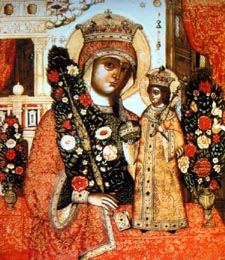
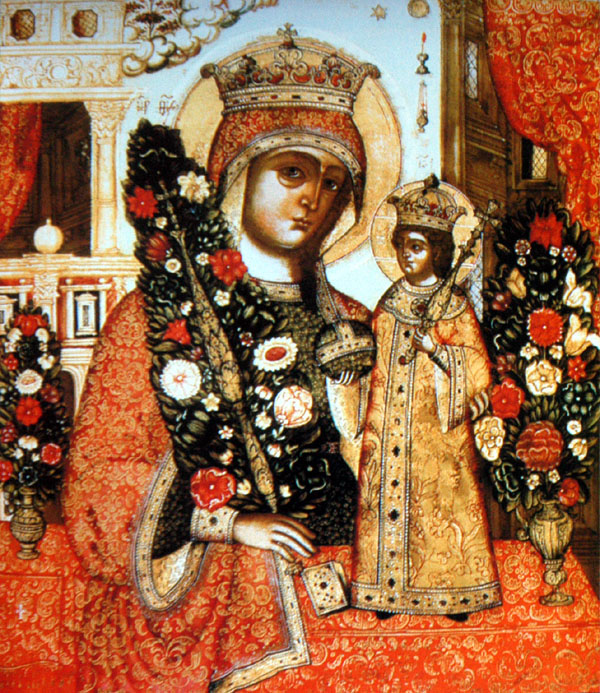
The Feast of the Icon of the Theotokos “the Unfading Bloom”

In the Russian Church, today is the Feast of the Icon of the Theotokos of “the Unfading Bloom”. Here is the article from the Orthodox Church of America on the Feast.

The “Unfading Bloom” Icon of the Most Holy Theotokos. On this icon the Most Holy Theotokos holds Her Divine Son upon Her right arm, and in Her left hand is a bouquet of white lilies. This bouquet symbolically signifies the unfading flower of virginity and spotlessness of the All-Pure Virgin, Whom the Church hymns: “Thou art the Root of virginity and the Unfading Blossom of purity.” Copies of this icon were glorified at Moscow, Voronezh, and other places in Russia.

Some Saints for the Month of April.

Since today is St Richard's Day, mentioned in the Martyrology, I thought I'd post another illustration from My Book of the Church's Year, by Enid M. Chadwick. This was drawn by an extremely Anglo-Catholic Anglican, but it is being used by the Personal Ordinariates. Chadwick was instrumental, along with the Anglican Priest, Hope Patten, in reviving devotion to Our Lady of Walsingham, which I mentioned here on Chevalier Charles Coulombe's video. Needless to say, all of these are Saints in the Catholic Church, but because of the special devotion to them only in England, many of them are not in the General Roman Calendar of 1960, which I use, as do the FSSP, the SSPX, and other Traditional Institutes and Orders.


IN LUMINE FIDEI: 3 APRIL – EASTER TUESDAY

IN LUMINE FIDEI: 3 APRIL – EASTER TUESDAY: Prosper Gueranger: Our Pasch is the Lamb, and we meditated on the mystery yesterday. Now let us attentively consider those words of Sacred...

3 April, A Chesterton Calendar

APRIL 3rd

It is very currently suggested that the modern man is the heir of all the ages, that he has got the good out of these successive human experiments. I know not what to say in answer to this, except to ask the reader to look at the modern man, as I have just looked at the modern man— in the looking-glass. Is it really true that you and I are two starry towers built up of all the most towering visions of the past? Have we really fulfilled all the great historic ideals one after the other, from our naked ancestor who was brave enough to kill a mammoth with a stone knife, through the Greek citizen and the Christian saint to our own grandfather or great-grandfather, who may have been sabred by the Manchester Yeomany or shot in the ’48? Are we still strong enough to spear mammoths, but now tender enough to spare them? Does the cosmos contain any mammoth that we have either speared or spared? When we decline (in a marked manner) to fly the red flag and fire across a barricade like our grandfathers, are we really declining in deference to sociologists— or to soldiers? Have we indeed outstripped the warrior and passed the ascetical saint? I fear we only outstrip the warrior in the sense that we should probably run away from him. And if we have passed the saint, I fear we have passed him without bowing.

‘What’s Wrong with the World.’

Chesterton, G. K.. The G. K. Chesterton Collection [50 Books] (Kindle Locations 43894-43905). Catholic Way Publishing. Kindle Edition.

4 April, The Roman Martyrology

April 4th anno Domini 2018 The 18th Day of Moon were born into the better life: 

At Seville, in Spain, the holy Confessor Isidore, Bishop of that see, famous for his holiness and teaching, who lighted up all Spain by his zeal for the Catholic faith, and by his observance of the discipline of the Church, [in the year 639.] 
At Thessalonica, under the Emperor Maximian and the President Faustinus, the holy martyrs, the Deacon Agathopodes, and the Reader Theodulos, who were drowned in the sea with stones tied round their necks, because of their confession of the Christian faith. 
At Milan, the burial of the holy Confessor Ambrose, Bishop of that see, by whose labours, teaching, and miracles at the time of the Arian misbelief nearly the whole of Italy was converted to the Catholic faith, [in the year 397.] [We keep his feast upon the 7th day of December, which is that of his ordination as bishop.] 
At Constantinople, the holy Monk Plato, who struggled resolutely for many years against the heretics, breakers of the holy images, [in the year 813.] 
In Palestine, [in the fifth century,] the holy Hermit Zosimus, who saw to the burying of holy Mary of Egypt. 
V. And elsewhere many other holy martyrs, confessors, and holy virgins.
R. Thanks be to God.

Memes of the Day


02 April 2018

The Thrifty Pig

A cartoon from the 1939-1945 War, made in 1942, when Canada was still an independent, but proud member of the British Empire, a/k/a the British Commonwealth of Nations. It was produced by Walt Disney for the National Film Board of Canada and the National War Finance Committee.

It was made by editing the original 1933 'The Three Little Pigs' cartoon. The Big Bad Wolf's top hat is replaced by a Nazi officer's cap bearing a swastika and he wears a swastika brassard. Practical Pig's house is still made of bricks, but each 'brick' is a Canadian War Savings Certificate.

After the Wolf is unable to destroy the solid brick house, he is routed by Practical Pig bombarding him with 'bricks'. The victorious song the Pigs sing has the refrain, 'Who's afraid of the Big Bad Wolf? The Union Jack's still waving!'.

Even most Canadians don't realise that the 'Canadian Red Ensign' was never the official flag of Canada. The Union Jack held that place, but it was only just a bit over two decades later, in 1965, that the Liberals under Prime Minister Lester 'Mike' Pearson managed to consign both the Union Jack and the Red Ensign to the dustbin of history, bringing in the Maple Leaf flag that people think of as the Canadian Flag today.

The Union Jack, or as it is officially called in Canada, the Union Flag, still holds a treasured place in many Canadians' hearts. It is in the Stand of Colours of every Branch of the Royal Canadian Legion, and still flies over some historical sites.

When one of the greatest Prime Ministers Canada has ever had, John, 'Dief the Chief', Diefenbaker, died, he was almost denied a State Funeral. He had left strict instructions that his coffin was not to be covered by the Maple Leaf. A compromise was finally reached, with the Red Ensign, its Union Flag canton prominently displayed, covered half the coffin, whilst the Maple Leaf, which Dief despised, covered the other half.


Not a Tame Lion: The 'Deplorable' C.S. Lewis


C.S. Lewis is one of my favourite writers. Despite the fact that he was an Anglican, and that I am suspicious of his 'Mere Christianity' as endorsing the indifferentist  heresy, that as long as one is a Christian of some sort God will be content, I still admire him as a thinker.

I did not start reading him until I was in my twenties and still an Anglican myself, beginning with 'The Narnia Chronicles', his juvenile 'fantasy' series, which my younger foster-sister brought home from the Church library. I moved on to his 'Perelandra Trilogy' of adult science fiction, and from there to his literary, philosophical and theological works. 

Two of my favourite works of his are 'The Pilgrim's Regress', and 'The Abolition of Man'. 'Regress' is an allegorical and semi-autobiographical novel detailing the protagonist's journeys through the various philosophies predominant in the early 20th century, finally arriving at 'Mother Kirk'.

'Abolition', which is subtitled 'Reflections on education with special reference to the teaching of English in the upper forms of schools,' using that as a starting point for a defence of objective value and natural law, is a philosophic reflection on natural law based morality.

Another favourite is less easily classified. It is 'The Discarded Image: An Introduction to Medieval and Renaissance Literature', his last book. It is an 'handbook' for any student of the mediæval period. In it he portrays the mediæval world view or 'model' as the 'medieval synthesis itself, the whole organisation of their theology, science and history into a single, complex, harmonious mental model of the universe', 

One thing that bothers me, however, is that since his death, he has been adopted or co-opted by a sort of comfortable, middle of the road, 'conservative' Christian that exists both in the Church of Christ and amongst the protestant heretics. This essay shows that this idea is logically untenable.

From Crisis Magazine

C.S. Lewis was not Catholic, much less a theologian who teaches with an authority Catholics are obliged to recognize. As an eloquent proponent of natural law and the close colleague of important Catholic writers like J.R.R. Tolkien and Elizabeth Anscombe, however, the Anglican Lewis is surely someone whose significance we must acknowledge. Unfortunately, among some there is a tendency to celebrate an imaginary Lewis, a tame conservative establishmentarian who opposes atheism, abortion, and human cloning but would otherwise fit nicely into a post-1960s dispensation of multiculturalism and working mothers. Such sanitizing of Lewis is unfortunate not because he was always right, but because we cannot possibly benefit from our conversations with the finest minds of the past until we are ready to listen to what such minds actually have to say.

“By learning to drink and smoke and perhaps to tell risqué stories,” observes Lewis, the supposedly emancipated modern girl has not really “drawn an inch nearer to the men than her grandmother.” Moreover, he adds, “her grandmother was far happier and more realistic. She was at home talking real women’s talk to other women and perhaps doing so with great charm, sense and even wit.” There are “sensible women,” but at a mixed party such women are wont to “gravitate to one end of the room and talk women’s talk to one another,” for they know full well that “it is only the riff-raff of each sex that wants to be incessantly hanging on the other.” So much for co-ed dorms. Or, for that matter, co-ed colleges.

Lewis’s first principles regarding sex are starkest when he addresses—and unambiguously rejects—the prospective ordination of women by the Anglican Church. To those who assert “that the equality of men and women is a Christian principle,” Lewis retorts as follows: “I do not remember the text in scripture, nor the Fathers, nor Hooker, nor the Prayer Book which asserts it.” What is pretty plain, Lewis continues, is the fact that “as the State grows more like a hive or an ant-hill it needs an increasing number of workers who can be treated as neuters,” and in his view this trend toward an androgynous culture is what drives calls for female clergy. In Lewis’s estimation, such calls rest upon the unexamined assumption that “sex is something superficial, irrelevant to the spiritual life.”

No, Lewis would not have denied the merits of female scholars like his friend Dorothy Sayers, much less those of the prophetesses we encounter in Scripture. For Lewis the issue was not the existence of exceptions, but of norms, and it is in light of this that we read Lewis’s fantasy adventure That Hideous Strength, wherein the hero Merlin proposes beheading a young married woman because she has used the witchcraft of Sulva—i.e., birth control—to keep her academic career from getting derailed by a baby. Even more indicative, perhaps, is that when one of the more chivalrous protagonists criticizes Merlin for his “appalling” “bloodthirstiness,” the ancient wizard doubles down.

Cruelty, rumbles Merlin,

is a charge I never heard before. A third part of my substance I gave to widows and poor men. I never sought the death of any but felons and heathen Saxons. As for the woman, she may live for me. I am not Master in this house. But would it be such a great matter if her head were struck off? Do not queens and ladies who would disdain her as their tire-woman go to the fire for less?

In other words: Relax! It was just a suggestion.

If there is an issue even more fraught with tension today than that of sex, it is nationality, and here too Lewis reveals himself as “deplorable.” In his short but brilliant essay “The Dangers of National Repentance,” Lewis analyzes a phenomenon which has more than merely political significance: The liberal guilt complex. “When a man over forty tries to repent the sins of England and to love her enemies,” Professor Lewis notes, it means something, as “he is attempting something costly; for he was brought up to certain patriotic sentiments which cannot be mortified without a struggle. But an educated man who is now in his twenties usually has no such sentiment to mortify.” Instead of having traditional patriotic sentiments, the typical Christian intellectual is an extreme cosmopolitan who has nothing but “contempt for the manners, pleasures, and enthusiasms of his less-educated fellow countrymen,” so “the first and fatal charm of national repentance is the encouragement it gives us to turn from the bitter task of repenting our own sins to the congenial one of bewailing—but, first, of denouncing—the conduct of others.”

Such remarks are apropos to many of today’s controversies, from the tearing down of Confederate monuments to attacks on the legacy of Christopher Columbus. To what extent the Old South or the Admiral of the Ocean Sea warrant criticism is beside the point, which is that it is sheer knavery to pass off as noble, self-sacrificing, and penitential the act of censuring people who mean little or nothing to us. When Christian intellectuals profess their commitment to “reconciliation” vis-à-vis imperialism or slavery or prejudice, it often looks very much as if all they are actually doing is throwing someone else—long-dead historical figures, their own ancestors, their redneck neighbors next door—under the bus of unconditional condemnation.

In any event, patriotism really is a virtue, contends Lewis in The Four Loves, a virtue best expressed by

love of home, of the place we grew up in or the places, perhaps many, which have been our homes; and of all places fairly near these and fairly like them; love of old acquaintances, of familiar sights, sounds and smells. Note that at its largest this is, for us, a love of England, Wales, Scotland, or Ulster. Only foreigners and politicians talk about “Britain.” […] With this love for the place there goes a love for the way of life; for beer and tea and open fires, trains with compartments in them and an unarmed police force and all the rest of it; for the local dialect and (a shade less) for our native language.

Such simple patriotism, adds Lewis, “asks only to be let alone” and “only becomes militant to protect what it loves.” So “it would be hard to find any legitimate point of view from which this feeling could be condemned.”

He goes on to observe that when patriotic sentiment declines, politicians are more inclined to invoke “justice, or civilisation, or humanity” rather than national interest. According to Lewis, such hyperbolic idealism “is a step down, not up,” for while the basic recognition of justice and other high principles is surely necessary, it is “insufferable” nonsense to pretend that we operate in the world as “some neutral Don Quixote.” And “nonsense draws evil after it. If our country’s cause is the cause of God, wars must be wars of annihilation.” In short Lewis contends that the most humane and sane policy would put England first, instead of waging war on behalf of Democracy or Freedom. It is also worth noting that until 2016, the American two-party system was more or less hardwired to exclude from the political process precisely those “nativist” impulses which Lewis commends as being almost beyond reproach.

Although candidly put forth by Lewis in his day, most of the preceding views can now be expressed in the public square only with the most careful delicacy, lest uncharitable misrepresentation, ostracism, and career-ending sanctions ensue. And ironically enough, those who help marginalize as untouchable views like Lewis’s are often the very people who purport to regard Lewis as a kind of Christian Socrates. If self-identified Lewis-admirers such as Bradley Birzer of Hillsdale give any weight to Lewis’s views on either sex or patriotism, or share his fear of “enslavement” to an “omnicompetent global technocracy,” I find little evidence for it in their de facto endorsements of globalism.

For better or for worse the current, supposedly extremist occupant of the Oval Office has never critiqued female police and military service by declaring that “battles are ugly when women fight.” Nor has he advocated the dismantlement of the welfare state, much less dared voice “the horrible suspicion that our only choice is between societies with few freemen and societies with none.” Compared to today’s decidedly pragmatic US President, the tradition-minded Cambridge medievalist proves to be more exclusive and more provincial, for it is the creator of the beloved Narnia series who would resist tenaciously any attempt to flood his country with Norwegians, however law-abiding and productive. So before preaching the Benedict Option or crusading for pro-life feminism, let the Christian intelligentsia first admit one inconvenient fact, which is that Professor Lewis stands several degrees to the right of Donald J. Trump.

Just a Bit of Humour-How the Internet Started, According to the Bible

HOW THE INTERNET STARTED, ACCORDING TO THE BIBLE
Please do not Google or check this with Snopes. They will lie to you. Trust me!
In ancient Israel, it came to pass that a trader by the name of Abraham Com did take unto himself a healthy young wife by the name of Dorothy. And Dot Com was a comely woman, large of breast, broad of shoulder and long of leg. Indeed, she was often called Amazon Dot Com.

And she said unto Abraham, her husband, "Why dost thou travel so far from town to town with thy goods when thou canst trade without ever leaving thy tent?"
And Abraham did look at her as though she were several saddle bags short of a camel load, but simply said, "How, dear?"
And Dot replied, "I will place drums in all the towns and drums in between to send messages saying what you have for sale, and they will reply telling you who hath the best price. The sale can be made on the drums and delivery made by Uriah's Pony Stable (UPS)."
Abraham thought long and decided he would let Dot have her way with the drums. And the drums rang out and were an immediate success. Abraham sold all the goods he had at the top price, without ever having to move from his tent.
To prevent neighbouring countries from overhearing what the drums were saying, Dot devised a system that only she and the drummers knew. It was known as Must Send Drum Over Sound (MSDOS), and she also developed a language to transmit ideas and pictures - Hebrew to the People (HTTP).
And the young men did take to Dot Com's trading as doth the greedy horsefly take to camel dung. They were called Nomadic Ecclesiastical Rich Dominican Sybarites, or NERDS.
And lo, the land was so feverish with joy at the new riches and the deafening sound of drums that no one noticed that the real riches were going to that enterprising drum dealer, Brother William of Gates, who bought off every drum maker in the land. Indeed he did insist on drums to be made that would work only with Brother Gates' drum heads and drumsticks.
And Dot did say, "Oh, Abraham, what we have started is being taken over by others." And Abraham looked out over the Bay of Ezekiel, or eBay as it came to be known. He said, "We need a name that reflects what we are."
And Dot replied, "Young Ambitious Hebrew Owner Operators." "YAHOO," said Abraham. And because it was Dot's idea, they named it YAHOO Dot Com.
Abraham's cousin, Joshua, being the young Gregarious Energetic Educated Kid (GEEK) that he was, soon started using Dot's drums to locate things around the countryside.
It soon became known as God's Own Official Guide to Locating Everything (GOOGLE).
That is how it all began. And that's the truth. I would not make up this stuff.
Nicked off Diane Emeney. Thanks, Diane!

Chevalier Charles Coulombe the Great Catholic Monarch & the End Times

An absolutely great video. The Chevalier discusses the prophecies of a 'Great Catholi Monarch' to come at the beginning of the End Times. However, he also discusses private revelation and prophecy in general and what weight it should be given.


British Pathe Newsreel on the Death of Queen Mary, Queen Elizabeth's Grandmother


Well, Duh!

Need more proof Google is biased and bigoted? I don't think there was anything for Christmas either.


IN LUMINE FIDEI: 2 APRIL – SAINT FRANCIS OF PAOLA (Confessor)

IN LUMINE FIDEI: 2 APRIL – SAINT FRANCIS OF PAOLA (Confessor): Francis was born at Paula in Calabria. His parents, who were for a long time without children, obtained him from Heaven after having ma...

IN LUMINE FIDEI: 2 APRIL – EASTER MONDAY

IN LUMINE FIDEI: 2 APRIL – EASTER MONDAY: Dom Prosper Gueranger: So ample and so profound is the mystery of the glorious Pasch, that an entire week may well be spent in its...

2 April, A Chesterton Calendar

APRIL 2nd

Modesty has moved from the organ of ambition. Modesty has settled upon the organ of conviction— where it was never meant to be. A man was meant to be doubtful about himself, but undoubting about the truth; this has been exactly reversed. Nowadays the part of a man that a man does assert is exactly the part he ought not to assert— himself. The part he doubts is exactly the part he ought not to doubt— the Divine Reason. Huxley preached a humility content to learn from Nature. But the new sceptic is so humble that he doubts if he can even learn. Thus we should be wrong if we had said hastily that there is no humility typical of our time. The truth is that there is a real humility typical of our time; but it so happens that it is practically a more poisonous humility than the wildest prostrations of the ascetic. The old humility was a spur that prevented a man from stopping: not a nail in his boot that prevented him from going on. For the old humility made a man doubtful about his efforts, which might make him work harder. But the new humility makes a man doubtful about his aims, which will make him stop working altogether.

‘Orthodoxy.’

Chesterton, G. K.. The G. K. Chesterton Collection [50 Books] (Kindle Locations 43885-43894). Catholic Way Publishing. Kindle Edition.

3 April, The Roman Martyrology

April 3rd anno Domini 2018 The 17th Day of Moon were born into the better life: 

In England, [in the year 1253,] holy Richard, Bishop of Chichester, famous for his holiness and the glory of his miracles. 
At Taormina, in Sicily, holy Pancras, Bishop of that see, who sealed with his blood the testimony of the gospel of Christ which the holy Apostle Peter had sent him thither to preach. 
At Isnia, in Scythia, the holy martyrs Evagrius and Benignus. 
At Thessalonica, under the Emperor Diocletian, the holy Virgins Agape and Chionia, because they refused to deny Christ, they were first starved in prison, and then cast into the fire, the flame took no hold upon them, but when they had prayed to the Lord, they then gave up their souls to him, [in the year 304.] 
At Tyre, the holy martyr Vulpian. 
During the persecution under the Emperor Maximian Galerius, he was sewn up inside a sack along with an adder and a dog, and drowned in the sea, [in the year 305.] 
At the Monastery of Mecidion, on Mount Olympus, the holy Abbot Nicetas, who suffered many things under the Emperor Leo the Armenian, on account of the honouring of holy images. 
In England, the holy Virgin Burgundofora, Abbess [of Farmoutier, about the year 655.] 
At Palermo, the holy Confessor Benedict of San Fradello, of the Order of Friars Minors, who was by race a black, whence he was commonly called "the Black." He was famous for his signs and mighty works. He fell asleep in the Lord upon the 4th day of April, [in the year 1585.] The Supreme Pontiff Pius VII. enrolled his name among those of the Saints. 
V. And elsewhere many other holy martyrs, confessors, and holy virgins.
R. Thanks be to God.

Memes of the Day


01 April 2018

Blessed Karl of Austria

Today is the anniversary of the death of Blessed Karl of Austria. Usually, when a Soul is Canonised, his Feast Day is placed on his 'heavenly birthday', the day of their death.

Not so, in Blessed Karl's case. Since he was a model husband, who the night before his wedding told his betrothed, Zita of Bourbon-Parma,  “Now let’s help each other get into heaven,” the date of their wedding was chosen as his Feast Day.


The Imperial and Royal Couples' Wedding Day

Since the Empress Zita has already been declared a Servant of God, the first rung on the ladder to Sainthood, it can be assumed that upon her Beatification she will be assigned the same Feast Day.


Blessed Karl and Servant of God Zita, pray for us, especially for married couples.

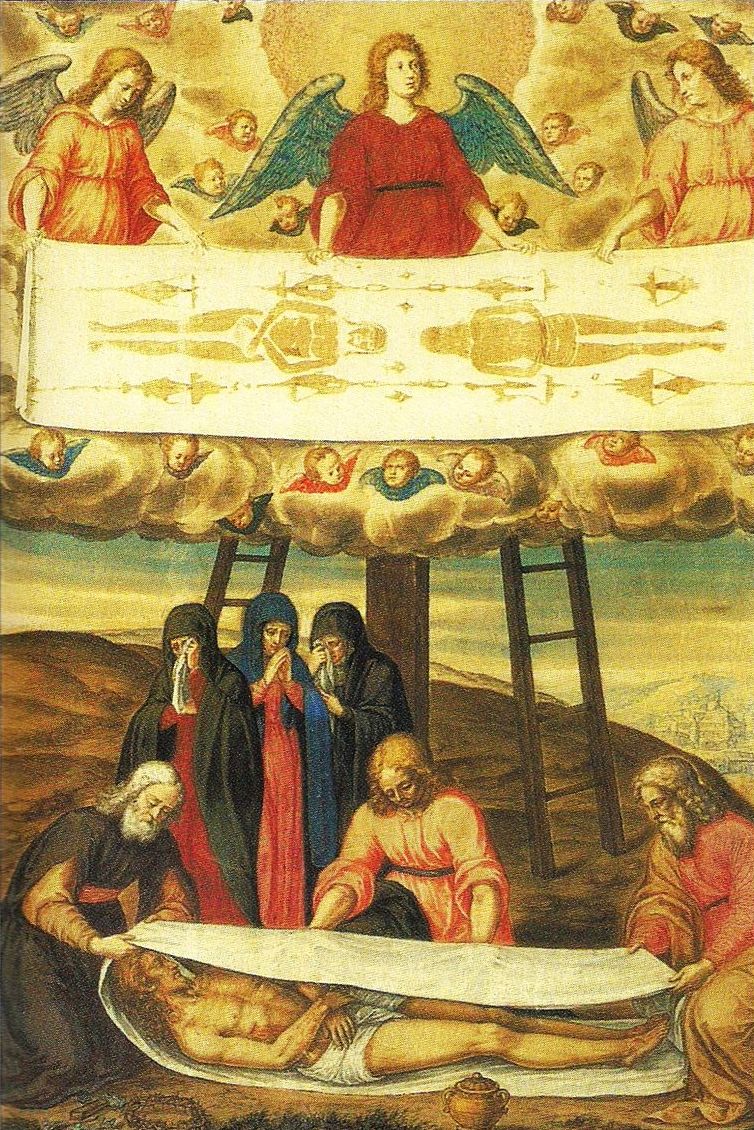
The Shroud of Turin

From FishEaters, the most comprehensive Traditional Catholic site on the web!

The Burial Cloths of Our Lord:The Shroud of Turin and the Sudarium of Oviedo


+++++++++++++++++++++++++++++++++++++++++++++++++++++++++
The atheists have done their best to 'debunk' the Shroud with no success. Much of the science behind proving its authenticity is covered in the article linked above, but here is a video by a Jewish photographer who was a member of STURP (Shroud of Turin Research Project). He went into the project a sceptic, sure it would be proven to be a fake. Not so! He became convinced that it is the Burial Cloth of Jesus Christ.


A photograph of the Shroud. It is actually a 'photographic negative' a fact which wasn't known until Secondo Pia took a photo of it in 1898 and discovered the 'negative properties.


The face from Pia's photograph. This creates a major problem for the debunkers. If the Shroud is a mediæval forgery, how was the forger able to create a negative centuries before the concept of photography was found?


And here is a link to Mr Schwortz's, the Jewish photographer mentioned above, website with masses of information on the Shroud.

The Shroud of Turin Website

For those who doubt the Resurrection, I say, Behold and Believe!

Pictures of Easter Day, 2018, in Wilber, Nebraska


Chevalier Charles Coulombe on Our Lady of Walsingham

The Chevalier discusses Our Lady of Walsingham and her Shrine at Walsingham, in Norfolk, England. The Shrine originated when Our Lady appeared to  Richeldis de Faverches, a pious English noblewoman, in 1061 in the village of Walsingham. The Blessed Virgin gave the Lady Richeldis the dimensions of her home in Nazareth where the Archangel Gabriel had appeared to her at the Annunciation. As a result Lady Richeldis had a building structure named "The Holy House", a replica of the home in which Our Lord was reared, built in Walsingham. It eventually became the largest, most loved Marian shrine in England, or 'Our Lady's Dowry' as it was known before the Deformation.

He also discusses the way the Angels moved the original Holy House from Nazareth to Loreto, via Croatia, with an earlier stop in another place in Italy.


A Lament for Our Lady's Shrine at Walsingham
In the wracks of Walsingham
Whom should I choose
But the Queen of Walsingham
to be my guide and muse.
Then, thou Prince of Walsingham,
Grant me to frame
Bitter plaints to rue thy wrong,
Bitter woe for thy name.
Bitter was it so to see
The seely sheep
Murdered by the ravenous wolves
While the shepherds did sleep.
Bitter was it, O to view
The sacred vine,
Whilst the gardeners played all close,
Rooted up by the swine.
Bitter, bitter, O to behold
The grass to grow
Where the walls of Walsingham
So stately did show.
Such were the worth of Walsingham
While she did stand,
Such are the wracks as now do show
Of that Holy Land.
Level, level, with the ground
The towers do lie,
Which, with their golden glittering tops,
Pierced once to the sky.
Where were gates are no gates now,
The ways unknown
Where the press of peers did pass
While her fame was blown.
Owls do scrike where the sweetest hymns
Lately were sung,
Toads and serpents hold their dens
Where the palmers did throng.
Weep, weep, O Walsingham,
Whose days are nights,
Blessings turned to blasphemies,
Holy deeds to despites.
Sin is where Our Lady sat,
Heaven is turned to hell,
Satan sits where Our Lord did sway --
Walsingham, O farewell!

God's April Fool Joke! I'm Dreaming of a Green Easter!

Remember that picture I posted over a week ago? The one of the beautiful crocuses blooming in our yard? Well here they are today!


We have about six inches of snow so far, and it's still coming down. The National Weather Service upgraded the forecast from a 'snow advisory' to a 'winter storm warning' a few hours ago.

We have overnight lows forecast in the teens and twenties the next few nights, so I don't think the crocus will survive, even under their blanket of snow. I am also worried that the daffodils and tulips which were coming up, tho' not yet budding, may be frozen off. This may be a comparatively colourless spring!


And Eastertide Has Begun!

From now until Whitsunday (Pentecost) is the Season of Eastertide. The Alleluia returned at the Vigil Mass last night, and will be added to the antiphons in the Divine Office throughout the Season. The Angelus is replaced by the Regina Cæli at 06.00, 12.00, and 18.00. I wish all my readers a blessed and glorious Eastertide!


He is Risen!


IN LUMINE FIDEI: THE HISTORY, MYSTERY AND PRACTICE OF PASCHAL TIME

IN LUMINE FIDEI: THE HISTORY, MYSTERY AND PRACTICE OF PASCHAL TIME: Dom Prosper Gueranger: The History of Paschal Time We give the name of Paschal Time to the period between Easter Sunday and th...

IN LUMINE FIDEI: 1 APRIL – EASTER SUNDAY – THE RESURRECTION OF OUR ...

IN LUMINE FIDEI: 1 APRIL – EASTER SUNDAY – THE RESURRECTION OF OUR ...: Forth to the paschal Victim, Christians bring your sacrifice of praise: The Lamb redeems the sheep; and Christ, the sinless ...

1 April, A Chesterton Calendar

APRIL 1st 

ALL FOOLS’ DAY 

We shall never make anything of democracy until we make fools of ourselves. For if a man really cannot make a fool of himself, we may be quite certain that the effort is superfluous. 

‘The Defendant.’

Chesterton, G. K.. The G. K. Chesterton Collection [50 Books] (Kindle Locations 43882-43885). Catholic Way Publishing. Kindle Edition. 

2 April, The Roman Martyrology

April 2nd anno Domini 2018 The 16th Day of Moon were born into the better life: 

The holy Confessor Francis of Paola, founder of the Order of Friars Minim, [in the year 1507.] He was famous for his graces and miracles, and Leo X enrolled his name among those of the Saints. 
At Caesarea, in Palestine, the holy martyr Amphian. During the persecution under the Emperor Galerius Maximian he rebuked the President Urban as he was sacrificing unto idols, and for this cause he was savagely mangled, and most cruelly tormented. His feet being wrapped in flax steeped in oil, and set on fire, and at length he was drowned in the sea, and thus did he go through fire and through water, and was brought out into a place of refreshment. 
There also suffered the holy martyr Theodosia, a Virgin of Tyre, during the same persecution. When she saw the holy Confessors standing before the judgment seat, she publicly saluted them, and besought them that when they should be come unto the Lord they would remember her. For this cause the soldiers took her, and led her before Urban the President, and by his command her sides and her breasts were deeply mangled, and she was cast into the sea, [in the year 307.] 
At Lyon, holy Nicetius, Bishop of that city, famous for his life and miracles, [in the year 573.] 
At Como, the holy Confessor Abundius, Bishop of that see, [in the year 468.] 
At Langres, holy Urban, [6th] Bishop of that see, [in the year 395.] 
In Palestine, holy Mary of Egypt, commonly called the sinner, [fifth century.] 
V. And elsewhere many other holy martyrs, confessors, and holy virgins.
R. Thanks be to God.

The Paschal Homily of St John Chrysostom

Are there any who are devout lovers of God?

Let them enjoy this beautiful bright festival!

Are there any who are grateful servants?
Let them rejoice and enter into the joy of their Lord!

Are there any weary with fasting?
Let them now receive their wages!

If any have toiled from the first hour,
let them receive their due reward;
If any have come after the third hour,
let him with gratitude join in the Feast!
And he that arrived after the sixth hour,
let him not doubt; for he too shall sustain no loss.
And if any delayed until the ninth hour,
let him not hesitate; but let him come too.
And he who arrived only at the eleventh hour,
let him not be afraid by reason of his delay.
For the Lord is gracious and receives the last even as the first.
He gives rest to him that comes at the eleventh hour,
as well as to him that toiled from the first.

To this one He gives, and upon another He bestows.
He accepts the works as He greets the endeavor.
The deed He honors and the intention He commends.
Let us all enter into the joy of the Lord!

First and last alike receive your reward;
rich and poor, rejoice together!
Sober and slothful, celebrate the day!
You that have kept the fast, and you that have not,
rejoice today for the Table is richly laden!

Feast royally on it, the calf is a fatted one.
Let no one go away hungry. Partake, all, of the cup of faith.
Enjoy all the riches of His goodness!

Let no one grieve at his poverty,
for the universal kingdom has been revealed.

Let no one mourn that he has fallen again and again;
for forgiveness has risen from the grave.

Let no one fear death, for the Death of our Savior has set us free.
He has destroyed it by enduring it.
He destroyed Hell when He descended into it.
He put it into an uproar even as it tasted of His flesh.

Isaiah foretold this when he said,
"You, O Hell, have been troubled by encountering Him below."
Hell was in an uproar because it was done away with.
It was in an uproar because it is mocked.
It was in an uproar, for it is destroyed.
It is in an uproar, for it is annihilated.
It is in an uproar, for it is now made captive.

Hell took a body, and discovered God.
It took earth, and encountered Heaven.
It took what it saw, and was overcome by what it did not see.

O death, where is thy sting?
O Hell, where is thy victory?

Christ is Risen, and you, o death, are annihilated!
Christ is Risen, and the evil ones are cast down!
Christ is Risen, and the angels rejoice!
Christ is Risen, and life is liberated!

Christ is Risen, and the tomb is emptied of its dead;
for Christ having risen from the dead,
is become the first-fruits of those who have fallen asleep.

To Him be Glory and Power forever and ever. Amen!


The Easter sermon of John Chrysostom (circa 400 AD)


And, here it is, in a different translation, read at the Divine Liturgy of Easter in an Orthodox Church.


Memes of the Day


Happy Easter!!!

To all of my readers, may you have a holy, blessed, and glorious Paschaltide!

Christ is Risen! He is Risen Indeed!
Christ is risen from the dead,
Trampling down death by death,

And upon those in the tombs

Bestowing life!


Христо́съ воскре́се ᾿изˈ ме́ртвыхъ,
сме́ртїю сме́рть попра́въ,
᾿и су́щимъ во гробѣ́хъ живо́тъ дарова́въ.


Χριστὸς ἀνέστη ἐκ νεκρῶν,
θανάτῳ θάνατον πατήσας,
καὶ τοῖς ἐν τοῖς μνήμασι,
ζωὴν χαρισάμενος!

Christus resurrexit a mortuis,
Morte mortem calcavit,
Et eis in sepulchris
Vitam donans!

Христос васкрсе из мртвих,
смрћу смрт уништи,
и онима који су у гробовима,
живот дарова!


Χριστὸς ἀνέστη! Ἀληθῶς ἀνέστη!
Christus resurrexit! Resurrexit vere!
Kristus vstal z mrtvých! Vpravdě vstal z mrtvých!
Христос воскресе! Ваистину воскресе!
Crist aras! Crist soþlice aras!


Crist is arisen! Arisen he sothe!
Christ is risen! He is risen, indeed!
Kristus är uppstånden! Han är sannerligen uppstånden!
Le Christ est ressuscité! Vraiment il est ressuscité!
Tá Críost éirithe! Go deimhin, tá sé éirithe!
Tha Crìosd air èiridh! Gu dearbh, tha e air èiridh!
Tengwar Rendering