
30 April 2018

Saints for Early May
As I point out in the note on the Martyrology post earlier, since Ven Pope Pius XII's reform of the Roman Calendar in 1955, tomorrow is the Feast of St Joseph the Worker. I am not absolutely certain of the date of the book from which these illustrations are taken, but the artist was an Anglo-Catholic, and the Book of Common Prayer still has the Feast of Ss Philip & James on 1 May.

Distributism and Capitalism: Some Contrasting Features Part 2.
The second instalment of Thomas Storck's essay.
From Practical Distributism

There are many supposed facts of economic life that any student of economics, or even any observer of political and economic news, is familiar with, matters such as unemployment, corporate mergers and acquisitions, labor relations, business cycles, and so on. I call these supposed facts, not because they do not exist, but because their existence is contingent upon man-made economic arrangements, such as laws and tax structures or even cultural norms. Contrary to the impression one takes from writings both of professional economists as well as from journalists, these things and events are not natural and necessary facts like the changing of the seasons or the daily rising of the sun. They need not exist, certainly at least not to the extent that they do in a capitalist economy. Let us take one of the items from the above list, business cycles, and consider it more carefully.
What are business cycles? "A business cycle is a swing in total national output, income, and employment, usually lasting for a period of 2 to 10 years, marked by widespread expansion or contraction in most sectors of the economy," is how the economist Paul Samuelson defines business cycles in his macroeconomics textbook.[2] Although everyone living in a capitalist economy is familiar with such cycles, or their effects, one might wonder why, apart from the special and external factors I will note below, such cycles exist. Consumer demand for necessary and reasonable goods normally will not fluctuate much - demand for food, clothing, housing, books and the like. Nor will the size of the workforce, and hence of the economy's ability to provide consumer goods, usually experience short-term major decreases or increases. Thus there is no reason to expect the two most important factors in moving an economy, demand and the ability to supply that demand, to change significantly in a short period of time. Of course, external factors, such as famines, natural disasters, wars, migrations, and so on can cause a sudden and large increase or decrease in either demand or the capacity to supply that demand. As such, a distributist economy will be as subject to such external dislocations as is a capitalist economy. They are simply an inescapable part of life on this earth. But there are other factors which are peculiar to capitalism which have caused probably the majority of business cycles, at least the majority of those which have occurred in recent decades.
Capitalism is fueled by an imperative of production for the sake of sales, regardless of consumers' needs or of their spontaneous desires for the goods or services in question. As such, it always rests upon foundations which are liable to be shaken. Distributism, on the other hand, rests upon the solid foundation of human nature and its natural needs and reasonable desires. But capitalist demand, which is usually artificially stimulated by advertising, is necessarily fickle or fragile. The artificial desire for larger and larger houses or cars, for example, tends to drive up prices of those goods, and can lead to so-called bubbles in which prices rise exponentially. Eventually these bubbles will burst. Such extreme up and down movements of prices can cause numerous related economic dislocations, such as panics or depressions, which are simply instances of severe business cycles.
The point of all this is that the natural end of mankind's economic activity is to supply our necessary and reasonable need for external goods and services. This is why God has given us the capacity to engage in economic activity. Given the fallen state of mankind, however, it is usually necessary to erect laws and institutions to guide our conduct toward its intended end. This distributism seeks to do in the economic realm. Capitalism, on the other hand, not only has done away with the safeguards against economic misdeeds which the Catholic civilization of an earlier age set up, but suffers from an inherent tendency toward economic exploitation and dislocation. And the commercial cultural climate which capitalism has produced fails to understand that any other way of carrying on economic activity is possible or feasible. But this is not the case. Catholics, in particular, who have a developed critique of economic conduct available in the Church's social teaching, have an especially grave responsibility to form their thinking according to this teaching. Capitalism is not inevitable. There are other real possibilities. It is chiefly a matter of our having the will to bring about the changes that are necessary in our economic activity. But it can be done.
Notes:
2: Macroeconomics, 16th ed., 1998, p. 125.
3: Ibid., p. 177.
From Practical Distributism

Continued from Part 1
What are business cycles? "A business cycle is a swing in total national output, income, and employment, usually lasting for a period of 2 to 10 years, marked by widespread expansion or contraction in most sectors of the economy," is how the economist Paul Samuelson defines business cycles in his macroeconomics textbook.[2] Although everyone living in a capitalist economy is familiar with such cycles, or their effects, one might wonder why, apart from the special and external factors I will note below, such cycles exist. Consumer demand for necessary and reasonable goods normally will not fluctuate much - demand for food, clothing, housing, books and the like. Nor will the size of the workforce, and hence of the economy's ability to provide consumer goods, usually experience short-term major decreases or increases. Thus there is no reason to expect the two most important factors in moving an economy, demand and the ability to supply that demand, to change significantly in a short period of time. Of course, external factors, such as famines, natural disasters, wars, migrations, and so on can cause a sudden and large increase or decrease in either demand or the capacity to supply that demand. As such, a distributist economy will be as subject to such external dislocations as is a capitalist economy. They are simply an inescapable part of life on this earth. But there are other factors which are peculiar to capitalism which have caused probably the majority of business cycles, at least the majority of those which have occurred in recent decades.
Capitalism is fueled by an imperative of production for the sake of sales, regardless of consumers' needs or of their spontaneous desires for the goods or services in question. As such, it always rests upon foundations which are liable to be shaken. Distributism, on the other hand, rests upon the solid foundation of human nature and its natural needs and reasonable desires. But capitalist demand, which is usually artificially stimulated by advertising, is necessarily fickle or fragile. The artificial desire for larger and larger houses or cars, for example, tends to drive up prices of those goods, and can lead to so-called bubbles in which prices rise exponentially. Eventually these bubbles will burst. Such extreme up and down movements of prices can cause numerous related economic dislocations, such as panics or depressions, which are simply instances of severe business cycles.
History is marked by bubbles in which speculative prices were driven up far beyond their intrinsic value.... Speculative bubbles always produce crashes and sometimes lead to economic panics.[3]In addition, although criminal greed is a characteristic of postlapsarian mankind in general, it is capitalism that has institutionalized such greed, and even praised and rewarded it. So, for example, exploitative or risky financial practices by banks are not always illegal, and even when illegal, those engaging in such practices often go unpunished or lightly punished because of the overall climate of opinion in a capitalist society, which tends to take a benign view of economic misdeeds. In the Middle Ages in Europe usurers were popularly regarded as among the most heinous of sinners, and this popular judgment was based on the teachings of society's intellectual elite, theologians, canon lawyers, philosophers and so on. The popular climate of opinion in contemporary America, on the other hand, reserves whatever moral animus it still has for other types of misdeeds, and too often among Christians believers it is only sins against the 6th or 9th commandments which are seen as really worthy of condemnation. All this is the result of the pervasive commercial mentality which affects most Americans.
The point of all this is that the natural end of mankind's economic activity is to supply our necessary and reasonable need for external goods and services. This is why God has given us the capacity to engage in economic activity. Given the fallen state of mankind, however, it is usually necessary to erect laws and institutions to guide our conduct toward its intended end. This distributism seeks to do in the economic realm. Capitalism, on the other hand, not only has done away with the safeguards against economic misdeeds which the Catholic civilization of an earlier age set up, but suffers from an inherent tendency toward economic exploitation and dislocation. And the commercial cultural climate which capitalism has produced fails to understand that any other way of carrying on economic activity is possible or feasible. But this is not the case. Catholics, in particular, who have a developed critique of economic conduct available in the Church's social teaching, have an especially grave responsibility to form their thinking according to this teaching. Capitalism is not inevitable. There are other real possibilities. It is chiefly a matter of our having the will to bring about the changes that are necessary in our economic activity. But it can be done.
Notes:
2: Macroeconomics, 16th ed., 1998, p. 125.
3: Ibid., p. 177.
Penrose Tiles - Absolutely Fascinating!
I am not a mathematician. In fact maths were my worst subject in school, and I can honestly say that my inability to grasp the basic concepts beyond addition, subtraction, multiplication, and division is the reason I do not have an university degree. My university required basic competency in maths in order to gain a baccalaureate, and I could not demonstrate such knowledge.
However, that does not mean that I am not fascinated by maths and some of their applications. This is an example. Unlike Lloyd (Lindybeige), I had never heard of Penrose Tiles, developed by Sir Roger Penrose, OM, FRS, until I clicked on this video. I then looked them up on Wikipedia, and I was met with this first sentence, 'A Penrose tiling is an example of non-periodic tiling generated by an aperiodic set of prototiles.' OK, they're fascinating, but not that fascinating!
At any rate, here's an illustration of Penrose Tiles.

However, that does not mean that I am not fascinated by maths and some of their applications. This is an example. Unlike Lloyd (Lindybeige), I had never heard of Penrose Tiles, developed by Sir Roger Penrose, OM, FRS, until I clicked on this video. I then looked them up on Wikipedia, and I was met with this first sentence, 'A Penrose tiling is an example of non-periodic tiling generated by an aperiodic set of prototiles.' OK, they're fascinating, but not that fascinating!
At any rate, here's an illustration of Penrose Tiles.
Here's the video I watched,
And here's the link to the Wikipedia article, Penrose Tiling.
Diary: Cars, Claret and the Constitution. The Passions of Jacob Rees-Mogg
This the man that I want to see as Her Majesty's Prime Minister. An unashamed Catholic, who votes his conscience, which is formed by the Teachings of Christ's Church, father of six, and a staunch monarchist.
From Reaction

From Reaction

I interviewed Jacob Rees-Mogg about his passions at Five Hertford Street, the private members’ club, on Wednesday. There were a surprising number of them, and they all seemed to begin with the letter ‘C’.
The title of the interview was ‘What Makes Jacob Tick?’ and, in front of a large and appreciative audience, he told us. The first was Claret, of which he said – surely rightly – that drinking the 2005 vintage was tantamount to infanticide.
The next was Cricket, about which he is now less obsessive than when as a schoolboy he’d known the names of every player in the England and Somerset teams. When I teased him over his six Children, asking if he was trying to repopulate the planet, we got an erudite and witty mini-lecture on the faults in Malthusian demography, and the geometrical rather than arithmetical increases possible in the global food supply.
Cars are another passion; he owns a 1936 and a 1968 Bentley, and rhapsodized about their beauty in the manner a poet might about a sunset.
Charming, intelligent and witty, Jacob was far from the caricature of the ‘stern and unbending Tory’ put about by his opponents, although when it came to his Catholicism he was proud to say that on moral issues he took his guidance from the Vatican rather than the Government Whips’ Office.
Saints Thomas More and John Fisher are his heroes – they share a Saints’ Day on 22 June, which I suspect is an important one in the Rees-Mogg calendar – who both died in 1535 for their faith. When it comes to voting on gay marriage, abortion and so on, Jacob will not be about to sacrifice his beliefs for political advancement.
This naturally brought us on to the central importance of the English Reformation to the Brexit movement, which has been mentioned by several writers recently, such as David Starkey and Victoria Glendinning, and which obviously underpins much of Britain’s ancestral sense of co-operative separateness from Europe. Jacob told us that the Statute in Restraint of Appeals (1533), the key legal foundation of the Reformation, was only repealed in 1969, in preparation for joining the Common Market four years later.
Which naturally brought us onto the next two Cs in Jacob’s emotional and political lexicon: Constitution and Country. In calm and measured tones, supported by statistic evidence, extensive quotation from what is clearly a capacious memory, and much impressive erudition, he laid out likely scenarios which would have any bitter Remainer foaming and fuming. With perfect loyalty to the Prime Minister, he explained how because the EU was essentially merely a Customs Union writ large, Labour’s plan to try to keep the EU in the Customs Union meant that it was trying to subvert the will of the people as expressed in the EU referendum.
The House of Lords’ recent support for an amendment to keep Britain in the Customs Union, by a majority of 123, thus raises precisely the same ‘Peers Versus the People’ controversy as over the Lloyd George Budget in 1909 and the Parliament Act of 1911, and also rides roughshod over the Salisbury Convention of 1947 whereby the Lords do not vote down measures in a Government’s election manifesto. Theresa May would therefore be perfectly within her constitutional rights to do what Herbert Asquith threatened to do in 1910, which was to create enough Liberal peers to force through the will of the people. Jacob reminded us that the cricketer WG Grace had been one of the prospective peers on Asquith’s list.
While Jacob was speaking, I mentally formed a list of good pro-Brexit prospective peers, two of whom – Stuart Wheeler and Robin Birley, the former leader of the Referendum party – were in the audience. I would also have Patrick Robertson, founder of the Bruges Group, James Dyson, Helena Morrissey, David Abulafia, the head of Historians for Britain, Matthew Elliot and Dominic Cummings of Vote Leave, Gisela Stuart of Change Britain, Nigel Farage, Dominic Lawson, Charles Moore, and the founder of this website, Iain Martin all wearing their ermine on the red benches before the next Customs Union vote came up. They should be in the Lords anyhow, representing the 17.4 million of us whose votes for Brexit are being systematically flouted and stymied by the unelected chamber.
When I emerged from these reveries, Jacob was talking about the Irish border issue, and the tough stance that Britain should take over it. Last week Paul Hogan, the highly federalist Commissioner in Brussels, said, ‘We’re very pleased in the European Union that we’re dealing with the prime minister of the United Kingdom, not with Mr. Rees-Mogg.’ After Wednesday’s breakfast, it’s easy to understand why. That said, Jacob is still in his forties, and although I didn’t spot that primal glint of ruthless ambition in his eye that is so evident in other politicians, he did not go into politics just to be – some more Cs here – The Conscience of Conservatism.
The Medical and Legal Establishment Has Got It Wrong On Alfie Evans
This was written before the State succeeded in murdering Alfie, but it is still pertinent.
From Reaction

From Reaction

Of all the worldwide comment on the Alfie Evans case, the core truth was best encapsulated by a headline in the Wall Street Journal: “Alfie Evans and the State. A medical debate that’s gone global is not about the money. It’s about power.”
That says it all. It is about the power of the establishment elites, in this case both medical and judicial – two classic arms of the corporate entitlement that rules Britain – to order the lives of the rest of the population. And what more potent virility symbol for a ruling clique than wielding the power of life and death? Or, since nobody sees any prospect of a prolonged life for Alfie Evans, in this instance the power of death.
It is more than half a century since a British judge set the date for the execution of a murderer; most judges profess relief that they do not face the professional burden of having to do so. Yet Mr Justice Hayden appointed 23 April, ironically not only St George’s Day but also the date on which the nation was celebrating the birth of a royal baby, for the removal of Alfie Evans’s life support. As at every stage of this power struggle, the motive invoked was Alfie’s “best interests”.
In the event, Alfie’s best interests turned out to consist of removing his ventilation, depriving him of nutrition for more than 24 hours, giving him minimal hydration and refusing, with the support of the courts, to release him from the hospital where this regime was being imposed on him. Although judicial permission had been given, in principle though not in practice, for his parents to take him home, this was deferred due to fears they might abscond with him to Rome and secure him humane treatment.
Behind all the smokescreen of technicalities regarding brain decay, white matter, artificial ventilation and other medical issues, the great unanswered question is: why did the authorities adamantly refuse Alfie’s parents the right to take their child to the Bambino Gesù paediatric hospital in Italy?
Nobody expected a miracle cure at the Bambino Gesù (though its world-class clinicians might at least have succeeded in diagnosing Alfie’s illness, in the interests of medical research). What was expected was that Alfie could have ended his days among people who did not automatically regard his best interests as synonymous with death. His palliative care would have been of a high order and, as a moral principle, he would not have been starved or dehydrated to death – the point at which gently allowing a hopeless case to slip away crosses the red line to become euthanasia. Food and drink are not medication, otherwise the Ritz would rate as a private hospital.
And what about his parents? In that environment they could have spent invaluable time with their son, become reconciled to the inevitability of his death, in the consoling knowledge that every human endeavour had been exhausted in the effort to save him. That experience would have brought them – though the over-used term may jar – “closure”.
Why was that not allowed to happen? The air ambulance ordered by the Pope was state-of-the-art, the medical personnel highly qualified, even the Italian military were involved and the danger of harm to Alfie in transit minimal; and, if he had died naturally, it would have been no worse than suffocating at Alder Hey. At least his parents would have done their best for him.
But family and parental rights are being marginalized in Britain. It was spelled out from the judicial bench that parental rights took second place to the child’s best interests, a subjective term that turned out to be a euphemism for killing him. If parents are, for example, Jehovah’s Witnesses, their refusal of necessary blood transfusions for their children are rightly overruled by the courts. Here, however, we had two loving parents, in full agreement, trying to take their child abroad with every medical facility both in transit and at their destination, but prevented by the state.
That is the grim reality: Alfie Evans is a prisoner of the State. Even at the court hearings he was represented not by his parents but by a state “guardian”; technically, Alfie was on the opposing side to his parents in the dispute over his life. For the establishment, detaining Alfie to die in this country became a virility symbol. And for the establishment the presumption is always in favour of death. The Medical Ethics Alliance denounced the way in which “the parents were stripped of their right to be decision-makers for their beloved child” and concluded: “Medical tyranny must stop.”
That tyranny contrasts shamefully with the goodwill of foreign leaders and commentators. The Pope intervened several times (Alfie is a baptized Catholic). The head of the Italian healthcare system, Walter Ricciardi, criticized the NHS mindset: “The way my English colleagues often deal with situations like this is shocking and inhumane.” The President of Poland, Andrzej Duda, pleaded for Alfie’s life, adding an insightful comment: “Perhaps all that’s needed is some good will on the part of decision makers.”
Quite. What was obvious at every court hearing was the large amount of discretionary power available to the judges. They could have come down on either side of the argument without manipulation of the law. Predictably, in a society where the culture of death has grown increasingly stronger, with public sensitivity anaesthetized by nearly nine million abortions, Caesar gave the thumbs-down.
For too long, fundamental moral issues that should have been subject to detailed and prolonged public debate have been decided by bluestocking Oxbridge baronesses sitting on consensual quangos. Yet the British condemn Americans for conducting culture wars which signal moral sensitivities are not dead across the Atlantic.
The Alfie Evans case chillingly demonstrates how far parental rights have been eroded and the remorseless advance of the intruder state. The establishment was bruised by its defeat in the Brexit referendum and will now go to any lengths to assert its power. That, as the Wall Street Journal commentator correctly recognized, is what this lamentable case is all about.
IN LUMINE FIDEI: 30 APRIL – SAINT CATHERINE OF SIENA (Virgin and Do...
IN LUMINE FIDEI: 30 APRIL – SAINT CATHERINE OF SIENA (Virgin and Do...: Catherine, a virgin of Siena, was born of pious parents. She asked for and obtained the Dominican habit, such as it is worn by the Sist...
IN LUMINE FIDEI: 30 APRIL – MONDAY IN THE FIFTH WEEK AFTER EASTER
IN LUMINE FIDEI: 30 APRIL – MONDAY IN THE FIFTH WEEK AFTER EASTER: Dom Prosper Gueranger: Jesus bestows an inestimable gift upon His Apostles, and from this gift there proceed two Sacraments. On the ...
30 April, A Chesterton Calendar
APRIL 30th
ST. CATHERINE OF SIENA’S DAY
Historic Christianity rose into a high and strange coup de théâtre of morality— things that are to virtue what the crimes of Nero are to vice. The spirits of indignation and of charity took terrible and attractive forms, ranging from that monkish fierceness that scourged like a dog the first and greatest of the Plantagenets, to the sublime pity of St. Catherine, who, in the official shambles, kissed the bloody head of the criminal. Our ethical teachers write reasonably for prison reform; but we are not likely to see Mr. Cadbury, or any eminent philanthropist, go into Reading Jail to embrace the strangled corpse before it is cast into the quicklime. Our ethical teachers write wildly against the power of millionaires, but we are not likely to see Mr. Rockefeller, or any modern tyrant, publicly whipped in Westminster Abbey.
‘Orthodoxy.’
Chesterton, G. K.. The G. K. Chesterton Collection [50 Books] (Kindle Locations 44045-44052). Catholic Way Publishing. Kindle Edition.
ST. CATHERINE OF SIENA’S DAY
Historic Christianity rose into a high and strange coup de théâtre of morality— things that are to virtue what the crimes of Nero are to vice. The spirits of indignation and of charity took terrible and attractive forms, ranging from that monkish fierceness that scourged like a dog the first and greatest of the Plantagenets, to the sublime pity of St. Catherine, who, in the official shambles, kissed the bloody head of the criminal. Our ethical teachers write reasonably for prison reform; but we are not likely to see Mr. Cadbury, or any eminent philanthropist, go into Reading Jail to embrace the strangled corpse before it is cast into the quicklime. Our ethical teachers write wildly against the power of millionaires, but we are not likely to see Mr. Rockefeller, or any modern tyrant, publicly whipped in Westminster Abbey.
‘Orthodoxy.’
Chesterton, G. K.. The G. K. Chesterton Collection [50 Books] (Kindle Locations 44045-44052). Catholic Way Publishing. Kindle Edition.
1 May, The Roman Martyrology
The edition of the Martyrology that I am using is prior to His Holiness Pope Pius XII institution of the Feast of St Joseph the Worker on this date as a Christian alternative to the Red's International Labour Day. The Feast of Ss Philp and James was moved to 11 May.
There will be an article tomorrow on St Joseph the Worker.
May 1st anno Domini 2018 The 16th Day of the Moon were born into the better life:
The blessed Apostles Philip and James. Philip brought nearly all Scythia to believe in Christ, but in the end, at the city of Hierapolis, in Asia, was fastened to a cross and stoned, and so fell asleep gloriously, [in the year 61.] James, who is written of as the brother of the Lord, and was the first Bishop of Jerusalem, was cast down from a pinnacle of the temple, whereby his legs were broken, and he was slain by a blow upon the head from a fuller's pole, and buried there not far from the temple.
In Egypt, the holy prophet Jeremiah, who was stoned by the people at Taphnis, and so there died, [590 B.C.,] and was buried. Holy Epiphanius saith that the faithful have been in use to pray at his grave and to take dust therefrom, whereby the bites of serpents are healed.
In the territory of Viviers, in Gaul, the blessed subdeacon Andeolus, whom holy Polycarp sent from the East along with others into Gaul to preach the Word of God. Under the Emperor Severus he was beaten with thorny clubs, and at length his head was broken into four parts with a wooden sword, and so he attained to martyrdom, [in the year 208.]
At Huesca, in Spain, the holy martyrs Orentius and Patience.
At Sedune, in Gaul, holy Sigismund, King of the Burgundians, who was drowned in a well, and so died, [in the year 524,] and was afterwards famous for miracles.
At Auxerre, [in the year 524,] the holy Confessor Amator, Bishop of that see.
At Auch, [in the fifth century,] holy Orientius, Bishop of that see.
In England, [in the year 778,] holy Asaph, Bishop of the see which is called by his name, and the holy Virgin Walburga, whose feast we keep upon the 14th day of May.
At Bergamo, the holy widow Grata.
At Forli, holy Peregrinus, of the Order of Servants of the Blessed Virgin Mary.
V. And elsewhere many other holy martyrs, confessors, and holy virgins.
R. Thanks be to God.


29 April 2018
Hot Wings
I am not a fan of hot wings, and, obviously, neither is one of my favourite humorists!
A more recent example of American inventiveness is "Buffalo-style" chicken wings. For many years, nobody ate chicken wings, and for a good reason: They are inedible. They are essentially meat-free bones. You might as well chew on a plate of toenails. But one day a shrewd restaurant owner came up with the idea of serving the wings "Buffalo-style," which means "to people who have been drinking beer." It is a known fact that beer-drinkers will eat pretty much anything; Exhibit A is "Slim Jims." You could put a dish of salted mothballs in front of beer drinkers, and they would snork them up. So chicken wings were an instant hit. Today, "Buffalo-style" chicken wings are served in restaurants all over the nation: The waitperson brings out a plate of bones, the customers gnaw on them for a while, and then the waitperson takes them back to the kitchen, where they're run through the dishwasher and placed on a plate for the next set of customers to gnaw on. A restaurant can sell the same set of "Buffalo-style" wings hundreds of times; this provides a big boost to the economy, and it is easier on the chickens. - Dave Barry
Abortive Camping Trip
Well, my short hiatus was even shorter than planned. Our overnight camping trip turned into an extended picnic, which was quite pleasant, even if not we had planned. We were under a wind advisory when we went to the lake, but according to the forecast it was supposed to calm down by 19.00. It hasn't! Since this has been the driest April in recent memory, it didn't seem a good idea to light a fire, even in the firepit, and without a fire, camping is not particularly fun.
This was especially frustrating because the Natural Resource District crew had cut up some fallen trees and left several chunks of log by the firepit, along with a pile of bark and wood slivers perfect for kindling. When we arrived, I found the perfect fire log! It had a hollow opening almost through the centre, and a bole that gave access to the hollow. I sat it up in the pit, put a couple of homemade firestarters in the bottom, foraged some dry pine needles and then stacked kindling on top of that. I had access to the firestarters through the bole. I was all set. As you can see, I had laid the perfect campfire that would burn all through the evening!

Now, by the time we get back out there, someone will have undoubtedly decided to have a picnic or a party, and my wonderfully laid fire will have been used!
We did take a couple of walks with the Household Canine. To our surprise, considering the cool weather we've had, the ticks are out. They seem to like my Cuter & Shorter Half rather than me, since she found several on her jeans and I saw none. Anyway, our picnic supper of beer, bread, and cheese was delicious.,
Next time! I'll have a fire yet!
This was especially frustrating because the Natural Resource District crew had cut up some fallen trees and left several chunks of log by the firepit, along with a pile of bark and wood slivers perfect for kindling. When we arrived, I found the perfect fire log! It had a hollow opening almost through the centre, and a bole that gave access to the hollow. I sat it up in the pit, put a couple of homemade firestarters in the bottom, foraged some dry pine needles and then stacked kindling on top of that. I had access to the firestarters through the bole. I was all set. As you can see, I had laid the perfect campfire that would burn all through the evening!

Now, by the time we get back out there, someone will have undoubtedly decided to have a picnic or a party, and my wonderfully laid fire will have been used!
We did take a couple of walks with the Household Canine. To our surprise, considering the cool weather we've had, the ticks are out. They seem to like my Cuter & Shorter Half rather than me, since she found several on her jeans and I saw none. Anyway, our picnic supper of beer, bread, and cheese was delicious.,
Next time! I'll have a fire yet!
A Short Hiatus
I posted a day or two ago about signs of spring. It seems to be here at least for a few days. As a result, my Cuter & Shorter Half and I (and the Household Canine) are going camping for one night.
I was in the process of writing two fairly lengthy posts, one on the leftist identity of fascism and naziism, and a follow up to my earlier post on constitutional vs absolute monarchy, but those will have to wait. So, I apologise that there will be no substantive posts from the Old Curmudgeon until I return.
I was in the process of writing two fairly lengthy posts, one on the leftist identity of fascism and naziism, and a follow up to my earlier post on constitutional vs absolute monarchy, but those will have to wait. So, I apologise that there will be no substantive posts from the Old Curmudgeon until I return.
Chevalier Charles Coulombe on the Wild Hunt
The Chevalier discusses the Wild Hunt, an element of Catholic folklore, and the various forms the tales have taken.
In the video he mentions this song by Johnny Cash as a modern reference to it. I admit to a weakness for classic Country Western music, so I thought I'd include this video.
Shakespeare Spoke Southern, Clyde Wilson
The Abbeville Institute is devoted to the study of Southern culture and political ideas. Marysville, Kansas, the town in which I was born and spent the first years of my life was a very Southern town, despite being in the northern tier of counties of 'Free State', pro-Union Kansas. It was originally settled by Virginians and Carolinians, and when the War of Northern Aggression broke out in 1861, it almost ceased to exist because the men returned home to fight for the independence of their sovereign home States.
I grew up eating a mixture of English and Swedish cooking thanks to my immigrant roots, but also what is now thought of today as 'Southern' or 'Soul' food. I recall when I was in university I had a friend from Chariton County, Missouri, the heart of 'Little Dixie', an enclave of 'Southrons' in the north central part of the State. We got so tired of the 'Yankee food' in the cafeteria that one day we went out and bought pork chops, black eyed peas, and mustard greens, made corn bread, and fixed ourselves a decent meal.
As I studied American history, I came to realise that the War of Northern Aggression, far from being a war to free the slaves, was a revolutionary movement to destroy the sovereignty of the States and establish an essentially unitary government whilst paying lip service to the federal principle on which the country was founded. It reminded me of the Early Roman Empire, the so-called 'Principate'. The Empire was essentially a monarchy ruled by the 'Princeps Senatus', sometimes called the 'Princeps Civitatis', meaning, respectively, 'the first amongst the Senate', and 'first amongst the citizens'. . The Senate still sat, and the trappings of the Republic were preserved, though the Republic was effectively dead.
I later became involved with the League of the South when it was still basically a cultural organisation designed to defend the culture of the South, but I distanced myself from them as they moved closer to white nationalism and what is now called the alt-right. To this day, I still proudly call myself an unreconstructed Confederate. I reject the term neo-Confederate, because that is the term usually used for white nationalists and Southerners who identify with the alt-right.
The following essay is by Clyde Wilson, one of the founders of the Southern League who has taken the same path as I have in distancing himself from them.
From the Abbeville Institute

I grew up eating a mixture of English and Swedish cooking thanks to my immigrant roots, but also what is now thought of today as 'Southern' or 'Soul' food. I recall when I was in university I had a friend from Chariton County, Missouri, the heart of 'Little Dixie', an enclave of 'Southrons' in the north central part of the State. We got so tired of the 'Yankee food' in the cafeteria that one day we went out and bought pork chops, black eyed peas, and mustard greens, made corn bread, and fixed ourselves a decent meal.
As I studied American history, I came to realise that the War of Northern Aggression, far from being a war to free the slaves, was a revolutionary movement to destroy the sovereignty of the States and establish an essentially unitary government whilst paying lip service to the federal principle on which the country was founded. It reminded me of the Early Roman Empire, the so-called 'Principate'. The Empire was essentially a monarchy ruled by the 'Princeps Senatus', sometimes called the 'Princeps Civitatis', meaning, respectively, 'the first amongst the Senate', and 'first amongst the citizens'. . The Senate still sat, and the trappings of the Republic were preserved, though the Republic was effectively dead.
I later became involved with the League of the South when it was still basically a cultural organisation designed to defend the culture of the South, but I distanced myself from them as they moved closer to white nationalism and what is now called the alt-right. To this day, I still proudly call myself an unreconstructed Confederate. I reject the term neo-Confederate, because that is the term usually used for white nationalists and Southerners who identify with the alt-right.
The following essay is by Clyde Wilson, one of the founders of the Southern League who has taken the same path as I have in distancing himself from them.
From the Abbeville Institute

One of the cultural markers that has identified that which we call Southern from the undistinguished mass of American nonculture is language. Obviously pronunciation is involved here, but also words, idiom, usage, style. A few years ago there was a celebrated (and therefore naturally very stupid) series on PBS on the English language. According to this series the only distinctive aspect of English to be found in the South was the black Gullah dialect of the South Carolina coastal islands. Otherwise, it seems, all Americans speak a general English —to illustrate where American English speech originated, they showed a picture of the home of U.S. Grant’s forebears in Ulster. The only mention of Southern speech was by the actual speakers who were interviewed, who kept pointing out speech differences that are common knowledge to every American but apparently not to the excruciatingly boring Canadian newsreader who was responsible for the program.
Let’s look at Southern speech as seen by people who know what they are talking about. It is interesting to note here that the supreme scholarly expert on American dialects was Professor Raven McDavid of the University of Chicago—who was a native of Greenville, South Carolina. What I have to say is supported by his work. But for a less technical source let me call to your attention to a wonderful book called The Language of the American South by Cleanth Brooks.
Brooks was a Vanderbilt Agrarian, just a little too young to be among the writers of I’ll Take My Stand, though he contributed to its sequel Who Owns America? Brooks went on at LSU and then to Yale, to become I would say the greatest American literary scholar and critic of the 20th century. He wrote the definitive works on Faulkner, saving Faulkner from cooption by the New York Marxists, and with Robert Penn Warren produced basic college texts that were in use for half a century. He also directed Richard Weaver’s graduate studies. (Brooks and Warren, already internationally distinguished, were driven out of LSU and out of the South by a carpetbagger college president, but that is another story for another day.)
Fairly late in his distinguished career, Brooks took the occasion of an invitation to a lecture series to produce a commentary on the language of the South. He states clearly why he does so—because the language of the South is the rich heritage that helps to explain the astounding world-class achievements of Southern writers in the 20th century which was his lifetime subject of study. He was much too polite to say this—but Southerners have the only native connection with English language among Americans and are the only Americans capable of creative use of the language to tell real stories about real people. What passes for American English today is a dull speech derived of its roots and all subtlety by the horde of German immigrants who invaded the Midwest in the 19th century. Among all the many dialects in which the rich and wonderful language of English is spoken across the world, standard American is the least attractive.
And where did the South get its language? From the same Southern English counties and at the same time as the earliest South got its ideal of the gentleman and its love of the land. Language is a living thing and changes over time, so we generalize. What we now regard as the cultivated English accent was a creation of 19th century “public” schools and universities and London commerce. Queen Elizabeth and Sir Walter Raleigh and Shakespeare did not talk like recent Oxford graduates. They talked more like a lowcountry Southerner, or at least such a Southerner up until the present rising generation. Shakespeare likely spoke like those who left England during his lifetime to settle Virginia. But if you or I recited Shakespeare in our native tongue, Yankees would think it was funny and a sign of ignorance.
Brooks’s argument is convincing, though we don’t have space to explore all the evidence here. The common assumption that Southern speech results from a black influence is a not true. After all, who taught who to speak English? Black people did not originate a Southern accent but what they did do was exercise a conservative influence over it, help preserve it. For a long time less influenced by book learning and the Yankee Webster dictionary than whites, they preserved oral customs. Brooks presented as evidence on this matter an 1861 English book which rendered the “Song of Solomon” from the Bible into the dialect of the Southern English county of Somerset. The Somerseters sound exactly like Uncle Remus.
Most of the world regards Southern-accented English as a sign of a superior person. Yankees pretend to believe it is a mark of ignorance, but there pretense is in this, as in so many other matters, is a cover-up for jealousy. The poet Robert Lowell, a very Boston Brahmin of the Boston Brahmins, went to Tennessee as a young man and lived in a tent in Allen Tate’s and Caroline Gordon’s yard. For the rest of his life he spoke with a Southern accent. You can hear it in the videos of his anti-Vietnam War speeches.
There has been more than one variety of Southern accent, but they have all been identifiers of our people as natives of Dixie. Is Southern speech disappearing? I do not know. Most of today’s supposed experts on American speech are so Politically Correct that they do not even ask the question.
When I first came to South Carolina 35 years ago, after living in Southern places overrun with Yankees, there was no sweeter sound in the world than the speech of a cultivated South Carolina lady. It conveyed grace, charm, spirit, kindness, and lightly worn education. It was a lovely remnant of the of the Old South, the only real civilization that has existed in the United States. Such speech is hard to find today in anyone under forty, though most people have not completely lost the Southern markers from their speech. However, in younger women there is a definite tendency toward Valley Girl talk. The tendency has not taken over completely, but I have heard intimations even in young male college students. Folks in the country and small towns are less effected.
There is no doubt the mass media are poisoning the young—in speech as well as other ways. You will not hear any Southern accents on the radio or television stations in the capital city of South Carolina. The foreign-owned and staffed media have even thrown out the three-centuries old, tradition-laden term Upcountry. The now refer to the region above the fall line as “the Upstate,” as if it was in New York. Have you noticed that “country music” in the video age has just about lost its soul and can seldom be distinguished now in either style or subject matter from vulgar American pop?
Southern language and Southern music (the two things are related) have been the only sources of creativity in the otherwise flat, dull, and stuffy substance of “American culture.” We can hope that in this respect, as in others, the South will manage to survive and deal with change without losing itself.
SOURCE: This first appeared in Southern Partisan magazine.
About Clyde Wilson
Clyde Wilson is a distinguished Professor Emeritus of History at the University of South Carolina where he was the editor of the multivolume The Papers of John C. Calhoun. He is the M.E. Bradford Distinguished Chair at the Abbeville Institute. He is the author or editor of over thirty books and published over 600 articles, essays and reviews and is co-publisher of www.shotwellpublishing.com, a source for unreconstructed Southern books. More from Clyde Wilson
Distributism and Capitalism: Some Contrasting Features - Part 1
Continuing our series of essays on Distributism, here is the first instalment of an essay by Thomas Storck.

G. K. Chesterton's younger brother, Cecil, gave what is probably the most succinct definition of distributism, or rather of a distributist in an article he wrote in 1917.
Capitalism, as Pope Pius XI characterized it in his encyclical Quadragesimo Anno, #100, is the separation of ownership from work. In other words, in a capitalist economy some people own the means of production and hire others to work for them. Now, strictly speaking, as Pius XI points out, there need not be anything unjust about such an arrangement, provided that a just wage is paid and the other stipulations of justice are observed. But in actual practice capitalism has rarely if ever observed the demands of justice. And it is not hard to understand why. An owner of capital has at least three strong temptations to exploit the economic process by turning it away from service to the common good toward merely his own enrichment.
First, since he is not directly the producer of a product, not himself a maker, he tends not to be focused on quality products out of pride of workmanship, but rather on producing by means of his workforce something that will sell. Attention to quality is governed by considerations of expenses versus profits, and even by consideration of possible product liability costs versus profits. In the most extreme form of capitalism, the corporation, most shareholders, although legally owners of the firm, have absolutely nothing to do with what it makes or sells, and hence are interested merely in their dividends or in rising share prices. And in one step even further removed, mutual funds, owners often do not even know what companies their funds invest in, and such investments are often short-term and change rapidly. It is true that in some old-fashioned capitalist enterprises the owner is involved in the business and may have some pride of craftsmanship. But as long as the owner is actively involved in the business, then there is still a distributist element in the firm, however small.
Secondly, because he is chiefly and directly interested in sales, not production of a quality product, if something will sell, that is pretty much the only question he considers. By means of advertising capitalists engage in persuasion to convince people to buy their products. In cases of authentic need, people know they need something and will go to seek it. If they are hungry, they will buy food, if they want something to read, they will buy a book. But advertising attempts to convince people that they need things they had no previous idea they needed. It directly stimulates people's acquisitive appetites, and thus helps create a society preoccupied with consumer goods.
The third temptation which capitalist enterprise puts before an owner is to withhold justice from his workers. Workers are always a negative item in a capitalist balance sheet, and hence a strong temptation to reduce labor costs by holding down wages, laying off workers, moving jobs overseas, or even replacing the workforce with robots, if that is possible. For a capitalist all these choices can seem entirely rational. And they are all rational according to the logic of capitalism. But they all miss the point with regard to the logic of man's economic activity, which is not about making unlimited profits for those who happen to hold economic power. If all workers could be replaced by robots, the workers might legitimately ask, Hey what about us? How are we supposed to obtain what's necessary for us and our families if we are replaced by robots? How are we even supposed to buy what you yourself produce in your factories? But the actual trajectory of capitalism has too often seen workers replaced by machines, laid off, or underpaid, so that they cannot procure what they and their families need.
With distributism, however, while certainly social and economic difficulties would exist, the pathologies fostered by capitalism would be eliminated or at least reduced. A small business owner generally takes pride in his work and his customer service, and sees his craft or trade as more than merely a means of moneymaking. He usually derives from his work more than merely an economic return, for, as John Paul II pointed out in his first social encyclical, Laborem Exercens, the "various actions belonging to the work process...must all serve to realize [the worker's] humanity, to fulfill the calling to be a person that is his by reason of his very humanity" (#6).
In addition, a distributist economy would not be complete without guilds or occupational groups, whose purpose is to orient economic activity toward fulfilling human needs rather than toward selling products of dubious quality or usefulness. And lastly, the employer\employee divide would be largely done away with under distributism. Larger enterprises would be run as worker cooperatives, and so decisions about automation or new equipment which could potentially replace workers would be made with more than an eye on profits alone. Certainly technological development would continue, but we should note that technology can take more than one direction. When capitalists make the decisions and directly or indirectly determine what kinds of technological research is done, then new inventions will often be of the kind which increase profits by making workers unnecessary. But in a distributist society research will focus on other ways to reduce costs or increase efficiency without necessarily reducing the need for workers - who, after all, will now themselves be the owners.
Because of this altered focus of the economic system, and of the society as a whole, many things that are taken for granted in a capitalist system would hardly exist under distributism. A short time ago I pointed out here why this would be the case with unemployment, certainly one of the perennial scourges of capitalism. In the next part of this article I will take up the subject of business cycles, and show how in a distributist economy their presence and importance would be considerably lessened.
Notes:
1: Shaw and My Neighbour's Chimney," The New Witness, May 3, 1917, p. 13.

G. K. Chesterton's younger brother, Cecil, gave what is probably the most succinct definition of distributism, or rather of a distributist in an article he wrote in 1917.
A Distributist is a man who desires that the means of production should, generally speaking, remain private property, but that their ownership should be so distributed that the determining mass of families - ideally every family - should have an efficient share therein. That is Distributism, and nothing else is Distributism. ... Distributism is quite as possible in an industrial or commercial as in an agrarian community. ...[1]This is an excellent definition of the formal economic arrangements of distributism, and moreover it points out the fact that distributism does not require that everyone become a farmer and that it will not hinder the progress of technology, as our critics sometimes assert. But while this definition highlights the structural aspect of well- distributed property ownership, which is the heart of distributism, there is more to distributism than that. For if distributism were simply a rearrangement of who owns what, but to be carried on in the same spirit with which capitalism is carried on, then eventually it would lead to the same economic and social ills that capitalism has produced. Rather, distributism requires a very different approach to mankind's economic activity, an approach that is focused on providing for our legitimate needs but not on inflaming our fallen appetites for more and more consumer goods.
Capitalism, as Pope Pius XI characterized it in his encyclical Quadragesimo Anno, #100, is the separation of ownership from work. In other words, in a capitalist economy some people own the means of production and hire others to work for them. Now, strictly speaking, as Pius XI points out, there need not be anything unjust about such an arrangement, provided that a just wage is paid and the other stipulations of justice are observed. But in actual practice capitalism has rarely if ever observed the demands of justice. And it is not hard to understand why. An owner of capital has at least three strong temptations to exploit the economic process by turning it away from service to the common good toward merely his own enrichment.
First, since he is not directly the producer of a product, not himself a maker, he tends not to be focused on quality products out of pride of workmanship, but rather on producing by means of his workforce something that will sell. Attention to quality is governed by considerations of expenses versus profits, and even by consideration of possible product liability costs versus profits. In the most extreme form of capitalism, the corporation, most shareholders, although legally owners of the firm, have absolutely nothing to do with what it makes or sells, and hence are interested merely in their dividends or in rising share prices. And in one step even further removed, mutual funds, owners often do not even know what companies their funds invest in, and such investments are often short-term and change rapidly. It is true that in some old-fashioned capitalist enterprises the owner is involved in the business and may have some pride of craftsmanship. But as long as the owner is actively involved in the business, then there is still a distributist element in the firm, however small.
Secondly, because he is chiefly and directly interested in sales, not production of a quality product, if something will sell, that is pretty much the only question he considers. By means of advertising capitalists engage in persuasion to convince people to buy their products. In cases of authentic need, people know they need something and will go to seek it. If they are hungry, they will buy food, if they want something to read, they will buy a book. But advertising attempts to convince people that they need things they had no previous idea they needed. It directly stimulates people's acquisitive appetites, and thus helps create a society preoccupied with consumer goods.
The third temptation which capitalist enterprise puts before an owner is to withhold justice from his workers. Workers are always a negative item in a capitalist balance sheet, and hence a strong temptation to reduce labor costs by holding down wages, laying off workers, moving jobs overseas, or even replacing the workforce with robots, if that is possible. For a capitalist all these choices can seem entirely rational. And they are all rational according to the logic of capitalism. But they all miss the point with regard to the logic of man's economic activity, which is not about making unlimited profits for those who happen to hold economic power. If all workers could be replaced by robots, the workers might legitimately ask, Hey what about us? How are we supposed to obtain what's necessary for us and our families if we are replaced by robots? How are we even supposed to buy what you yourself produce in your factories? But the actual trajectory of capitalism has too often seen workers replaced by machines, laid off, or underpaid, so that they cannot procure what they and their families need.
With distributism, however, while certainly social and economic difficulties would exist, the pathologies fostered by capitalism would be eliminated or at least reduced. A small business owner generally takes pride in his work and his customer service, and sees his craft or trade as more than merely a means of moneymaking. He usually derives from his work more than merely an economic return, for, as John Paul II pointed out in his first social encyclical, Laborem Exercens, the "various actions belonging to the work process...must all serve to realize [the worker's] humanity, to fulfill the calling to be a person that is his by reason of his very humanity" (#6).
In addition, a distributist economy would not be complete without guilds or occupational groups, whose purpose is to orient economic activity toward fulfilling human needs rather than toward selling products of dubious quality or usefulness. And lastly, the employer\employee divide would be largely done away with under distributism. Larger enterprises would be run as worker cooperatives, and so decisions about automation or new equipment which could potentially replace workers would be made with more than an eye on profits alone. Certainly technological development would continue, but we should note that technology can take more than one direction. When capitalists make the decisions and directly or indirectly determine what kinds of technological research is done, then new inventions will often be of the kind which increase profits by making workers unnecessary. But in a distributist society research will focus on other ways to reduce costs or increase efficiency without necessarily reducing the need for workers - who, after all, will now themselves be the owners.
Because of this altered focus of the economic system, and of the society as a whole, many things that are taken for granted in a capitalist system would hardly exist under distributism. A short time ago I pointed out here why this would be the case with unemployment, certainly one of the perennial scourges of capitalism. In the next part of this article I will take up the subject of business cycles, and show how in a distributist economy their presence and importance would be considerably lessened.
Continued in Part 2
Notes:
1: Shaw and My Neighbour's Chimney," The New Witness, May 3, 1917, p. 13.
Lindybeige on B.C./A.D. or C.E./B.C.E.?
He has a perfect solution! Lloyd is an atheist, so I definitely disagree with his dismissal of Our Lord as possibly not existing, but he has a brilliant solution to the 'politically incorrect' terms Before Christ and Anno Domini.
He also has some very choice remarks about why the 'politically correct' SJWs will never accept his solution.
He also has some very choice remarks about why the 'politically correct' SJWs will never accept his solution.
IN LUMINE FIDEI: 29 APRIL – SAINT PETER OF VERONA (Martyr)
IN LUMINE FIDEI: 29 APRIL – SAINT PETER OF VERONA (Martyr): Peter was born at Verona of parents who were infected with the heresy of the Manichees. But he himself, almost from his very infancy, f...
IN LUMINE FIDEI: 29 APRIL – FOURTH SUNDAY AFTER EASTER
IN LUMINE FIDEI: 29 APRIL – FOURTH SUNDAY AFTER EASTER: Dom Prosper Gueranger: Our Jesus has organised His Church and confided to His Apostles the sacred deposit of the truths which are to...
29 April, A Chesterton Calendar
APRIL 29th
The creed of our cruel cities is not so sane and just as the creed of the old country-side; but the people are just as clever in giving names to their sins in the city as in giving names to their joys in the wilderness. One could not better sum up Christianity than by calling a small white insignificant flower ‘The Star of Bethlehem.’ But then again one could not better sum up the philosophy deduced from Darwinism than in the one verbal picture of ‘having your monkey up.'
‘Daily News.’
Chesterton, G. K.. The G. K. Chesterton Collection [50 Books] (Kindle Locations 44040-44045). Catholic Way Publishing. Kindle Edition.
The creed of our cruel cities is not so sane and just as the creed of the old country-side; but the people are just as clever in giving names to their sins in the city as in giving names to their joys in the wilderness. One could not better sum up Christianity than by calling a small white insignificant flower ‘The Star of Bethlehem.’ But then again one could not better sum up the philosophy deduced from Darwinism than in the one verbal picture of ‘having your monkey up.'
‘Daily News.’
Chesterton, G. K.. The G. K. Chesterton Collection [50 Books] (Kindle Locations 44040-44045). Catholic Way Publishing. Kindle Edition.
30 April, The Roman Martyrology
prid. Kal. Maias
April 30th anno Domini 2018 The 15th Day of the Moon were born into the better life:
At Rome, [in the year 1380,] the holy Virgin Catherine of Siena, of the order of St Dominic, famous for her life and miracles, whose name Pius II enrolled among those of the holy virgins, and whose feast we keep upon the 5th day of May.
At Lambesa, in Numidia, the holy martyrs the Reader Marian, and the Deacon James. Marian had already triumphed over persecution by confessing Christ, under the Emperor Decius, but was arrested again along with his illustrious companion. After dire torments both were wondrously strengthened by revelations from God, and were at last beheaded, along with many others, [in the year 260.]
At Saintes, [in the first century,] the blessed martyr Eutropius, Bishop of that see, who was consecrated a Bishop by holy Clement and sent into Gaul, where he long preached, and then died a conqueror, having his head broken in for confessing Christ.
At Cordova, the holy martyrs the Priest Amator, the Monk Peter, and Lewis, [in the year 855.]
At Novara, [in the fourth century,] the holy martyrs the Priest Lawrence, and the boys whom he had taken as pupils.
At Alexandria, the holy martyrs the Priest Aphrodisius, and thirty others.
At Ephesus, the holy martyr Maximus, who was crowned in the persecution under the Emperor Decius.
At Fermo, in Picenum, the holy Virgin and martyr Sophia.
At Naples, in Campania, [in the fifth century,] holy Severus, Bishop of that see, who, amid other wondrous works, did on an occasion raise a dead man from the grave to convict of untruthfulness the false creditor of a widow and orphans.
At Evorea, in Epirus, holy Donatus, Bishop of that see, who was distinguished for his eminent holiness in the time of the Emperor Theodosius.
At London, in England, holy Erconwald, [in the year 698,] Bishop of that see, [from the year 665 for eleven years. He was Abbot of Chertsey, and founded both that monastery and one for women at Barking, which was governed by his sister St. Edilburga,] who was famous for many miracles, and whose feast we keep upon the 14th day of November.
V. And elsewhere many other holy martyrs, confessors, and holy virgins.
R. Thanks be to God.
April 30th anno Domini 2018 The 15th Day of the Moon were born into the better life:
At Rome, [in the year 1380,] the holy Virgin Catherine of Siena, of the order of St Dominic, famous for her life and miracles, whose name Pius II enrolled among those of the holy virgins, and whose feast we keep upon the 5th day of May.
At Lambesa, in Numidia, the holy martyrs the Reader Marian, and the Deacon James. Marian had already triumphed over persecution by confessing Christ, under the Emperor Decius, but was arrested again along with his illustrious companion. After dire torments both were wondrously strengthened by revelations from God, and were at last beheaded, along with many others, [in the year 260.]
At Saintes, [in the first century,] the blessed martyr Eutropius, Bishop of that see, who was consecrated a Bishop by holy Clement and sent into Gaul, where he long preached, and then died a conqueror, having his head broken in for confessing Christ.
At Cordova, the holy martyrs the Priest Amator, the Monk Peter, and Lewis, [in the year 855.]
At Novara, [in the fourth century,] the holy martyrs the Priest Lawrence, and the boys whom he had taken as pupils.
At Alexandria, the holy martyrs the Priest Aphrodisius, and thirty others.
At Ephesus, the holy martyr Maximus, who was crowned in the persecution under the Emperor Decius.
At Fermo, in Picenum, the holy Virgin and martyr Sophia.
At Naples, in Campania, [in the fifth century,] holy Severus, Bishop of that see, who, amid other wondrous works, did on an occasion raise a dead man from the grave to convict of untruthfulness the false creditor of a widow and orphans.
At Evorea, in Epirus, holy Donatus, Bishop of that see, who was distinguished for his eminent holiness in the time of the Emperor Theodosius.
At London, in England, holy Erconwald, [in the year 698,] Bishop of that see, [from the year 665 for eleven years. He was Abbot of Chertsey, and founded both that monastery and one for women at Barking, which was governed by his sister St. Edilburga,] who was famous for many miracles, and whose feast we keep upon the 14th day of November.
V. And elsewhere many other holy martyrs, confessors, and holy virgins.
R. Thanks be to God.


28 April 2018
Chevalier Chevalier Coulombe on Unsuccessful Mexico
The Chevalier discusses the fact that the reason that Mexico is 'unsuccessful' is that the United States have diligently worked to make sure that Mexico never succeeds.
Abortion Advocate Cites UK Bishops’ Statement on Alfie Evans to Defend Alder Hey
The fruit of the evil, Satan serving, Bishops of England's defence of murdering Alfie.
From LifeSiteNews

From LifeSiteNews

LONDON, April 27, 2018 (LifeSiteNews) – A pro-abortion journalist cited on UK national television a recent statement by some UK bishops regarding Alfie Evans to support her claim that the hospital was right in removing the toddler’s ventilation.
When show host Piers Morgan mentioned on April 24’s “Good Morning Britain” that Pope Francis supported Alfie’s parents, Hilary Freeman retorted that the English bishops had sided with the hospital.
“We have the Pope on social media making a statement saying ‘Let these parents have a say in what happens to their child’,” Morgan said.
“And yet the bishops of England and Wales have said that we should listen to the hospital doctors and they know what they’re doing,” replied Freeman.
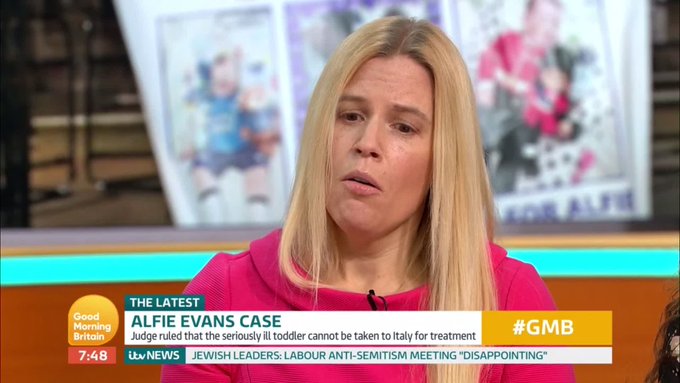

The Catholic Bishops’ Conference of England and Wales released their statement on the dispute between Alder Hey and Alfie’s parents on April 18. They gave the hospital a ringing endorsement, saying that doctors are acting “with integrity and for Alfie’s good as they see it.”
“The professionalism and care for severely ill children shown at Alder Hey Hospital is to be recognised and affirmed,” the bishops added.
Freeman later defended in the show her decision to have a second-trimester abortionwhen she discovered her child had a rare disorder, saying it was in her unborn daughter’s “best interest.”
Alfie Evans, who is just under the age of two, remains in Alder Hey hospital in Liverpool after being removed from his ventilator Monday evening. He defied doctors’ expectations by beginning to breathe on his own.
Parents Tom Evans and Kate James have been fighting every step of the way for their son to be given oxygen, food, and water. They have asked the courts to allow their son to travel to Italy for treatment, but in a series of rulings this week, the courts sided with the hospital. Courts have insisted that the hospital is acting in the boy's "best interest."
Piers Morgan has sided with the parents, saying in a tweet that Alfie is "their" child.
"At least let his parents take him home to die, for goodness sake. He’s THEIR little boy, nobody else’s," he wrote.
Not all of UK’s bishops appear to side with the hospital.
Bishop Philip Egan of Portsmouth tweeted on April 23:
“Let’s offer heartfelt prayers today for little Alfie Evans - now an Italian citizen - and his courageous parents. If there is anything at all that can be done, may the Lord enable us by His love and grace to effect it.”
Subscribe to:
Posts (Atom)