I hate articles like this! It's not as if I don't already have enough to read. However, new suggestions are always welcome to add to my library.
From The Imaginative Conservative
By Joseph Pearce
In “50 Books for Life: A Concise Guide to Catholic Literature,” Roy Peachey demonstrates that he is widely read and is catholic (small “c”) and cosmopolitan (in the best sense of the word) in his reading of literature from beyond the anglophone world. Seldom have I seen a list of books which encompasses so many linguistic traditions.
50 Books for Life: A Concise Guide to Catholic Literature, by Roy Peachey (134 pages, Angelico Press, 2019)
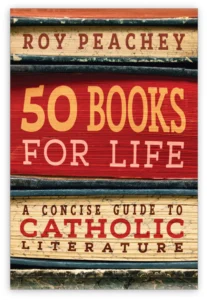 Many of us don’t read as much as we should, or as much as we could, or as much as we might like. Some of us have got out of the habit of reading altogether; or perhaps we only read social media or we only read online. Perhaps we are glued to a screen and never pick up a book. Some of us might be happy with this absence of books in our lives, which is a shame, a crying shame, because it leaves us profoundly impoverished. Those who live without books are depriving themselves of being part of the Great Conversation which really good and great books make possible. This is why we should persuade ourselves and others to read well. As for those who need no persuading but only a little guidance, we should do what we can to help. We should try to assist those who want to start reading well but don’t know where to start. This was what prompted me to write several guides to good reading, such as Literature: What Every Catholic Should Know, Poems Every Catholic Should Know, Poems Every Child Should Know, and Classic Literature Made Simple: Fifty Great Books in a Nutshell. This is also presumably what prompted Roy Peachey to write 50 Books for Life: A Concise Guide to Catholic Literature.
As one who has sought to serve as a literary guide, I always find it intriguing to discover how the guidance of others dovetails with, or differs from, my own. It was, therefore, with a considerable sense of intrigue that I opened the pages of Mr. Peachey’s book.
There is little doubt that Mr. Peachey is a good and worthy guide. He evidently knows the Catholic literary landscape very well. A fellow Englishman, he was educated at Oxford, Lancaster, Nottingham, the Open University, and the University of London. He has degrees in History, English and Chinese Studies, and is currently working on a doctorate in Theology. He has written ten books, the most recent of which, The Garden of Perfect Clarity, his second novel, has been widely and justly praised.
Mr. Peachey’s approach differs in form from my own in the sense that we move in opposite directions chronologically. In Classic Literature Made Simple, I move forward in time, beginning in antiquity with Homer and ending at the very close of the twentieth century with novels by Tim Powers and Michael D. O’Brien; Mr. Peachey drives in reverse, so to speak, beginning in the twenty-first century with Kyung-Sook Shin’s Please Look After Mom, which has won major awards and has sold over two million copies but of which I was previously unaware (mea culpa!), and ending two millennia ago with The Bible. He doesn’t include pre-Christian literature because he is offering a concise guide to “Catholic literature” whereas my book was a guide to “classic literature”.
At first sight, it seems a little odd that only six out of our respective selections of fifty books are identical: Dante’s Divine Comedy, Sir Gawain and the Green Knight, Manzoni’s The Betrothed, Sigrid Undset’s Kristen Lavransdatter, Evelyn Waugh’s Brideshead Revisited and Tolkien’s The Lord of the Rings. We both select works by Chesterton, Flannery O’Connor and George Mackay Brown but not the same works. The main reason for this lack of correlation is not a fundamental difference of taste nor a difference of opinion on what constitutes greatness; it is the selection criteria. He leaves out “classic” works that I included because, presumably, he doesn’t consider them to be “Catholic”. This presumably explains the complete omission of Shakespeare whereas I chose no fewer than eleven of the Bard’s plays. It is interesting that Mr. Peachey seems unaware of the mountain of research pointing to Shakespeare’s Catholicism, not least of which is Shakespeare’s intertextual embrace of the poetry of the Jesuit martyr, St. Robert Southwell, as indicated in allusions to Southwell’s verse in Hamlet, Lear and other plays. Mr. Peachey includes Southwell’s poems in his book but doesn’t seem to see their intertextual presence in Shakespeare’s work. Certainly, for one who has researched and written three books on the evidence, both biographical and textual, for Shakespeare’s Catholicism, it seems odd that the Bard is omitted entirely from any guide to Catholic literature.
A further bona fide reason for the difference in Mr. Peachey’s selection from my own, aside from the distinction between “classic” and “Catholic” literature, is a difference in the definition of “literature” itself. Whereas my selection was strictly literary, including only epics, plays, poetry and novels, Mr. Peachey includes several great books that would normally be taught and studied in theology or history classes, and would not normally be found on literature syllabi. Thus, for instance, he includes St. Augustine’s Confessions, St. John Chrysostom’s Homilies, and St. Bede’s Ecclesiastical History. Their inclusion is fine within the parameters of Mr. Peachey’s selection criteria, though precluded by mine.
Mr. Peachey’s quixotic selection of Chesterton’s book on Dickens, rather than his great novel The Man Who was Thursday, is decidedly odd, as is his agreement with Fr. Ian Ker’s equally odd assessment of Chesterton as being “a fairly slight figure” as an author of fiction. C.S. Lewis, among others, would beg to differ vehemently with such a judgment. Even were we to accept that Chesterton’s fiction is eclipsed by his non-fiction, and even allowing for T.S. Eliot’s great admiration for Chesterton’s book on Dickens, it would surely have been more appropriate to have included Orthodoxy or The Everlasting Man, or Chesterton’s masterful studies of St. Francis of Assisi and St. Thomas Aquinas, rather than his work on the great Victorian novelist.
And speaking of “quixotic” selections, why was Don Quixote not included on the list? And where’s Belloc’s Path to Rome?
Enough! I’m becoming far too curmudgeonly in the expression of my differences with Mr. Peachey’s selection. On a brighter note, it was good to see his inclusion of some great, and greatly neglected, Catholic poets, such as Les Murray and especially David Jones. I could go on, and on and on, and almost all of it would be the singing of Mr. Peachey’s praises. He is clearly widely read and is catholic (small “c”) and cosmopolitan (in the best sense of the word) in his reading of literature from beyond the anglophone world. Seldom have I seen a list of books which encompasses so many linguistic traditions: French, Spanish, Norse, Norwegian, Korean, Polish, Italian, Latin, Japanese. Such a global perspective is to be “catholic” in both senses of the word (upper and lower case “c”). There are several books on this list that I have not read and that I clearly need to read. Mr. Peachey is a first-rate guide and I am deeply grateful for his guidance.
__________
The featured image is “La lecture” (unknown date), by Alfred de Richemont (1857–1911), and is in the public domain, courtesy of Wikimedia Commons.

No comments:
Post a Comment
Comments are subject to deletion if they are not germane. I have no problem with a bit of colourful language, but blasphemy or depraved profanity will not be allowed. Attacks on the Catholic Faith will not be tolerated. Comments will be deleted that are republican (Yanks! Note the lower case 'r'!), attacks on the legitimacy of Pope Leo XIV as the Vicar of Christ, the legitimacy of the House of Windsor or of the claims of the Elder Line of the House of France, or attacks on the legitimacy of any of the currently ruling Houses of Europe.