From The Imaginative Conservative
By Thaddeus Kozinski, PhD
The books we read this past year in the high-school class I dubbed “Evil 12” so accurately portray evil—whether horrific and nightmarish or subtle and uncanny—that they lead the reader to recognize and love goodness all the more. Indeed, each conveys the depths of both evil and goodness in imitation of the Gospel.
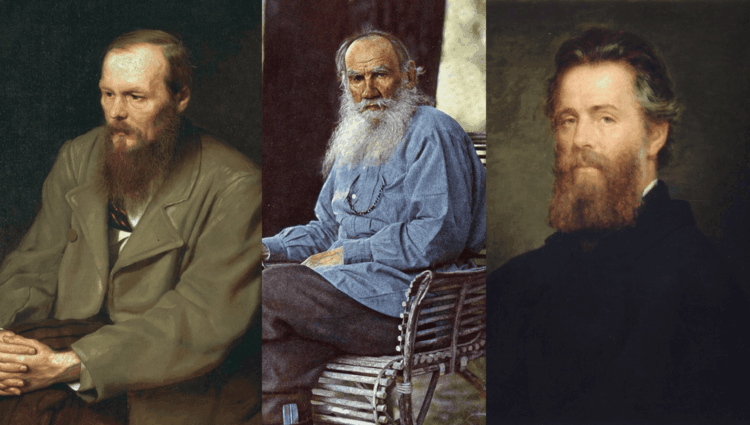 This past year, I taught a course to senior high school students with the generic title of “English 12.” A more fitting title, which I only realized after teaching it, would have been “Evil 12.” It’s not clear whether that title would have scared off or attracted students, so perhaps the generic one was fine. I do not think the original designer of the course planned it this way, and neither did I when selecting some of the texts, but it truly was a year-long crash course on evil, its nature, meaning, causes, effects, and disguises, but most of all, its mystery: Dostoevsky, Tolstoy, Melville, Solzhenitsyn, O’Connor, Frankl, Orwell, Conrad, Kafka, and Shakespeare.
The medieval scholastic definition of evil has never been refuted or surpassed: the absence of what should be present. It is the should that clinches it, for a mere absence of something is not evil. It is not evil that there is an absence of green in the red rose. Green should not be present. That there are real absences in the world, in human actions and lives, in being, goodness, truth, and beauty, absences that are not supposed to be there, is a great mystery. The greatest of beings, goods, truths, and beauties is defined as God, in whom there is and could not possibly be any absence. Everyone, believer or not, ineluctably holds something to be absolute, without absence, perfectly good, and he lives in orientation to it, whether he admits this to himself or not. For the Christian, the absolute and thus greatest of goods is that God became one of us: “And the Word became flesh and dwelt among us, and we beheld His glory, the glory as of the only begotten of the Father, full of grace and truth” (John 1:14). The most incomprehensible thing about this event is that it wasn’t evil. How could the infinite God become a finite man without suffering an absence of what should be present, His divinity, that is, without evil? Only Faith can contemplate this mystery.
The greatest possible good for man, the Incarnation, was followed thirty-three years later by the greatest possible evil of man, an act with the greatest possible absence of what should have been most present. Even the non-believer cannot doubt the enormous evil of this act, for even a purely historical understanding of the event reveals Jesus to be the most innocent man to walk the face of the earth, and that he was killed precisely because of this. And yet, as He died freely and intentionally out of love for human beings, this event of absolute evil was also the greatest act of love possible by both God and man, as He was both. Finally, Christians claim to know—though, again, all the evidence indicates it—this greatest evil, this greatest absence of what should have been present, was followed by an even more and unimaginable perfect presence, the Resurrection, the Risen and Ascended Lord reigning over all for all eternity, yet in our midst even today through the Holy Spirit and the Church that is His Mystical Body on Earth.
The murder of God, Jesus crucified, is thus the defining event, epiphany, and icon of both perfect goodness and absolute evil, containing and determining once and for all the ultimate meaning of good and evil for all time and eternity. One can say that Plato’s Good, the cause and meaning of all existence, descended from the Sun into the Cave as a person, one who lived the perfect human life, and because he was both God and man, that life enabled every human being to escape the cave of sin through participation in that perfection. We, and not just Christians, now know what goodness truly is, a human life of sacrificial love of God and neighbor in imitation of and obedience to the God-man, and thus what evil is, a life of disobedience and hatred of God and neighbor. There can be no greater good for man than salvation, both our own and that of our neighbor, and no greater evil than damnation, both our own and that of our neighbor: “If someone says, ‘I love God,’ and yet he hates his brother or sister, he is a liar; for the one who does not love his brother and sister whom he has seen, cannot love God, whom he has not seen” (1 John 4:20).
Due to the inestimable influence of the Christ event on human consciousness, culture, and history, there is no denying this new and definitive meaning and standard of good and evil, even by the unbeliever, as is made clear by Tom Holland, an agnostic, in his magnificent book Dominion. Non and even anti-Christians may try to create an alternative moral paradigm—and boy have they tried—but what is done is done. The Christ event is seared into the consciousness of man until the end of time. All their attempts throughout history have only foregrounded it all the more starkly. Even if we were to reduce the event to just a story or myth, it is the greatest of them all, one that men cannot forget, for it has permanently changed the moral and spiritual consciousness of humanity. The secular humanist cannot but propose love of neighbor as the highest moral imperative, though he knows not why. As René Girard has taught us, the concern for and defense of the victim is now, and has been since the Gospels triumphed over the Pharisees’ scapegoating lies, the ultimate moral and political priority of the “secular” societies and political orders of the West. Communism, liberalism, transhumanism, and “woke” are just secularized gospels, for they couldn’t exist without the Gospel.
In the plan of God, all human lives are meant to be participations in the life of the God-man, with all our actions incorporated and recapitulated into His one Action. If this is the case, then all imitations of human action, all stories, are just facets and episodes and versions of the story, compared to which the most tragic and comedic of tales are mere trifles. Since the greatest good and the greatest evil occurred simultaneously, we can infer that for humans, after the fall into sin, to learn about goodness, to do good actions, and to become good, we must also learn about and experience evil. Adam and Eve, before their fall, did not have to learn this way, but we cannot return to their unfallen pedagogical mode, though we aspire through grace to experience God intimately as they did by nature. The greatest of stories, then, are those that best imitate the Story, those that not only most powerfully and profoundly incorporate and present both evil and good as they really are, but also allow the reader intimately to experience these so as to love and hate what he ought, which, as Plato and Aristotle taught us, is the definition of the purpose of education.
The books we read this past year in “Evil 12” are some of these greatest of stories, for the evil portrayed in them so accurately, whether horrific and nightmarish or subtle and uncanny, leads the reader to recognize and love goodness all the more. I will say something about each of them, focusing on how they convey the depths of both evil and goodness in imitation of the Gospel. I am presuming the reader’s acquaintance with the basic plots, so I will not go into much detail, and I will be zeroing in on the cruciform teaching of evil in each of them.
What have you done—What have you done to yourself?
Our first book was Dostoevsky’s Crime and Punishment. When we meet Raskalnikov, well before the murder that begins his journey into the depths of evil as well as goodness, he is already in a malaise of darkness, a living hell. If the book were written a hundred years later, his state would have been identified as clinical depression or mental illness, and accurately so, but such pharmacological categories provide a label more than an explanation, for the afflictions of the mind are as mysterious and unfathomable as those of the spirit, which often occur together and cannot be neatly separated. Dostoevsky knew this, and instead of merely labeling or describing, or even trying to explain the cause of Raskolnikov’s condition, he invites us to share in his very consciousness through masterful narrative combining interior dialogue and description:
When he was in the street he cried out, ‘Oh, God, how loathsome it all is! and can I, can I possibly…. No, it’s nonsense, it’s rubbish!’ he added resolutely. ‘And how could such an atrocious thing come into my head? What filthy things my heart is capable of. Yes, filthy above all, disgusting, loathsome, loathsome!—and for a whole month I’ve been….’ But no words, no exclamations, could express his agitation. The feeling of intense repulsion, which had begun to oppress and torture his heart while he was on his way to the old woman, had by now reached such a pitch and had taken such a definite form that he did not know what to do with himself to escape from his wretchedness.
Dostoevsky’s masterful depiction of Raskolnikov’s state invites a variety of “explanations”: mental illness, physical maladies, environmental ugliness, cultural degradation, economic destitution, familial dysfunction, ideological corruption, et. al. And all of these do play a role, as they always do in real life. But the brilliance of Dostoevsky’s characterization is that any of them could account for Raskolnikov, yet none do. Why anyone could be in such a state that murdering someone in cold blood has become a live option, and why one would choose this option, cannot adequately be explained. Surely one could say accurate things about it, involving deep theological, metaphysical, and psychological truths and compelling arguments, but the mystery of evil is beyond academic speech. What Dostoevsky, the novelist, is able to do in narrative form is convey evil’s ineffable mystery that shrouds the explicable, the spiritual residing in the material, the natural charged with the supernatural, the uncanny pervading the ordinary, and the diabolical working with the psychological.
At a certain point before the murder, Raskolnikov overhears a bar conversation about philosophy and becomes completely obsessed with the Nietzschean idea, first articulated by Plato in the Republic through the mouthpiece of Thrasymachus, that “morality” is nothing but a social construct, with right and wrong merely conventional, customary, and arbitrary constraints on human behavior surreptitiouly created by the weak to enslave the strong but feared and revered by all as a sacred and divine authority. Raskolnikov not only entertained the possible truth of this theory but also imagined himself as one of these strong men; he just lacked the courage to realize his true nature by committing an act of sacrilege against the moral law and thereby transcending it. By a sort of evil providence, all the circumstances and events of his life seem inexorably to lead him to the murder of his neighborhood pawn broker as the only way to test his new theory and perhaps escape the living hell of his present life.
The primary and most profound evil is not Raskolnikov’s murder of the miserable and vicious pawn broker, which cannot be excused but can at least be understood as the effect of a temporary ideologically insanity in which it seemed a rational, utilitarian calculus for the greater social good, if not merely to provide for his stuggling widowed mother, but his unplanned murder of her poor, innocent, mentally disabled sister, who was in the wrong place at the wrong time. This heinous act can neither be excused nor understood. It was an act of pure malice, and malice is incomprehensible. Raskolnikov did not want to go to jail and suffer for his crime, so he was in a position to do anything to prevent this—anything. At that moment, “I want” became god for Raskolnikov, the culmination and epiphany of the satanic theology on which he had been meditating for months.
Instead of becoming the Übermensch, Raskolnikov, whose name means “division,” descends into an even deeper hell of soul than the one from which this hellish act emerged. The rest of the book is his journey to redemption, on which the reader meets various “doubles” of Raskolnikov, characters who commit analogous evils and embark on parallel journeys and thus serve as literary mirrors in which both the reader and Raskolnikov can see more deeply into themselves and the intimate connectedness of the human psyche and spirit. These doubles provide the possibility of Raskolnikov’s redemption. Sonia is the most powerful of them all:
She jumped up, seeming not to know what she was doing, and, wringing her hands, walked into the middle of the room; but quickly went back and sat down again beside him, her shoulder almost touching his. All of a sudden she started as though she had been stabbed, uttered a cry and fell on her knees before him, she did not know why. ‘What have you done—what have you done to yourself?’ she said in despair, and, jumping up, she flung herself on his neck, threw her arms round him, and held him tightly. Raskolnikov drew back and looked at her with a mournful smile. ‘You are a strange girl, Sonia—you kiss me and hug me when I tell you about that…. You don’t think what you are doing.’ ‘There is no one—no one in the whole world now so unhappy as you!’ she cried in a frenzy, not hearing what he said, and she suddenly broke into violent hysterical weeping.
“What have you done to yourself?” Raskolnikov could have asked Sonia the same question, for she was a prostitute. Thus, the doubling. But as depicted in this dialogue, Sonia loves Raskolnikov more than herself, and much more than Raskolnikov does himself. It is her love—gratuitous, inexorable, supernatural, mysterious—that continually deflects Raskolnikov from the path of damnation, in contrast to Svidrigailov, another double and mirror, in whom we see a Raskolnikov without a Sonia. Only Sonia’s inexplicable and fathomless goodness can counter and transform Raskolnikov’s inexplicable and fathomless evil, and in the end, both are redeemed.
Ivan Illych: A Most Terrible Life
The safest road to hell is the gradual one – the gentle slope, soft underfoot, without sudden turnings, without milestones, without signposts. —C.S. Lewis
There is no murder in this story, and no satanic theology justifying it. Of course, there is a death in this story, but it is not depicted as evil. On the contrary, death was the best thing that ever happened to Ivan Illyich, for it was his life that was evil:
“Three days of frightful suffering and the death! Why, that might suddenly, at any time, happen to me,” he thought, and for a moment felt terrified. But — he did not himself know how — the customary reflection at once occurred to him that this had happened to Ivan Ilych and not to him, and that it should not and could not happen to him, and that to think that it could would be yielding to depression which he ought not to do.
As we see here, it was not only his life that was evil. His “friends” and even his family members treated him with annoyance at best and contempt at worst during his illness. All his relations, except one:
“Well, friend Gerasim,” said Peter Ivanovich, so as to say something. “It’s a sad affair, isn’t it?”
“It’s God will. We shall all come to it some day,” said Gerasim, displaying his teeth — the even white teeth of a healthy peasant…
Ivan is an upper-middle-class city judge in Russia, and the first half of the novella depicts his climbing of various bureaucratic and social ladders, acquisition of a wife and family, and settling down into the daily tasks and pleasures of a comfortable and pleasant life:
The pleasures connected with his work were pleasures of ambition; his social pleasures were those of vanity; but Ivan Ilych’s greatest pleasure was playing bridge. He acknowledged that whatever disagreeable incident happened in his life, the pleasure that beamed like a ray of light above everything else was to sit down to bridge with good players, not noisy partners, and of course to four-handed bridge (with five players it was annoying to have to stand out, though one pretended not to mind), to play a clever and serious game (when the cards allowed it) and then to have supper and drink a glass of wine. after a game of bridge, especially if he had won a little (to win a large sum was unpleasant), Ivan Ilych went to bed in a specially good humour.
But as Tolstoy describes it: “Ivan Ilych’s life had been most simple and most ordinary and therefore most terrible.” At the pinnacle of his carefully choreographed life of propriety, amusement, and career-advancing sinecures, Ivan falls off a ladder and bumps his side during a bout of obsessive apartment decorating, after which he develops an illness of the kidney that leads to his death. In the months between the fall and his death, we accompany Ivan as he passes through the various psychological and spiritual stages—hope, denial, despair, rage, depression—until hours before his death, after three straight days of agonized screaming, he discovers the meaning of life and makes peace with his death. Only the reader is witness to the transformation.
The evil that Tolstoy portrays so masterfully in the story is the absence of love, a love that should have been present. Ivan and his work, social, and family relations appear to be good people living good lives: educated, prosperous, industrious, cultured, moderate, sensible, and law-abiding. But, as Ivan discovers in his great suffering, when only Gerasim shows him any love and compassion, his life was and had been, since his childhood, completely meaningless. And it was meaningless because it was loveless. His life had everything except that which makes life actually worth living—transcendent purpose, relationships of love, and most of all God. It was surely possible for Ivan to have lived a more meaningful life in his professional, bourgeois urban culture and lifestyle—doing his daily legal work, playing Bridge, going to fancy dinners, decorating his house, etc. Such mundane tasks, humdrum activities, and superficial concerns are the context in which most live out their spiritual lives, and Tolstoy doesn’t mean to imply that one cannot live in the world and not be of it. But Ivan chose to be of the world.
The pleasures, amusements, and goods of the world are not evil in themselves, but are only good as bodily accompaniments for, instruments of, and means to the higher goods of the soul, such as meaning, personal love, virtue, and religion, and even these are only good if they are sought and experienced as mediators and pathways to God. It would be better to have nothing, or even nothing but evils, than to have all goods but not the love of God and neighbor, especially when it is the possession of goods, even if not an excessive amount, that blinds one to the emptiness of them. This was the case with Ivan. It was only when Ivan had nothing but suffering and imminent death that he realized his “good” life was the very apotheosis of evil, for it was a life absent precisely that good which should have been most present. He had a sense of what this good was, something to do with the soul, meaning, love, and God, yet it was vague and abstract, not experimental and visceral. He still did not really know what this good was. He knew it had something to do with Gerasim, who had once allowed Ivan to rest his legs upon his back when the pain was unendurable. But what was it exactly? And why didn’t Ivan know? “In the depth of his heart he knew he was dying, but not only was he not accustomed to the thought, he simply did not and could not grasp it.” The whole purpose of life is to prepare for death, as Plato and all traditional wisdom literature and religions teach. But Ivan had spent his entire life preparing merely for more life, and now that there was no more of it left, he was at a loss to know what to think or do.
Ivan’s final realization before his death, and what saved him from dying unrepentant in despair, is that love is all that matters in life, and it conquers death. This wisdom was his reward for making a last-minute, small but pure act of love, perhaps for the first time in his life, right before he died. Here in Ivan’s death scene we see the juxtaposition and coincidence of evil and good, suffering and love, that is the cruciform essence of both:
At that very moment Ivan Ilych fell through and caught sight of the light, and it was revealed to him that though his life had not been what it should have been, this could still be rectified. He asked himself, “What is the right thing?” and grew still, listening. Then he felt that someone was kissing his hand. He opened his eyes, looked at his son, and felt sorry for him. His wife came up to him and he glanced at her. She was gazing at him open-mouthed, with undried tears on her nose and cheek and a despairing look on her face. He felt sorry for her too.
“Yes, I am making them wretched,” he thought. “They are sorry, but it will be better for them when I die.” He wished to say this but had not the strength to utter it. “Besides, why speak? I must act,” he thought. with a look at his wife he indicated his son and said: “Take him away…sorry for him…sorry for you too….” He tried to add, “Forgive me,” but said “Forego” and waved his hand, knowing that He whose understanding mattered would understand.
And suddenly it grew clear to him that what had been oppressing him and would not leave him was all dropping away at once from two sides, from ten sides, and from all sides. He was sorry for them, he must act so as not to hurt them: release them and free himself from these sufferings. “How good and how simple!” he thought. “And the pain?” he asked himself. “What has become of it? Where are you, pain?”
He turned his attention to it.
“Yes, here it is. Well, what of it? Let the pain be.”
“And death…where is it?”
He sought his former accustomed fear of death and did not find it. “Where is it? What death?” There was no fear because there was no death.
In place of death there was light.
“So that’s what it is!” he suddenly exclaimed aloud. “What joy!”
To him all this happened in a single instant, and the meaning of that instant did not change. For those present his agony continued for another two hours. Something rattled in his throat, his emaciated body twitched, then the gasping and rattle became less and less frequent.
“It is finished!” said someone near him.
He heard these words and repeated them in his soul.
“Death is finished,” he said to himself. “It is no more!”
He drew in a breath, stopped in the midst of a sigh, stretched out, and died.
Bartleby: The Monster of Wall Street
The Death of Ivan Illych is a parable of the spiritual danger of worldliness, but it can also be read as a sociological critique of the soulless bureaucracy of modernity, in which means become ends, power evacuates meaning, rules replace agency, and persons are sacrificed for profit. Herman Melville’s Bartleby the Scrivener: A Story of Wall Street is also a parable and a critique. The object of Melville’s critique is clear, the dehumanizing culture of an incipient corporate capitalism, but the parable is harder to discern.
The plot is quite simple: An elderly business lawyer, the narrator, hires a man named Bartleby as a scrivener, a document copier or law clerk, and a few months into the job, Bartleby stops copying. He does not quit the job, but just copying, or anything else he is asked to do, responding to every task requested of him by his employer with “I would prefer not to.” The rest of the story consists of the narrator’s several failed attempts to remedy the situation, which include Bartleby literally sleeping in the office every evening, culminating in Bartleby being arrested, taken to prison, and dying.
About the recent development of the “white-collar worker” and the “office” in Melville’s time, a recent book notes:
In some heavily mercantile cities, such as New York, they had already become ubiquitous: the 1855 census recorded clerks as the city’s third largest occupational group, just behind servants and laborers. For many, this was a terrible development. Nothing about clerical labor was congenial to the way most Americans thought of work. Clerks didn’t work the land, lay railroad tracks, make ammunitions in factories, let alone hide away in a cabin by a small pond to raise beans and live deep. Unlike farming or factory work, office work didn’t produce anything. At best, it seemed to reproduce things.
Melville’s story certainly does not praise the work of the clerk, but neither does he demonize it. The lawyer and his clerks are depicted as ordinary working men, albeit neurotic ones, and the office is clean and orderly, though lacking a view of the sky and replete with walls, seemingly everywhere. It’s certainly not an exciting, meaningful, or fulfilling job, but it pays the bills better than manual labor and serves an important purpose in the new legal and financial culture of the mid-nineteenth century city. What Melville is trying to convey here is a much more subtle evil. And he does so by creating a monster.
Monsters exist, but only in the mind, for they are representations, symbols, metaphors, not actual persons. The word monster is derived from the Latin monstrare, meaning “to demonstrate,” and monere, “to warn.” Thus, monsters appear when something urgently needs to be shown, when there has been a failure to communicate and understand something of vital importance through ordinary, rational means, such as moral exhortation, custom, law, religion, or conscience. The monster is a warning, either of a past evil that has not been addressed or reckoned with, a present evil that lies hidden or is known but ignored, or a future evil that is bound to arrive if present actions, circumstances, and mindsets do not change for the better. Sometimes the monster embodies all three. The monster can not be reasoned with, ignored, pacified, or killed, and its message is infallibly delivered, because the message is the monster itself. Whether we learn what the monster has to teach us is another story.
Bartleby is a monster, though not a particularly scary or violent one. What is his message to the narrator, and to the reader? What past, present, or future evil does he embody?
The next day I noticed that Bartleby did nothing but stand at his window in his dead-wall revery. Upon asking him why he did not write, he said that he had decided upon doing no more writing.
“Why, how now? what next?” exclaimed I, “do no more writing?”
“No more.”
“And what is the reason?”
“Do you not see the reason for yourself,” he indifferently replied.
The lawyer never answers Bartleby’s question. It is the only question that Bartleby asks in the entire story, and just about the only exception to his repeated refrain of “I would prefer not to.” The reason is not, as the lawyer concludes, that Bartleby is going blind from innumerable hours of constant copying, although that is the case. The reason is that there was never a reason to do any copying in the first place, and thus no reason not to stop copying. Indeed, there was no reason to do anything at all.
And this was true. Bartleby is not only a monster but also a prophet. There is no reason to do anything. Of course, there are reasons why we do things, instrumental, utilitarian, calculative, logical reasons. One could say that our lives are nothing but a long, incessant series of particular acts of practical reasoning: for me to obtain, produce, or do that, I must obtain, produce, or do this. The daily life of a business law clerk is literally nothing but one practical calculation, logical inference, means-to-end-to-means-to-end reasoning after another regarding the legal minutiae of that which is, of all the occupations in the world, the most instrumental, utilitarian, and calculative—business.
So, there were certainly reasons, rational ones, for Bartleby both to begin his copy-work as a law clerk and to continue copying until the day he quit, was fired, or died. However, although the instrumental logic of the law office is clear and compelling—do the copying, and do it using such and such procedures, because it is your job to do the copying, and it is your job because you were hired to do it, and you were hired to do it because you proved you could do it, etc.—work places provide no clear and compelling reason to do anything outside the narrow scope of it’s utilitarian, productive, calculative, and instrumental logic. And this is true for all human occupations and activities. In other words, the reason for engaging in any activity of human life, including the activity of just continuing to live, cannot be provided by the inner logic of that activity, for that logic only applies within the activity itself. If it is a matter of why one should do this or that activity, or anything at all, it is a question not about means but meaning. Practical reasoning can only answer how and provide the means to an end that is always-already given, implicit in but not the product of its reasoning. Activities presuppose but cannot deliver on their own a compelling answer as to why an activity is worth doing. The question of why any activity is worth doing, indeed, why life itself is worth living, must be answered outside of and before practical reasoning, whether in the context of a work environment or personal decision. In the absence of answers as to the end and the why of an activity, there is literally no reason to do it, and in the absence of the answer to the end and the why of life, there is no reason to live.
What we are talking about is meaning. Humans cannot live without meaning, and if they have not discovered a meaning for life that is fulfilling, they resort to ones that are not, with all the dehumanizing and degrading consequences that must ensue. In Melville’s depiction of Wall Street, the work-a-day world of means-to-ends, utility, calculation, and profit has become the locus of meaning for its inhabitants, and though they “function” in that world and continue to do their work, and probably will until the day they die, they exhibit clear signs of bodily, psychological, and spiritual dysfunction. But because they still retain some meaning, however tenuous, ersatz, and unfulfilling, a meaning apart and not derived from the work-a-day world, they can manage to keep going. Bartleby, however, does not function at all, and that is because he has lost all meaning. He is the monster of Wall Street, embodying in his ghost-like indolence, mindless refusal, and indifferent hopelessness a warning to his fellow workers and to the reader. The goodness that accompanies the revelation of evil is precisely the goodness of meaning, which is revealed as such in the utter horror of its complete absence in the monster.
There is literally no reason to do anything, for human life is not reducible to the logic of transaction and exchange, efficiency and productivity, calculation and risk, that is, means-to-end instrumentality. For if there is no end for which all our activities are means, then there are no means either. If everything is just a means, then it is all meaningless. Neither is life merely a matter of getting what one wants, for why do we want anything at all, and what if there is nothing at the end of all our incessant wanting that is worth wanting? Existence is not reasonable, not because it is irrational, but because it is pure gift, which transcends practical reason. Copying documents is only good because something other than copying is good, until we reach the Good itself, which infinitely transcends the order of practical reason of means, activity, and work. Bartleby is the monster that every human being can become when means become ends, when purpose, meaning, and love are eclipsed and replaced by the “rationality” of the work-a-day world. He is not an intimidating, violent, or destructive monster, for he represents the fatal wound of the soul that can only be self-inflicted.
In Part II, we will discuss Solzhenitsyn, O’Connor, and Frankl.
__________
The featured image combines images of Fyodor Dostoevsky (painted by Vasily Perov 1872), Leo Tolstoy (photographed by Sergei Prokudin-Gorskii, 1908), and Herman Melville (painted by Joseph Oriel Eaton, 1870). These files are all in the public domain and appear here courtesy of Wikimedia Commons.

No comments:
Post a Comment
Comments are subject to deletion if they are not germane. I have no problem with a bit of colourful language, but blasphemy or depraved profanity will not be allowed. Attacks on the Catholic Faith will not be tolerated. Comments will be deleted that are republican (Yanks! Note the lower case 'r'!), attacks on the legitimacy of Pope Leo XIV as the Vicar of Christ, the legitimacy of the House of Windsor or of the claims of the Elder Line of the House of France, or attacks on the legitimacy of any of the currently ruling Houses of Europe.