Patience
The musings and meandering thoughts of a crotchety old man as he observes life in the world and in a small, rural town in South East Nebraska. I hope to help people get to Heaven by sharing prayers, meditations, the lives of the Saints, and news of Church happenings. My Pledge: Nulla dies sine linea ~ Not a day without a line.
31 August 2022
31 August, Antonio, Cardinal Bacci: Meditations For Each Day
Eastern Rite - Feasts of 31 August AM 7530
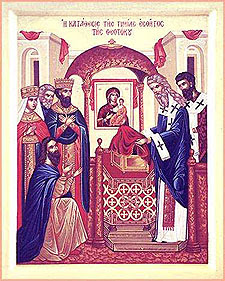
The Placing of the Venerable Belt of the Most Holy Theotokos in a church in Constantinople’s Chalcoprateia district took place during the reign of the emperor Theodosius the Younger. Before this, the holy relic, entrusted to the Apostle Thomas by the Mother of God Herself, was kept by pious Christians in Jerusalem after Her Dormition. During the reign of Emperor Leo the Wise (886-911), his wife Zoe was afflicted with an unclean spirit, and he prayed that God would heal her.
The empress had a vision that she would be healed of her infirmity if the Belt of the Mother of God were placed upon her. The emperor then asked the Patriarch to open the coffer. The Patriarch removed the seal and opened the coffer in which the relic was kept, and the Belt of the Mother of God appeared completely whole and undamaged by time. The Patriarch placed the Belt on the sick empress, and immediately she was freed from her infirmity. They sang hymns of thanksgiving to the Most Holy Theotokos, then they placed the venerable Belt back into the coffer and resealed it.
In commemoration of the miraculous occurrence and the twofold Placing of the venerable Belt, the Feast of the Placing of the Venerable Belt of the Most Holy Theotokos was established. Parts of the holy Belt are in the Vatopedi monastery on Mt. Athos, in Trier monastery, and in Georgia.
Troparion — Tone 8
Ever-Virgin Theotokos, protectress of mankind, / you have given your people a powerful legacy: / the robe and sash of your most honored body which remained / incorrupt throughout your seedless childbearing; / for through you time and nature are renewed! / Therefore we implore you: “Grant peace to your people and to our souls great mercy!”
Kontakion — Tone 4
Today your flock celebrates the enshrinement of your precious sash, / and it earnestly cries out to you: / “Rejoice, O Virgin, boast of all Christians!”
IN LUMINE FIDEI: 31 AUGUST – SAINT RAYMUND NONNATUS (Bishop and Con...
31 August, The Chesterton Calendar
AUGUST 31st
Carlyle said that men were mostly fools. Christianity, with a surer and more reverent realism, says that they are all fools. This doctrine is sometimes called the doctrine of original sin. It may also be described as the doctrine of the equality of men.
'Heretics.'
31 August, The Holy Rule of St Benedict, Patriarch of Western Monasticism
CHAPTER LXXIII. That the whole observance of Perfection is not set down in this Rule
1 May. 31 Aug. 31 Dec.
We have written this Rule, in order that, by observing it in Monasteries, we may shew ourselves to have some degree of goodness of life, and a beginning of holiness. But for him who would hasten to the perfection of religion, there are the teachings of the holy Fathers, the following whereof bringeth a man to the height of perfection. For what page or what word is there in the divinely inspired books of the Old and New Testaments, that is not a most unerring rule for human life? Or what book of the holy Catholic Fathers doth not loudly proclaim how we may by a straight course reach our Creator? Moreover, the Conferences of the Fathers, their Institutes and their Lives, and the Rule of our holy Father Basil - what are these but the instruments whereby well-living and obedient monks attain to virtue? But to us, who are slothful and negligent and of evil lives, they are cause for shame and confusion. Whoever, therefore, thou art that hasteneth to thy heavenly country, fulfil by the help of Christ this least of Rules which we have written for beginners; and then at length thou shalt arrive, under God’s protection, at the lofty summits of doctrine and virtue of which we have spoken above.
1 September, The Roman Martyrology
September 1st 2022, the 5th day of the Moon, were born into the better life:
In the province of Narbonne, the holy Abbot and Confessor Giles.
At Benevento, [in the third century,] the Twelve Holy Brethren Martyrs.
In Palestine, holy Joshua and holy Gideon.
At Jerusalem, the blessed Prophetess Anna, whose holiness is set forth in the words of the Gospel.
At Capua, upon the Aquarian Way, the holy martyr Priscus, who was one of the original disciples of Christ.
At Reims, in Gaul, holy Xystus, a disciple of the blessed Apostle Peter, who was by him consecrated as the first Bishop of that city, and received the crown of martyrdom in the persecution under Nero.
At Todi, in Umbria, [in the second century,] the holy martyr Terentian, Bishop [of that city,] who was racked and tormented with armed whips by command of the Pro-Consul Laetian, under the Emperor Hadrian, whereafter his tongue was cut out and he was condemned to be beheaded, and so finished his testimony.
At Heraclea, [in Thrace,] the holy Deacon Ammon, and the forty holy Virgins to whom he taught the faith, and whom he led with him, under the tyrant Licinius, to the glory of martyrdom.
In Spain, the holy martyrs Vincent and Laetus.
At Piombino, in Tuscany, the holy martyr Regulus, who was martyred there under Totila, on his landing from Africa.
At Sens, [in the seventh century,] the blessed Confessor Lupus, Bishop [of that see,] concerning whom it is said that one day when he was standing at the holy Altar in the presence of the clergy a precious stone fell from heaven into his chalice.
At Capua, holy Priscus, Bishop [of that city.] He was one of those Priests who, in the persecution under the Vandals, were diversely afflicted for the Catholic faith's sake, and were put on board an old ship wherein they came from Africa to the shores of Campania, and being scattered about those parts, and set over diverse churches, they wonderfully spread abroad the Christian religion. His Companions were Castrensis, Tammatrus, Rosius, Heraclius, Secundinus, Adjutor, Mark, Augustus, Elpidius, Canion, and Vindonius.
At Aquino, [in the sixth century,] holy Constantius, Bishop [of that see,] famous for the gift of prophecy, and for many other graces.
At Le Mans, [in the fifth century,] holy Victorius, Bishop [of that see.]
At Baden, in the country of Constance, the holy Virgin Verena.
V. And elsewhere many other holy martyrs, confessors, and holy virgins.
R. Thanks be to God.
30 August 2022
Stubborn Opposition to Vatican II 'Not Catholic' Says Cardinal
How would he know? Roche wouldn't recognise Catholicism if he tripped over a catechism, which is why Francis made him Prefect of the DDW.
From The Tablet
By Christopher Lamb
Cardinal Roche is now the highest-ranking English-born priest to serve in the Roman Curia since Cardinal Rafael Merry del Val.England’s new cardinal says those who are “stubbornly opposing” the liturgical reforms of the Second Vatican Council are in danger of adopting a position that is no longer Catholic.
Cardinal Arthur Roche, the Prefect of the Dicastery for Divine Worship and Discipline of the Sacraments, became the third English cardinal to be created by Pope Francis after he received his red hat during a ceremony in St Peter’s Basilica on 27 August.
Roche was among 20 prelates admitted to the College of Cardinals, with 16 of them under the age of 80 and eligible to vote in a future conclave.
The former Bishop of Leeds has one of the most sensitive and demanding jobs in the Church’s central government, requiring him to work closely with the Pope and with the world’s bishops in overseeing Catholic worship.
A trusted adviser to Francis, the Yorkshire-born church leader was recently named by the Pope as a member of the Dicastery for Bishops, an influential Vatican body which plays a critical role in helping the Pope appoint bishops across the world. When Francis read out the names of the latest batch of cardinals earlier in the year, Roche’s was the first on the list.
But the 72-year-old cardinal has also been under attack himself during a time when, as liturgy prefect, he has been closely involved in re-establishing restrictions on the celebrations of the old rite, the form of worship used by the Church before the reforms mandated by the 1962-65 Vatican council. The new restrictions have been met with a mixture of anger and defiance by some traditionalist Catholics.
According to the new constitution of the Roman Curia, Roche’s department is tasked with promoting the “sacred liturgy in accordance with the renewal undertaken by the Second Vatican Council”. It’s a point the cardinal was keen to emphasise ahead of his elevation.
“The council is the highest legislation that exists in the Church,” he told The Tablet and the National Catholic Reporter. “If you disregard that, you are putting yourself sideways, to the edges of the Church. You are becoming more Protestant than you are Catholic.”
The reforms to Catholic worship decreed by Vatican II, which emerged from a liturgical movement that dates back to the nineteenth century, included a greater emphasis on the active participation of ordinary believers in the liturgy and saw the sacraments no longer only celebrated in Latin but in local languages.
“After two world wars which had been initiated in the heart of Christian Europe, it was obvious that there needed to be an enormous reform within the Church,” Roche said in reference to Vatican II, which began 17 years after the end of World War II.
“That reform is taking place, but it’s a slow process because there are those who are dragging their feet with regard to this and not only dragging their feet but stubbornly opposing what the Church has actually decreed. That’s a very serious matter. In the end, people have to ask themselves: am I really a Catholic, or am I more of a Protestant?”
The pre-Vatican II liturgy requires a priest to say the prayers of the Mass in Latin, often inaudibly, while facing ad orientem (“facing east” and with his back to the people).
Although a significant minority are drawn to its contemplative, “otherworldly” style, celebrations of the older liturgy have also become a rallying point for dissent from the Francis pontificate and opposition to Vatican II.
When the Pope issued his restrictions on the Old Rite, he told the bishops he was seeking to protect the unity of the Church while ending the suggestion there are two different churches with two different liturgies. These restrictions were then followed up with guidelines on how to apply them by Roche’s office.
Nevertheless, supporters of the Old Rite continue to make their case across various media platforms. Two days before the consistory to create the new cardinals, the American actor Shia LaBeouf announced he had been received into the Catholic Church and said that his conversion was partly due to the older, Latin Mass.
He made his remarks in an interview with Bishop Robert Barron, the leader of the Diocese of Winona-Rochester in the United States who established the Catholic media ministry outfit, Word on Fire. LaBeouf, 36, who won a Bafta in 2008, said he experienced the Latin liturgy while preparing to play St Padre Pio in a new film about the Italian saint. He said the Latin Mass affects him deeply “because it feels like they’re not selling me a car”.
Bishop Barron, who has more than three million followers on Facebook, is visiting London next month when he will address an event in Parliament, celebrate Mass at Westminster Cathedral and give a talk to a gathering of more than 1,000 Catholic leaders. The visit, from 11-18 September, is being organised by Catholic Voices in collaboration with Word on Fire.
In response to LaBeouf’s remarks, Cardinal Roche said it is a priest’s job to talk to people about their experiences of the liturgy and that he’d like to know “why he thinks that, what are his reasons for saying that, and what is his experience”. He emphasised that the Mass should be celebrated with “great dignity” and that this is not a trait that only belongs to the older liturgy.
“The Latin Mass is still available in the 1962 Missal for those who wish for that,” he said, adding that Mass celebrated in Latin in the rite of Paul VI (post-Vatican II) should also be more readily available.
At the beginning of the consistory ceremony in St Peter’s Basilica, Cardinal Roche addressed the Pope on behalf of the new cardinals. It is customary for the cardinal who was named first by the Pope to carry out this task.
“Our mission today is to help you carry this cross and not to increase its weight. With great joy, we wish to walk at your side knowing that to you have been entrusted the keys of the Kingdom,” Roche said in front of a packed basilica with 180 cardinals and thousands of pilgrims who had travelled to Rome for the consistory. “From you, Holy Father, we learn to resist the temptation of any narrowness of mind and heart which shrinks to the size of self instead of expanding "to the measure of the fullness of Christ.”
Among those present in the basilica were several government delegations sent to witness the occasion. The United Kingdom delegation included Lord McFall, the Lord Speaker of the House of Lords and a Catholic, and Lord Ahmad, a Foreign Office minister. Cardinal Vincent Nichols of Westminster and several bishops from England and Wales were also in Rome for the ceremony. After the ceremony, they greeted the new English cardinal in the magnificent “Aula delle Benedizioni” (the Hall of Blessings) inside the Vatican’s Apostolic Palace.
The ceremony marked the eighth consistory of the Francis pontificate and once again showed the Pope’s desire to ensure the men who will take part in a future papal election come from a broad cross-section of the global Church. Over the years, he has significantly increased the number of cardinals coming from Asia, Africa and Latin America.
On 27 August, four bishops from countries that had never had cardinals before, including Mongolia, Paraguay, Singapore and East Timor, were given red hats. Archbishop Anthony Poola of Hydeberad India is the first Dalit (from the so-called “untouchable” caste) to become a cardinal, and Dom Leonardo Steiner is the first to lead a diocese in the Amazon rainforest. Also receiving a red hat was the world’s youngest cardinal, Giorgio Marengo, a 48-year-old Italian missionary in Mongolia, and the Bishop of San Diego, Robert McElroy, a bishop from the United States who shares Francis’ pastoral priorities.
Making cardinals is the closest thing a Pope has to succession planning, and Francis has now chosen 63 per cent of the 132 cardinal electors. In his homily, the Pope urged the cardinals to be attentive to the less public but more pastoral elements of their ministry. He reminded them that Cardinal Agostino Casaroli, the influential Cold War-era Vatican diplomat, made weekly visits to juvenile inmates in a Rome prison and even joked about an Italian priest who knew not only all his parishioners' names but also the family dog.
“A man of apostolic zeal is impelled by the fire of the Spirit to be concerned, courageously, with things great and small,” he said before quoting the phrase: “To suffer no restriction from anything however great, and yet to be contained in the tiniest of things, that is divine.” This maxim was composed in 1640 as a way to describe the genius of St Ignatius of Loyola, the founder of the Jesuits.
Cardinal Roche is now the highest-ranking English-born priest to serve in the Roman Curia since Cardinal Rafael Merry del Val served as the Holy See’s Secretary of State from 1903 to 1914. Roche said he felt “very humbled” by his appointment as a cardinal and that it was an “enormous responsibility” as it meant a “broader remit” for advising the Pope.
He said it was a moment for Church leadership to be “more transparent, more open” and ready to build communion. From 29 and 30 August, cardinals from across the world will gather in the Vatican to discuss the Pope’s new constitution on the Roman Curia, which includes a series of landmark reforms.
Cardinal Roche said the new constitution was about the “nature of the relationship of the Pope with the bishops of the world and using his curia to be a bridge between the two”. He said it meant “greater collaboration at the episcopal conference level and individual bishop level with the See of Peter” while emphasising the Church’s missionary nature.
The Circularity of Word Salad Synodality. Walking Together… in a Circle Apparently.
Cardinal Grech's statement may be the stupidest thing I have ever read! You should learn to engage the brain before the mouth, Eminence!
From Fr Z's Blog
I think today’s presser on the Synod (“walking together”) on Synodality (“walking togetherness”) produced the best description of Synodality (“walking togetherness”) so far.
It’s the cirrrrrrcle of liiiiiiife!
Otherwise… maybe it’s this?
In the Inferno, Canto 3, Dante is led by his master Virgil through the Gate of Hell (with its famous inscription) into the Fore-Hell. Fore-Hell is the place of the tepid, who never decided to be either good or evil. Here Dante sees a plain where a vast crowd of souls screaming in agony are stung by wasps, their blood dripping wounds eaten by worms. They are doomed to chase in a circle for all of eternity after a huge whirling banner that has no symbol, no meaning.
I then: “Master! what doth aggrieve them thus,
That they lament so loud?” He straight replied:
“That will I tell thee briefly. These of death
No hope may entertain: and their blind life
So meanly passes, that all other lots
They envy. Fame of them the world hath none,
Nor suffers; mercy and justice scorn them both.
Speak not of them, but look, and pass them by.”And I, who straightway look’d, beheld a flag,
Which whirling ran around so rapidly,
That it no pause obtain’d: and following came
Such a long train of spirits, I should ne’er
Have thought, that death so many had despoil’d.When some of these I recogniz’d, I saw
And knew the shade of him, who to base fear
Yielding, abjur’d his high estate. Forthwith
I understood for certain this the tribe
Of those ill spirits both to God displeasing
And to his foes. These wretches, who ne’er lived,
Went on in nakedness, and sorely stung
By wasps and hornets, which bedew’d their cheeks
With blood, that mix’d with tears dropp’d to their feet,
And by disgustful worms was gather’d there.
There’s some circularity for ya’.
Virgil tells Dante not to acknowledge any of these souls, which is part of their punishment: non-recognition a deserved nobody-ness. This is the consequence of moral cowardice.
And so we return to the Synod (“walking together”) of Bishops in the circularity of a Synod (“walking together”) on Synodality (“walking togetherness”).
BTW… before I leave you to ponder this, demons long to have an identity, and so invoking as “spirits” that which is not God allows demons to attach to the names.
ALA Guide To Grooming Young Readers
From The American Conservative
By Rod DreherDo you work for a library in a small, rural, conservative community? Are you a frontline staff member there, with no managerial or administrative authority? Do you wish you could do more to make your library more inclusive to the LGBTQIA+ community, but meet with resistance?
I hope it’s not just me! I’ve been working as a frontline staff member at a small town library for nearly a decade. I have struggled with trying to affect positive change at my library in the area of inclusivity. It can be disheartening to feel you’re not supported by your library, and by extension the community that library serves. You feel like you should just give up on advocacy. But you shouldn’t.
There all small things you can do to welcome LGBT folks into your library, small steps you can take to move your library and community progressively forward. Here are a few things I’ve done, that will hopefully inspire those in similar positions and locales to keep fighting the good fight.
More:
Sneakily fit stuff into current programs. So you’re not doing Drag Queen Storytime (yet), but you’re probably doing Regular Old Storytime, right? Try to “sneak” inclusive messages into your current programs. For instance, if you’re reading a book about a Mama bear and a Papa bear, maybe when you read it you just change it to be about 2 Papa bears! Or if you’re reading a book about a rabbit who likes to get dirty and play sports, maybe when you read it you pointedly say it’s a girl rabbit. If there are characters in a book where the gender is unidentified or irrelevant, feel free to play and change it up! Chances are kids and families won’t even notice, but for that same-sex family or gender-nonconforming child who does, it will really mean a lot to them to know their librarian has their back.
And:
Don’t give up. This is the most important lesson I can impart upon you. For instance, when you ask “Can I do a GLBT Book Month display in June?” And your supervisor says “No.” Or “Think of the children.” Or “Customers will complain.” Or “Why? There are no gay people here our town.” You could very easily be discouraged. (And angry.) (And confused. Don’t they know every Thursday is gay night at the town pub?) But don’t stop asking. Ask next year, and the year after that, and the year after that. One year they might say yes. And the year after that they might say “Sure you can do that again.” And it might become a tradition, and every year you can put up more rainbow flags than the year before. The only way you’ll find out is if you continue to be persistent. And if you’re thinking a display is a trivial example, it’s not really: A warm and friendly display can be welcoming to the LGBT folks in your community, who probably currently feel unwelcome, and it’s a simple thing to start with. Sure, you want to eventually get to Drag Queen Storytime, but you should start with something simple!
This was a few years ago. When people started to complain, the ALA removed the byline of librarian Tess Goldwasser from the piece.
Like I said, this isn't brand new, but it's still up on the ALA site, on its diversity blog, where you can find all manner of ultra-wokeness. There is, of course, no reason to believe this kind of activism has gone away. In fact, as has been well documented, now public schools have taken up the practice of secretly encouraging kids to embrace their supposed queerness.
It's really something to think about what a violation of the public trust all this is. These are public employees, meant to staff and administer public institutions. Yet they openly want to subvert the values of that same public, when it comes to sexuality. Do they not fear alienating the people who pay their salaries? I guess not. Nobody has ever made them pay a price for their lying for the sake of colonizing the minds of children.
Why should anybody trust these people anymore? If this were a secret plan to put Christian content into the kids' stacks at the public library, people would be angry. But when it's the religion of the ruling class, crickets.
UPDATE: A reader writes:
As a former librarian, it’s truly sad what’s happened in the profession. Once upon a time, the professional expectation most librarians would have had of themselves is to present both sides of an issue, especially one causing the amount of discussion and social upheaval this one is. So, maybe you do buy some books that are pro-trans ideology if they’re likely to be read in your community, but you balance that with Abigail Schrier and Helen Joyce and display them together so people could read both if they choose and make their own minds up. But then, the ALA, for all its talk about book banning and freedom to read, said nothing about the campaign to make Irreversible Damage disappear. Truly disappointing abdication of responsibility and a faster slide into cultural irrelevance.
On the issue of school libraries and explicit materials, school libraries are (were once?) understood to be a different institution than the more open public library. It’s an extension of instruction and subject to the mission of the school, so while that mission might differ from school to school, it’s hard for me to envision a school where an explicitly illustrated, first-person, marginal-quality graphic novel about the coming out experience of the writer would serve the educational mission of a school. There are plenty of books that explain sexuality in age-appropriate terms without illustrated sex acts, but once again I would ask if I were developing that collection whether sexuality is even a topic I really needed to focus on at all, and a piece of popular fiction likely isn’t how I’d do it.
In short, a school library has a different mission than a public library, so I don’t buy the excuse that “we needed to have it in case a student wanted to read it.” A librarian can exercise their judgment based on quality, school mission, and age appropriateness of the books they buy.
Lessons of an Anglican Split
'The creation of a new Anglican diocese in Australia offers Catholics a glimpse of a future we do not want'. 'Synodality' at work. This should be an object lesson to Francis and the Bishops of Australia.
From The Catholic Weekly
By Msgr Harry Entwistle
Last week a gathering of Anglicans from the Pacific Region began their Conference in Canberra by announcing the creation of a new Anglican Diocese of the Southern Cross with former Archbishop of Sydney, Dr Glenn Davies as bishop. This diocese is not part of the Anglican Church in Australia but linked to the majority of the world’s Anglicans through the Primates Council of the GAFCON network. This network held its first gathering in 2008 in response to the consecration of a same-sex partnered bishop in the USA and the blessing of same sex unions in Canada.
Evangelicals in Australia hoped that the Anglican Church resist this path but those hopes were finally dashed at the Anglican Synod earlier this year when the bishops refused to acknowledge the biblical teaching that Christian marriage is a union between a man and a woman.
The realisation that the Anglican Church will continue to embrace the ‘progressive’ ethical and moral values of the secular world and shape their understanding of Scripture accordingly, has prompted some evangelicals to link themselves to others who share their views.
Divisions in Anglicanism are not new. Ever since the Reformation there has been differing factions within Anglicanism. There has been those who have held on to their Catholic sacramental and ecclesiological heritage as best they could, the Calvinist/evangelical faithful for whom the Scriptures are the sole authority in faith, and the broad church faithful who are anti-dogmatic liberals.
Over the centuries the evangelicals have been dominant and have frustrated the numerous attempts by the Catholic wing to reunite with Western Catholicism. In more recent times the broad church or “progressive liberals” have been the main influence in the western Anglican world while the evangelicals have maintained dominance in Africa, South America and Asia which account for the majority of Anglicans live.
The Anglican Church has a flair for maintaining an exterior veneer of unity while being riddled with interior dissent. They call it, “living with differences” which in reality means that the most powerful group suppresses all dissent by declaring that unity is more important than truth.
When the Anglican Church ordained women to the priesthood and episcopacy some Catholic minded faithful (including myself) saw this as the trigger to redouble their efforts to reunite with Rome. The deeper reason was that ordaining women was believed to be the first step by the Anglican Church to abandoning any credible claim to Catholicity.
The evangelicals had different reasons for not supporting the priestly ordination of women so were content to remain within the Anglican Church at that time. The result of the Catholic minded Anglican approach to Rome was the invitation by Pope Benedict XVI to erect a new diocese-like structure known as an Ordinariate.
Within this structure, former Anglicans could enter into the fullness of Catholic unity while maintaining the distinctiveness of some of their English Spiritual tradition and expressing that tradition through an approved form of the Roman Rite. The Ordinariate of Our Lady of the Southern Cross was erected in Australia in 2012.
Within the past ten years Catholic minded Anglicans and evangelical Anglicans have split from the Anglican Church. The Catholics have come “back home” to Rome. The evangelicals, who despite sharing very similar moral and social teaching views to Catholics, are highly unlikely to join the Ordinariate. The reason for both these splits is the belief that the Anglican Church has abandoned God’s truth as revealed in Jesus, Scripture and Tradition.
The history of God’s people reveals that whenever they distanced themselves from God, his Law and the teaching of the Church by embracing the culture of the secular pagan world, they have been judged, punished and eventually restored after being reconciled to God. Is this why splits have occurred and Anglicanism is crumbling?
The exit of Anglican Catholics has resulted in the demise of any serious Catholic thread in Anglicanism and the erection of the Diocese of the Southern Cross will significantly weaken Australian Anglicanism. It has taken a while but the veneer of Anglican unity has been trampled under the foot of Truth.
We Catholics need to learn from this sad development because it is clear that within the Catholic Church, including Australia, there are voices whose agenda is to push the Church down the same ‘progressive’ road by adopting a diluted doctrine, secular morality and corporate structures that are accelerating the demise of the Western Canterbury Communion.
If we don’t learn, the virus of schism will surely infect the Catholic Church.
The Way of the Cross During Pandemic
Lecture Twenty-Five in the Quarantine Lectures, with Dr Jody Vaccaro Lewis, MA, PhD, Assistant Professor of Sacred Scripture and Patrology, Pontifical Faculty of the Immaculate Conception, Washington, DC.
National Summorum Pontificum Pilgrimage From the Arlington Cathedral to the Washington Cathedral, September 17, 2022
If you're in the Washington, DC area, clear your calendar for Saturday, 17 September! Be in Arlington by 09.00!
From Rorate Cæli
An Incredibly Stupid Answer to a Smart Question
Roche has never struck me as the sharpest knife in the drawer, but he is a 'yes man' which makes him perfect as Francis's hatchet man against Tradition.
From Southern Orders
By Fr Allan J. McDonald
Crux interviewed Cardinal Roche and His new Eminence gives a stupid answer to a smart question. I am glad that Ms. Allen asked this question, because of all the papal talk about dialogue and bridge building really rings hollow when it comes to a small minority of lay and clerical Catholics who want the ability to have what two great popes allowed, the 1962 Roman Missal and other sacramental celebrations associated with that era of the Church.
Two popes graciously allowed these celebrations and bishops, clergy and laity ran with the ball given to them only to have a curmudgeon cancel that culture and permission and without dialogue.
So, Miss Allen, a very good question, a smart one, at that, only to receive a bad answer from the new Cardinal, a stupid answer at that!
Who has polarized the traditional Mass community? Who is polarizing the Church? The one doing it and those who support him, blame the victims rather than the catalyst for it. This is typical in the abuse history of the Church.
Pope Francis could have easily modulated the celebration of the older liturgical books in various minority communities challenging them to accept Vatican II as it is written and encouraging them to be less strident in expecting the older books to eclipse the new Tradition of the modern liturgical “traditions” which definitely need to be reformed too as Pope Emeritus Benedict indicated.
Canceling Pope Saint John Paul II’s and Benedict’s liturgical directions is a scandal, pure and simple and causes the disunity we now see as well as anger:
I have a question that might be a little uncomfortable, but it should be asked. You mentioned unity and bridge-building. How does this bridge-building apply to those who are perhaps wounded by the restrictions of the Traditional Latin Mass?Well, there isn’t too much of a restriction. The Latin Tridentine Mass, or the Mass from the 1962 missal, is still available. But you know, you touch this area, and everyone starts screaming. That should tell us something straight away. What is this, that’s almost becoming hysterical? Because the Church has decreed at its highest level of legislation, which is a council, an ecumenical council, it has decreed that the liturgy should be reformed, reformed for the present day so that it actually speaks as a vehicle of evangelization, as well as being, most importantly, the center of our worship of God, as a community, in charity.
It’s important to get the fundamental things right first, before they’re politicized, and I think there’s a lot of politicizing of this issue, which is unworthy, really.
Is it possible to build-bridges with this element of politicization at play, or is it too difficult, in your view?
All I can say is that my dicastery is very open to talking to people, and that during the course of this past year, since the publication of Traditionis Custodis, I have received so-called ‘traditionalist’ groups, but we’ve got to be very careful, because the Church passes on the tradition, and it’s the Church that makes the tradition, it’s not people in lobbies that create the tradition, but it’s the Church in faithfulness to that.
I always think that, for me as an English man, a great example to me is our history, our Reformation history, where our young priests were tortured and very cruelly executed for two things: for the Mass, and in faithfulness to the See of Peter, in faithfulness to the pope. Whenever we celebrate Mass, we always mention as a point of unity, first that we’re in union with the pope, and second that we’re in union with the bishop, who is in union with the pope.
If you take that seriously, then it raises for all of us an examination of conscience with regard to how we view that: Is that really something that we view seriously, or are we trying to create another Church? Are we trying to be Protestant instead of Catholic?
The Vatican Just Endorsed The Greatest Evil Of Our Time
A Pontifical Academy founded by John Paul II rejects the most obvious, basic tenets of the faith while a Vatican cardinal tells people to be nice to the heretical German synodal way.
Off the Menu: Episode 241 - Gabor Boy
Topics include the Catholic Queens, Catharine of Aragon and Mary, Queen of Scots.
0:00 Intro 0:25 Borscht 5:00 Calendar/Ukraine 20:00 Lightning Round 31:20 Georgia 37:00 Austria Military 43:00 Catherine of Aragon 45:00 Mary Queen of Scots 47:50 Tito 50:00 Heirs & War 57:00 Reclaiming the Cities 1:15:00 Closing Thoughts
Liturgical Shipwreck 25 Years of the New Mass 1969-1994 - Part XI
Not only does the Congregation's editorial, which has just been cited [cf. pp. 30-31], accept the fact that abuses have become institutionalized and are accepted as the rule by the present generation, which has known nothing else, but it included another admission, the importance of which it would be impossible to exaggerate: It acknowledges that "the credibility of the liturgical reform is being put in jeopardy" [La credibilita della riforma liturgica venga posta in pericolo]. I would differ from the assessment of the Congregation and insist that the credibility of the liturgical reform has long passed the situation of being in danger. Any credibility that it ever possessed has long been totally and irrecoverably lost.
Archbishop Marcel Lefebvre once observed that, in the midst of the present crisis, the future of Catholicism lies in its past. This is certainly the case where the future of the Roman liturgy is concerned. The imposition of an artificially concocted, ecumenically tainted rite of Mass in place of the Mass of all ages must be considered as an historical aberration which can only be corrected by restoring that liturgy which developed and endured for more than nineteen centuries as the liturgy that will form the basis of the Church's worship also in the twenty-first century.
Is this an illusion or just wishful thinking? Far from it! It now seems likely that at the turn of the century, in France at least, the majority of the faithful who still assist at Mass on Sunday will be assisting at a Tridentine Mass. Where the Eldest Daughter of the Church leads, may not other countries follow? It would be less than honest to pass over the fact that the majority of French Catholics who assist at the Traditional Mass on Sundays do so in chapels of the Society of St. Pius X and that this will be even more the case in the future if the number of priests ordained from its seminaries increases. Despite the "excommunications" of 1988, the Society is flourishing more now than ever before and as of 1994 has six thriving seminaries. The judgment of the Congregation for the Doctrine of the Faith in declaring null and void the Honolulu "excommunication" of six Catholics for "schismatic activities" which included supporting "the Pius X schismatic movement" and procuring the services of an "excommunicated Lefebvre bishop" to perform Confirmations 40 has proved what those with a modicum of theological or canonical literacy have always known, that in the present state of ecclesiastical anarchy, the faithful can by no means be termed schismatic if they resort to the Society of St. Pius X chapels, because they know of no other means of obtaining access to the Traditional Mass, to which they have a right-----or, for that matter, no other means of taking part in any other form of reverent Catholic worship. During a state of emergency in the Church-----and there can be no doubt that such a state prevails throughout most of the Western World today-----Catholics are entitled to act outside the normal structures of the Church when they are convinced that this is necessary in order for them to keep their faith, and such action cannot in the furthest stretch of imagination be considered schismatic, providing that they recognize the authority of the Pope and do not intend to separate themselves from the Church. This applies not only to the Society of St. Pius X, but to the many so-called "independent priests" of exemplary orthodoxy. Yet at the same time we must pray earnestly that it will be made possible for the Society and these independent priests to work within the official structures of the Church at the earliest possibility. In this regard, a great deal will depend upon the next pontificate.
The Degrees of Humility
Since Bishop Challoner's Meditation for today is on the degrees of humility, I thought it would be apt to share St Benedict's 'Humility' from the Rule. Here are the twelve degrees of humility as laid out in Chapters of the Rule read from 25 September until 10 October:
From The Holy Rule of St Benedict, Patriarch of Western Monasticism
The Holy Scripture crieth out to us, brethren, saying: “Every one that exalteth himself shall be humbled, and he who humbleth himself shall be exalted.” In saying this, it teacheth us that all exaltation is a kind of pride, against which the prophet sheweth himself to be on his guard when he saith: “Lord, my heart is not exalted nor mine eyes lifted up; nor have I walked in great things, nor in wonders above me.” For why? “If I did not think humbly, but exalted my soul: like a child that is weaned from his mother, so wilt Thou requite my soul.” Whence, brethren, if we wish to arrive at the highest point of humility, and speedily to reach that heavenly exaltation to which we can only ascend by the humility of this present life, we must by our ever-ascending actions erect such a ladder * as that which Jacob beheld in his dream, by which the angels appeared to him descending and ascending. This descent and ascent signifieth nothing else than that we descend by self-exaltation and ascend by humility. And the ladder thus erected is our life in the world, which, if the heart be humbled, is lifted up by the Lord to heaven. The sides of the same ladder we understand to be our body and soul, in which our divine vocation hath placed various degrees of humility or discipline, which we must ascend.
The first degree of humility, then, is that a man, always keeping the fear of God before his eyes, avoid all forgetfulness; and that he be ever mindful of all that God hath commanded, bethinking himself that those who despise God will be consumed in hell for their sins, and that life everlasting is prepared for them that fear Him. And keeping himself at all times from sin and vice, whether of the thoughts, the tongue, the hands, the feet, or his own will, let him thus hasten to cut off the desires of the flesh.
Let him consider that he is always beheld from heaven by God, and that his actions are everywhere seen by the eye of the Divine Majesty, and are every hour reported to Him by His angels. This the prophet telleth us, when he sheweth how God is ever present in our thoughts, saying: “God searcheth the heart and the reins.” And again “The Lord knoweth the thoughts of men.” And he also saith: “Thou hast understood my thoughts afar off”; and “The thought of man shall confess to Thee.” In order, therefore, that he may be on his guard against evil thoughts, let the humble brother say ever in his heart: “Then shall I be unspotted before Him, if I shall have kept me from mine iniquity.”
We are, indeed, forbidden to do our own will by Scripture, which saith to us: turn away from thine own will. And so too we beg of God in prayer that His will may be done in us. Rightly therefore are we taught not to do our own will, if we take heed to the warning of Scripture: “There are ways which to men seem right, but the ends thereof lead to the depths of hell”; or, again, when we tremble at what is said of the careless: “They are corrupt and have become abominable in their pleasures.” And in regard to the desires of the flesh, we must believe that God is always present to us, as the prophet saith to the Lord: “O Lord, all my desire is before Thee.”
Let us be on our guard, then, against evil desires, since death hath its seat close to the entrance of delight; wherefore the Scripture commandeth us, saying: "“Go not after thy concupiscences.” Since, therefore, “The eyes of the Lord behold the good and the evil,” and “The Lord is ever looking down from heaven upon the children of men, to see who hath understanding or is seeking God, and since the works of our hands are reported to Him day and night by the angels appointed to watch over us; we must be always on the watch, brethren, lest, as the prophet saith in the psalm, God should see us at any time declining to evil and become unprofitable; and lest, though He spare us now, because He is merciful and expecteth our conversion, He should say to us hereafter: “These things thou didst and I held my peace.”
The second degree of humility is, that a man love not his own will, nor delight in fulfilling his own desires; but carry out in his deeds that saying of the Lord: “I came not to do mine own will, but the will of Him Who sent me.” And again Scripture saith: “Self-will hath punishment, but necessity wins the crown.” *
The third degree of humility is, that a man for the love of God submit himself to his superior in all obedience; imitating the Lord, of Whom the apostle saith: “He was made obedient even unto death.”
The fourth degree of humility is, that if in this very obedience hard and contrary things, nay even injuries, are done to him, he should embrace them patiently with a quiet conscience, and not grow weary or give in, as the Scripture saith: “He that shall persevere to the end shall be saved.” And again: “Let thy heart be comforted, and wait for the Lord.” And shewing how the faithful man ought to bear all things, however contrary, for the Lord, it saith in the person of the afflicted: “For Thee we suffer death all the day long; we are esteemed as sheep for the slaughter.” And secure in their hope of the divine reward, they go on with joy, saying: “But in all these things we overcome, through Him Who hath loved us.” And so in another place Scripture saith: “Thou hast proved us, O God; Thou hast tried us as silver is tried by fire; Thou hast led us into the snare, and hast laid tribulation on our backs.” And in order to shew that we ought to be under a superior, it goes on to say: “Thou hast placed men over our heads.” Moreover, fulfilling the precept of the Lord by patience in adversities and injuries, they who are struck on one cheek offer the other: to him who taketh away their coat they leave also their cloak; and being forced to walk one mile, they go two. With Paul the Apostle, they bear with false brethren, and bless those that curse them.
The fifth degree of humility is, not to hide from one’s Abbot any of the evil thoughts that beset one’s heart, or the sins committed in secret, but humbly to confess them. Concerning which the Scripture exhorteth us, saying: “Make known thy way unto the Lord, and hope in Him.” And again: “Confess to the Lord, for He is good, and His mercy endureth for ever.” So also the prophet saith: “I have made known to Thee mine offence, and mine iniquities I have not hidden. I will confess against myself my iniquities to the Lord: and Thou hast forgiven the wickedness of my heart.”
The sixth degree of humility is, for a monk to be contented with the meanest and worst of everything, and in all that is enjoined him to esteem himself a bad and worthless labourer, saying with the prophet: “I have been brought to nothing, and I knew it not: I am become as a beast before Thee, yet I am always with Thee.”
The seventh degree of humility is, that he should not only call himself with his tongue lower and viler than all, but also believe himself in his inmost heart to be so, humbling himself, and saying with the prophet: “I am a worm and no man, the shame of men and the outcast of the people: I have been exalted, and cast down, and confounded.” And again: “It is good for me that Thou hast humbled me, that I may learn Thy commandments.”
The eighth degree of humility is, for a monk to do nothing except what is authorised by the common rule of the monastery, or the example of his seniors.
The ninth degree of humility is, that a monk refrain his tongue from speaking, keeping silence until a question be asked him, as the Scripture sheweth: “In much talking thou shalt not avoid sin”: and, “The talkative man shall not be directed upon the earth.”
The tenth degree of humility is, that he be not easily moved and prompt to laughter; because it is written: “The fool lifteth up his voice in laughter.”
The eleventh degree of humility is, that when a monk speaketh, he do so gently and without laughter, humbly, gravely, with few and reasonable words, and that he be not noisy in his speech, as it is written: “A wise man is known by the fewness of his words.”
The twelfth degree of humility is, that the monk, not only in his heart, but also in his very exterior, always shew his humility to all who see him: that is, in the work of God, in the oratory, in the monastery, in the garden, on the road, in the field or wherever he may be, whether sitting, walking or standing, with head always bent down, and eyes fixed on the earth, that he ever think of the guilt of his sins, and imagine himself already present before the terrible judgment-seat of God: always saying in his heart what the publican in the Gospel said with his eyes fixed on the earth: “Lord, I a sinner am not worthy to raise mine eyes to heaven.” And again, with the prophet: “I am bowed down and humbled on every side.”
Having, therefore, ascended all these degrees of humility, the monk will presently arrive at that love of God which, being perfect, casteth out fear: whereby he shall begin to keep, without labour, and as it were naturally and by custom, all those precepts which he had hitherto observed through fear: no longer through dread of hell, but for the love of Christ, and of a good habit and a delight in virtue which God will vouchsafe to manifest by the Holy Spirit in his labourer, now cleansed from vice and sin.
French Bishop Has Guts To Suspend Priest for Being a Mason
From 2013, a Bishop actually willing to defend the Faith against the machinations of the 'Synagogue of Satan' (not my words, but those of Bld Pius IX in his Encyclical Etsi Multa - On the Church in Italy, Germany and Switzerland.)
From Catholicism.org
By Brian Kelly
Finally! Now, at last, we have one bishop, Yves Boivineau of Annecy (the same diocese as Saint Francis de Sales, when he was in exile from Geneva) who has taken action, under the pope’s prompting, against the conspiracy to destroy the Church from within. He has dutifully suspended Father Pascal Vesin, an open member of the Grand Orient of France. About forty years ago, the late Canadian Cardinal Edouarde Gagnon (+2007), Bishop of St. Paul, Alberta, was assigned by Pope Paul VI to investigate the infiltration of the Freemasons into the Vatican, but nothing ever came of it. Gagnon was head of the Pontifical Council for the Family from 1974-1990. His dossier on the conspiracy was buried. I don’t have time to fill in the details but a Google search for Gagnon and Freemasonry will provide the facts (or read Fr Charles Murr's recent book, Murder in the 33rd Degree, which gives all the details.-JW)
From CNA
CNA: Bishop Yves Boivineau of Annecy in southeastern France has barred a local priest from public ministry after he was exposed as an active Freemason.
Father Pascal Vesin, 43, was suspended for his active membership in a Masonic lodge of the Grand Orient of France. He became a member in 2001, five years after his 1996 ordination as a Catholic priest, the French newspaper Le Figaro reports.