All I can think of when I hear his name is Monty Python's song: "Heidegger, Heidegger, a boozy beggar who could think you under the table".
From The Imaginative Conservative
By Arthur Hippler
The recovery of ancient philosophy as a means for questioning our basic assumptions about the world of our experience, assumptions hardened by modern philosophy and modern science, is nothing less than a recovery of “wonder” as fundamental to philosophy.
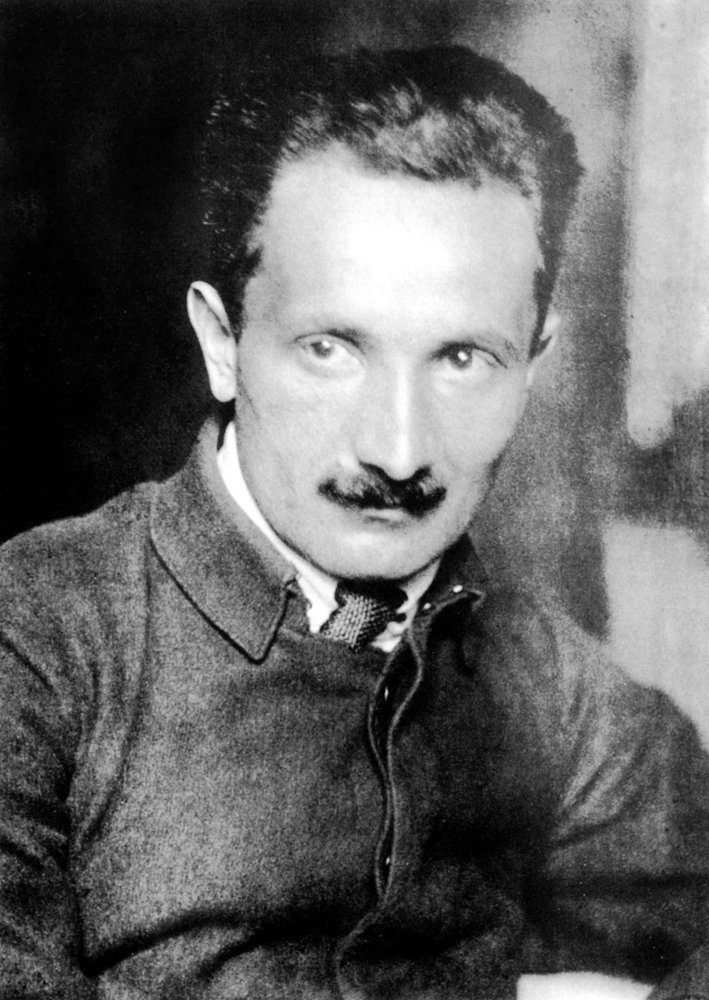
Martin Heidegger
“The more strongly I get into my own work, the more securely I am invariably forced back to the great beginnings among the Greeks. And frequently I hesitate over whether it would not be more essential to abandon all my own attempts and merely make sure that this world does not become only a pale tradition, but that it once more stands before our eyes in its exciting greatness and exemplariness.” (Martin Heidegger, Letter to Elisabeth Blochman, 12/19/1932)[1]
Heidegger is the unnamed source of the Great Books approach to learning at St. John’s College, and by extension, Thomas Aquinas College. The “Great Books” curriculum presupposes that authors are not “right” because they are modern, “ignorant” or “backward” because they are ancient. But this presupposition, so obvious to students of a Great Books program, was pioneered in the 20th century by Heidegger, through whom, as Hannah Arendt recalled, “the cultural treasures of the past, believed to be dead, are being made to speak.”[2] Jacob Klein, for his part, said of his study with Heidegger, “When I heard him lecture, I was struck by one thing: that he was the first man who made me understand something written by another man, namely, Aristotle.”[3]
Before Heidegger, Plato and Aristotle were largely seen as worth studying only for “intellectual history” – as museum pieces. At best, they could offer “cultural ideals,” but they could not challenge modern assumptions of what is “factual.” One of the best examples of this period was Werner Jaeger’s magnum opus, Paideia: the Ideals of Greek Culture. The volume on Plato is entitled “Conflict of the Cultural Ideals in the Age of Plato.” To use the language of Max Weber, outside of science there are no “facts” but only “values,” – opinions about what is good and bad, noble and base. Philosophy is not science and hence only provides “values” or more generally, “worldviews” that create “values.”
Heidegger flatly rejected this description of philosophy. The whole point of reading Plato, Aristotle and the other ancient philosophers is to make our modern assumptions “questionable”: “Ancient texts are monuments that evoke thinking – we are not learning about the past, but rather forcing the present back on itself to intensify its questionability.”[4] Indeed, “In studying ancient texts we are repeating in an original manner what is understood in the past for the sake of one’s own situation.”[5] The confidence that modern people have in their scientific understanding conceals a whole set of unquestioned assumptions: “Only a self-complacent modernity lapsed into barbarism can wish to make us believe that Plato, as it is tastefully expressed, is done for.”[6] Modern scholarship in ancient philosophy exacerbates this by recreating Plato as a “man of his time” who has nothing to say to the present. For Heidegger, it is a “Platonism of barbarians” that attempts to interpret Plato apart from these “authentic roots of Plato’s thought,” that is, “the original situation in which Plato carried out his mode of questioning, setting up starting points, and making claims to knowledge.”[7]
How could Plato allow us to make our own situation “questionable”? It would allow us to see that we have a “cave” of modern thought, not with shadows from Homeric poetry, but the assumptions of modern science.[8] By “modern science,” Heidegger means not just the science of his own day, but fundamentally, the whole project initiated by Descartes.[9] Heidegger says of Descartes Rules for the Direction of the Mind “Only one who has really thought through this relentlessly sober volume long enough, down to its remotest and coldest corner, fulfills the prerequisite for getting an inkling of what is going on in modern science.”[10] Jacob Klein’s Greek Mathematics and the Origins of Algebra can be understood as the fulfillment of this reflection. As Klein himself observes at the opening of his book, “The intimate connection of the formal mathematical language with the content of mathematical physics stems from the special kind of conceptualization which is a concomitant of modern science and was of fundamental importance in its formation.”[11] We take the Cartesian “conceptualization” of the universe largely for granted. We think of things as “real” the more that they are quantifiable and measurable: “Mathematical knowledge is regarded by Descartes as the one manner of apprehending entities which can always give assurance that their Being has been securely grasped.”[12]
Platonic questioning however would not allow us to take modern science and the modern philosophy that gave rise to it as “given.” If we are to understand the various disciplines that we consider knowledge, this requires “constant checking and cross checking” which the “Platonic dialogues, in the life of speech and counter speech, are particularly suited to carry out.”[13] If we look for a “teaching” in the dialogues at the expense of having our own assumptions challenged, we miss their unique advantage for us: “One can understand the inner greatness, e.g. of the Platonic dialogues, only if one follows the way in which the many intertwined and seemingly empty debates about words steer toward this abyss [of questionability], or more precisely, how they hover over it, thus bearing the whole disquiet of the primary and ultimate philosophical problems.”[14] In every dialogue, “we would do well to put aside for the moment our seemingly greater sagacity and our superior air of ‘knowing all about it already’.”[15]
Since the study of ancient texts should make our modern assumptions “questionable,” this will apply in particular to the way the tradition communicated those texts. In our reading of Plato, we should resist receiving a textbook “theory of ideas,” which is certainly “Platonism” but not clearly “Plato.”[16] Such an interpretation fails to serve the purpose of drawing the reader into the “disquiet” of the dialogues. Any reading of the dialogues has to capture the “questionability” of the ideas themselves. The modern reader should not walk away with a picture of “Ideas” as disembodied “spirits of some sort, fluttering around.”[17] In the dialogues themselves, the “Ideas” always emerge in relation to our experience, never floating above it. Emphasizing the root of eidos in the Greek word for “seeing,” Heidegger points out “The ideas, as what is sighted, are (if we can speak in this way at all) only in this perceiving seeing; they have an essential connection with perceiving. The ideas, therefore, are not present but somehow hidden objects which one could lure out through a kind of hocus-pocus.”[18] If the “Ideas” are a pat “solution” instead of a prod to inquiry, it makes Plato merely “boring.”[19]
As Heidegger explains in his lectures on Plato’s Theaetetus,
We must constantly be aware that with the word ἱδέα Plato means something which relates to his innermost philosophical questioning, something which opens up and guides this questioning, and something which for the entirety of Plato’s career remains a question. Instead of ‘explaining’ ἰδέα in terms of the dry school conception of a so-called Platonic theory of ideas, we must grasp the possibility and necessity of this word, at any rate its surprising occurrence in our passage, and we must grasp this from the given constellation of problems.[20]
In an essay dedicated to Jacob Klein, Eva Brann remarks on how the “ideas” are treated in Plato’s Parmenides: “Can you think of another philosophical theory which is presented from the very outset in terms of a series of devastating difficulties, never to be explicitly resolved?”[21] This is why Heidegger denies that Plato has a “system,” if one means by that a teaching that resolves all the tensions and difficulties: “whoever speaks of Plato’s system …is falsifying history and blocking the way to the inner movement of this philosophizing and the understanding of its claim to truth.”[22]
Similarly, Heidegger applies these same principles to Aristotle. In his 1923 work Aristotle: Fundamentals of the History of His Development, Werner Jaeger hypothesizes that Aristotle was first an early Platonist, then a critical metaphysician and finally an empirical scientist. By contrast, Heidegger’s famous biographical analysis consists of the following: “Regarding the personality of a philosopher, our only interest is that he was born at a certain time, that he worked, and that he died.” [23] Heidegger can set the question of “development” aside, because he considers the importance of Aristotle’s work as a means for making our own understanding of “science” and “nature” questionable.
Without embarrassment for Aristotle’s “outdated” science, Heidegger confidently uses Aristotle to understand “motion and change,” declaring that “Since Aristotle, who was the first and last to grasp the philosophical problem, philosophy has not taken a single step forward in this area.”[24] Heidegger insists that “Aristotelian physics is not only not more primitive than modern physics, but it is the latter’s necessary presupposition, both substantively and historically.”[25] He devotes a whole essay to this claim.[26] To insist that Aristotle’s thinking about nature is “philosophy” and that it is not overthrown by modern science is fundamental to the principle that “Great Books” in science and mathematics from the premodern age have a permanent place in the curriculum.
Indeed, it is vain to read pre-modern texts only as an anthropological enterprise, to see their “worldview.” As Heidegger explains, “Plato and Aristotle did not have the term ‘worldview’ or the nexus of experiences and attitudes announced in it. They had to see how to deal with philosophy and lay hold of the problems.” In other words, philosophy is not a cultural artefact of shared “answers.” Philosophy has “no need for the finery of ‘worldviews’,”[27] as if “we philosophize ‘in a worldview’ just as we might travel ‘in rough clothes or in Belgian lace’.”[28] Heidegger’s language reminds one of the Renaissance fair, where modern people dress up in outdated clothes to “feel” and “play act” the past. Reading Plato and Aristotle should rather provoke the reaction, “why should I believe in ‘worldviews’ at all?”
An important consequence of the belief that beyond science are only “worldviews” and “values” is the sense of living in a “disenchanted universe,” a world only understood by what is practical and technical. As Max Weber explains, “science belongs as a link and motive forces” to a “process of disenchantment.”[29] Against this position, Heidegger insisted that the assumptions of modern science, coming from Descartes and others, had artificially produced a disenchanted or “de-livened” world.[30] The world which Weber seems to accept, Heidegger claims, is a construct, a “projection.” The world of our experience is not simply a Cartesian world of extended bodies in space, to which value-predicates, e.g. “beautiful,” “ugly” “useful,” “useless” etc., are add-ons.[31] Rather, our experience is always an experience of implied meaning, however superficial that may be: “it is not the case that objects are at first present as bare realities, as objects in some sort of natural state, and that they then in the course of our experience receive the garb of a value-character, so they do not have to run around naked.”[32]
Rudiger Safranski memorably summarizes of Heidegger’s critique of “value philosophy” in Phenomenological Interpretations of Aristotle in the following way:
Heidegger pours scorn on Rickert’s philosophy of value–which also influences Max Weber–and on the claims of an allegedly value-free science. And with downright cold fury he speaks about the edifying ideological kind of metaphysics that, in peaceful coexistence with the rest of our knowledge, paints a sky above us from which values hang down like fruit from a tree–a metaphysics, therefore, that compensates for all the suffering on the disenchanted steel capsule of the rational world….[33]
 The recovery of ancient philosophy as a means for questioning our basic assumptions about the world of our experience, assumptions hardened by modern philosophy and modern science,[34] is nothing less than a recovery of “wonder” as fundamental to philosophy: “Questioning comportment is motivated, one might say, by a desire to know. It arises from a drive for knowledge which itself originates from θαυμάζειν, astonishment and wonder.”[35] Commenting on the text from the Theaetetus, where Socrates that “this is especially the pathos of a philosopher, to be astonished. For there is no other beginning of philosophia than this,”[36] Heidegger remarks, “The pathos of astonishment thus does not simply stand at the beginning of philosophy, as, for example, the washing of his hands precedes the surgeon’s operation. Astonishment carries and pervades philosophy.”[37]
By contrast, the pathos of modern philosophy, first evident in Descartes, is certitude: “the absolute certainty of knowledge which is attainable at all times is pathos and thus the arche, the beginning of modern philosophy.”[38] Heidegger frequently makes the point that modern science is not distinguished by the use of mathematics and experimentation. Both are evident in pre-modern science.[39] Rather, the drive for certitude, for knowledge in a form that is completely evident and knowable, promotes mathematics as the fundamental form of knowledge.[40] While doubt is part of philosophy, as is evident in the Platonic dialogues, it is not the radical doubt of Descartes. For the only solution to radical doubt is a corresponding radical certitude, provided by the mathematical form of modern science. As a result, philosophic wonder, with its balance between doubt and certitude, is extinguished. Philosophy degenerates into a discussion of “values” and “worldviews” to fill up the meaningless universe of res extensa.
I have attempted all along to lay out how Heidegger clears the path to reading Plato and Aristotle. It is a different question, and a vexed one, how well Heidegger reads the texts of Plato and Aristotle themselves. While I have benefitted from his 1931 Essence of Truth course, focused as it is on the Cave image from the Republic (in part 1) and the struggle of Theaetetus to define knowledge (in part 2), I have found many of his other works on Plato and Aristotle difficult to fathom. My own experience has been that the assumptions that guide his interpretation reap a greater harvest in works such as Jacob Klein’s Commentary on Plato’s Meno and Greek Mathematics and the Origins of Algebra, and Hans Jonas’s The Phenomenon of Life (particularly rich in its treatment of Aristotle). But these works are unthinkable without the path cleared first by Martin Heidegger.
_________
The Imaginative Conservative applies the principle of appreciation to the discussion of culture and politics—we approach dialogue with magnanimity rather than with mere civility. Will you help us remain a refreshing oasis in the increasingly contentious arena of modern discourse? Please consider donating now.
Notes:
[1] Translated in R. Safranski, Martin Heidegger: Between Good and Evil, p.215
[2] “Martin Heidegger at Eighty.” The New York Review of Books 17, no. 6 (October 21, 1971): 50–54.
[3] “A Giving of Accounts: Jacob Klein and Leo Strauss,” The College (published by St. John’s College) 22 (April 1970): 4.
[4] “Phenomenological Interpretations in Connection with Aristotle,” (1922) p.113 in Supplements, edited by John van Buren.
[5] ibid, p.114
[6] The Basic Problems of Phenomenology, (1927), p.111-112
[7] Ontology–The Hermeneutics of Facticity, (1923) p.34 cf. The Essence of Truth: On Plato’s Cave Allegory and Theaetetus (1931-32): “For in genuine historical reflection we take just that distance from the present which allows us room to leap out beyond our own present, i.e. to treat it just as every present as present deserves to be treated, namely as something to be overcome.” p.6
[8] Cf. The Essence of Truth: On Plato’s Cave Allegory and Theaetetus, pp.50-51
[9] As early as “The Concept of Time in the Science of History” (1915), Heidegger also recognized the contribution of Galileo to the modern formulations. (pp.52-53 in Supplements). See also his brief discussion of Galileo in Phenomenological Interpretation of Kant’s Critique of Pure Reason (WS 1927/28), pp.22, 30-32.
[10] What is a Thing? (1936) p.101
[11] Greek Mathematics and the Origins of Algebra, (1968) p.4
[12] Being and Time, (1927) p.95
[13] Plato’s Sophist, (1924) p.6
[14] The Essence of Human Freedom: An Introduction to Philosophy (1930) p.22
[15] Nietzsche I, (1938) p.170
[16] ibid, p.204
[17] Plato’s Sophist, p.334
[18] The Essence of Truth: On Plato’s Cave Allegory and Theaetetus (1931-32), p.58
[19] Plato’s Sophist, p.223
[20] Essence of Truth: On Plato’s Cave Allegory and Theaetetus p.139
[21] “Plato’s Theory of Ideas,” The St. John’s Review (Volume 32, No. 1, 1980).
[22] Schelling’s Treatise: On the Essence of Human Freedom, (1936) p.27
[23] Basic Concepts of Aristotelian Philosophy, (1924) p.20. Jacob Klein repeats this formula, leaving out reference to Heidegger: “Aristotle: An Introduction,” The Lectures and Essays of Jacob Klein, p.171
[24] The Essence of Human Freedom: An Introduction to Philosophy (1930) p.33
[25] ibid, p.41
[26] On the Essence and Concept of φυσις in Aristotle’s Physics B, 1, Pathmarks, pp.183-230
[27] “Phenomenological Interpretations in Connection with Aristotle,” p.121
[28] Phenomenological Interpretation of Aristotle (1922), p.34
[29] “Science as a Vocation.” In The Vocation Lectures: “Science as a Vocation,” “Politics as a Vocation”, translated by Rodney Livingstone, 1–31.
[30] Toward the Definition of Philosophy, (1919) p.75. These lectures were given the same year as “Science as a Vocation.”
[31] Being and Time (1927) p.99
[32] Phenomenological Interpretation of Aristotle, p.69
[33] Safranski, Martin Heidegger: Between Good and Evil, p.98
[34] cf. Being and Time, 22
[35] Toward the Definition of Philosophy, p.56
[36] 155d
[37] “What is Philosophy?” (1955), p.79
[38] Ibid. p.89
[39] Phenomenological Interpretation of Kant’s Critique of Pure Reason, p.21; What is a Thing? p.66; “Age of the World Picture,” (1938), Pathmarks, pp.117-121
[40] “Thus [Descartes’s] ontology of the world is not primarily determined by his leaning towards mathematics, a science which he chances to esteem very highly, but rather by his ontological orientation in principle towards Being as constant presence-at-hand, which mathematical knowledge is exceptionally well suited to grasp.” (Being and Time, 96)
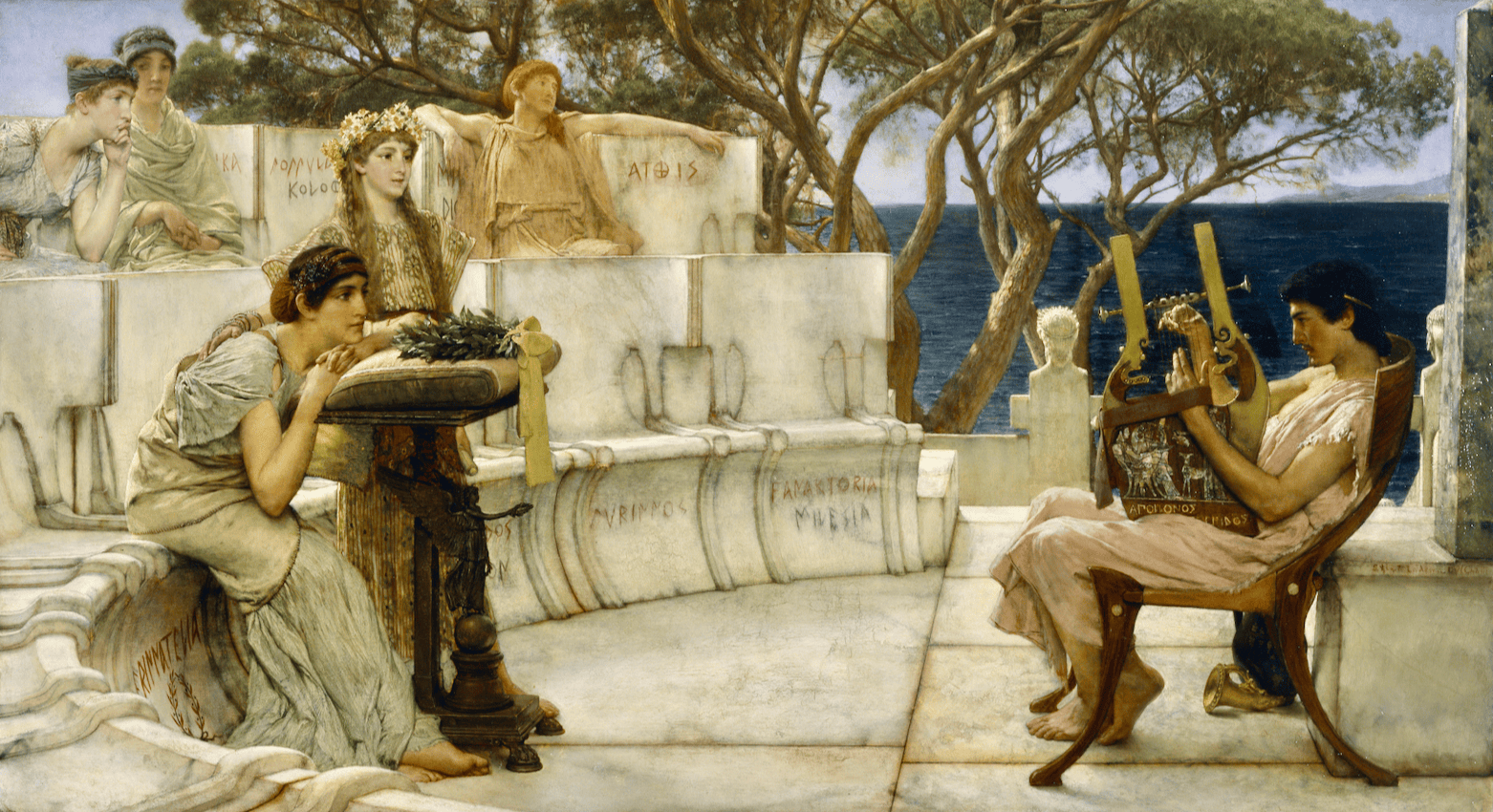
The featured image is “Sappho and Alcaeus” (1881), by Lawrence Alma-Tadema, and is in the public domain, courtesy of Wikimedia Commons. The photograph of Martin Heidegger is courtesy of Wikimedia Commons.

No comments:
Post a Comment
Comments are subject to deletion if they are not germane. I have no problem with a bit of colourful language, but blasphemy or depraved profanity will not be allowed. Attacks on the Catholic Faith will not be tolerated. Comments will be deleted that are republican (Yanks! Note the lower case 'r'!), attacks on the legitimacy of Pope Leo XIV as the Vicar of Christ, the legitimacy of the House of Windsor or of the claims of the Elder Line of the House of France, or attacks on the legitimacy of any of the currently ruling Houses of Europe.