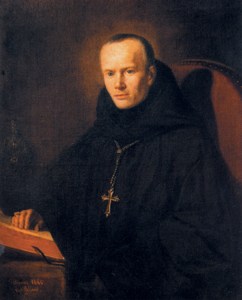
Honor to thee on this day of thy triumph! Honor to the apostle of the Gentiles, who comes to meet thee, as his noble conquest, on the threshold of eternity. From early youth how thy soul yearned for that unknown God, whom the apostle at length revealed to the longing aspirations of thy grand, upright nature! To the darkness of polytheism, to the doubts of philosophy, to the vague glimmers of confused traditions, suddenly succeeded the light of truth; and its triumph was complete. Thou, O Christian Plato, didst enlarge the horizon of philosophy, and didst so rectify its formulas that in them truth could be fittingly clothed. Thou, in thy turn, didst become an apostle; the distinction of Greek and barbarian, that law of the ancient world, was lost in the common origin assigned by St. Paul to all peoples; to the eyes of thy faith, slaves and freemen were equal in that nobility which makes the human race the race of God; while the charity, which overflowed in thy heart, filled it with the immense pity of God Himself for the long ages of ignorance in which mankind had been plunged.
Thus in thy zeal, obeying the inspiration of the Holy Ghost, thou, like a cloud laden with the blessings of the Lord, didst bring fertility to the far west. The people of Gaul learned from thee to seek God, to find Him, and to live in Him; and this new church had no reason to envy the earlier ones built on the foundations of prophets and apostles. O chosen stone, good for the foundations, so intimately united to the Cornerstone that every construction thou upholdest becomes a holy temple of the Lord: the church of France built upon thee, is also the house of God.
O Dionysius, quicken again the divine seed thou didst sow. Restore to Paris and to France their traditions, now forgotten in the fever of gain and pleasure. Bring back Athens to the communion of Christ’s vicar, the indispensable condition of union with our Lord. For every church under heaven obtain such pastors as thou didst describe in the following lines which reveal thyself: “By the holy love which draws us to Him, Jesus calms the tempest of distracting cares; and recalling our souls to the unity of the divine life, He confirms us in the permanent fruitfulness of this noble ministry. Soon, by the exercise of the sacred functions, we draw nigh to the angels, striving to set ourselves, like them, in the fixed state of unchangeable holiness. Thence, gazing upon the divine splendors of the blessed Jesus, and enriched with the profound knowledge of mystical contemplation, we become fitted to be ourselves consecrated in order that we may consecrate, to receive light in order to communicate it, to become perfect in order to lead others to perfection.” (Dionys. De eccl. hier. i)

No comments:
Post a Comment
Comments are subject to deletion if they are not germane. I have no problem with a bit of colourful language, but blasphemy or depraved profanity will not be allowed. Attacks on the Catholic Faith will not be tolerated. Comments will be deleted that are republican (Yanks! Note the lower case 'r'!), attacks on the legitimacy of Pope Leo XIV as the Vicar of Christ, the legitimacy of the House of Windsor or of the claims of the Elder Line of the House of France, or attacks on the legitimacy of any of the currently ruling Houses of Europe.