I've often "prayed" for the success of my favourite team in a match, not because I think God cares, but as stress relief in a critical moment.
From The Imaginative Conservative
England’s triumph in the World Cup had nothing to do with the prayers of the Virgin, nor was Our Lady of Guadalupe failing to answer the prayers of those Mexicans who sought her intercession on Mexico’s behalf. If their prayers were answered, it might have been in the form of the gentlest of reproofs to those who had succumbed to superstition in seeking Mary’s “magical” help.
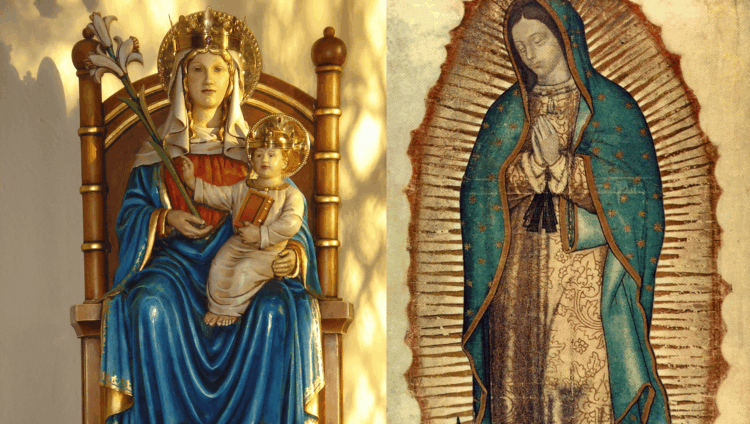 What would happen if Our Lady of Guadalupe went head-to-head in a prayer contest with Our Lady of Walsingham? If you find this question confusing or even absurd, thanks be to God! It means that you have not lost your sanity in pursuit of a bogus sanctity. What prompted me to ask such a provocative and preposterous question is an article published in the Wall Street Journal on July 3 under the headline, “Pilgrimages for Goals: Mexicans Will Do Almost Anything for a World Cup Win”. Under a weird photograph of a figure of the baby Jesus, dressed in the uniform of the Mexican soccer team, which is on display at the Metropolitan Cathedral in Mexico City, presumably to be venerated, the article catalogues promises made by Mexicans to Our Lady of Guadalupe in return for her prayers for Mexican victory in the World Cup. If the Virgin’s prayers to her Son would bring victory for the Mexican team, Mexican “pilgrims” promised all sorts of things in acts of pious thanksgiving to the Virgin. These included promises to quit drinking, to study harder or to become less abusive spouses. “When Mexico plays, many fans pray to the Virgin of Guadalupe to help them push the ball,” said Francisco Acero, auxiliary bishop of the Archdiocese of Mexico City, who blessed the renovated Azteca stadium last year.
The Wall Street Journal article was published ahead of Mexico’s World Cup clash with England on July 5. It was written with an element of whimsicality spiced perhaps with a touch of anti-Catholic cynicism, the latter of which was voiced by a female “expert”, described as “a business anthropologist formerly of Clemson University”, who spoke of Catholicism being “imposed” on the indigenous people of Mexico. The Church was smart enough, the former Clemson student(?) opined, to allow the people to put their trust in the Virgin of Guadalupe. “There’s obviously a sense that there’s some sort of power there,” she observed.
What are we to make of this?
First, to be fair, the vast majority of Mexicans don’t believe that Our Lady of Guadalupe supports the Mexican soccer team nor that she asks her Son for His miraculous intervention to secure victory. But what are we to make of the suggestion that we should pray for our team’s victory?
As an Englishman and a lifelong Chelsea fan, I can honestly say that I have never prayed for my country’s or my soccer club’s victory. At best, it seems absurd to do so and, at worst, obscene. Were I to do so, I might be tempted to pray to Our Lady of Walsingham, a title bestowed by the English faithful on the Blessed Virgin following an apparition in 1061. Such was devotion to Our Lady of Walsingham during medieval times that the Marian shrine at Walsingham became one of the main pilgrimage destinations of the whole of Christendom. Prayers were said for her intercession by the English army before major battles against the French, which might be more understandable in such matters of life and death, but still questionable and problematic from a theological perspective if the prayer was specifically for victory and not for the grace to fight and die courageously. In comparison, Our Lady of Guadalupe is relatively modern, appearing to Juan Diego in 1531. Since then, however, the number of pilgrims to Mexico City has far outstripped the number of pilgrims who have walked, and still walk, the Walsingham Way.
Throughout the world, and especially in north America, there must be millions of images of Our Lady of Guadalupe. There are far fewer images of Our Lady of Walsingham.
Needless to say, I did not pray for England’s victory against Mexico. I did hope, however, that my country would play well and I hoped also that the better team would win, and that England would prove to be the better team. I was not very confident. The game was being played at Mexico’s Azteca stadium, in front of an impassioned and partisan crowd. This was to Mexico’s advantage. It would be played in intense heat and at an altitude of over 7,000 feet above sea level, twice as high as England’s highest mountain. This was also to Mexico’s advantage. But then, shortly before the game was due to start, things started to work in England’s favour. There was a storm which brought rain, lowering both the temperature and the humidity. There was also an hour’s delay due to the weather, enabling the temperature to drop still further before kick-off. The air was cooler and the grass underfoot was wet, both of which were to England’s advantage. It rains a great deal in England, as everyone knows, and English players are accustomed to playing in wet conditions. As all these factors came into play, I found myself feeling more confident than I had been when the game began.
England played very well. Both teams played very well. The game was a true classic. England held on to the slimmest of leads in spite of playing with only ten men due to an English player receiving a red card shortly after half-time. The team held firm in heroic resistance to wave after wave of Mexican attacks. The reward was a breathtaking victory.
England’s triumph had nothing to do with the prayers of the Virgin, nor was Our Lady of Guadalupe failing to answer the prayers of those Mexicans who sought her intercession on Mexico’s behalf. If their prayers were answered, it might have been in the form of the gentlest of reproofs to those who had succumbed to superstition in seeking Mary’s “magical” help. Her prayer is always the same as that which all Christians are called to make. It is that God’s will is done on earth as it is in heaven, and that we are not led into temptation and that we are delivered from evil. Those who were tempted to superstition and to a recourse to “magic” prior to the game had their prayers answered, albeit not in the way that they’d hoped. They’d been delivered from evil.
__________
The featured image combines an image of Our Lady of Walsingham (uploaded by Thorvaldsson, licensed under the Creative Commons Attribution 3.0 Unported license) and Our Lady of Guadalupe (public domain). Both files appear here courtesy of Wikimedia Commons.

No comments:
Post a Comment
Comments are subject to deletion if they are not germane. I have no problem with a bit of colourful language, but blasphemy or depraved profanity will not be allowed. Attacks on the Catholic Faith will not be tolerated. Comments will be deleted that are republican (Yanks! Note the lower case 'r'!), attacks on the legitimacy of Pope Leo XIV as the Vicar of Christ, the legitimacy of the House of Windsor or of the claims of the Elder Line of the House of France, or attacks on the legitimacy of any of the currently ruling Houses of Europe.