From The Imaginative Conservative
By Hilaire Belloc
It is our business to give up all for whatever is truth, whether it appeals to our emotion or not; whether we have others with us or not; whether our mood concurs or repels. The intelligence is absolute in its own sphere. Intelligence commands us to accept the truth, and for the truth a man must lay down his life.
 Blessed Thomas More died in the support of one particular isolated truth, because it was the truth, and for no other reason. He did not make a sacrifice of this or that—he had made plenty of sacrifices—he did not give up, as heroic men give up around us day by day, position and income and the comfort of those who are dearest to them for the general Faith. He gave up life itself, deliberately; he accepted a violent death as of a criminal, not even for the Faith as a whole, but on one particular small point of doctrine—to wit, the supremacy of the See of Peter.
Now let me discuss the magnitude of this act. It is of sufficient greatness that it was performed for one isolated point of truth. But there was much more. It was a sacrifice not supported.
This it is that I desire to affirm, to reaffirm, to repeat, and to repeat again. This is that to which I desire to bear witness and which, had I the power, I would make prominent in every history. Not that this unique man gave up much for his conscience; that, to the honour of mankind, myriads have done and will do. Not even that he gave up life itself in that cause. Not even that he gave it up for one detached article out of so many. But rather that he found it in him so to act without support: a triumph of the will.
Now consider how men are supported in their rare heroisms.
There is in the first place the support of those who, weaker than the martyr himself, wish him well; those for whom he is a symbol, and who turn to him secretly as a flag-bearer, and by whom they hope perhaps to be later reconciled with that which they know to be the truth, but which they have not the courage to proclaim. He was not supported by an ambient fashion; he was not even supported, properly speaking, by a tradition, and—the most awful thing of all—he was not supported from within by anything more than that supreme instrument of action, the Catholic Will.
Newman said very well that we all die alone; but this is to die alone indeed! To allow oneself to be killed, of one’s own choice, in full life, rather than to pay the price of yielding upon one dry, narrow intellectual point; having to applaud one and to support one and to sustain one; neither enthusiasm within nor the sense of agreement from others without.
Let me put before you those two points. They are essential to an understanding of the scale upon which the martyr acted.
First, I say, he was not supported from within.
He had no enthusiasm for the papacy; he had fashioned for himself no tradition of defending it; no habit, no formed body of argument and action in its favour. He did not defend the papacy (in a day when its rights were everywhere doubted) because it was second nature to him. No: just the other way.
All his life he had been—as indeed was every man of intelligence, judgment and heart, in the turning point between the Middle Ages and the Modern—a reformer in the full sense of that word. He had been in his youth the English Erasmus, denouncing with contempt, as did a thousand others, not only the manifold and crying abuses into which clerical organisation had fallen, but many things which were not abuses at all, rather honest devotions, if a little exaggerated. His enthusiasm, the flame of his thought, his memories of sharp emotion in those affairs were all in tune with that flame of reforming zeal, which can so easily in such a moment be deflected into rebellion against the unity of Christendom. About this particular point of Papal Supremacy he had never worried. He had come out of a generation profoundly shaken in the matter; its intellectuals, contemptuous of the state into which the See of Rome had fallen, full of memories of the Schism and of the Councils, far from admiring the temporal pomp, and what was worse, the mechanical revenues of the Papal Court. Had Thomas More’s death been a death for the Real Presence of Our Lord in the Sacrament of the Altar, for the Most Holy Mother of God, for the golden light which is thrown across the earth by the movement of the wings of the Faith, it would have been quite another matter. He would have had ample support from within. His affections would have been engaged, and the whole man would have been at work. So has it been with great troops of martyrs. But not with him.
He had in this matter of the Supremacy closely examined the thing, as one might any other historical problem: “reading it up” and thinking out the pros and cons. And at one moment—a man of very grave reading, an excellent lawyer, with a brain like a razor for separating one category from another—he had hesitated whether the supremacy of the Pope over Christendom were man-made or not. He had inclined to think it a man-made thing. When he had thrashed the whole thing out fully and thoroughly, he came to his conclusion, as might a judge, without “affection,” without any particular movement of the heart. The Supremacy of Peter and of his successors (he decided) was of divine origin.
So far so good. That one point being isolated—intellectual, not moral, in no way attached to the heart, nothing that could inflame a man—he kept it carefully segregated and clear. He was willing to admit the succession of Anne’s child; to take oaths of loyalty of any degree and in any respect, save in that one point of the Supremacy. And did he run out to defend it with warmth? Far from it! He kept it in the background; he tried not to answer upon it; he followed the debates as might a counsel for the defence, making his points, reserving action.
All that is very cold and very disappointing. But he died—which is more than you and I would have done. And he died merrily.…
If ever a man died alone, he died alone.
And the moral is clear. It is our business to give up all for whatever is truth, whether it appeals to our emotion or not; whether we have others with us or not; whether our mood concurs or repels. The intelligence is absolute in its own sphere. Intelligence commands us to accept the truth, and for the truth a man must lay down his life.
Let all those, therefore, who in defining the truth, though it be but in one corner and with regard to one arid thing, to them seeming dead, invoke the patronage of this very national Englishman. His fun, his courage, his scholarship will be of advantage to them; so also will his sanctity—if in such days as these I may speak of such a quality.
_________
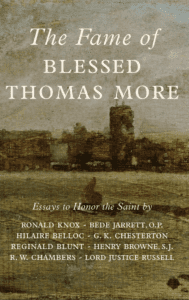
This essay is a chapter from The Fame of Blessed Thomas More.
The featured image is “Thomas More bidding his daughter Margaret Roper farewell,” and is in the public domain, courtesy of Wikimedia Commons.

No comments:
Post a Comment
Comments are subject to deletion if they are not germane. I have no problem with a bit of colourful language, but blasphemy or depraved profanity will not be allowed. Attacks on the Catholic Faith will not be tolerated. Comments will be deleted that are republican (Yanks! Note the lower case 'r'!), attacks on the legitimacy of Pope Leo XIV as the Vicar of Christ, the legitimacy of the House of Windsor or of the claims of the Elder Line of the House of France, or attacks on the legitimacy of any of the currently ruling Houses of Europe.