From The Imaginative Conservative
G.K. Chesterton believed that only a firm and patriotic understanding of citizenship will keep the American experiment in shape and prevent it from melting into anarchy. If America does not insist that its people, and especially its immigrants, are citizens of the state, the state itself will melt into a formless, anarchic mess.
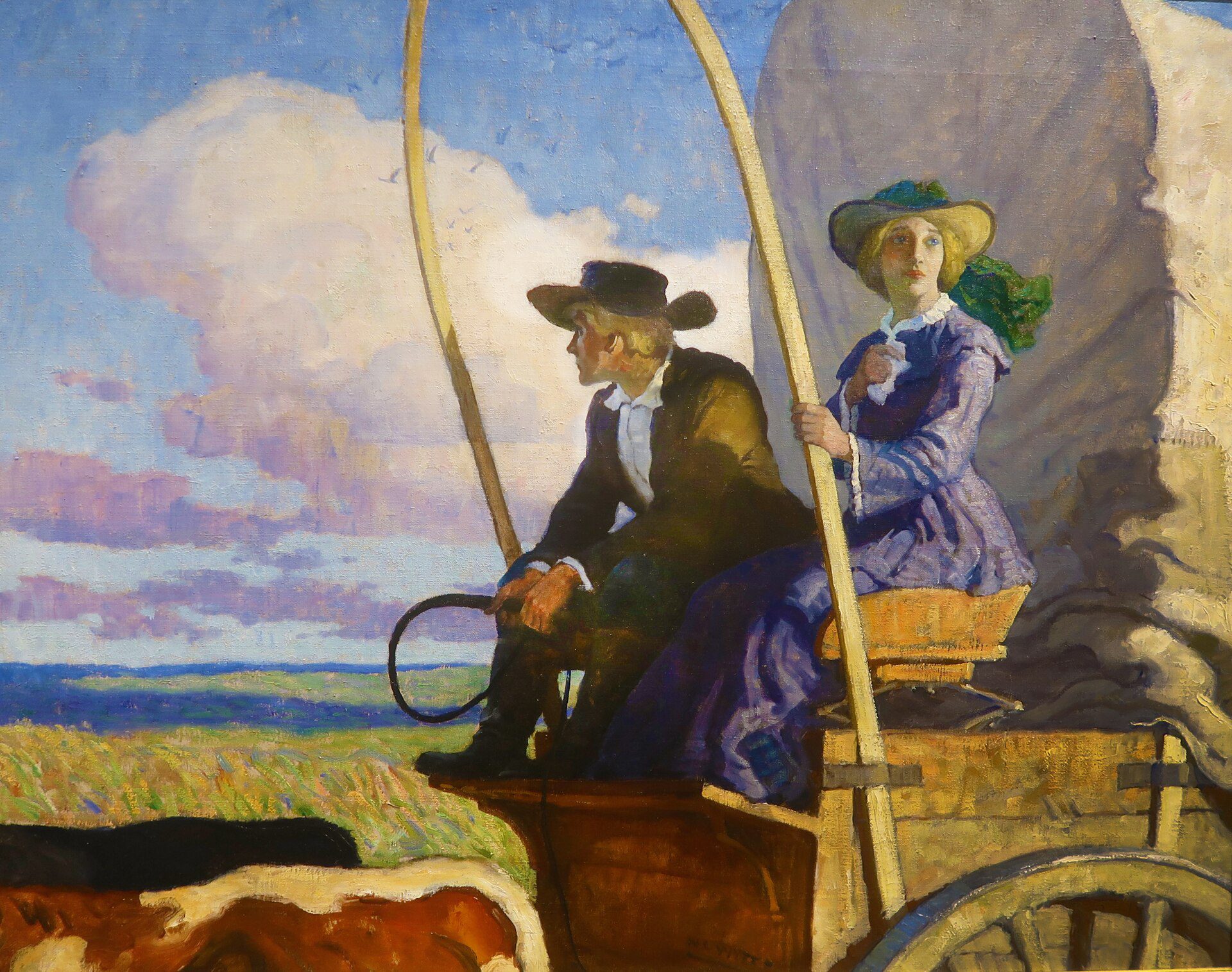 As the United States celebrates its 250th birthday, I thought it might be good to revisit Chesterton’s view of America a century ago, as well as offering my own view of it today. As fellow Englishmen living a century apart, Chesterton and I can offer an outsider’s view of the nation which he visited twice and in which I have made my home. Each of us surveys the New West and the Wild West with the eyes of the Old West.
Chesterton’s most amusing anecdotal account of the chasm that separates the Old World of Catholic Christendom from the New World of Puritan New England was given in his autobiography. He recalls having tea with the celebrated American author Henry James in the charming Sussex seaside town of Rye in 1908, years before Chesterton would visit the United States for himself. The two authors discussed the literature of the day, including the plays of Shaw and the works of Hugh Walpole, with delicate and decorous politeness until the peace was shattered by “a loud bellowing noise resembling that of an impatient foghorn”. Chesterton recognized the voice as belonging to his good friend, Hilaire Belloc, “probably shouting for bacon and beer”. As Chesterton tells the story far better than I can, I’ll defer to his own account:
I had every reason to believe that he was a hundred miles away in France. And so, apparently, he had been; walking with a friend of his in the Foreign Office, a co-religionist of one of the old Catholic families; and by some miscalculation they had found themselves in the middle of their travels entirely without money.… Their clothes collapsed and they managed to get into some workmen’s slops. They had no razors and could not afford a shave. They must have saved their last penny to recross the sea; and then they started walking from Dover to Rye; where they knew their nearest friend for the moment resided. They arrived, roaring for food and drink and derisively accusing each other of having secretly washed, in violation of an implied contract between tramps. In this fashion they burst in upon the balanced tea-cup and tentative sentence of Mr. Henry James.
Chesterton doubted whether Henry James appreciated the irony “of the best comedy in which he ever played a part”:
He had left America because he loved Europe, and all that was meant by England or France; the gentry, the gallantry, the traditions of lineage and locality, the life that had been lived beneath old portraits in oak-panelled rooms. And there, on the other side of the tea-table, was Europe, was the old thing that made France and England, the posterity of the English squires and the French soldiers; ragged, unshaven, shouting for beer, shameless above all shades of poverty and wealth; sprawling, indifferent, secure. And what looked across at it was still the Puritan refinement of Boston; and the space it looked across was wider than the Atlantic.…
Switching perspective, let’s cross the Atlantic with Chesterton by opening the pages of his book, What I Saw in America. Published in 1922, it recounts Chesterton’s impressions of the United States after his first visit to the country in the early days of Prohibition.
One aspect of America which Chesterton saw and which we still see is the cult of bigness and the cult of sameness: “Broadly speaking, there is only one hotel in America. The pattern of it, which is a very rational pattern, is repeated in cities as remote from each other as the capitals of European empires.” Speaking of his first impression of a skyscraping American hotel, Chesterton mixed the wit and wisdom which is so much the secret of his brilliance: “When I first went into one of the big New York hotels, the first impression was certainly its bigness. It was called the Biltmore; and I wondered how many national humorists had made the obvious comment of wishing they had built less.”
The tragedy of America, which has become the tragedy of the globalized world in the century since Chesterton wrote, is that quality has been sacrificed to the cult of quantity. Today, every strip mall looks the same across the whole vastness of the United States; the same fast food is produced in the same chain restaurants, each with an identical menu; the same chain stores, chained to each other and to the same global supply chain, sell the same mass-produced trash to a trivialized culture. Chesterton foresaw all this a century ago, prophesying that the “coming peril” was “standardization by a low standard”. What he foresaw, we now see. He is the prophet, ours is the loss.
Another prescient aspect of what Chesterton saw in America a century ago was his view of the multiracial character of the United States. Having described “the great American experiment… of a democracy of diverse races which has been compared to a melting-pot”, he then deepens the meaning of the metaphor by stressing the importance of the pot to the melting:
[The] metaphor implies that the pot itself is of a certain shape and a certain substance; a pretty solid substance. The melting-pot must not melt. The original shape was traced on the lines of Jeffersonian democracy; and it will remain in that shape until it becomes shapeless. America invites all men to become citizens; but it implies the dogma that there is such a thing as citizenship.
In effect, Chesterton is saying that only a firm and patriotic understanding of citizenship will keep the American experiment in shape and prevent it from melting into anarchy. If America does not insist that its people, and especially its immigrants, are citizens of the state, the state itself will melt into a formless, anarchic mess.
The melting pot must be strong enough to withstand the heat and the friction caused by the mixing of the various cultures, enabling the various ethnic ingredients to melt and meld into a vaguely homogenized nation with a commonly held culture. In the America of Chesterton’s time, the melting pot’s strength resided in the economic prosperity which the United States generated during this period and in the cultural unity that being “American” signified at the time. The pot was forged, therefore, by an alloy of material wealth and patriotic cohesion.
The success and ultimate viability of multiculturalism is therefore connected to the melting pot within which it exists. If the pot is made of too weak a material to withstand the heat generated by ethnic fusion it will itself melt, resulting in anarchy and violence. If, on the other hand, it needs to be made of the hard and toxic metal known as totalitarium in order to prevent its melting, multiculturalism serves merely as the prerequisite to tyranny. In short, if the melting pot becomes too weak or too strong, it becomes a menace to human liberty and to the flourishing of authentic culture.
Chesterton saw the multicultural melting pot as something singularly and even peculiarly American, “partly by original theory and partly by historical accident”. In contrast, most other countries would see such multiculturalism as “incongruous or comic”. He did not see, indeed how could he see, the situation in which Europe finds itself today, which is not so much comic as tragic. The secular melting pot of contemporary Europe has caused a cultural reaction that has raised the temperature of the pot to such a degree that it is in danger of melting. There are those who are stirring the pot in order to raise the heat and others calling for the pot to be reinforced with totalitarium by the imposition of the draconian force of tyrannical law. Europe seems to be facing cultural meltdown of unprecedented proportions or the emergence of Big Brother.
Let’s switch from what Chesterton saw in America to what I see in America today. The first is that there are two Americas. There is the public face of America that America shows to the world and then there is the hidden face of America that can only be seen from the inside. Before I moved to the United States, twenty-five years ago, four days before 9-11, I could only see America from the outside. I saw Hollywood and other manifestations of American popular culture and I saw the America which wields the big stick on the world stage. It was only after I moved here that I saw beyond the ugliness of America the Big and was able to see, for the first time, America the Beautiful. This is the America which resists the abomination of abortion, the holocaust of systemic infanticide. This is the America of the culture of life. Nowhere in the world is the pro-life movement as active and dynamic as it is in the United States. This is the ultimate empirical measurement of a culture’s health or sickness. If a culture accepts and embraces the killing of its own children it is on a suicidal path of self-destruction. The Old World seems to have condemned itself to death; the New World still defends new life.
In addition, we see that Catholic Christianity is thriving in the United States in a way that gives encouragement to Catholics in Europe. The Faith flourishes here. It is evangelical, dynamic and orthodox. It offers hope and promises renewal. And it is also in the United States that we are seeing the rise and revival of classical education. We are seeing the return of the Great Books to school curricula. We are seeing the revitalization of the Great Conversation which the Great Books facilitate. The delightful irony is that the Old World is being revived and resurrected in the New World. It is true that good things are happening in other parts of the world, thanks be to God, but it is undeniable that America is blazing a trail that is inspiring those in other countries to follow. On this, the 250th anniversary of the founding of the nation, there is much to celebrate. God bless America the Beautiful!
__________
The featured image, uploaded by Jim Griffin, is “It Was Like a Great Green Sea” (1921), by N.C. Wyeth. This file is made available under the Creative Commons CC0 1.0 Universal Public Domain Dedication, courtesy of Wikimedia Commons.

No comments:
Post a Comment
Comments are subject to deletion if they are not germane. I have no problem with a bit of colourful language, but blasphemy or depraved profanity will not be allowed. Attacks on the Catholic Faith will not be tolerated. Comments will be deleted that are republican (Yanks! Note the lower case 'r'!), attacks on the legitimacy of Pope Leo XIV as the Vicar of Christ, the legitimacy of the House of Windsor or of the claims of the Elder Line of the House of France, or attacks on the legitimacy of any of the currently ruling Houses of Europe.