
From One Peter Five
By Maxim Grigorieff, MA
In the first part of this essay, we examined the origins of one of the most beloved wonder-working images of the Mother of God among the Russian Orthodox people — the Seven-Arrow’s Icon. This icon is Latin in its origin and associated spirituality, and it was revealed by the favour of God and the Theotokos at a time of profound trial for both Russia and the Russian Church. These developments took place as Russia was gradually distancing itself from Catholicism against the background of
- a long-standing reluctance to submit to the authority of the Pope;
- the emerging seventeenth-century aspiration to establish a national Church of the Russian people and state, independent of Polish influence;
- the Old Believers schism, in which the opponents of the Patriarch’s reforms accused the official Church of ‘Latinism’;
and the broader Protestantising tendencies that accompanied the reforms of Peter the Great, founder of the Russian Empire and a noted admirer of the Netherlands and German culture.The Seven-Arrows Icon first manifested itself as worthy of veneration through the miraculous healing of a peasant; it subsequently saved the city and its inhabitants from an outbreak of cholera, strengthening the faith of the people of God despite the rationalist and sceptical attitudes of state officials and of the Holy Synod under their control. It thus became firmly established in popular devotion and, as a prototype, gave rise to several variations and numerous copies — a kind of spiritual progeny that survived the persecutions of the Bolsheviks and remains with us to this day, despite its ‘Latin’ character, or perhaps even because of it. Be that as it may, by the end of the twentieth century the time had come for new miraculous manifestations of the Sorrowful Mother of God.
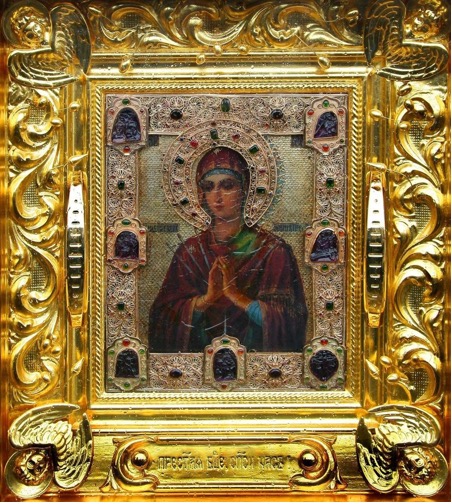
One of the ‘daughter’ icons that was derived from the original Seven-Arrows from Vologda — the ‘Seven Arrows’ icon (Семистрельная) — appeared in Moscow in 1999. This icon would become known as the Icon of the Theotokos ‘Softener of Evil Hearts’ (Умягчение злых сердец). These icons, although they belong to the same type, are two distinct images, albeit frequently confused both by foreigners and by Russians themselves. Strictly speaking, ‘Softener of Evil Hearts’ is but one of the many offshoots of the original wonder-working icon of the seventeenth century, the Vologda ‘Seven Arrows’ icon. Both icons feature the Latin symbol of the seven swords representing the seven sorrows of Our Lady.
But the newer icon, Softener of Evil Hearts, has become almost as famous and beloved as the original from the 17th century and, what is more, appeared after the consecration of Russia by Pope St. John Paul II and the fall of Communism, and hence, finds itself in the centre of a different epoch fulfilling a different role in divine providence. However, there is a more local, Russian context, wherein this icon appeared.
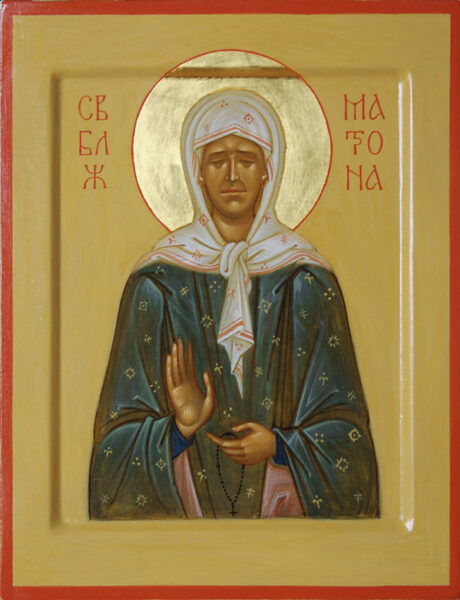
Its miraculous story began at the end of the twentieth century. In 1999 a Moscow resident, Margarita Vorobyova, together with her daughter Anastasia, attended the glorification[1] of a Russian Orthodox Saint named Matrona of Moscow, a very controversial figure but also one of the most popular saints in contemporary Russia.[2] Here we must take some time to detail this curious figure, in order to understand better the context of this new miraculous icon.
Our Lady against Stalinism and Occultism in Orthodoxy
This contemporary Orthodox saint was believed to have the gift of healing, spiritual foresight and the reading of hearts. She was blind and paralysed and gained quite a following in Moscow, even under Soviet persecution, and died in 1952. However, a book published in 1993 alleged controversial deeds and teachings from her, some of which seemed to be superstitious.
The book recounts that the elder promised to continue aiding people even after her death and demanded absolute obedience to her alone,[3] teaching, among other things, the necessity of closing windows to prevent demons from entering—and, in one extraordinary episode, vomiting immediately after receiving Communion and burning the Sacrament, supposedly as a means of expelling demons.[4]
This scandalous episode appears to describe, in fact, the initiation of a witch-healer through the desecration of the Eucharist:
“After Communion, you must vomit, and do not spare the lid—hold it on your head, and vomit directly into it; then, together with the cloth, cast it into the fire.” Praskovya followed these instructions: a coagulated piece of blood emerged and she threw it into the flames. As it burned, a column of black smoke rose high into the sky. Praskovya recovered, regained her strength, and thereafter Matronushka [Matrona] told her: “You shall be healing people.”[5]
Another notorious episode in the book describes a supposed meeting between Matrona of Moscow and Joseph Stalin, during which the Soviet leader allegedly asked her whether Moscow should be evacuated, and received from her both encouragement and a prophecy of victory for the Russian people. This story, presented in the unofficial, yet very influential book, fell on fertile ground among supporters of what has sometimes been called ‘Orthodox Stalinism’ — a syncretic outlook held by certain patriotic circles who felt bitter resentment after the collapse of the Soviet Union.
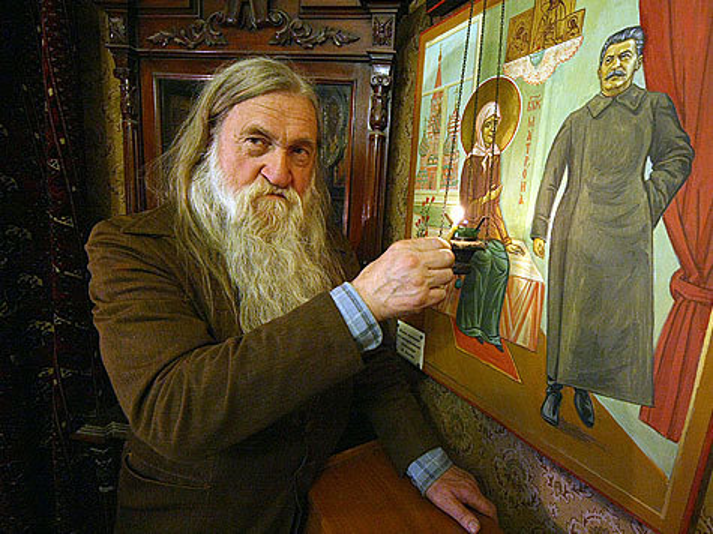
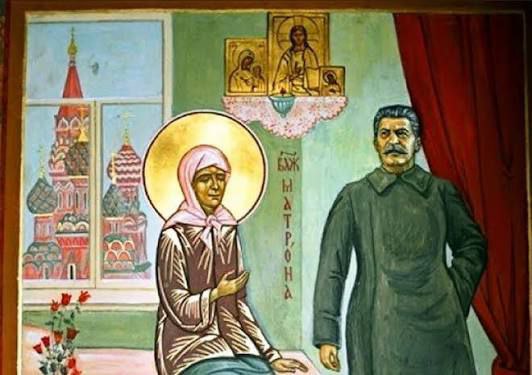
These alleged words and deeds of Matrona led some prominent Orthodox theologians to cast doubt on Matrona’s holiness. Indeed, her cult, influenced by that book which touched the souls of different groups of Russians after the Soviet collapse, divided the ‘enlightened rationalists’ of the Russian Orthodox Church from the ‘superstitious peasants.’ However, the popular piety was so strong that it ultimately led to the Orthodox Church authorities to confirm Matrona’s holiness by an official glorification and a order to write an ‘official’ biography of the saint, purged of all inappropriate material. However, what resulted was simply a mild censorship of the original occult book, not an exhaustive investigation of all the facts.[7] Nowadays, even the official ‘Life of St Matrona,’ and even the scholarly article in the Orthodox Encyclopaedia,[8] are based upon that same superstitious book made public in 1993.
The fact is that the Russian Church failed to protect and educate the flock properly. It would seem that the phenomenon of Matrona had put the Russian Church authorities into a bind, with either choice leading to some evil. If they had cancelled the canonisation, they would have faced a revolt of the common faithful. If they went through with the canonisation, it would establish in the Church these chthonic ideas that gave rise to the original impulse to venerate Matrona.
Now here is where the Theotokos intervened. Her logic is not to shatter people’s faith, but rather to set it in order.
We return, once more, to the story of Margarita Vorobyova and her daughter Anastasia. This is a story of a family who was yet to come, of which the Vorobyovs themselves were not yet aware. The guardian of the wonderworking ‘Softening of Evil Hearts’ icon of the Theotokos, Mr. Sergei Fomin, testifies:
It all began when I had not yet met my future wife, Margarita Vorobyova. On 2 May 1999 she and her daughter Nastya attended the glorification of Matrona of Moscow among the saints, and they were given a small icon of Matrona.
On their way home they noticed that small drops had appeared on the icon of Matrona. They thought it was just a coincidence and placed it in their prayer corner.
The next day Nastya asked for 25 roubles. In the church shop she had very much liked an icon of the Mother of God called ‘Softening of Evil Hearts.’ At first she even thought it showed an angel, since one is more used to seeing the Mother of God with the Child in her arms. They bought the icon, had it blessed at Matrona’s grave, and brought it home.
It was a simple, cheap printed image, not a painted icon in a classical sense of the word icon, but simply a piece of paper (another soviet heritage that is still rejected by Old Believers as fake, not loved by New-Rite Orthodox conservatives either). Still, it was chosen by Our Lady, provided by her in a matter connected to the newly canonised saint of the Moscow Eparchy. This icon of the Theotokos happened to be a copy of the Seven Arrows icon from Vologda, but with this additional Latin element: the Theotokos is depicted with her hands together in an unmistakably Latin prayer posture, unknown in Russia and in the Greek world.
Continuing with the testimony of Mr. Fomin:
During the night they woke because a strong fragrance had filled the room. They then discovered that all the icons were covered with small drops, but the new icon of the Mother of God was covered more than any of the others.[9]
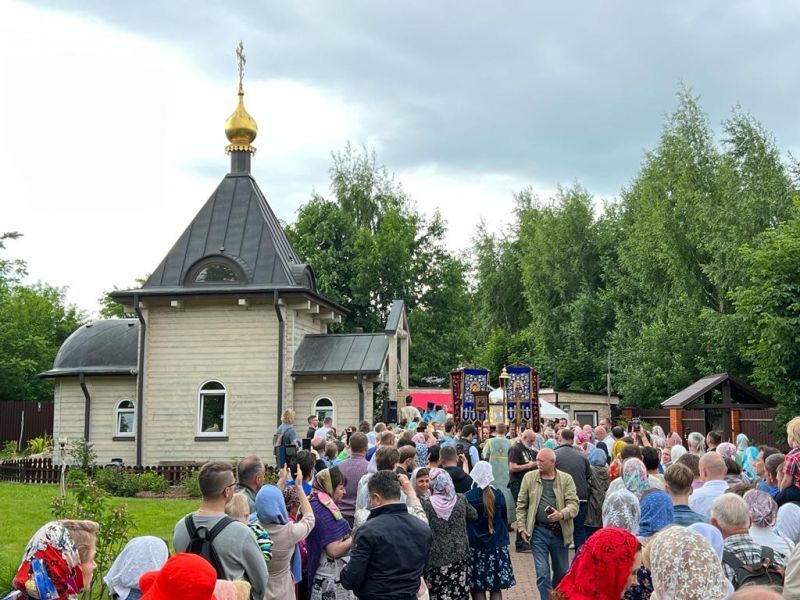
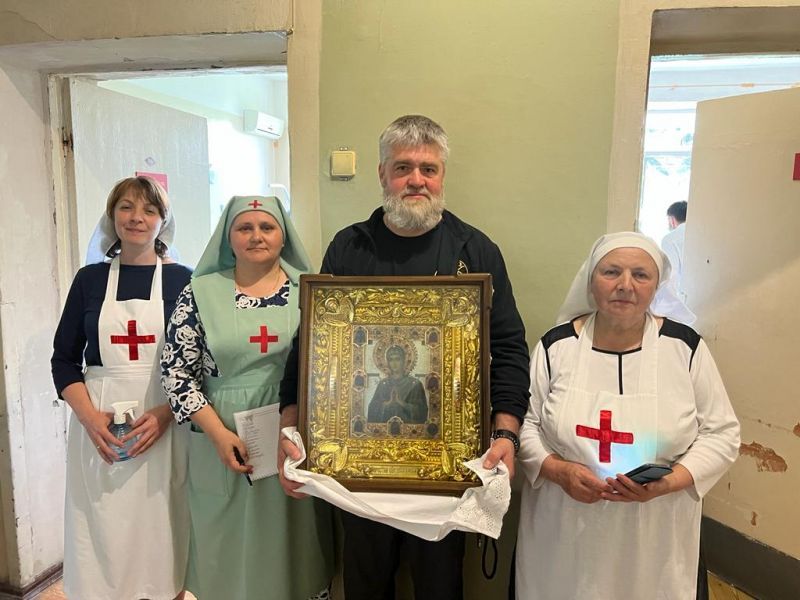
Since then, the veneration of the icon has steadily grown, and it has been taken to many cities across Russia and throughout the world. It is now
one of the great treasures sacred of the Russian Orthodox Church today. The icon has travelled throughout the world, bringing consolation to the faithful and indeed, softening the hearts of those who are opposed to God. Our church has been built in honour of the icon, and the upper key of Moscow, though much of the time the icon is brought throughout Russia and around the world, including the United States, Ukraine, Georgia, Australia, Mount Athos, Greece and Japan.[10]
Spiritual meaning of Our Lady’s Choice and Her Motherly Lesson to Patriarch Kirill
Small drops of some liquid, as reported, first appeared on the little icon of Matrona after the canonisation service. It is possible that many such small images had been touched to the reliquary containing her relics. And this could have become a big deal that would deepen the controversy even more.
Yet the simple printed icon, bought for twenty-five roubles (the equivalent of about one US dollar at the time) — the one in which they had at first not even recognised the Mother of God, the ‘strange’ image — began to give forth fragrance and myrrh more strongly than all the others, sanctifying everything around it — and not by ‘accumulation’ or ‘acquiring’ energy from the all-powerful Matrona or from people’s prayers. The latter idea is what Patriarch Kirill believes believes icons do, which is a form of superstition. Here are his words:
‘Why do we speak of a “wonder-working icon”? Because before it prayers of particular power have been offered, and ordinary physical matter — wood covered with paint — absorbs this energy and later gives it back to people.’[11]
A little more than fifteen years after the first, local canonisation of Matrona of Moscow, who had become something of a banner of popular superstitious belief, Patriarch Kirill, following the same people, essentially speaks of the egregore of particular places and objects. Here a person sends his earthly ‘sacrifices’ and energies to heaven, building up for himself an energetic capital over the course of decades through repeated prayer. It resembles a form of paganism mingled with Pelagianism, akin to a modern belief in superheroes — placing the emphasis on human beings as possessing power in themselves and attaining salvation by ‘accumulating’ it, rather than on God, who sends forth the living, flowing water of grace even from stones, from human weakness, and from mere paper and cardboard.
The Mother of God, however, foreseeing this from the very beginning, shows that an icon pours forth streams of grace not because it serves as an accumulator or a kind of bank for generations of worshippers, nor by virtue of its ‘canonicity’ or because it has been painted with colours, but by the good will of the Prototype and by the providence of God.
It is, in a sense, nothing less than a blow struck against magical thinking — not by the sword of scepticism towards Matrona or any other saint or popular devotion, but by the power of Christ, made manifest in weakness.
Small drops had reportedly appeared on the icon of Matrona, while streams of true and fragrant myrrh, beyond doubt for those who took part in the events themselves, flowed from the simple ‘Latin’ icon of the Mother of God.
The Fatima Connection
Whoever Matrona of Moscow may truly have been (and she may have been a woman of holy life with an unfortunate circle of superstitious followers), the Mother of God quietly shifts the focus — not to Herself, although this would have been due and just, but to Her Seven Sorrows, and thus, ultimately, to the Passion of Jesus Christ. She offers people His primacy through Her own service, acting through the heart — the heart of a Mother connected to the Heart of Jesus. Thus for those faithful seeking God in their hearts, She offers the faithful Her Sorrowful Heart in this Latin style icon working miracles. Instead of a logical argument, She turns their hearts to Him. This is exactly in line with Fatima, when Our Lady said in June 13 apparition: ‘My Immaculate Heart will be your refuge and the road that will conduct you to God.’ (Remarkably, on June 13, 1917, on the same day Our Lady said these words, the Russian Catholic Church of the Byzantine rite was literally consecrating Russia to the Theotokos in a historic synod in St. Petersburg. This will be covered in detail in our forthcoming book).
In the concluding part of this essay, we shall trace the events of recent history beginning in 1999, when the icon manifested itself through the streaming of myrrh and even of blood—phenomena strikingly reminiscent of those known in the Latin tradition. We shall consider the warnings attributed to the Mother of God, the particular connection of this devotion with the cult of the New Martyrs and Confessors of Russia — a theme that unites the Russian Orthodox Church with the Russian Catholic Church of the Byzantine Rite, both in the past and in the present—and we shall also turn to the remarkable and distinctly Catholic prayer approved by the Russian Orthodox Church in honour of the icons discussed here.
[1] “Glorification” is the term used for the ceremony and process of “canonisation” in the East.
[2]Below, all information concerning the legend of the discovery of the Softening of Evil Hearts icon and its veneration is drawn from, or verified against, the account of the icon’s custodian, Mr Sergei Fomin, particularly his 2023 interview with VKpress, as well as other open sources. Any comments or evaluations are the author’s own. This approach is intended to preserve the tradition as authentically as possible.
The interview can be reached at: https://www.vkpress.ru/life/khranitel-ikony-umyagchenie-zlykh-serdets-rasskazal-o-realnykh-istoriyakh-chudesnykh-istseleniy-/?id=157142
[3]Сказание о житии блаженной старицы Матроны / Авт.-сост.: З. В. Жданова. Коломна, 1993
[4] Ibid
[5] Ibid, Рассказ Прасковьи Кузьминичны из Епифани. Russian: ‘После причастия должна быть у тебя рвота, а ты не жалей покрышку-то, на голове, и прямо в нее, и после этого вместе с платком бросишь в печку”. Прасковья все это сделала, вышел кусок кровяной запеченный и бросила в огонь. И когда горело, из трубы шел столб черного дыма, высоко-высоко шел. И Прасковья выздоровела, стала поправляться и после этого Матронушка ей сказала: “Ты будешь лечить людей”.
[6] Taken from: Адамович О., Черных Н. Москвичи молятся на Сталина // Московский комсомолец. 20.10.2010. URL: https://www.mk.ru/social/2010/10/20/538186-moskvichi-molyatsya-na-stalina.html
[7] One may argue, there simple was not enough objective evidence left, independent from the Zhdanova’s book of 1993.
[8]О.С. Канитонова Е.В. Орлова. Матрона // Православная Энциклопедия, URL: https://www.pravenc.ru/text/2562616.html
From the same interview for VKpress, URL: https://www.vkpress.ru/life/khranitel-ikony-umyagchenie-zlykh-serdets-rasskazal-o-realnykh-istoriyakh-chudesnykh-istseleniy-/?id=157142
[10] From an American publication blessed by the ROCOR Archbishop Kyrill. St. Paisius Orthodox Monastery, Akathist to the Myrrh-streaming Icon of the Mother of God “Softener of Evil Hearts,” (Safford, AZ: 2021), 3.
[11] Слово Святейшего Патриарха Кирилла после Литургии в храме святителя Димитрия Ростовского в Барнауле от 21 сентября 2015 г. URL: https://www.patriarchia.ru/article/97086

No comments:
Post a Comment
Comments are subject to deletion if they are not germane. I have no problem with a bit of colourful language, but blasphemy or depraved profanity will not be allowed. Attacks on the Catholic Faith will not be tolerated. Comments will be deleted that are republican (Yanks! Note the lower case 'r'!), attacks on the legitimacy of Pope Leo XIV as the Vicar of Christ, the legitimacy of the House of Windsor or of the claims of the Elder Line of the House of France, or attacks on the legitimacy of any of the currently ruling Houses of Europe.