✠✠✠✠✠
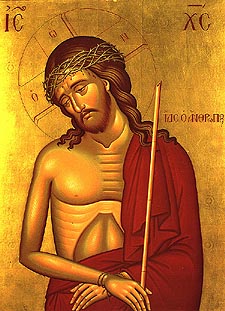
Holy Week: A Liturgical Explanation for the Days of Holy Week
3. MONDAY, TUESDAY, WEDNESDAY: THE END
These three days, which the Church calls Great and Holy have within the liturgical development of the Holy Week a very definite purpose. They place all its celebrations in the perspective of End Times; they remind us of the eschatological meaning of Pascha. So often Holy Week is considered one of the “beautiful traditions” or “customs,” a self-evident “part” of our calendar. We take it for granted and enjoy it as a cherished annual event which we have “observed” since childhood, we admire the beauty of its services, the pageantry of its rites and, last but not least, we like the fuss about the Paschal table. And then, when all this is done we resume our normal life. But do we understand that when the world rejected its Savior, when “Jesus began to be sorrowful and very heavy... and his soul was exceedingly sorrowful even unto death,” when He died on the Cross, “normal life” came to its end and is no longer possible. For there were “normal” men who shouted “Crucify Him” who spat at Him and nailed Him to the Cross. And they hated and killed Him precisely because He was troubling their normal life. It was indeed a perfectly “normal” world which preferred darkness and death to light and life.... By the death of Jesus the “normal” world, and “normal” life were irrevocably condemned. Or rather they revealed their true and abnormal inability to receive the Light, the terrible power of evil in them. “Now is the Judgment of this world” (John 12:31). The Pascha of Jesus signified its end to “this world” and it has been at its end since then. This end can last for hundreds of centuries, but this does not alter the nature of time in which we live as the “last time.” “The fashion of this world passeth away...” (I Cor. 7:31).
Pascha means passover, passage. The feast of Passover was for the Jews the annual commemoration of their whole history as salvation, and of salvation as passage from the slavery of Egypt into freedom, from exile into the promised land. It was also the anticipation of the ultimate passage—into the Kingdom of God. And Christ was the fulfillment of Pascha. He performed the ultimate passage: from death into life, from this “old world” into the new world into the new time of the Kingdom. And he opened the possibility of this passage to us. Living in “this world” we can already be “not of this world,” i.e. be free from slavery to death and sin, partakers of the “world to come.” But for this we must also perform our own passage, we must condemn the old Adam in us, we must put on Christ in the baptismal death and have our true life hidden in God with Christ, in the “world to come....”
And thus Easter is not an annual commemoration, solemn and beautiful, of a past event. It is this Event itself shown, given to us, as always efficient, always revealing our world, our time, our life as being at their end, and announcing the Beginning of the new life.... And the function of the three first days of Holy Week is precisely to challenge us with this ultimate meaning of Pascha and to prepare us to the understanding and acceptance of it.
1. This eschatological (which means ultimate, decisive, final) challenge is revealed, first, in the common troparion of these days:
Troparion—Tone 8
Behold the Bridegroom comes at midnight,ox
And blessed is the servant whom He shall find watching,
And again unworthy is the servant whom He shall find heedless.
Beware, therefore, O my soul, do not be weighed down with sleep,
Lest you be given up to death and lest you be shut out of the Kingdom.
But rouse yourself crying: Holy, Holy, Holy, are You, O our God!
Through the Theotokos have mercy on us!
Midnight is the moment when the old day comes to its end and a new day begins. It is thus the symbol of the time in which we live as Christians. For, on the one hand, the Church is still in this world, sharing in its weaknesses and tragedies. Yet, on the other hand, her true being is not of this world, for she is the Bride of Christ and her mission is to announce and to reveal the coming of the Kingdom and of the new day. Her life is a perpetual watching and expectation, a vigil pointed at the dawn of this new day. But we know how strong is still our attachment to the “old day,” to the world with its passions and sins. We know how deeply we still belong to “this world.” We have seen the light, we know Christ, we have heard about the peace and joy of the new life in Him, and yet the world holds us in its slavery. This weakness, this constant betrayal of Christ, this incapacity to give the totality of our love to the only true object of love are wonderfully expressed in the exapostilarion of these three days:
“Thy Bridal Chamber I see adorned, O my Savior
And I have no wedding garment that I may enter,
O Giver of life, enlighten the vesture of my soul
And save me.”
2. The same theme develops further in the Gospel readings of these days. First of all, the entire text of the four Gospels (up to John 13: 31) is read at the Hours (1, 3, 6 and 9). This recapitulation shows that the Cross is the climax of the whole life and ministry of Jesus, the Key to their proper understanding. Everything in the Gospel leads to this ultimate hour of Jesus and everything is to be understood in its light. Then, each service has its special Gospel lesson :
On Monday:
At Matins: Matthew 21: 18-43—the story of the fig tree, the symbol of the world created to bear spiritual fruits and failing in its response to God.
At the Liturgy of the Presanctified Gifts: Matthew 24: 3-35: the great eschatological discourse of Jesus. The signs and announcement of the End. “Heaven and earth shall pass away, but my words shall not pass away....”
“When the Lord was going to His voluntary Passion,
He said to His Apostles on the way:
Behold, we go up to Jerusalem,
And the Son of Man shall be delivered up
As it is written of Him.
Come, therefore, and let us accompany Him,
With minds purified from the pleasures of this life,
And let us be crucified and die with Him,
That we may live with Him,
And that we may hear Him say to us:
I go now, not to the earthly Jerusalem to suffer,
But unto My Father and your Father
And My God and your God,
And I will gather you up into the heavenly Jerusalem,
Into the Kingdom of Heaven....”
(Monday Matins)
Troparion — Tone 8
Kontakion — Tone 2
You know that this is the last hour, O wretched soul, / and fear the cutting of the fig tree. / Work diligently therefore at the talent given to you / keep watch and pray: / Let us not remain outside the bridal chamber of Christ.
✠✠✠✠✠

Hieromartyr Hypatius, Bishop of Gangra, was bishop of the city of Gangra in Paphlagonia (Asia Minor). In the year 325, he participated in the First Ecumenical Council at Nicea, at which the heresy of Arius was anathematized.
When Saint Hypatius was returning in 326 from Constantinople to Gangra, followers of the schismatics Novatus and Felicissimus fell upon him in a desolate place. The heretics ran him through with swords and spears and threw him into a swamp. Like the Protomartyr Stephen, Saint Hypatius prayed for his murderers.
An Arian woman struck the saint on the head with a stone, killing him. The murderers hid his body in a cave, where a Christian who kept straw there found his body. Recognizing the bishop’s body, he hastened to the city to report this, and the inhabitants of Gangra piously buried their beloved archpastor.
After his death, the relics of Saint Hypatius were famous for numerous miracles, particularly for casting out demons and for healing the sick.
From of old the hieromartyr Hypatius was particularly venerated in the Russian land. Thus in the year 1330, the Ipatiev monastery was built at Kostroma, on the place where the Mother of God appeared with the Pre-eternal Christ Child, the Apostle Philip, and the hieromartyr Hypatius, Bishop of Gangra. This monastery later occupied a significant place in the spiritual and social life of the nation, particularly during the Time of Troubles.
The ancient copies of the Life of the hieromartyr Hypatius were widely distributed in Russian literature, and one of these was incorporated into THE READING MENAION of Metropolitan Macarius (1542-1564). In this Life there is an account of the appearance of the Savior to Saint Hypatius on the eve of the martyr’s death.
The entry for the saint’s Feast consists of his Life, some prayers, and words of praise and instruction. The pious veneration of Saint Hypatius was also expressed in Russian liturgical compositions. During the nineteenth century, a new service was written for the hieromartyr Hypatius, distinct from the services written by Saint Joseph the Studite, contained in the March MENAION.
Troparion — Tone 4
In truth, you were revealed to your flock as a rule of faith, / an image of humility and a teacher of abstinence; / your humility exalted you; / your poverty enriched you. / Hierarch Father Hypatius, / entreat Christ our God / that our souls may be saved.

No comments:
Post a Comment
Comments are subject to deletion if they are not germane. I have no problem with a bit of colourful language, but blasphemy or depraved profanity will not be allowed. Attacks on the Catholic Faith will not be tolerated. Comments will be deleted that are republican (Yanks! Note the lower case 'r'!), attacks on the legitimacy of Pope Leo XIV as the Vicar of Christ, the legitimacy of the House of Windsor or of the claims of the Elder Line of the House of France, or attacks on the legitimacy of any of the currently ruling Houses of Europe.