
From One Peter Five
Troparion, Tone 4:
Soften our evil hearts, O Mother of God, and quench the attacks of those who hate us, and relieve every distress of our souls; for as we look upon your holy image, we are moved by your suffering and your mercy toward us and we kiss your wounds, yet we tremble at our own arrows that pierce you. Do not allow us, O compassionate Mother, to perish because of our hardness of heart or the hardness of heart of our neighbours, for you are truly the Softener of Evil Hearts.
The Seven Arrows Icon of the Theotokos in Vologda
History preserves many signs of the unity of the Church — the unity that seems to have been lost between East and West, between the Catholic Church under Rome and the Third Rome — Russia — a great European empire of the age when the so-called ‘confessions’ had already hardened into fixed forms, from which it inherited what we now call Orthodoxy, something we are often taught to see as foreign to Catholicism. And yet this unity shines through the centuries in various ways.
In an article about the Russian Catholic Church of the Byzantine Rite, I have already given a brief account of how the Catholic unity in which Russia was baptised did not cease even after the schism of the Greeks.
Now we shall speak of more recent signs of unity.
Just as an arm dislocated at the elbow or shoulder does not cease to be part of the same body and to share in its circulation, so the Russian Church, in its finest and most spiritual expressions, has always remained connected with the Catholic Church through the Immaculate Mother: through the prayer of the Holy Rosary, which was promoted by St Seraphim of Sarov; through the Kazan icon, which was preserved in Rome during the years of persecution and later returned to Russia; and through another, lesser known icon, about which we shall speak today.
The Seven-Arrows Icon of the Mother of God (Семистрельная) is a miracle-working image that was discovered in the Church of the Apostle John the Theologian at a parish by the River Toshna in the Toshna district of Vologda county.[1] The place lies today to the south-east of the village of Markovo in the Vologda region and is considered to be a part of the Russian North — a conservative region famous for its support to the Old-Believers, monastic tradition and folk culture deeply rooted in Orthodox Christianity.
Yet the icon has clearly come to Russia from the Latin West. Although the icon was given the name of the ‘Seven-Arrow Icon,’ and arrows do appear on some copies, the original icon depicts swords, following the Latin tradition, as will be discussed below.
The Latin Origin
Although the icon is widely venerated in the Orthodox world today, scholars generally recognise that its iconographic type has strong roots in Western Christian devotional imagery, particularly the Latin tradition of the Seven Sorrows of the Virgin.
This devotion developed especially between the 13th and 15th centuries in Western Europe, particularly among monastic orders such as the Order of Servants of Mary (Servites). The devotion identified seven major moments of sorrow in the life of the Virgin:
- The Prophecy of Simeon
- The Flight into Egypt
- The Loss of Jesus in the Temple
- Mary meeting Christ on the road to Calvary
- The Crucifixion
- The Deposition from the Cross
- The Burial of Christ
These sorrows became a popular subject in Western Christian art and prayer. In medieval Latin art, Mary was often depicted with swords piercing her heart, symbolising these sorrows. The image became especially widespread in the late Middle Ages and Renaissance under the title ‘Our Lady of Sorrows.’
One of the most famous Western representations is the Mater Dolorosa, in which the Virgin appears grieving and pierced by swords.

from a Fresco depicting mother Mary in the Basilica di Santo Stefano Rotondo al Celio – Rome. Italy
Thus the visual concept of swords piercing Mary’s heart does originate in Western Latin Christian art and devotion. However, in Orthodox Rus’, in its far north-east, by the will of the Mother of God, an icon of this very type became a herald of unity. This is suggested by the providential circumstances of its discovery, as well as by the history and character of its veneration.
The Church Where The Icon Was Found
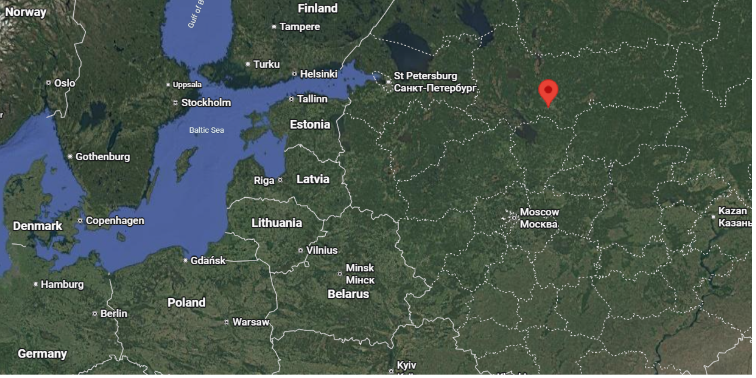
The Church of St John was built in 1698 by a landowner named Feodor Ivanovich Bakin. As an ordinary Russian landowner, he had serfs, one of whom even escaped and was apparently put on the wanted list and even informed about by a local priest who gave his testimony to the authorities — a typical story of those years of serfdom.[2]
Architecturally, the Church followed the typical style of seventeenth-century Vologda stone church building. It was a single-domed cubic structure standing on a high basement level, a feature characteristic of the region, but not the only one that is important to our story.
What is interesting is that seventeenth-century stone architecture in the Vologda region was beginning to show signs of the Baroque. While the churches still followed traditional Russian forms, their facades would become increasingly animated with elaborate decoration, layered cornices, and a strong vertical emphasis. The basic structural logic remained medieval, but the decorative language anticipated Baroque exuberance — something that Orthodox polemicists and apologists would mock as sort of Renaissance degeneracy, superstition and decadence of Popery imposed upon the Russian Church, imitating a Protestant attitude in their fundamentalist and nationalist discourse.
Historians (and the pious Russian faithful who supported this church) would not support this ideology. They would rather describe the style as a northern Russian ‘pre-Baroque’: a period when late Muscovite architectural forms (Old Orthodox Strictness) began to incorporate ornamental tendencies circulating across Eastern Europe in the later seventeenth century, which only shows another element of silent unity of Christendom, despite all schisms.
The main structure of St John’s Church was crowned with five domes set on tall drums — a feature both Russian and East-European. However, a small refectory was connected to the church with a two-tier bell tower. It was here in the bell tower the icon had been resting for some unknown period of time before it was revealed to larger society.
Unfortunately, the Church did not survive the Bolshevik persecutions, as shall be discussed below, but from the description it could well have looked like a smaller copy of the Vyatka Cathedral of the Resurrection of Christ or the Cathedral of the Great Martyr Catherine in the Kirov region (or something in between, on a more modest scale). Photos of these two churches below may help a Western reader imagine the picture.
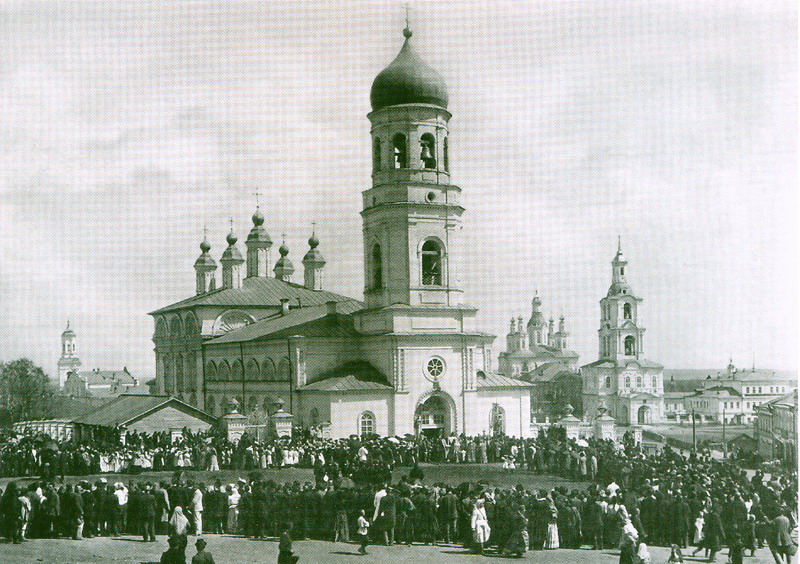
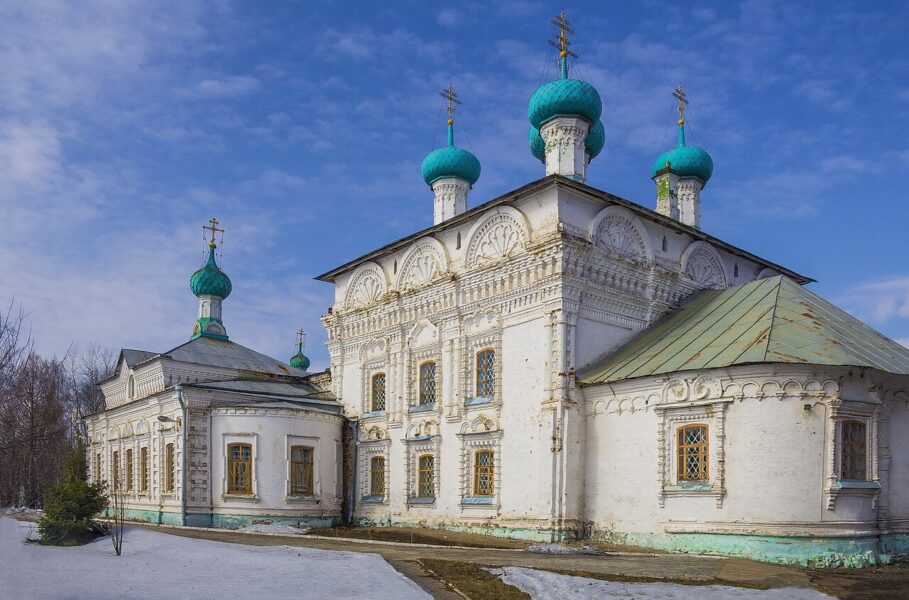
St John’s Church had three side chapels: one dedicated to the Apostle John the Theologian, another to the Holy Trinity, and the third to the Seven-Arrows Icon of the Mother of God. It appears that this last dedication was made only after the icon had been discovered, and had become widely known and venerated among the people, for this was not the case from the beginning.
The Icon’s Mission and the Lady’s Wish
According to tradition, a peasant from the Kadnikov district who suffered from severe paralysis once had a dream in which he heard a voice. The voice instructed him to go to the church of St John the Theologian, find an image of the Most Holy Mother of God in the bell tower, and pray before it with faith for healing.
At first, the clergy and parishioners did not believe the peasant and did not allow him to search for the icon. He tried again — he was still refused. Finally after going back to insist a third time was he allowed to climb the bell tower, where old and damaged icons were kept. There, at a turn in the staircase, the icon was discovered. It had been lying on the floor, and the bell-ringers had unknowingly been walking over it as if it were an ordinary board.
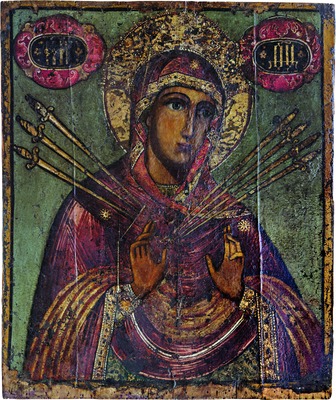
The image was brought down into the church and a service of supplication was performed before it. Soon afterwards, the peasant received complete healing.
What does this tradition tell us?
That the wonderworking icon had long been in this village church. Why was the icon lying on the floor? Perhaps it had somehow come into the possession of the local clergy and laity who, considering it ‘not entirely Orthodox’, did not place it in the church, yet could not simply destroy it, since they still invoked in her the Mother of God, and therefore hid it away. Later, with the passing of years, it lost any recognition altogether and came to be used as an ordinary board, mistakenly or deliberately. The tradition remains obscure about the intentions, which is noteworthy, since the same obscurity, inconsistency, and lack of reflection mark the origin of any schism, particularly the schism between the See of Rome and Russia.
Yet it is amidst the confusion that the Mother of God and Ever-Virgin Mary, according to Divine Providence and her most gracious will, herself called the local people through a manifest miracle of healing to venerate her sorrows and not to be ashamed of them in that particular image. And she did not leave this western image, once regarded as foreign and neglected, without the power of her miracles.
The Historical Context is Significant
The confusion was indeed quite expected. The seventeenth century Russian history was, in general, a century of sorrows and confusion. At that time the “Time of Troubles” was just coming to an end — this was a period of great civil war caused by the interruption of the Rurikid dynasty, which had ended with Ivan the Terrible, who persecuted his own people and brought about the death of Metropolitan Philip for opposing these oppressions. During this crisis, the Poles laid claim to the Russian throne and sought to secure it both through dynastic right—by advancing the candidature of their prince, Władysław—and by lending their support to the pretender known as False Dmitry, who claimed to be the miraculously surviving son of Ivan the Terrible.
The Poles cast out of the Kremlin and a new dynasty installed, there soon broke out a terrible church schism under Patriarch Nikon. This is known simply as “The Raskol (‘schism’),” in which a council made liturgical changes to the Russian liturgy provoking resistance from traditionalists who became known as “Old Believers.” This period produced further bloodshed as the State put various Old Believers to death from the 1650s-1680s.
The year 1698 itself (the year when St John’s Church was erected to become, by providence, the Seven Arrows icon’s first shelter) is marked in Russian history by the conclusion of Peter I’s Great Embassy, the Streltsy uprising, and the beginning of sweeping reforms, including further reforms of the Church influenced by a Protestant spirit.
After the suppression of the Streltsy revolt, Tsarevna Sophia, the sister of Peter the Great (and a more ‘conservative’ and devoutly religious candidate for the Russian throne who allied with old aristocracy and the streltsy, the military elite), was forcedly tonsured as a nun, and mass executions of the streltsy took place. Peter I returned from Europe, introduced the shaving of beards and imposed a tax on them, struck against traditional culture, and began the process of the secularisation and Protestantisation of Russia, becoming the visible head of the Russian Church.
Russia thus set out upon an anti-Catholic course:
- partly as a manifestation of resentment towards the Poles, who had come close to seizing the Muscovite throne;
- in the context of an anti-Uniate uprising and as part of a wider project to develop the Eastern Church as an alternative to Union with Rome; and
- within the framework of an already established Protestant anti-Roman discourse.
In this context, the Most Holy Mother of God spoke her word through the miraculous appearance of the icon — she is with us in our sorrows. And she seems to stand rather with the Latins than with the Protestants, but entirely with local Russian people and for them, although with no sign of any political affiliation or preference.
Another Significant Miracle
A second major episode connected with the icon took place during the cholera epidemic of 1830—1831, which struck many parts of the Russian Empire, including the city of Vologda. In July 1831 two miracle-working icons were brought into the city: the ‘new’ Seven-Arrows Icon and an ancient — ‘traditional’ — icon of the Dormition of the Mother of God from the Semigorodny [the Seven-Cities’] Monastery.
These holy images were carried in a procession around the city of Vologda. According to a civic record dated 15 October 1831, the cholera epidemic, which had already struck the city three times, began to diminish gradually after the procession and soon disappeared completely.
The legal petition, known as the ‘Resolution of the Town Community,’ requested permission from Bishop Stephen to establish an annual procession in memory of this deliverance. It proposed bringing the Seven-Arrows Icon to Vologda every year on 19 July, and the Dormition Icon on 21 July. However, the government-run Holy Synod did not approve the request and instead ordered that accurate copies of the icons be made. These copies were produced in 1836, funded by the city’s mayor.
In 1895, a further appeal was made to establish a church feast commemorating the city’s deliverance from cholera. However, this request was not satisfied for some unknown reason. It is quite probable that by then the issue was no longer that the icon was of Latin origin. That might have been a problem for the Old Believers who were marginalised and persecuted, having no power or decisive influence in the society. For the official Church, the difficulty may already have been elsewhere — in the deism and rationalism that had entered the minds of the Russian government, the nobility, and the intelligentsia, who no longer wished to hear of miraculous deliverances.
The seeds of unbelief, no doubt, bore their fruit.
After the Russian Revolution of 1917, the Church of St John the Theologian — the original shelter of the Icon — fell into decline and was eventually destroyed in the 1930s. On 18 June 2006, a memorial cross was erected on the site and consecrated by Archbishop Maximilian of Vologda and Veliky Ustyug. The inscription on the cross reads:
In memory of the Toshna Church of St John the Theologian which once stood here and of the manifestation of the miracle-working Seven-Arrows Icon of the Mother of God.
The Fatima Connection
Today, the icon’s feast day is the 13th of August. This is a very interesting date related to Fatima. On 13 August 1917 in Fatima, the apparition of the Mother of God to the three shepherd children did not take place, because the children had been arrested by a local administrator who was hostile to religion. Thus we may see in this a kind of reparation made by the Mother of God for the sins of unbelief and militant godlessness — the very dangers about which Mary herself was concerned when she appeared to the children at Fatima and, through them, called the world to prayer.
The original icon, preserved by Orthodox believers, is now kept in the Church of St Lazarus the Four-Day-Dead, located at the Gorbachev Cemetery in Vologda. This church was one of only two churches in Vologda where worship continued during the Soviet period, except for the years from 1940 to 1945, the end of the Great Patriotic War (known outside Russia as World War II). It was after this war when peace triumphed that the icon was placed in the reopened church. Many sacred objects rescued from destroyed churches and monasteries were transferred there and Our Lady thus gave them refuge.
Its veneration is shown by the many votive offerings left by believers who have prayed to the Mother of God for help. Numerous marks from nails can also be seen on the sides of the icon, evidence of the metal coverings that once adorned it in the past. Now it is decorated with a velvet covering.
Every Saturday after the Divine Liturgy, a prayer service is celebrated before the icon. During the COVID-19 pandemic, on 3 April 2020, the Russian Orthodox Metropolitan Ignatius of Vologda and Kirillov made a prayerful procession around the city of Vologda carrying the miracle-working Seven-Arrows Icon together with other revered relics of the diocese. After the procession, an Akathist to the Mother of God was celebrated in the Resurrection Cathedral. This prayer, since it organically incorporates a Latin devotion into a Russian liturgical context, is highly significant. But we will treat on this Akathist in Part III of our story.
For outside Vologda, across the Russian empire, the image of the Seven-Arrows Icon was copied again and again, and developed into an entirely Russian iconographical prototype. As a result this image of the Theotokos with seven swords in her heart became deeply embedded in the piety of the Russian people. So much so that in the twentieth century, after Atheistic persecutions had destroyed a significant part of the Church’s culture and the spiritual life of the people (and on the eve of the fall of Communism in Russia), the Mother of God once again began to act through this Latin, yet already so popular and familiar image, in another form and under a different name, working wonders for the salvation of souls. And, as God so often does, not through power, but through weakness and simplicity that endures.
This new icon, together with the general Akathist associated with it, its connection with the Catholic veneration of the Sorrows of the Mother of God, and its significance within Russian history, will be examined in turn in the two following parts of this essay.
Read Part II
[1]The basic facts about the icon and the circumstances of its origin, with the exception of the Western origin of the image itself, have been verified against the corresponding article in the Russian Orthodox Encyclopedia. This ensures that none of our Orthodox English-speaking readers could be skeptical of the basic information. Шевченко Э. В. Семистрельная икона Божией Матери // Православная энциклопедия. Электронная версия. URL: https://www.pravenc.ru/text/2662344.html
[2] КАУ ВО «Государственный архив Вологодской области», оцифрованный архив, том 7», accessed March 9, 2026.

No comments:
Post a Comment
Comments are subject to deletion if they are not germane. I have no problem with a bit of colourful language, but blasphemy or depraved profanity will not be allowed. Attacks on the Catholic Faith will not be tolerated. Comments will be deleted that are republican (Yanks! Note the lower case 'r'!), attacks on the legitimacy of Pope Leo XIV as the Vicar of Christ, the legitimacy of the House of Windsor or of the claims of the Elder Line of the House of France, or attacks on the legitimacy of any of the currently ruling Houses of Europe.