✠✠✠✠✠

Lazarus Saturday and Palm Sunday
Visible triumphs are few in the earthly life of our Lord Jesus Christ. He preached a kingdom “not of this world.” At His nativity in the flesh, there was “no room at the inn.” For nearly thirty years, while He grew “in wisdom and in stature, and in favour with God and man” (Luke 2:52), He lived in obscurity as “the son of Mary.” When He appeared from Nazareth to begin His public ministry, one of the first to hear of Him asked: “Can anything good come out of Nazareth?” (John 1:46). In the end, He was crucified between two thieves and laid to rest in the tomb of another man.
Two brief days stand out as sharp exceptions to the above—days of clearly observable triumph. These days are known in the Church today as Lazarus Saturday and Palm Sunday. Together they form a unified liturgical cycle which serves as the passage from the forty days of Great Lent to Holy Week. They are the unique and paradoxical days before the Lord’s Passion. They are days of visible, earthly triumph, of resurrectional and messianic joy in which Christ Himself is a deliberate and active participant. At the same time, they are days that point beyond themselves to an ultimate victory and final kingship which Christ will attain not by raising one dead man or entering a particular city, but by His own imminent suffering, death and resurrection.
By raising Lazarus from the dead before Thy Passion,
Thou didst confirm the universal resurrection, 0 Christ God!
Like the children with the palms of victory,
we cry out to Thee, 0 Vanquisher of Death:
Hosanna in the highest!
Blessed is He that comes in the name of the Lord!
(Troparion of the Feast, sung on both Lazarus Saturday and Palm Sunday)
Lazarus Saturday
In a carefully detailed narrative, the Gospel relates how Christ, six days before His own death, and with particular mindfulness of the people “standing by, that they may believe that thou didst send me” (John 11:42), went to His dead friend Lazarus at Bethany outside of Jerusalem. He was aware of the approaching death of Lazarus but deliberately delayed His coming, saying to His disciples at the news of His friend’s death: “For your sake, I am glad that I was not there, so that you may believe” (John 11:14).
When Jesus arrived at Bethany, Lazarus was already dead four days. This fact is repeatedly emphasized by the Gospel narrative and the liturgical hymns of the feast. The four-day burial underscores the horrible reality of death. Man, created by God in His own image and likeness, is a spiritual-material being, a unity of soul and body. Death is destruction; it is the separation of soul and body. The soul without the body is a ghost, as one Eastern Orthodox theologian puts it, and the body without the soul is a decaying corpse. “I weep and I wail, when I think upon death, and behold our beauty, fashioned after the image of God, lying in the tomb dishonoured, disfigured, bereft of form.” This is a hymn of Saint John of Damascus sung at the Church’s burial services. This “mystery” of death is the inevitable fate of man fallen from God and blinded by his own prideful pursuits.
With epic simplicity, the Gospel records that, on coming to the scene of the horrible end of His friend, “Jesus wept” (John 11:35). At this moment Lazarus, the friend of Christ, stands for all men, and Bethany is the mystical centre of the world. Jesus wept as He saw the “very good” creation and its king, man, “made through Him” (John 1:3) to be filled with joy, life and light, now a burial ground in which man is sealed up in a tomb outside the city, removed from the fullness of life for which he was created, and decomposing in darkness, despair and death. Again as the Gospel says, the people were hesitant to open the tomb, for “by this time there will be an odor, for he has been dead four days” (John 11:39).
When the stone was removed from the tomb, Jesus prayed to His Father and then cried with a loud voice: “Lazarus, come out.” The icon of the feast shows the particular moment when Lazarus appears at the entrance to the tomb. He is still wrapped in his grave clothes and his friends, who are holding their noses because of the stench of his decaying body, must unwrap him. In everything, stress is laid on the audible, the visible and the tangible. Christ presents the world with this observable fact: on the eve of His own suffering and death, He raises a man dead four days! The people were astonished. Many immediately believed in Jesus and a great crowd began to assemble around Him as the news of the raising of Lazarus spread. The regal entry into Jerusalem followed.
Lazarus Saturday is a unique day: on a Saturday a Matins and Divine Liturgy bearing the basic marks of festal, resurrectional services, normally proper to Sundays, are celebrated. Even the baptismal hymn is sung at the Liturgy instead of Holy God: “As many as having been baptized into Christ, have put on Christ.”
Troparion — Tone 1
By raising Lazarus from the dead before Your passion, / You did confirm the universal Resurrection, O Christ God! / Like the children with the palms of victory, / we cry out to You, O Vanquisher of death: / Hosanna in the Highest! / Blessed is He that comes in the Name of the Lord!
Kontakion — Tone 2
Christ the Joy, the Truth and the Light of all, / the Life of the World and the Resurrection / has appeared in His goodness, to those on earth. / He has become the Image of our Resurrection, / granting divine forgiveness to all!
✠✠✠✠✠
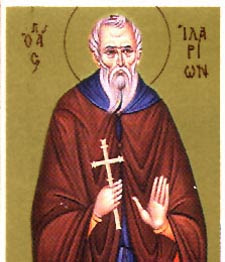
Saint Hilarion the New, Igumen of Pelekete Monastery, from his youth devoted himself to the service of God and spent many years as a hermit. Because of his holy and blameless life, he was ordained to the holy priesthood, and later he was made igumen of the Pelekete monastery (near the Dardanelles). Saint Hilarion was granted gifts of clairvoyance and wonderworking by the Lord.
Through prayer he brought down rain during a drought, and like the Prophet Eliseus he separated the waters of a river, he drove harmful beasts from the fields, he filled the nets of fishermen when they had no success in fishing, and he did many other miracles. In addition to these things, he was able to heal the sick and cast out demons.
Saint Hilarion suffered on Great and Holy Thursday in the year 754, when the military commander Lakhanodrakon suddenly descended upon the Pelekete monastery in pursuit of icon-venerators, boldly forcing his way into the church, disrupting the service and throwing the Holy Gifts upon the ground. Forty-two monks were arrested, slapped into chains, sent to the Edessa district and murdered. The remaining monks were horribly mutilated: they beat them, they burned their beards with fire, they smeared their faces with tar and cut off the noses of some of the confessors. Saint Hilarion died for the veneration of icons during this persecution.
Saint Hilarion left behind spiritual works containing moral directives for spiritual effort. Saint Joseph of Volokolamsk (September 9 and October 18) was well acquainted with the work of Saint Hilarion, and he also wrote about the significance of monastic struggles in his own theological works.
Troparion — Tone 5
Adorned with gladness of soul / as a pure vessel of the wisdom of Christ, / you were a reflection of the life in God. / Therefore you are resplendent with the light of virtues, / O Father Hilarion, / and you guide us unerringly to the salvation of our souls!
Kontakion — Tone 4
Righteous Hilarion, like a fruitful olive tree that has blossomed, / with your oil, you mystically make radiant those who sing to you: / “Rejoice, unwavering rule of the righteous!”
✠✠✠✠✠

Saint Stephen the Confessor, Igumen of Triglia Monastery, suffered under the iconoclast emperor Leo the Armenian (813-820). From a young age, the holy ascetic dedicated his life to God and received monastic tonsure. He later became head of the Triglia monastery near Constantinople.
When persecution again began against holy icons, the saintly igumen was summoned for questioning, and they tried to force him to sign a document rejecting the veneration of icons. Saint Stephen steadfastly refused to betray Orthodoxy and he boldly denounced the emperor for his impiety. They subjected the saint to cruel torments, after which they sent him to prison in the year 815. Weakened and sick, the holy Confessor Stephen soon died in prison from his sufferings.
Troparion — Tone 8
Champion of the Catholic Faith, teacher of purity and of true worship, / the enlightener of the universe and the adornment of hierarchs: / all-wise father Stephen, your teachings have gleamed with light upon all things. / Intercede before Christ God to save our souls.

No comments:
Post a Comment
Comments are subject to deletion if they are not germane. I have no problem with a bit of colourful language, but blasphemy or depraved profanity will not be allowed. Attacks on the Catholic Faith will not be tolerated. Comments will be deleted that are republican (Yanks! Note the lower case 'r'!), attacks on the legitimacy of Pope Leo XIV as the Vicar of Christ, the legitimacy of the House of Windsor or of the claims of the Elder Line of the House of France, or attacks on the legitimacy of any of the currently ruling Houses of Europe.