31 January 2022

Integralism is Christendom – Pt. I

A good starting introduction to integralism (or integrism, as we used to call it), what it is and what it is not. More to come.

From One PeterFive

By Joshua May


Perhaps no term in modern Catholic political discourse is so poorly understood—deliberately or innocently—as “integralism.” The term is bandied about without second thought both by scornful opponents who deride it as “Catholic sharia law” and by wishful utopians who define it as nothing more or less than whatever vaguely traditional throne-and-altar political project they personally happen to espouse at the moment. It is true that the word, which only entered the mainstream traditional conversation with gusto in the last few years, still lacks an immediately recognizable, broadly agreed-upon definition. Indeed, even the use of the word itself is not universally accepted as the best to describe this political system, but it does happen to be the word mostly used by most writers most of the time, and so it is with the term “integralism” that we must begin our investigation of what, exactly, this Catholic political philosophy entails. What follows is my humble attempt at a synthesis, a summary, of work laid out in greater detail elsewhere by far greater minds. The work of compiling a definitive, comprehensive political manifesto belongs to a greater pen than mine.

Because integralism has as many doppelgangers, impostors, and strawmen as it does genuine faces, it seems prudent to take a “compare and contrast” approach. This essay will attempt to explain what integralism is and, just as importantly, given the polemics surrounding it, what it is not, all the while maintaining the caveat that this can only be a starting point. By keeping to broad strokes and fundamentals, I also hope to avoid the peripheral debates on issues where integralist thinkers can vary greatly. This essay is an invitation to an immense and rich integralist literature, some selected highlights of which will be provided at the end.

Integralism is the Social Kingship of Christ…

Integralism seeks to unite or integrate the natural, earthly end of man (most properly cared for by the state) and the supernatural, divine end of man (most properly cared for by the Church). To the integralist, Church and state are like body and soul. They are unique, distinguishable, and serve different roles, but share a common purpose and aim. For both Church and state, the summum bonum is the salvation of souls, each in their own capacity. This is an alliance of ends, not a fusing of institutions: at no point does Church or state absorb or usurp the other. Think of the relationship rather as that between a helmsman and a navigator. Both are vital for the functioning of a ship. The helmsman steers the ship, but without the guidance of a navigator he can only ever hope to sail aimlessly through open waters. Likewise, it is the state that, endowed with temporal power, physically steers the ship of society, setting laws and punishing vice. It is the Church as navigator, with her hand not on the wheel but on the telescope, sextant, and map, who provides man and the state the why and whither of the sailing. At all times, the helmsman and navigator must act in harmony, lest the ship be lost.

At the heart of the integralist project is the Social Kingship of Christ, a doctrine stated clearly by pre-Vatican II popes but lost in the miasma of the post-conciliar era (despite the “integralist” caveat given at Vatican II).[1] In essence, this is a call for Christ’s reign to be proclaimed not only by all creatures individually, but also by all creation, corporately and in toto. If man is called to know, love, and serve God, how can his every endeavor and enterprise not also be called to this end? Is a man to worship God only at church, or in every sinew of his being and every aspect of his life? It falls to Leo XIII to state in Immortale Dei,

The State, constituted as it is, is clearly bound to act up to the manifold and weighty duties linking it to God, by the public profession of religion…men living together in society are under the power of God no less than individuals are (6).

The failure to translate the kingship of Christ to the material world, to opt instead to reserve it to a personal, spiritual domain, is a Protestant or Manichaean fallacy that denies the transformative power of grace upon nature.[2] In the Incarnation, grace infuses and sanctifies all aspects of creation and of man’s life. Everything in the material world and everything in human society can and should be dedicated to the Lord, Who is the origin and telos of all creation. We perceive this even now, in vestigial form, when we christen a ship or bless an Easter basket. It follows that the state is bound, no less than the Church, no less than the family, no less than man, no less than creation, to explicitly affirm the Kingship of Christ, to defend the rights and prerogatives of the Church He founded, and to propagate her truths and confound errors that would lead men away from her.

…but not Catholic theocracy.

Any talk of integrating Church and state can only sound alarm bells for the Liberal, who accepts as axiomatic “religious liberty” and the “separation of Church and state” (both understood in an Americanist, Liberal sense). The specter of a Catholic theocracy is summoned. Clear distinctions need to be made. It must first be understood that under an integralist state, there would be no forced conversion, no mass killings of heretics. Similarly, no confessional state is envisioned; no one is advocating for clerics to hold public office or for direct rule of the state by the Church (theocracy). Just as laymen have no right to interfere with the appointment of bishops, the election of popes, etc., so too the Church is not to dominate in processes most properly belonging to the state—by attempting to directly set trade policy, for instance. The Church is instead a moral guide whose members, baptized and properly catechized, naturally tend to explicitly  and consciously manifest her social teachings when they serve as statesmen (and in every other profession, from trash collector to judge, for that matter).

But what is the position of the non-Catholic in a state where public policy is consciously informed by Catholic teaching? This depends. In a nation where Catholicism is a minority, integralists caution the prudence of religious tolerance—permitting other religions to exist as a concession, but still officially endorsing and promoting only the Catholic faith.[3] In a country that is majority Catholic, the state must be correspondingly bolder. Public non-Catholic proselytization and new construction of non-Catholic religious buildings cannot be allowed, and religious tests for public office would follow. This is because a logically consistent state could not forbid such harms to the body as murder and rape without also outlawing the harm to the soul (far more serious in magnitude) that heresy represents.[4] Similarly, anti-blasphemy laws would be necessary, for the rights of God always supersede the rights of man.

In any circumstance, the natural law must always be a guiding principle, and no state, regardless of the religious makeup of its populace, can ignore it. Consequently, all states must bring an immediate end to evils that cry out to heaven for vengeance: abortion, contraception, pornography, usury, etc.

Integralism is postliberal…

Liberalism, properly defined, is the polar opposite of integralism. It is also, woefully, the philosophy that governs nearly every aspect of our common life. Its fundamental principles are lauded and defended by virtually all Western politicians, on the left and on the right. Liberal attitudes have infected our Church, our relationships, our economy, and our very ability to conceive of ourselves properly. Patrick Deneen, in his masterful work Why Liberalism Failed, identifies the two key pillars of liberalism: “1) anthropological individualism and the voluntarist conception of choice, and 2) human separation from and opposition to nature.”[5]

Permeating Western society is the idea that something is right or good simply because I desire it, and no one has the right to stop me from pursuing my own subjective goals, so long as I do no harm to others (usually defined quite narrowly). The idea of an objective and universal moral code, whether natural law or the revealed truths of the Faith, is discarded as a relic, an oppressive force that stifles human liberty.

Liberty in this understanding supplants and then becomes God.

Along with the moral code, social hierarchies, and relationships of legitimate authority, the idea of things having objective natures in themselves is cast into the dustbin of history. In short, anything that originates from any point outside raw human will must necessarily be a limitation on human freedom. On the political left, the issue of gender presents itself as the most obvious contemporary example of this. My gender is my choice, and no one—not the government, not the Church, and certainly not “nature” can tell me anything about it.

But liberalism also manifests itself in economic matters, and here we must turn an accusing finger to the political right.

Unrestrained capitalism (in practice, virtually all extant forms of capitalism) rests on identical logic as gender ideology. My money is mine, and no one—not the government, not the Church, and certainly not the cry of the poor—can tell me what to do with it. Money for the right, like gender for the left, is for my own private gain and happiness and has no greater meaning beyond that. Integralism, being postliberal, seeks to turn away from all varieties of Liberalism, on both the left and the right.

…but not “Conservative.”

At least in American political discourse, the term “liberal” is commonly misused to refer narrowly to the political Left, which is a deficient understanding of the term. The contemporary “liberal-conservative” divide is a Potemkin village, and there is more that unites these two sides than divides them, appearances notwithstanding. Even the name “conservative” reveals the movement’s hand: it has no positive program, nothing to offer, just a slow-rolling of left Liberalism. As Deneen says in a recent article,

As the illness [left Liberalism] progressed, “conservatism” would embrace the less diseased position that appeared ‘healthier’ in comparison to liberalism’s further metastization. Positive promotion of marriage and the family gave way to opposition to divorce, gave way to opposition to homosexual marriage, gave way to opposition to transgender ideology, gave way to hearty defenses of religious liberty. Within a generation, expect conservatives to apologize for the bigotry that once led them to endorse even wan versions of religious liberty.

 Here is summed up the entire problem of “conservatism:” it conserves nothing, it defends nothing, it stops nothing. It is a finger raised politely in concern as the Liberal bulldozer steams on, it is a strongly-worded editorial in the newspaper, it is sometimes (as with Trumpism) a rabid raging at the storms around us—but it is not a solution.

Conservatism is not worth the time of the integralist or the Catholic. It is nothing more than right Liberalism, just as bad as left Liberalism (but more deceptive!).

As opposed to being conservative, integralism is restorative. We do not seek to slow down, to win small victories here, to place all hope on the Supreme Court there, to play on Liberalism’s turf and under Liberalism’s rules of a morally neutral state, near-unlimited freedom of speech, or functional religious indifferentism. Integralism seeks a total break with the Enlightenment, Protestant, Freemasonic founding of the entire Western political order (the principles of both 1789 and 1776) and a restoration of the true, the good, and the beautiful. Our vision of the political order is not a pathetic nostalgia for some dubious, ephemeral conception of the alleged golden age of the 1950s. We scorn the limitedness of “Make America Great Again.” We know that only by returning to the principles and structures of Christendom can we hope to bring about the social kingship of Christ and true human happiness. Yes, we are going to anger the left when we outlaw abortion and other social evils. But just as strongly, the true integralist will be the enemy of the conservatives when he comes for their mindless accumulation of wealth, their usury, their fractional reserve banking, their diabolical stock market, and their war on the poor.[6] All must give way to Christ.

To be Continued.

Photo by Mark Boss on Unsplash

[1] “Religious freedom, in turn, which men demand as necessary to fulfill their duty to worship God, has to do with immunity from coercion in civil society. Therefore it leaves untouched [integram] traditional Catholic doctrine on the moral duty of men and societies toward the true religion and toward the one Church of Christ” (Dignitatis Humanae, 1). De Mallerais comments on Archbishop Lefebvre’s opposition to the declaration notwithstanding his later signing of the document: “The clauses included in Dignitatis Humanae on ‘the true religion’ or the ‘just limits’ of religious liberty made it just about possible to interpret the eleven lines that strictly speaking were the declaration (no. 2) in a Catholic manner, even if that was not the obvious meaning of the text, as the rest of the document makes clear.” The Biography of Marcel Lefebvre (Angelus Press: 2004), 312.

[2] Editor’s Note: the historical companion to this truth is undoubtedly John C. Rao’s Black Legends and the Light of the World: the War of Words with the Incarnate Word.

[3] Note the very important difference between religious liberty—which has been condemned by the Church and which considers all religions to be on an equal footing under the law, as if man had an innate right to choose error—and religious tolerance, which acknowledges the imperfect reality of society and, while not encouraging error and stemming its growth, chooses prudently not to force a resolution of the issue under current circumstances. For more on religious liberty, see D.C. Schindler’s foundational work The Politics of the Real, where he argues convincingly that separation of Church and state is, in very principle, simply impossible.

[4] A distinction has always been made in the Catholic tradition between public and private heretics. The Church has never attempted to punish someone for a privately held belief. It is the public manifestation of heresy—the attempt to lead others into error—that is an assault on the peace and must not be allowed. Hence the much-maligned “burning of heretics” only ever encompassed notorious and unrepentant public heretics. Canonized saints, including educated Renaissance men like St Thomas More, strongly defended the practice. If murderers are worthy of the death penalty, then why not the heresiarchs whose harm is so much greater in its effects?

[5] Patrick Deneen, Why Liberalism Failed (Yale University Press, 2018), 31.

[6] There is insufficient space here to launch a robust defense of Catholic economic teaching, as taught by pre-and post-conciliar Popes and based on Gospel principles. For a fuller examination of the issue, the author recommends the podcast series Good Money, a creation of New Polity (www.newpolity.com). This podcast profoundly changed the author’s approach to money and the way he structures his finances.

Behind a Declaration

I disagree with MM's analysis of the American treason. It WAS a revolution and it WAS the inspiration for the French Revolution.

From The Mad Monarchist (5 July 2013)

Another fourth of July having passed, it is an occasion again to ponder the dramatic events of the American War for Independence, popularly known as the American Revolution (or Revolutionary War). The most important thing about the conflict is that it gave birth to the United States of America which has had no small impact on the subsequent history of the entire world, particularly after assuming global super-power status in the aftermath of World War II. That created some problems for the idea of the American Revolution and the Declaration of Independence that is still celebrated every fourth of July. As someone once said (I want to say it was Mussolini but I could be wrong), ‘the problem with revolutions is that the revolutionaries survive them’ or words to that effect. With the Declaration of Independence, the American revolutionaries claimed extraordinary powers. They claimed the “right” that any people dissatisfied with their government were justified in using violent means to overthrow that government and replace it with one more to their liking. The document, of course, is silent on how “the people” come to such a decision. After all, no democratic vote was taken across the colonies in favor of independence or even for rising up against the British. Even the most ardent Patriots had to admit that their cause was a minority one and that most colonists either opposed the revolution or were unwilling to support it.

Even at the time those stirring words were penned, exactly who “the people” included was a debatable point. Loyal Americans were even then being killed, tortured, robbed and driven into exile because they did not support the revolution. And, of course, as we still see clearly today, the United States, having achieved independence (and ultimately great power status) has never been willing to apply those same rights to other people or even their own. When the southern states voted to secede from the Union they were met with crushing military force and the utter devastation of their country to force them back into the Union. When the United States won The Philippines from Spain, the Union inherited a guerilla war for independence and American troops had to be sent in to crush the Filipino rebels. Americans are expected to change governments by means of the democratic process rather than armed rebellion, within the structure of the federal republic set up by the constitution which must remain always sacrosanct. Revolutionaries all around the world, oftentimes the most monstrous of characters, have not hesitated to point out to the United States the hypocrisy of American opposition to their own acts of terror and rebellion given how they revere their own founders who did the same.

In that respect, the Revolutionary War and the Declaration of Independence have sometimes been problematic for the United States but because it created the country these things can never be denounced but must be clung to with religious fervor. Some of the very same men who fought the Revolutionary War and helped write the Constitution and the Bill of Rights were some of the same men who had rebels shot for defying government regulations and passed the Alien and Sedition Act which put people in jail for daring to voice opposition to the government. Most historians, if they have any honesty at all, will admit this. However, they will usually fall back on the tired line that, while the American Patriots may not have been perfect, they were at least better than the British alternative. This is most often seen when modern, liberal American scholars must deal with groups they have ordained as perpetual victims; African-Americans and Native Americans. They must admit that men like George Washington and Thomas Jefferson had slaves but paint them as being kindly masters who were never really comfortable with the institution. To hear some talk, one would think slaves had been forced on these men and that they were incapable of emancipating them even though they really, really wanted to.

They will also have to admit that, during the Revolutionary War, most Blacks took the side of the British Crown. Some will try to appear even-handed and understanding, pointing out (quite correctly) that it only made sense for slaves to side with the British since the British offered freedom in return for service to the Crown. However, most will hasten to add that this was no more than a British ruse and that the British never had any intention of actually keeping that promise. Here, despite their best efforts, their liberal condescension can usually be detected. They paint a picture of unfortunate, ignorant slaves being duped by those dastardly Brits. The truth, of course, is that most African-Americans sided with the British because it was in their own rational self-interest to do so and they were absolutely right. Just as attitudes on race were different in the northern colonies where there were no slaves, so too in Britain itself was slavery regarded as rather unsavory even at that time. Regardless of what happened during the war, slavery would have been abolished in America much earlier had the British won. At the time, the British attitude toward Blacks was not that different from any other people. The only difference was that in Britain the idea of equality, racial or otherwise, was still regarded as absurd. They saw slavery for what it was and that probably helped in getting rid of the institution. In America, on the other hand, slave holders could shout for liberty and be praised for it. Slavery was not really slavery, it was the “peculiar institution”. Because the Founding Fathers had already declared that “all men are created equal” yet still owned slaves, it could only be reasoned that slaves were not just men deprived of their freedom but not men at all, simply property. With such an attitude it is no wonder that slavery lingered in America so long and was so hard to eradicate.

On the subject of the Native Americans, their suffering and the horrors inflicted on them are one of the least known aspects of the Revolutionary War. Many books tell of their attacks on colonial settlers, and there were such attacks and they were quite brutal affairs -such was local custom. However, few American history books relate how the Continental Army went on a punitive campaign against the American Indians, endeavoring to wipe them out completely, destroying everything they had, killing men, women and children alike and leaving nothing behind so that the survivors would starve or freeze to death. How many people know that the idealized George Washington, because of this campaign, was given a name by the Iroquois that meant, “Burner of Villages”? After Washington became the first President of the United States, for a long time many American Indians still used the term “Burner of Villages” as the title of every American President. Again, most American history does not talk too much about the part played by Native Americans at all, however, those that do try to play up the minority who allied with the Patriots or they, again, blame Indian atrocities on the British and paint the American Indians as being duped by more clever British officials into supporting their side. In fact, most Native Americans displayed a clear grasp of the political situation at the time and had for many years. They acted in their own rational self-interest which, unfortunately, meant choosing the side that was to lose. Just as in the French and Indian War they looked at the British who were sending over colonists and the French who mostly sent over Jesuits and fur traders and most decided it was in their best interest to side with France. In the Revolutionary War, even more looked at the colonies continuously reaching westward and the British Crown trying to keep them confined to the coastal region so as to avoid costly conflicts and quite logically sided with the British.

Unlike some monarchists, although my sympathies would unquestionably have been with the loyalists on July 4, 1776, I do not have the animus some do against the United States. It was a “revolution” in an academic sense only. Technically it was simply a war of secession. The “revolutionaries” won and yet the British government went on as before and King George III remained safely on his throne. I do, however, object to the way facts are glossed over (usually unpleasant ones) and the way the Revolutionary War and its main players have been so deified in the popular imagination. Many remark about how successful the United States was, growing and expanding and yet they fail to mention how this came about. There were certainly bitterly antagonistic political factions in the early republic (and still are) but the United States benefited immensely from what were rather cruel policies. The divisions that existed were differences of opinion between two varieties of liberals. The traditional conservatives, the loyalists, had all been driven from the country and that certainly makes government a great deal easier. Perhaps most significant though is the refusal to take responsibility for the consequences of the ideas and the fanaticism encouraged by the Revolution.

Many monarchists are quick to blame the French Revolution on the American Revolution. The ideas inspired it and the expense of French intervention caused it to this way of thinking. I, however, have never subscribed to that mentality. To me, this lets off far too easy those who actually rioted in the streets, who actually stormed the palaces, who actually voted for the revolution and who actually carried it all out. However, there is no question that the success of the American rebels helped to make revolution thinkable in France and the French Revolution had far more disastrous and long-term consequences than simply the division of the English-speaking world into two camps. There again though, to this very day, we see a refusal of people to face up to the responsibilities of the revolutionaries. The Declaration of Independence that Americans celebrate on the Fourth of July could certainly be used by the revolutionaries in France to justify their grotesque behavior. Modern historians, however, praise the French Revolution for bringing food to the hungry and democracy to the disenfranchised (neither of which is true) while also acknowledging that this came at a terrible price in terms of human suffering, as though this were an entirely unavoidable consequence. Not true!

The Reign of Terror did not just happen, it was ordered. It did not have to happen, the King and Queen did not have to die and those who preached the principles of revolution and even those who embraced the Declaration of Independence in America should be made to accept responsibility for what their ideas caused. No revolution ever filled the stomach of a starving child. Killing the King and Queen of France put no bread on anyone’s table. Even if you believe that some of the ideals of the revolution were laudable, the revolution was not necessary to bring those about. There is every indication that King Louis was moving toward a more representative government anyway. Similarly, King George III did ultimately offer the American colonies autonomy within the British Empire, effectively dominion status as it would later be known, but was rejected. These people all could have remained loyal and worked within the system to achieve those goals that were just and reasonable. They chose not to, it was their decision and they are responsible for the consequences of  that, most of which have been very, very negative.

31 January, Antonio, Cardinal Bacci: Meditations For Each Day


Blessed Are Those Who Love Peace

1. “Blessed are the peacemakers,” Our Lord says, “for they shall be called children of God.” (Mt. 5:9)

All those who are in the state of grace, and therefore living on the supernatural plane, are the adopted sons of God and sharers in His divine nature, (Cf. 2 Peter 1:4) which they will enjoy one day in the Beatific Vision. Our Saviour, however, refers to those who love peace as being in a special way the sons of God. Why is this? St. Augustine offers the real explanation. (Cf. De Serm. Domini, lib. I, Cap. 2) God is perfect peace and harmony. In Him there is no conflict. His being and His activity are identical. He is perfect unity and simplicity, eternal and unaffected by the limitations of space and time. Now, the son should be a living image of the father. Those who reflect, although necessarily in a limited way, this peace, harmony and serene activity in their own personality, deserve to be called in a special way the sons of God. They are the true lovers of peace.

2. How can one achieve this calmness of approach and manner of behaviour? We can consult St. Augustine again. (Ibid.) It is particularly necessary that the faculties and movements of our lower nature should be under control and subjects to right reason. It is reason which should govern us. It should guide us constantly and exercise complete control over all those parts of our nature which are common to men and animals. It is disastrous if the desires of the flesh rebel against the spirit, and worse still if they gain the upper hand. Then there can be no more peace of heart. There is no longer that reflection of the divine harmony which the grace of God had bestowed on us. There is only slavery, the slavery which takes away liberty and peace. It is very necessary, therefore, that “that part of man which is the highest and most perfect should rule without opposition the remaining parts which are common to men and animals; but in its turn this supreme faculty, that is, the intellect or reason, should be subject to God Almighty.” (Ibid.)

It is clear from these words that peace in us is the result of two kinds of necessary obedience, the obedience to right reason of the lower faculties, and the obedience of right reason to God, our Creator.

“This is the peace which God gives on earth to men of good will; this is the most perfect wisdom.” (Ibid.)

3. Peace is especially opposed to sentiments of anger and hatred against our brothers. It commands us to love and help them. Hatred is the heritage of Cain, because God says that “he who does not love abides in death. Everyone who hates his brother is a murderer. And you know that no murderer has eternal life abiding in him.” (I John 3:15) A man who hates his brother may not actually kill him, but he is guilty of murdering him in his heart. As a result he loses peace of soul, because, as St. Augustine points out (Sermon 82), by hating somebody you create disorder in yourself and destroy that divine harmony which was the gift of divine grace and charity.

If we wish to preserve interior peace, we must cast out from our hearts every vestige of hatred for our neighbour and entertain love, understanding and forgiveness for all. By loving our enemies we place ourselves above them by an act of true Christian nobility. We imitate Jesus, Who forgave His executioners and prayed for them from the Cross. A fit of anger is like a moment of madness. It is a great misfortune for anyone to yield to it. He speaks and acts like a man who has lost his reason and allows himself to be carried away by blind passion. When the moment of insanity is over, he will be ashamed of himself and of all that he has said and done.

It is necessary to be masters of ourselves and of our feelings. Never speak or act until anger has subsided within you. By persevering in co-operation with the grace of God, preserve that inward calmness which is a reflection of the peace of God.

Eastern Rite -Feasts of 31 January AM 7530

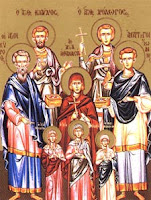
Today is the Feast of the Holy Wonderworkers and Unmercenaries Cyrus and John, and those with them.
✠✠✠✠✠

Saint Cyrus was a noted physician in the city of Alexandria, where he had been born and raised. He was a Christian and he treated the sick without charge, not only curing their bodily afflictions but also healing their spiritual infirmities. He would say, “Whoever wishes to avoid being ill should refrain from sin, for sin is often the cause of bodily illness.” Preaching the Gospel, the holy physician converted many pagans to Christ. During the persecution by Diocletian (284-305), Saint Cyrus withdrew into Arabia, where he became a monk. He continued to heal people by his prayer, having received from God the gift to heal every sickness.

In the city of Edessa at this time lived the soldier John, a pious Christian. When the persecution started, he went to Jerusalem and there he heard about Saint Cyrus. He began to search for him, going first to Alexandria and then to Arabia. When Saint John finally found Saint Cyrus, he remained with him and became his faithful follower.

They learned of the arrest of the Christian woman Athanasia and her three young daughters. Theoctiste was fifteen; Theodota was thirteen, and Eudoxia was eleven. Saints Cyrus and John hastened to the prison to help them. They were concerned that faced with torture, the women might renounce Christ.

Saints Cyrus and John gave them the courage to endure what lay before them. Learning of this, the ruler of the city arrested Saints Cyrus and John, and seeing their steadfast and fearless confession of faith in Christ, he brought Athanasia and her daughters to witness their torture. The tyrant did not refrain from any form of torture against the holy martyrs. The women were not frightened by the sufferings of Saints Cyrus and John but courageously continued to confess Christ. They were flogged and then beheaded, receiving their crowns of martyrdom.

At the same place, they executed the Holy Unmercenaries Cyrus and John. Christians buried their bodies in the church of the holy Evangelist Mark. In the fifth century, the relics of Saints Cyrus and John were transferred from Canopis to Manuphin. Later on, their relics were transferred to Rome, and from there to Munchen (Munich) (another account is located under June 28).

Saints Cyrus and John are invoked by those who have difficulty in sleeping.

Troparion — Tone 5

You have given us the miracles of Your martyrs, Cyrus and John, / as an invincible rampart; / through their prayers, frustrate the plans of the heathens, / and strengthen the faith of Catholic Christians, / for You alone are good and love mankind.

Kontakion — Tone 3

(Podoben: “Today the Virgin...”)
Having received the gift of miracles through divine grace, O saints, / you work wonders in the world unceasingly. / You remove all of our passions through your invisible surgery, / divinely-wise Cyrus and glorious John, / for you are truly divine physicians.

IN LUMINE FIDEI: 31 JANUARY – SAINT JOHN BOSCO (Confessor)


IN LUMINE FIDEI: 31 JANUARY – SAINT JOHN BOSCO (Confessor): John Bosco was born in 1815 in Becchi, Italy, to the farmhands Francesco Bosco and Margherita Occhiena. Francesco died when John was tw...

31 December, The Chesterton Calendar


JANUARY 31st

The 'Iliad' is only great because all life is a battle, the 'Odyssey' because all life is a journey, the Book of Job because all life is a riddle.

'The Defendant.'

31 January, The Holy Rule of St Benedict, Patriarch of Western Monasticism


CHAPTER VI. Of the Practice of Silence

31 Jan. 1 June. 1 Oct.

The third degree of humility is, that a man for the love of God submit himself to his superior in all obedience; imitating the Lord, of Whom the apostle saith: “He was made obedient even unto death.”

1 February, The Roman Martyrology


Kaléndis Februárii Luna vicésima nona Anno Dómini 2022

February 1st 2022, the 29th day of the Moon, were born into the better life:

The holy martyr Ignatius, who ruled the church of Antioch as the third Bishop of that See in succession to the blessed Apostle Peter.
In the persecution under the Emperor Trajan he was condemned to be killed by wild beasts, and was sent to Rome in chains by command of the emperor. There, in the presence of the Senate, he was first put to most grievous torments and then thrown to lions, the which throttled him with their teeth, and so he was made Christ's offering, (in the year 107.)
At Smyrna, the holy martyr Pionius. He was a Priest who had written much controversial matter on behalf of the Christian faith. After suffering a foul imprisonment, during the which he strengthened many brethren by his exhortations to the enduring of martyrdom, he was put to many tortures and nailed upon a pyre, where he obtained a blessed end by being burnt for Christ's sake. And with him suffered fifteen others, (in the year 251.)
At Ravenna, holy Severus, (in the year 389,) Bishop of that city, to the which place he was chosen, on account of his extraordinary merits, through a miraculous sign in the form of a dove.
At Tron, in Gaul, (in the fifth century,) holy Paul, Bishop of that see, whose life shone with grace, and the preciousness of whose death is attested by miracles.
Upon the same day, holy Ephrem, Deacon of the church of Edessa, who after much work for the faith of Christ fell asleep in the Lord, eminent for holiness and teaching, in the time of the Emperor Valens, (in the year 378.)
In Ireland, (in the year 523,) the holy Virgin Brigid. At the moment that she bowed down her head to receive the hallowed veil, she chanced to touch the wooden steps of the altar with her hand, and in witness to her virginity the dry wood at once became green.
At Florence, in Tuscany, the blessed Virgin Veridiana, recluse, of the Order of Vallombrosa, (Castel Florentin, 1242.)
V. And elsewhere many other holy martyrs, confessors, and holy virgins.
R. Thanks be to God.

Memes of the Day


30 January 2022

King Charles the Martyr

Of the Devil?

'Banning or suspending the Extraordinary Form can only be inspired by the devil.' - attributed to His Eminence Robert, Cardinal Sarah.

From A Living Sacrifice

By Fr Dana Ambrose Christensen, Obl. OSB

Too good not to share in light of the great confusion which has befallen our Church.

From the ever-wise Cardinal Sarah:

“Banning or suspending the Extraordinary Form can only be inspired by the devil. I am of the opinion of Benedict XVI. What was holy and sacred yesterday cannot be condemned to disappear today. What harm does the Traditional Mass cause? What harm? If they can learn to meet Christ in a Mass celebrated in silence, in respect for the sacred, they must not doubt it. Everybody wants to grow in God. Why stop him? It is not a riot. They do not deny in any way the Second Vatican Council, quite the contrary.”

Catholic Cop Wins $75K Settlement After Suspension for Praying at Abortion Facility

Of course, cops who protest, on duty and in uniform, for leftist policies are left alone in the first place.

From the National Catholic Register

By Katie Yoder/CNA


The city of Louisville, Kentucky, is paying a local police officer a $75,000 settlement after he was suspended for praying outside an abortion facility, according to the firm representing him.

Officer Matthew Schrenger was off duty when he stopped to pray with his father on the public sidewalk outside the EMW Women’s Surgical Center nearly a year ago, on Feb. 20, according to the Thomas More Society. Schrenger arrived in the early morning, before the abortion provider opened, as part of 40 Days for Life, an international grassroots campaign dedicated to ending abortion through prayer and fasting.

Matt Heffron, senior counsel for the Thomas More Society, previously said that Schrenger, a 13-year police veteran, was praying the Rosary, according to the local Fox affiliate, WDRB News.

For his actions, Schrenger was suspended for more than four months with pay, stripped of his police powers and placed under investigation, a Jan. 27 press release by the Thomas More Society read.

According to a letter last June obtained by WDRB News, the Louisville Metro Police Dept. expressed concern that Schrenger wore his full uniform while participating in “protest activity,” but acknowledged that he attempted to cover it up with his coat.

Surveillance video obtained by WDRB showed Schrenger praying and walking outside of the facility for an estimated 45 minutes and carrying a “pray to end abortion” sign at one point, the outlet reported.

The settlement comes three months after Schrenger sued the city’s mayor, police chief and police department in a federal lawsuit filed by the Thomas More Society with Blaine Blood, a Louisville attorney, in October.

Schrenger’s attorney, Heffron, called the city’s actions against the 13-year police veteran “a significant and inexcusable violation of a loyal officer’s constitutional rights.”

“The unfair discipline revealed undeniably content-based discrimination against Officer Schrenger’s personal pro-life views and violated his First Amendment rights,” Heffron said. “He did not engage in any political protest on duty – he prayed quietly. Yet Officer Schrenger was punished for this peaceful, private behavior.”

He accused the police department of a double standard.

“The treatment of Officer Schreger was particularly galling considering other Louisville police officers previously had marched, while on duty and in uniform, in political protests that apparently were approved by the police department,” he said. “He was treated very differently than other officers who had undeniably engaged in true political protest and activism while participating in LGBT and Black Lives Matter demonstrations.”

According to the Thomas More Society, open-records requests showed that those other officers faced no suspension or any kind of discipline whatsoever.

The Extent of Papal Authority

Father takes a look at the history of the power of the Popes and how it certainly seems that Francis has overstepped the bounds.

From Fr Hunwicke's Mutual Enrichment

Few theologians shaped Anglo-Papalism in the twentieth century more than Dom Gregory Dix. In 1938 he published a scintillating succession of articles explaining, to his fellow Anglicans, the Vatican I teaching about papal power. Near his conclusion came the following:

"The language of the Vatican [I] decrees on the Roman Pontiff is admittedly formidable at a first reading. ..."A primacy of jurisdiction, ordinary, immediate and episcopal" in every diocese in Christendom ... It is so unlike the powers we Anglicans concede to a Primacy. But is it? [Dix next apparently refers to the episode when the Bishop of Exeter refused to institute a clergyman, Mr Gorham, to a benefice and excommunicated latae sententiae anybody who should do so; the institution was done by a Commission from the Archbishop of Canterbury. Dix goes on:] That was an act of jurisdiction in another man's diocese. It was an act of "ordinary" jurisdiction, since the Archbishop had an indisputable right, in the circumstances, to do it. It was an act of "immediate" jurisdiction, since he did not act as the bishop's delegate but against his protests. It was an act of "episcopal" jurisdiction, since it conveyed cure of souls. In other words, the whole Vatican definition of a primacy is latent in the harmless Anglican conception, for use when needed."

In our own time, when the Bishop of Chichester, Eric Kemp, refused to ordain or license women, these acts were performed within the Chichester Diocese by Commission from Archbishop Carey, thereby providing another example of Dix's point.

When English Anglican Canon Law was revised in the 1960s, the powers of the Archbishops were clearly laid out: "The archbishop has throughout his province at all times metropolitical jurisdiction, as superintendent of all ecclesiastical matters therein, to correct and supply the defects of other bishops, and, during the time of his metropolitical visitation, jurisdiction as Ordinary ..." A later codification made clear that, during a visitation "the jurisdiction of all inferior Ordinaries is suspended ..."

The gist of Dix's broader argumentum ad hominem was: If you say that the early popes did not "exercise jurisdiction over the whole Church", I will agree, but with the proviso that this was a period when Bishops didn't exercise jurisdiction either ... because the whole concept of canonical jurisdiction only came later and so is anachronistic. 

The sort of authority which early popes did exercise in the Universal Church, so Dix argued, was exactly the same sort of authority that contemporary bishops exercised in their local, Particular, Churches. 

When Vatican I defined the Petrine Ministry, it did so in the juridical/canonical language of its own period (just as the first four Ecumenical Councils framed their Christology in the terms of the Greek metaphysics of their own time; although, as Dix puts it, the Gospel writers had not been Greek metaphysicians). Swallow episcopal jurisdiction, you can't avoid swallowing papal jurisdiction. Swallow the anachronisms of Nicea, and you'll be hard put to avoid swallowing those of Vatican I.

Sic Dixit.

Where Dix would indeed, I strongly suspect, dissent from the exercise of the Papacy as it happens during this present disordered pontificate is in his explanation: "It is, by implication a 'reserve power' in the constitution of the Church, which presupposes an emergency in the local church." 

This seemed, in 1938, fairly obvious. The Pope may have had ordinary, immediate, and episcopal jurisdiction, but he did not normally compose and issue the annual diocesan list whereby Father X was moved from parish Y to parish Z. He did not write each Pastoral Letter. Nor did the pope lay down in a personal communication to Mrs Murphy which decades of the Rosary she was to say when she nipped out to do her shopping, or exactly whereabouts the parish vacuum cleaner was to be stored.

Or how often the heating system was to be serviced. Even though lives could be at stake ...

There can be really profound implications in whether the junior curate in a parish takes his Day Off on Tuesday or Wednesday. Since the Roman Pontiff has Immediate Jurisdiction over all Catholics ... every single one in all the world ... it is clearly his right ... and duty ... to check up on which day each junior cleric throughout the world puts his feet up. And how far up he puts them.

Whenever there is angry controversy or violent disorder about such matters, and even if there isn't, the Holy Father would certainly have the right ... and duty ... to leap nimbly on to Eurostar and to come and sort things out ... Holy Father, how badly we need you ... come and be ordinary, immediate, and episcopal among us ...

Exactly.

That's not how it works.

That's not how it's meant to work.

Bishops are not "mere Vicars" of the Pope ... well, they weren't supposed to be according to Vatican II, anyway. 

And not until the Era of PF have they been treated as such. Incredibly, this is an era in which a pope, so he believes, has the authority to 'phone up a parishioner anywhere in the world and to give her pastoral directions ... without any reference to her bishop or pastor. An era in which each bishop is to be surrounded by minute regulations about his liturgical arrangements in his own diocese.

This is not a 'normal' period of Church history. It is a manic aberration. Its 'papacy' is an absurd parody of the Ministry granted by the Lord to S Peter.

You think I'm exaggerating matters? Get this:

Some Roman functionary, acting, so he claims, on the authority of PF, has recently attempted to lay down exactly what factual information each parish priest may or may not divulge in his parish newsletter!!

Do the nouns 'fool' and 'bully' spring unbidden to your mind? Or the adjectives 'pompous' and 'risible'?

That is why this current tyranny is too thoroughly ridiculous to survive; and too totally preposterous to demand any sort of respect or compliance.

How to Respond to a Synod on the Synod on Synodality

Along with many of us, Mr Millette is confused as to what a 'Synod on Synodality' actually is. I don't know, either, but it doesn't sound good.

From One Peter Five

By Dan Millette

I have a confession to make.

It’s embarrassing to admit. I feel like less of a man because of it, if I can even call myself a man. I blame society. I blame my parents. I blame anything pre-Vatican II. Most of all, I blame being brainwashed with a non-innovative outlook.

Out I come with it: I still have no idea what a synod on synodality is.

This is a serious moral issue, I am told. No less than a Prince of the Church, Cardinal Joseph Tobin of Newark, has remarked that I may, in fact, be a heretic because of it. “My favorite definition of heresy is a refusal to deal with complexity,” says the least popular episcopal Tobin. “If you look at the heresies of the church, the great heresies, they couldn’t accept one thing or the other, and they didn’t want to live with the tension.” Nighty-night Arius, there’s a new heresy in town.

Now what Tobin says sounds complicated. Of course, according to his favorite definition of heresy, this means he is not a heretic. For him, heretics are those who refuse to deal with the complexity of the synod on synodality. The path of synodality is not straight and narrow we are told, and we must embrace this convoluted reality. Straight and narrow paths are only for less important places, like heaven.

In my defense, I imagine there are many other Catholics who do not understand what a synod on synodality is. Not the old lady in her pew reciting rosaries with heroic rigidity. Not the mother of seven who is busy homeschooling, feeding, and occasionally hiding in a bathroom away from her children. Maybe not even Cardinal Dolan of New York, who has preached: “I don’t know if I completely understand it; and the Holy Father is honest in admitting that neither does he have the full comprehension.” In fact, I suspect no one – not a single soul – who is responsible for living a real life, in the real world, understands the idea of a synod on synodality. Hence, I suspect most people roll their eyes and ignore all this synod-talk.

However, ignoring it will no longer be possible for the average Catholic. The local bishops have come calling. That is, many bishops, in the spirit of synodality, are currently hosting their own diocesan synods. The purpose is to force discussion on Pope Francis’ synod on synodality. In other words, these bishops are hosting synods on the synod on synodality. Sound complicated? Good. This, I am told, means that there is no heresy.

What is involved with these local synods? Many things. Synodal prayers are said at Mass, with a banquet of vague, inoffensive, and meaningless phrases. Flashy posters, graphically designed by second grade students, are placed throughout the narthex.

The official logo of the synodal path

Homilies are preached on the synodal process – though I forget in which Gospel Jesus dialogued about synodality. Diocesan Zoom calls are scheduled to discuss what it means to discuss. More meetings and guided conversations follow, usually during work hours so only retired church-goers – devoted to singing a new Church into being – can attend. Then, a precious document, never to be read, is created and passed on to the next level of Church bureaucrats. With that, a Mass is said by the bishop to declare the local synodal process complete. The synodal game has been played to perfection. All that is left is for the bishop to beg for money. These synods can’t be cheap.

Inane complexity is not a strength of mine. While I have offered a reasonable synopsis of the local synodal process, I still maintain I have no idea what any of this means. Regardless, there is one vital question still to be asked: What are Catholics to do with these diocesan synods? I ask this question with sincerity.

A hint of an answer, I believe, is found in something not yet mentioned: the diocesan survey. Assuming you do not use the fire escape when leaving Mass – it is tempting – many dioceses are distributing synodal surveys to the faithful as they head out the church doors. These surveys provide an excellent clue for understanding what one must do with the synodal process.

I will demonstrate with my own completed diocesan survey, answers and all:

Within your faith community, how would you rate your sense of belonging from not at all to totally belonging? [Scale of 1-100]

Rock solid 7 out of 100.

I get the most spiritually affirmed by…

Dude. Definitely by synods.

Think of a time that you felt you really belonged to a faith community.

“Felt” gives away the answer. Whenever there are felt banners, I feel like I belong. Especially when there is fire on them. I like fire on felt banners. They should all be on fire.

Think of a time that you felt you did not belong to a faith community.

That time when the Holy Father called me rigid, insecure, a proud proselytizer, lazy, a rosary counter, ideological, a modern Gnostic, self-absorbed, a restorationist, Pelagian…

Are you staying connected to your Church or faith community?

Yes to the Church. No to the faith community.

What are you willing to do to increase your spiritual relationship and who will you get to help you do this?

I am willing to drive 2.5 hours at 5:00am to attend the nearest traditional Latin Mass. My young children will help me do this. They always insist we take them there instead of the usual Mass in town.

Pope Francis wants to hear from you, what would you like to tell him?

Trust me, he doesn’t want to hear from me. However, I would like to tell him that my favorite definition of heresy is, “a species of infidelity in men who, having professed the faith of Christ, corrupt its dogmas” (Aquinas, II-II, 11-1).

***

In other words, as seen with the survey, the only way to respond to a synod on the synod on synodality is to mock it. It is to deride, scorn, laugh at, and sabotage its every move, for that is what these synods are attempting to do to Holy Mother Church. Let this charade be given the ridicule it deserves. And then, in charity, may we pray for those who promote such foolishness. For one thing I do understand is this: “How narrow is the gate, and strait is the way that leadeth to life: and few there are that find it!” (Mt. 7:14).

Now those are simple words to follow.