31 October 2021

The Shroud of Turin - Fact or Fiction

When the Shroud was 'debunked' my faith was severely shaken. Oh, NOT my Faith, but my faith in science.


This is my interview with Barrie Schwortz from the Shroud of Turin Education and Research Association which runs www.shroud.com. We talk about how Barrie became a member of the first team of scientific researchers to examine the shroud, what their research discovered, and how it changed his life.

Word of the Day: Christ the King

CHRIST THE KING. A feast originally established by Pope Pius XI in 1925, to be celebrated with special solemnity on the last Sunday of October. It is now observed on the last Sunday of the liturgical year. Its object is to worship Christ's Lordship of the Universe, both as God and Man, and it was instituted to meet the crisis of faith in the Savior's authority, exercised by the Church, of which he is the invisible head.

Fr Zed on the BBC Podcast' Trying to Save the Latin Mass'

Fr Zed mentions the podcast, and adds an interesting observation about the song played toward the end of it.

From Fr Z's Blog

In that audio report there is, toward the end, a song by Georges Brassens called “Tempête dans un bénitier”. It is very French – as in “excuse my French” in its… expression of less than high regard for the liturgical changes and those who forced them.

Brassens was a writer for Le Figaro and a prodigious songwriter. He and countless others objected to the changes in the liturgy during the 60’s that were never asked for by the laity and were being shoved down everyone’s throats by their loving shepherds.   This dates from 1976.


Tempête dans un bénitier
Le souverain pontife avecque
Les évêques, les archevêques
Nous font un satané chantier
Ils ne savent pas ce qu’ils perdent
Tous ces fichus calotins
Sans le latin, sans le latin
La messe nous emmerde
A la fête liturgique
Plus de grand’s pompes, soudain
Sans le latin, sans le latin
Plus de mystère magique
Le rite qui nous envoûte
S’avère alors anodin
Sans le latin, sans le latin
Et les fidèl’s s’en foutent
O très Sainte Marie mèr’ de
Dieu, dites à ces putains
De moines qu’ils nous emmerdent
Sans le latin
Je ne suis pas le seul, morbleu
Depuis que ces règles sévissent
A ne plus me rendre à l’office
Dominical que quand il pleut
Il ne savent pas ce qu’ils perdent
Tous ces fichus calotins
Sans le latin, sans le latin
La messe nous emmerde
En renonçant à l’occulte
Faudra qu’ils fassent tintin
Sans le latin, sans le latin
Pour le denier du culte
A la saison printanière
Suisse, bedeau, sacristain
Sans le latin, sans le latin
F’ront l’églis’ buissonnière
O très Sainte Marie mèr’ de
Dieu, dites à ces putains
De moines qu’ils nous emmerdent
Sans le latin.
Ces oiseaux sont des enragés
Ces corbeaux qui scient, rognent, tranchent
La saine et bonne vieille branche
De la croix où ils sont perchés
Ils ne savent pas ce qu’ils perdent
Tous ces fichus calotins
Sans le latin, sans le latin
La messe nous emmerde
Le vin du sacré calice
Se change en eau de boudin
Sans le latin, sans le latin
Et ses vertus faiblissent
A Lourdes, Sète ou bien Parme
Comme à Quimper Corentin
Le presbytère sans le latin
A perdu de son charme
O très Sainte Marie mèr’ de
Dieu, dites à ces putains
De moines qu’ils nous emmerdent
Sans le latin
Storm in a holy water font
The Sovereign Pontiff with that
Bishops, archbishops
Make us a damn construction site
They don’t know what they’re losing
All those damn hugs
Without Latin, Without Latin
Mass pisses us off
At the liturgical feast
No more big ceremonies, suddenly
Without Latin, Without Latin
No more magical mystery
The rite that captivates us
Then turns out to be harmless
Without Latin, Without Latin
And the faithful don’t care
O most Holy Mary mother of
God tell these whores
Of monks that they piss us off
Without latin
I’m not the only one, morbleu
Since these rules are rife
Not to go to the office anymore
Sunday only when it rains
They don’t know what they’re losing
All those damn hugs
Without Latin, Without Latin
Mass pisses us off
By renouncing the occult
They will have to do tintin
Without Latin, Without Latin
For the denarius of worship
In the spring season
Switzerland, verger, sacristan
Without Latin, Without Latin
The church will truant
O most Holy Mary mother of
God tell these whores
Of monks that they piss us off
Without Latin.
These birds are rabid
These crows that saw, trim, slice
The healthy and good old branch
From the cross where they are perched
They don’t know what they’re losing
All those damn hugs
Without Latin, Without Latin
Mass pisses us off
The wine of the sacred chalice
Changes into blood sausage
Without Latin, Without Latin
And its virtues are weakening
In Lourdes, Sète or Parma
As in Quimper Corentin
The presbytery without Latin
Has lost its charm
O most Holy Mary mother of
God tell these whores
Of monks that they piss us off
Without latin


The Differences Between the Feast of Christ the King and the NO 'Solemnity of Christ the King'


It was instituted by His Holiness Pope Pius XI, of Blessed Memory, in 1925 by his Encyclical Letter, Quas Primas.

Quas Primas was a development of ideas going back to the Church Fathers, but concretely presented earlier by Leo XIII, and Pope Pius himself. Pope Leo had said in Annum Sacrum,

His empire extends not only over Catholic nations and those who, having been duly washed in the waters of holy baptism, belong of right to the Church, although erroneous opinions keep them astray, or dissent from her teaching cuts them off from her care; it comprises also all those who are deprived of the Christian faith, so that the whole human race is most truly under the power of Jesus Christ. 
And Pope Pius had said in his Ubi arcano Dei consilio, 
 ...(A)s long as individuals and states refused to submit to the rule of our Savior, there would be no really hopeful prospect of a lasting peace among nations.
A short comparison of the Rites: 

 The Collect from the Traditional Roman Rite:

Almighty and everlasting God, who in thy beloved Son, the King of the whole world, hast willed to restore all things: mercifully grant that all the families of nations, now kept apart by the wound of sin, may be brought under the sweet yoke of his rule.Who with thee liveth and reigneth, in the unity of the Holy Spirit, one God, world without end.
And for comparison, the Collect for the Feast from the Missal of Pope Paul VI:
Almighty ever-living God, whose will is to restore all things in your beloved Son, the King of the universe, grant, we pray, that the whole creation, set free from slavery, may render your majesty service and ceaselessly proclaim your praise. Through our Lord Jesus Christ, your Son, who lives and reigns with you in the unity of the Holy Spirit, one God, for ever and ever.
A pretty stark difference, eh? From all the nations of the world brought under the sweet yoke of Christ's rule to all of creation rendering service and proclaiming God's praise. The last time I checked, all of creation, except Man and the fallen angels, did all of that as essential to their nature.

Of course, this was completely in line with Annibale Bugnini's plans to protestantise the Liturgy.


“We must strip from our Catholic prayers and from the Catholic liturgy everything which can be the shadow of a stumbling block for our separated brethren that is for the Protestants.”
“The liturgical reform is a major conquest of the Catholic Church, and it has ecumenical dimensions, since the other Churches and Christian denominations see in it not only something to be admired in itself, but equally as a sign of further progress to come” 
With one exception the readings have been changed, as well. In the Traditional Rite, the Epistle is Col 1:12 - 20, and the Gospel is John 18:33 - 37. The Gospel from John survives in Year B in the three year cycle, Year A being Matt 25:31-46, and Year C, Luke 23:35-43

The point of these alterations, along with the change of date, seems to have been to remove the idea that Christ should reign as King today, the date being in the Time after Pentecost, in our hearts, our homes and families, in our societies, and in our nations, to be replaced with the idea that Christ will reign at the end of time, with the date on the last Sunday of Ordinary Time. over all creation. In fact, to emphasise that very point, Paul VI changed the name of the feast from the Feast of Christ the King to the Solemnity of Christ the King of the Universe. This, of course, removes the pesky idea that Christ is King, even now, over protestant. Muslim, Jewish, pagan, and atheist hearts, homes, societies and nations. That would be triumphalist and exclusionary!

And, by placing it on the last Sunday in October, it was deliberately placed close to 'Reformation Day', kept by many protestant churches on the same Sunday to celebrate the heresiarch Luther's rebellion against Christ's Holy Catholic Church. Therefore, moving it was done to placate the heretics.


The doctrine of the Feast is expressed very well in this prayer from Fr Stedman's Jesus+Mary+Joseph Novena Manual: 

 HAIL, CHRIST, OUR KING 
MOST SWEET JESUS! Come near to us, Thy children. Receive from our hands that crown which those who are but dust of earth, try to seize from Thee. Enter now in triumph among us, Thy fervent Lawmakers may break the tables of Thy Law, but whilst they lose their thrones and are forgotten, we, Thy subjects, will continue to salute Thee « Hail, Christ, our King! 
They have said that Thy GOSPEL is out-of-date, that it hinders progress, and must no longer be considered. They who say this soon disappear into obscurity and are forgotten; whilst we, who adore Thee, continue to salute Thee « Hail, Christ, our King! 
The proud, the worldly « those who possess unlawful riches « those who thirst for riches, honors and pleasures alone « declaring Thy moral law to be for past ages « will be hurled against the Rock of Calvary and Thy Church and falling, will be reduced to dust, and sink into oblivion, « whilst we, Thy followers, continue to salute Thee « Hail, Christ, our King! 
Those who seek the dawn of a material civilization, divorced from God, will surely die, poisoned by their own false doctrine, deserted and cursed by their own children « whilst we, who would console Thee, will continue to salute Thee« Hail, Christ, our King! 
Yes, hail to Thee, O Christ, our King! Put to flight Lucifer, the fallen angel of darkness, from our homes, schools and society « force him and his agents into Hell « chain him there everlastingly « whilst we, Thy friends, continue to salute Thee« Hail, Christ, our King!
Stedman, Fr. Joseph F.. Jesus, Mary, Joseph Novena Manual: The New Revised (Kindle Locations 935-952). Confraternity of the Precious Blood. Kindle Edition. 
An excellent explanation of the ideas and doctrines of the Feast of Christ the King may be read in Mr Michael Davies', The Reign of Christ the King. This booklet is a transcript of the keynote speech at the Catholic Voice International Conference in Chicago in the early 1990s. I was also a speaker at the conference on the subject of Christ the King and Monarchism, so I got to hear Mr Davies deliver his speech, after having been privileged to have dinner with him the night before.

And for those who do not have access to the prayers and hymns of the Traditional Office of Christ the King, here is a 'Little Office' I compiled some years ago, based on the example of the approved Little Offices, such as the Immaculate Conception, St Joseph, and the Holy Angels. (pdf file available here.)


Here is a traditional prayer to Christ the King, which is really an Oath of Allegiance to His Kingly Powers:


Prayer to Christ the King

O CHRIST, JESUS, I acknowledge Thee as Universal King.
For Thee, all creatures have been made. Do Thou exercise
over me all the rights that Thou hast.

Renewing my Baptismal Vows, I renounce Satan,
with all his works and pomps, and I promise to live as a
good Catholic: Especially, do I pledge myself, by all
the means in my power, to bring about the triumph of the
rights of God and of Thy Church.

Divine Heart of Jesus, I offer Thee all my poor actions to obtain that all hearts may recognize Thy Sacred Royalty and that thus the Reign of Thy Peace may be established throughout the entire world.
Amen.


Christ The King From "The Saint Andrew Daily Missal" (1953)


Pope Pius XI (whose motto was: Pax Christi in regno Christi) instituted the feast of Christ the King as a solemn affirmation of our Lord's kingship over every human society; He is King, not only of the soul and conscience, intelligence and will of all men but also of families and cities, peoples and states and the whole universe. In his Encyclical Letter "Quas primas"the Pope showed how laicism or secularism, organizing society without any reference to God, leads to the apostasy of the masses and the ruin of society because it is a complete denial of Christ's Kingship. This is one of the great heresies of our time, and the Pope considered that this annual, public, social and official assertion of Christ's divine right of Kingship over men in the liturgy would be an effective means of combating it.

That Christ is King over all creation is the theme of the whole Mass and Office of the feast. The Mass begins with the magnificent Apocalyptic vision of the Lamb of God, sacrificed but henceforth glorified forever, acclaimed by the innumerable host of Angels and Saints (Introit). By its position on the last Sunday of October, towards the end of the Liturgical year and just before All Saints, the feast of Christ the King comes as the climax of our celebration of all Christ's mysteries and a kind of earthly anticipation of his everlasting reign over the elect in the glory of heaven. It sums up the Christian message that by his Death and Resurrection Christ has conquered sin and death and reigns in the glory of his victory among the elect who are its fruit. Christ is the creative Word; He is the Man-God, seated at the right hand of the Father; He is our Saviour; these are His three titles to kingship.


Happy Feast Day!

Favorite Royal Images: The Last Burmese Queen

A picture of HM Queen Supayalat   (13 December 1859 – 24 November 1925) a fascinating woman.

From The Mad Monarchist (8 October 2013)

HM Queen Supayalat of Burma
A very...formidable woman, the wife (and half-sister) of the last native King of Burma

31 October, Antonio, Cardinal Bacci: Meditations For Each Day

Motives of Humility

1. Humility is the most necessary and the most difficult of the virtues. It is the most necessary because it is the foundation of the entire Christian edifice of spiritual perfection. No stable structure can be built without a firm foundation.

This virtue is also necessary because God gives His grace only to the humble, and without His grace we can gain no supernatural merit. “God resists the proud but gives grace to the humble.” (James 4:6) Humility is, moreover, the most difficult of the virtues. It is hard to renounce one's possessions and give them away to the poor in accordance with the evangelical counsel. It is harder to renounce one's wayward instincts and passions. It is even harder, however, to renounce one's own ego with all its immoderate desires. Nevertheless, this is what Christian humility demands of us. We must deny ourselves and acknowledge our nothingness. We must recognise that it is folly to glory in things which do not belong to us, but are merely gifts from God.

It is necessary to practise the virtue of humility continually if we are to become humble. For this purpose it is useful to meditate on the motives which should inspire us to humble ourselves both before God and before men. Our sins constitute one of these motives. All that we are and all that we have in the physical and in the supernatural order are gifts from our Creator and Redeemer, but sin belongs to us alone.

It is we ourselves who are responsible for sin, because in direct opposition to His will we abused the faculties which God gave us. This is surely a reason for humiliating ourselves; sin, which is an offence against God and is our spiritual ruination, is the only thing which we can claim as properly belonging to us. Unfortunately, we have committed innumerable sins in thought, word, deed, and omission; alone and in public, by day and by night, as children and as adults; against the commandments of God, against the precepts of the Church, and against the obligations of our state in life. Our whole existence has been marred by offences and acts of ingratitude against God, our greatest Benefactor.

2. Another motive for humility is our deficiency in virtue. We have received many gifts from God, but what use have we made of them? We have received gifts of nature and of grace, good inspirations, good example, and precious time and opportunity for doing good. On those occasions when the voice of God spoke most clearly in our hearts, we made good resolutions and promised to abandon sin and to walk with greater fervour in the way of perfection. Unfortunately, however, we continue to lag behind. This is a new motive for humbling ourselves and for beseeching from God the gift of perseverance.

3. Finally, there is the transient nature of mortal life. One illness is enough to carry us to the grave, there to rot and to be eaten by worms. It is sufficient for the capillary vessel of the brain to be burst in order to render us incapable of forming a single thought or of uttering a single word. We imagine that we are very important, whereas in fact we are insignificant before God and before the mighty universe. Let us do our best, therefore, to be humble. If we can become as little children, God will be pleased with us and will make us members of His kingdom. “Unless you turn and become like little children, you will not enter into the kingdom of heaven.” (Mt. 18:3)

Eastern Rite - Feasts of 31 October AM 7530

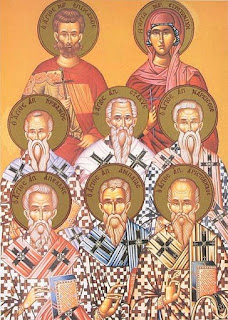
Today is the Twenty-third Sunday After Pentecost and the Feasts of the Holy Apostles Stakhys, Apellēs, Amplίas, Urban, and Nárcissus of the 70 and Others with Them and of the Holy Martyr Epίmakhos.
✠✠✠✠✠

Saint Stachys, one of the Seventy Apostles, was ordained as Bishop of Byzantium by Saint Andrew (November 30). He founded a church at Argyropolis, and many people gathered there to hear him preach. He was a good shepherd to his flock, zealously proclaiming the Gospel of Christ, converting many to the true Faith, and laboring tirelessly for their salvation for sixteen years. He departed to the Lord in peace.

Saints Amplίas and Urban were also made Bishops by Saint Andrew. Amplίas was the Bishop of Diopolis, and Urban was the Bishop of Macedonia. They also suffered martyrdom because they were destroying the pagan idols.

Saint Nárcissus was appointed as Bishop of Athens by the Apostle Philip. He was tortured and put to death by the idol-worshippers because of his zeal in proclaiming the truth of the Gospel.

Saint Apellēs was the Bishop of Herakleia, and he brought many to the Christian Faith.

Saint Aristóboulos, one of the Seventy Apostles, was the brother of Saint Barnabas (June 11) and proclaimed the Gospel in Britain, where he died in peace. He is also commemorated on March 16, but on March 15 in Greek usage.

Troparion — Tone 5

(Podoben: “Come, let us worship the Word...“)
Let us acclaim Stachys, Apellēs, Amplίas, Urban, Nárcissus, and Aristóboulos as a six-stringed harp of the Spirit, / singing of God's marvellous gifts to mankind. / Together, as divine Apostles, / they ask that grace may be granted to our souls

Kontakion — Tone 8

(Podoben: “As the first fruits of our nature...“)
Fittingly, let us praise those sacred treasures of the All-Holy Spirit and rays of the Sun of Glory, / the wise Apostles Apellēs, Urban, Aristóboulos, Amplίas, Nárcissus, and Stakhys, / who received grace from our God.
✠✠✠✠✠

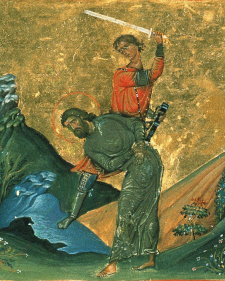
The Holy Martyr Epίmakhos of Alexandria was a native of Egypt. For a long time, he lived in seclusion on Mount Pēlousium. When he learned that Christians were being persecuted in Alexandria, Saint Epίmakhos entered the city and destroyed some pagan idols, declaring that he too was a Christian. Apellianos, the eparch of Alexandria, ordered him to sacrifice to the idols, and when the Saint refused to do this, he commanded that he be tortured.

Among those who witnessed his suffering was a woman who was blind in one eye. A drop of the Martyr's blood fell into her eye and she received her sight. Thus, the woman came to believe in Christ. After enduring many fierce torments, the Saint was beheaded with a sword.

The Holy Martyr Epίmakhos is also commemorated on March 11 (the transfer of his relics).

Troparion — Tone 4

Your holy martyr Epίmakhos, O Lord, / through his suffering has received an incorruptible crown from You, our God. / For having Your strength, he laid low his adversaries, / and shattered the powerless boldness of demons. / Through his intercessions, save our souls.

Kontakion — Tone 3

(Podoben: “Today the Virgin...”)
Of your own accord you went to contend for the true Faith, O Epίmakhos, / and courageously you cried out to the impious: / "I have come to strive in a contest for the truth, / and to destroy the idols of perdition." / And when you were beheaded, you received a crown of righteousness.

IN LUMINE FIDEI: 31 OCTOBER – VIGIL OF ALL SAINTS ( ALL HALLOWS EVE)

IN LUMINE FIDEI: 31 OCTOBER – VIGIL OF ALL SAINTS ( ALL HALLOWS EVE): Dom Prosper Guéranger: Let us prepare our souls for the graces Heaven is about to shower upon the Earth in return for its homage. Tomorro...

IN LUMINE FIDEI: 31 OCTOBER – CHRISTUS REX (CHRIST THE KING)

IN LUMINE FIDEI: 31 OCTOBER – CHRISTUS REX (CHRIST THE KING): This feast was instituted by Pope Pius XI in the Holy Year of 1925 to salute the Author and Founder of the Church as “King and Lord” and ...

IN LUMINE FIDEI: 31 OCTOBER – TWENTY-THIRD SUNDAY AFTER PENTECOST

IN LUMINE FIDEI: 31 OCTOBER – TWENTY-THIRD SUNDAY AFTER PENTECOST: Dom Prosper Guéranger: For the years when the number of the Sundays after Pentecost is only twenty-three, the Mass for today is taken...

31 October, A Chesterton Calendar

OCTOBER 31st

HALLOW E'EN

If we ever get the English back on to the English land they will become again a religious people, if all goes well, a superstitious people. The absence from modern life of both the higher and the lower forms of faith is largely due to a divorce from nature and the trees and clouds. If we have no more turnip ghosts it is chiefly from the lack of turnips.

'Heretics.'

31 October, The Holy Rule of St Benedict, Father of Western Monks

CHAPTER XXIV. What the measure of excommunication should be

1 Mar. 1 July. 31 Oct.

The measure of excommunication or chastisement should be meted out according to the gravity of the offence, the estimation of which shall be left to the judgment of the Abbot. If any brother be found guilty of lighter faults, let him be excluded from the common table. And this shall be the rule for one so deprived: he shall intone neither Psalm nor antiphon in the Oratory, nor shall he read a lesson, until he have made satisfaction. Let him take his meals alone, after those of the brethren so that if, for example, the brethren eat at the sixth hour, let him eat at the ninth: if they eat at the ninth, let him eat in the evening, until by proper satisfaction he obtain pardon.

1 November, The Roman Martyrology

Kaléndis Novémbris Luna vicésima sexta Anno Dómini 2021

The morrow is the Feast of All the Saints. This famous feast was instituted to be held every year throughout the whole city of Rome, in honour of the Blessed Virgin Mary, Mother of God, and of all the holy martyrs, by Pope Boniface IV, after he had consecrated to Christian worship the temple called the Pantheon or Temple of all the gods. And the same festival was afterwards being kept in diverse ways in diverse churches, when Gregory IV decreed that it should be solemnly observed for ever throughout the universal Church upon the first day of November, in honour of all the Saints.
November 1st 2021, the 26th day of the Moon, were born into the better life:

At Terracina, in Campania, (in the reign of the Emperor Diocletian,) the holy Deacon Caesarius, who suffered many days in prison, and was afterwards put into a sack, along with the holy Priest Julian, and cast into the sea.
At Dijon, the holy Priest Benignus, who was sent into Gaul to preach the Gospel by blessed Polycarp, under the Emperor Marcus Aurelius. He was put to many most grievous torments by the judge Terence, who commanded at last that his neck should be struck with an iron bar and a lance thrust through his body.
Upon the same day, the holy handmaiden Mary, who was accused of Christianity, under the Emperor Hadrian. She was grievously lashed, racked, and torn with hooks, and so suffered martyrdom.
At Damascus, suffered the holy martyrs Caesarius, Dacius, and five others.
In Persia, under King Sapor, the holy martyrs John the Bishop and James the Priest.
At Tarsus, under the Emperor Maximian, holy Cyrenia and Juliana.
(At Clermont,) in Auvergne, holy Austremonius, the first Bishop of that see.
At Paris, (in the fifth century,) deceased the holy Marcellus, Bishop (of that see.)
At Bayeux, in the time of Childebert, King of the Franks, holy Vigor, Bishop (of that see.)
At Tivoli, the holy Monk Severinus.
In the Gatinais, (in the fourth century,) the holy Confessor Maturin.
V. And elsewhere many other holy martyrs, confessors, and holy virgins.
R. Thanks be to God.

Memes of the Day


30 October 2021

Vatican Extends Opportunities To Gain Indulgences for the Dead

Great news! Now, instead of just the Octave of All Souls, the plenary indulgence for the poor souls may be gained throughout the month of November!

From Joan's Rome

By Joan Lewis

Due to the ongoing pandemic and related health and safety measures, the Apostolic Penitentiary – in response to requests from bishops around the world – is once again extending opportunities to gain indulgences for the benefit of the faithful departed.

By Adriana Masotti

The Vatican’s Apostolic Penitentiary published a decree on Thursday providing for the possibility of obtaining plenary indulgences in favour of the faithful departed throughout the entire month of November.

The decree, signed by Cardinal Mauro Piacenza, notes that the decision to once again extend the time period for gaining the indulgences was taken in response to “various pleas recently received from the various Sacred Pastors of the Church, due to the continuing state of the [Covid-19] pandemic.”

By means of the decree, the Apostolic Penitentiary “confirms and extends for the entire month of November 2021 all the spiritual benefits already granted on 22 October 2020” – that is, it allows the faithful to gain plenary indulgences for the souls in purgatory by visiting a cemetery on every day in November and praying for those who have died; normally, the indulgence is limited to the first eight days of the month.

A second plenary indulgence is also established for the day of the commemoration of the faithful departed, All Souls’ Day, November 2. The current decree allows the faithful to obtain that indulgence for the benefit of the deceased on any day of November, at their choice.

The Penitentiary notes in the decree that “from the renewed generosity of the Church, the faithful will certainly draw pious intentions and spiritual vigour to guide their lives according to the Gospel law, in filial communion and devotion to the Supreme Pontiff, the visible foundation and Pastor of the Catholic Church.”

The present Decree, like the one issued last year in the midst of the pandemic, is intended to meet the need to avoid gatherings, a potential cause of the spread of Covid-19, which still affects the world’s population to varying degrees.

The Daily Pilgrimage to Purgatory

Let's empty Purgatory! This is a devotion especially appropriate for the month of November. N.B. All of the indulgences are obsolete since Indulgentiarum Doctrina, 1967. Current indulgences are contained in the Enchiridion Indulgentiarum.

An Explanation Of This Particular Devotion. Its Usages, Its Benefits, and Its History.


With the Permission of the Superiors

Origin of The Daily Pilgrimage to Purgatory

In the writings of St. Margaret Mary, we find the following exhortation: “In union with the divine Heart of Jesus make a short pilgrimage to Purgatory at night. Offer Him all your activities of the day and ask Him to apply His merits to the suffering souls. At the same time implore them to obtain for you the grace to live and die in the love and friendship of this divine Heart. May He never find in you any resistance to His holy will, nor any wish to thwart His designs in your regard. Fortunate will you be, if you succeed in obtaining deliverance for some of these imprisoned souls, for you will gain as many friends in heaven.”

This pious practice which St. Margaret Mary recommended to her novices for the octave of All Souls, was introduced to the members of the Arch-confraternity of Our Lady of the Sacred Heart in the year 1885. Since then many of the faithful have made this pilgrimage daily. Our world-wide Arch-confraternity, therefore, would seem to have been chosen by divine Providence to obtain comfort and deliverance for many souls in Purgatory.

In a letter of recommendation, given on January 5, 1884, his Eminence, Cardinal Monaco la Valette, Vicar General of His Holiness, sanctioned the propagation of the “Daily Pilgrimage to Purgatory." On October 8 of the following year, his successor, Cardinal Parochi deigned not only to honor us with a letter of approbation, but also delivered a splendid sermon on this practice in the church of Our Lady of the Sacred Heart in Rome, in which it had been introduced. May it please the divine Heart of Jesus to use this booklet as a means of spreading this work of sympathetic love for the Poor Souls everywhere. May this most benevolent of hearts extend to all who in any way assist in its circulation, the fullness of His graces and blessings.

Advantages Of This Practice

It is short. The Daily Pilgrimage requires little more of your time than an ordinary prayer, a religious thought, or a devout ejaculation.

It is easy. It can be practiced by anyone without effort, regardless of age or state of life, at any time, and in any place.

It is comforting. No more is required than to descend in spirit for a few moments into Purgatory, and to petition God to send light, relief and peace to the holy souls, to relieve them of their sufferings, and to hasten the hour of their deliverance.

It is holy. It is in accordance with the wishes of the Sacred Heart. It increases His honor. He is our companion on this pilgrimage. We share in His love, and receive from Him light, relief and peace for the suffering souls.

It is generous. It offers to the Sacred Heart every meritorious deed performed in the course of a day: prayers, mortifications, good works, alms, suffrages of every kind, and places them at His disposal on behalf of the Poor Souls.

It is inexhaustible. It implores Our Lord and Savior to apply to them the infinite merits of His Life. His Passion and Death, and also those of the Blessed Virgin Mary, St. Joseph and all The Saints.

It is efficacious.…. If only you knew with what ardent desire these holy souls long for this new “remedy” which has such efficacy to relieve their sufferings. For this is what St Margaret Mary calls the devotion to the Sacred Heart.

It is meritorious... By extending this act of brotherly love to the Poor Souls, our own merits are increased in the same measure as the pious thoughts which it inspired, the good disposition which it creates, the acts of virtue which it prompts.

It goes on increasingly…... At every moment of the day and night, somewhere on earth members of the Archconfraternity pray for our departed friends according to our intention. There is an uninterrupted sequence of holy Masses, Stations of the Cross, good works, prayers and indulgences. Those whose death we mourn will never be forgotten.

It is approved by the Church…… Many bishops have readily given their approval. His Eminence, the Cardinal Vicar of his Holiness, has recommended it twice in a most explicit manner. The Holy Father himself has deigned to bestow the richest privileges upon the altar of the Poor Souls in the Church of Our Lady of the Sacred Heart in Rome.

It is favored by God himself …… Numerous spiritual and temporal favors have manifested, again and again, how pleasing this practice is to the Sacred Heart. One may use it with confidence as a means of obtaining the conversion of a sinner, the restoration of health, or a special grace. Very effective also is the promise to promote this devotion if a petition be heard. If the Lord rewards in this life the gift or a cup of cold water, given in His name to the poor, He certainly will reward, even more generously, the help offered for His sake to the Poor Souls.

It is salutary…… By helping the Poor Souls, we assure ourselves their perpetual gratitude; they will pray for us, especially after their entrance into eternal happiness; in particular will they endeavor to obtain for us the grace of a happy death.

“On awakening on this morning on the Sunday of the Good Shepherd” wrote St. Margaret Mary two hundred years ago, “two of my suffering friends came to take leave of me, today the Good Shepherd received them into His eternal home. They left with untold joy and happiness. When I asked them to remember me, they replied: “Ingratitude has never entered heaven.”

It deserves to be propagated……O you my Christian friends who read these lines, priests, religious or devout laypeople, help to spread this devotion, It is so simple, and requires so little effort; moreover, you will be rewarded for it. Let at least one tiny drop of water trickle into Purgatory every day. If no one refuses to do so, many souls will be released, and a refreshing stream of grace will flow without ceasing through that prison of fire.

Daily Pilgrimage to Purgatory Preparation:

(Either one of the following acts or a similar one will suffice.)

Prayer - O St. Margaret Mary, whom the Lord has chosen to reveal to the whole world all the treasures hidden in his merciful heart of Love! O thou who hast heard how the Poor Souls in Purgatory begged for this new remedy, the devotion to the Sacred Heart which relieves them so effectively of their torments! O thou who hast set free so many of these poor prisoners by practicing this devotion: obtain for us the grace to make this Pilgrimage worthily in the company of the Sacred Heart of Jesus. Amen.

Unite your own intentions with those of the faithful who make this pilgrimage daily.

Consecration of the Day:

Divine Heart of Jesus, in making this pilgrimage with Thee as my Companion, I consecrate to Thee all my thoughts, words and actions of the entire day. I pray Thee to unite my small merits with Thine and to apply them to the Poor Souls, especially the soul of Thy servant, N.N.

Likewise do I entreat you, holy souls, to help me obtain the grace to persevere in love and loyalty toward the Sacred Heart, by submitting readily and without complaint to whatever designs He may have in my regard.

Offering - Eternal Father, we offer Thee the Blood, Passion and Death of Jesus Christ and the sorrows of the most holy Mary and St. Joseph in payment for our sins, in suffrage for the holy souls in Purgatory, for the wants of our Holy Mother the Church and for the conversion of Sinners. Amen.

Ejaculation - “May the Sacred Heart of Jesus be loved everywhere.” 300 days.

“Our Lady of the Sacred Heart, pray for us.” 300 days

“St. Joseph, model and patron of those who love the Sacred Heart, pray for us.” 300 Days, Plenary Indulgence, once a month

Preparatory Meditation:


Let us for a moment, in company with the Sacred Heart, descend in spirit into the consuming flames of Purgatory. 

How many of these souls are beginning their painful imprisonment this very moment! I know many of them have been there for a long time and shall be there for a longer time to come! And what a holy legion almost entirely purified and cleansed at the present moment, shall rise to heaven this very day!

How happy the Poor Souls are! They have escaped hell forever. They are certain to obtain eternal happiness. They are friends of God; they are saved. And yet, how miserable they are at the same time. They must still suffer temporal punishment for sins which have been already forgiven them. The gates of their heavenly fatherland are still closed to them; they are sentenced to expiating fire.

Behold them in their present plight! Listen to their lamentations! Speak to them a word of friendship and sympathy, and hasten to their assistance!

The Heroic Act of Charity in Favor of the Poor Souls in Purgatory

The heroic Act of Charity is the most beautiful and most effective manifestation of devotion to the Poor souls, as well as of love of God and neighbor in general. For those of our associates who did not make it as yet, we give the following explanation.

1. Purpose of meaning of Heroic Act of Charity.
The heroic act of charity on behalf of the souls in Purgatory consists of a voluntary offering, made by one of the faithful in their favor, of all works of satisfaction done in this life, as well as of all suffrages which shall be offered after death. By this act he deposits all these works and suffrages in the hands of the Blessed Virgin, that she may distribute them on behalf of those holy souls whom it is her good pleasure to deliver from the pains of Purgatory, and at the same time he declares that by this personal offering he forgoes on their behalf only the special and personal benefit of those works of satisfaction, so that, if he be a priest, he is not hindered from applying the Holy Sacrifice of the Mass according to the intention of those who give him alms for that purpose.

Every meritorious act performed in the state of sanctifying grace and with a good intention, gains for us the following spiritual privileges:
- An increase in sanctifying grace and heavenly glory.
- Many graces of body and soul for ourselves and for others.
- Remission of temporal punishment for our sins.

Only this third fruit, the satisfactory or expiatory part of the works that we accomplish is conceded or applied to the souls in Purgatory, whereas the fruit of merit and impetration (of prayer), remains ours. The heroic act therefore does not prevent us from praying for ourselves or for others, nor to let others share in our good works.

Remarks

In making the heroic act and desiring to gain the indulgences attached to it, one foregoes in truth and in fact, without reservation of any kind, and without exception, the special and personal benefits of all works of satisfaction and suffrage, and deposits them as a voluntary offering to God in the hands of the Blessed Virgin.
This act of charity is not a vow and does not bind under sin. It may be revoked at any time. It stands to reason, however, that, by doing so, one can no longer gain the indulgences attached to the heroic act.

Indulgences

The priests who have made this offering may enjoy the benefits of the privileged altar personally every day of the year. All of the faithful who have made this act may gain:

1. A plenary indulgence applicable only to the departed, every day that they receive Holy Communion, provided they visit a church or public oratory and pray for the intention of the Sovereign Pontiff.
2. A plenary indulgence every Monday, if they hear Mass in suffrage for the souls in Purgatory and fulfil the usual conditions. The sick, old people, those living in the country, travelers, prisoners, etc., who cannot hear Mass on Monday may offer to this end that of the Sunday.
3. All indulgences granted, or to be granted and gained by the faithful who have made this offering, are applicable to the holy souls in Purgatory, even when this faculty is not so expressed in the formula or decree of the concession of such indulgences.

Motives For Making The Heroic Act

1. You gain many indulgences.
2. Innumerable souls are quickly released from Purgatory; heaven is filled with new saints, who will glorify and praise God for all eternity, also on your behalf.
3. You will gain the special love of the Holy Trinity, of Our Savior, and of all the saints and you have the promise of
Our Lord applied to you: “Blessed are the merciful, for they shall obtain mercy.” (Math. 5, 7.)
4. After you have made the heroic act, the Poor Souls will become your debtors; in heaven they will labor that you may not be lost, that you shall not suffer Purgatory at all, or at least be released from it soon.
5. The Blessed Virgin receives an increase of signal veneration, since she will be proclaimed, loved, and invoked as the most loving Queen of the Poor Souls and sweet dispenser of our merits to them. There can be no doubt that she will have a special affection for those who love and honor her in this way, both while they are in this world and after they have passed into eternity.

Unnecessary Apprehension In Regard To The Heroic Act

Do not be afraid that you will suffer any loss by this act of charity. Neither need you fear that you yourself will be in danger of having to endure a long and painful Purgatory. On the contrary, you can only gain by it, since you will enjoy the special love of the Most Holy Trinity, of Our Savior, the Blessed Virgin, and of all the saints. Who shall fare better in the end: he who relies solely on justice of God, or he who heroically offers his merits to the Poor Souls and trusts entirely in God‟s infinite mercy and generosity? The latter without doubt. In making the heroic act of charity, therefore, you have nothing to fear for yourself; you can only gain by it.

Nor need you fear that the souls of your relatives, friends and benefactors will be slighted in the least. The Blessed Virgin does not distribute arbitrarily the good works offered for the Poor Souls, but according to that measure of charity and justice which God himself employs in the distribution of His graces. She will therefore favor with your merits preferably those souls towards whom you have special obligations.

Many persons, distinguished by their position, learning and holiness, have made this heroic act in favor of the Poor Souls and will not regret it in eternity. Follow their example, and likewise offer the atoning merits of your good works for the comfort and deliverance of the Poor Souls.

No special formula for making the heroic act is prescribed. For your convenience however, we herewith give the formula taken from the works of St. Alphonsus de Liguori. Its briefness lends itself to a frequent and profitable renewal of this act.

“Oh my God, in union with the merits of Jesus and Mary, I offer Thee for the souls in Purgatory, all my satisfactory works, as well as those which may be applied to me by others during my life, and after my death. And, so as to be more agreeable to the Divine Heart of Jesus and more helpful to the departed, I place them all in the hands of the merciful Virgin Mary.

Invocations for the Poor Souls.

We beseech Thee, Oh Lord, help the souls detained in the fire of Purgatory, whom Thou hast redeemed with Thy Precious Blood.
Dear Lord Jesus, grant them (or him) eternal rest.
300 days.

The Daily Pilgrimage To Purgatory - A Pious Union of Prayer

Its Object


“In union with the Divine Heart of Jesus make a short pilgrimage to Purgatory at night. Offer Him all your activities of the day and ask Him to apply His merits to the suffering souls. At the same time implore them to obtain for you the grace to live and die in the love and friendship of this divine Heart. May he never find in you any resistance to His holy will nor any wish to thwart His design in your regard. Fortunate will you be, if you succeed in obtaining deliverance for some of these imprisoned souls, for you will gain as many friends in heaven.”

Its Purpose

The purpose of this “Pious Union” is to obtain relief and deliverance from Purgatory for the Poor Souls. Its secondary aim is the attainment of personal holiness, the conversion of sinners and the acquisition of the necessary spiritual and temporal graces.

Its Privileges

a. Special protection of the Sacred Heart, Who considers every act of charity towards the Poor Souls as done to Himself.
b. Gratitude of the souls in Purgatory. “If only you knew,” writes St. Margaret Mary, “with what great longing these holy souls yearn for this new „remedy‟, which relieves them so effectively of their sufferings. For this is what they call true devotion to the Sacred heart, especially the sacrifice of the holy Mass offered in His honor.” In another place the Saint says: “Ingratitude has never entered heaven.”
c. A share in the prayers and good works of the associates.
d. The departed members of this “Pious Union,” particularly those who have been specially recommended, receive unceasingly the fruits of the numerous holy Masses, offered for the intention of this association.

Its Obligations

a. Promise without binding yourself in conscience, to meditate every day, no matter how briefly, on Purgatory or some other pious practice, e.g. on some ejaculatory prayer to which indulgences applicable to the Poor Souls are attached.
b. Send, if possible once a year, a holy Mass for the intention of this “Pious Union .Offer for the same intention all the Masses you attend, all the Holy Communions you receive, all the good works you perform, particularly those which have for their purpose the veneration of the Sacred Heart.

Remarks

Help to spread the devotion to the Sacred Heart, so dear and beneficial to the suffering souls.

Distribute the booklet: “Daily Pilgrimage to Purgatory.”

Enrol, if you have not yet done so, in the Archconfraternity of Our Lady of the Sacred Heart. All of its indulgences are applicable to the Poor Souls.

Indulgenced Prayers

Eternal Father, I offer Thee the Precious Blood of Jesus Christ in satisfaction for my sins, and in supplication for the Holy Souls in Purgatory, and for the needs of the Holy Church.
500 days. Plenary Indulgence once a month if said daily.

Sweet Heart of Mary, be my salvation!
300 days. Plenary Indulgence once a month if said daily.

My Jesus mercy!
300 days. Plenary Indulgence once a month if said daily

Jesus, meek and humble of Heart, make my heart like unto Thine!
500 days, once a day. Plenary indulgence once a month if said daily

May the Sacred Heart of Jesus be loved everywhere! 300 days.

Our Lady of the Sacred Heart, pray for us! 300 days.

St. Joseph, Model and Patron of those who love the Sacred Heart, pray for us! 300 days. Plenary Indulgence once a month.

Nihil Obstat:
MA. SCHUMACHER
Censor Librorum
August 15, 1933
Imprimatur:
✠ EDWARD F. HOBAN
Bishop of Rockford

The Vatican Is Worried About The Consequences Of Its Evil Actions

Mr Stine reports what the Polish Bishops said after their ad limina.

Polish bishops report that there is some regret in Rome over Traditionis Custodes and the ban on the Latin Mass and possible consequences of it. I doubt the worries are shared by Francis.

Word of the Day: Co-Redemptrix

CO-REDEMPTRIX. A title of the Blessed Virgin as co-operator with Christ in the work of human redemption. It may be considered an aspect of Mary's mediation in not only consenting to become the Mother of God but in freely consenting in his labors, sufferings, and death for the salvation of the human race. As Co-Redemptrix, she is in no sense equal to Christ in his redemptive activity, since she herself required redemption and in fact was redeemed by her Son. He alone merited man's salvation. Mary effectively interceded to obtain subjective application of Christ's merits to those whom the Savior had objectively redeemed.

Something Wholesome in Denmark

Mr Coulombe brings heartening news from Denmark, which he visited recently. St Ansgar, Patron of Scandinavia, pray that your people return to the Faith!

From Crisis

By Charles Coulombe 

I have always been fascinated by Denmark. The small Scandinavian Kingdom that was once so much larger (it even owned the U.S. Virgin Islands before 1917) first impressed itself on me as a child, when I watched Danny Kaye sing about “Wonderful, wonderful Copenhagen.” The tales of Hans Christian Andersen made an early entrance into my brain, followed in swift succession by Shakespeare’s Hamlet, the weird yarns of Isak Dinesen, and, at last, the gloomy musings of Kierkegaard.

I knew that, as with Britain and her sister Scandinavian realms, Denmark lost the Faith after the Reformation—and in the 60s became known alongside Sweden as a mecca for sexual license. I was well aware that, along with Britain, Scandinavia, and to some extent the Protestant parts of Germany, the country retained a State Church that few actually participated in but whose Monarch was required to be a member. Moreover, I gained a healthy respect for the Danish Queen’s intellectual interests. But much as I had always wanted to see the country, Denmark was not on the top of my travel list.

This changed dramatically for several reasons. One was that I came to know the Danish-born Dr. Dagny Kjaergaard. A world-renowned Catholic scholar, she had basically co-written the Catechism of the Catholic Church with Cardinal Schönborn. Having lived through the German occupation and converted to Catholicism in the 1950s (when that was definitely NOT a popular move in her native land), she was as immovable in her Faith as she was affable in her manner—and she was a staunch Latin Mass devotee.

A regular viewer of my podcast from Denmark sent me a book in Danish recounting the stories of twenty recent converts called Hjem (“Home”). Unable to read it myself, I lent it to Dr. Kjaergaard—and she was overjoyed. She told me that she had given up hope for her beloved land but that the book had rekindled it. This was fortunate, as she died not long after.

But I was now in touch with a growing number of Latin Mass enthusiasts in the northern Kingdom. When I was invited to a Latin Mass Men’s Retreat, I jumped at the chance. I would finally be able to see Denmark, and to get a glimpse of what is surely one of the least known but growing phenomena in the contemporary Catholic Church—the growing number of conversions in Scandinavia.

So it was that I was picked up in late September by a young Danish gentleman at Copenhagen Airport. As it was my first time in Denmark, he offered to show me a few of the sights in Copenhagen before driving off to the retreat centre. He remarked that he had only found out about Dr. Kjaergaard’s existence when he read her obituary in the National Catholic Register and that he wished he had known her. But it then transpired that his was one of the conversion accounts in Hjem; I assured him that while he had not known about her, she had known about him—and was much happier as a result!

In any case, he took me by the famed Little Mermaid statue—and mentioned that most Americans are very disappointed by it, expecting something of the size of the Statue of Liberty. We saw the Catholic Cathedral of St. Ansgar, which despite having its high altar destroyed in the wake of Vatican II still has a lovely interior—and a double-eagle fresco in the sanctuary as a sign of its having been financed by the Austrian Emperor. We also saw the Lutheran cathedral, which has a very cold interior despite—or perhaps because of—the monumental and world-famous statues of Christ and the Twelve Apostles by Thorvaldsen. We then went to the beautifully preserved Church of the Sacred Heart to pick up two more retreatants. Then we drove off to the woods of Northern Sjaelland, the island upon which Copenhagen sits.

Klitborg, as the retreat centre is named, is a Catholic but privately-owned facility with a beautiful and rustic chapel. There were two priests for the retreat: one an older American who has been on the Danish Mission for over 50 years, the other a younger-middle-aged German. There were about 25 attendees—of whom I was by far the oldest. Only a couple were cradle Catholics; none of the others had been Catholic for more than ten years, and several have not yet been received. About half were married with young families, the others were single. They came from all over Denmark, and most had not actually met before. We were there two nights, and when my party arrived it transpired that everyone had been divided into cooking and cleaning crews—I was in the first! Dinner duly consumed and everything put away, we adjourned to the chapel for Compline. It was in the Old Rite, and the lads chanted the Latin beautifully. We then went to our respective rooms.

Saturday featured a traditional Low Mass, very devoutly followed, and a conference in Danish. I could not follow these of course, but from the summaries I was given, they were all very solid and practical summaries of how to apply the Faith to life.

After a delicious lunch, there was a mixture of hike and procession: crucifix at our head, the rosary being recited, hymns sung, and confessions heard on the way. For about two miles we walked through the beautiful Danish forest—the rowan trees all sprouting their bright red berries—until we reached Rørvig Church. Built about 1200, it was of course a Catholic Church originally; we all had the strange feeling of bringing it back to its natural home. The doors, alas, were locked, but we sang the Salve Regina in the little churchyard—perhaps the first time that had happened since the 16th century.

We returned for another conference, dinner, and Compline. Afterward, there was chatting, drinking, and smoking in a truly warm atmosphere of good cheer. I learned some of my fellow retreatants’ conversion stories and was much impressed by them. A few came from Lutheran or other Christian backgrounds—but most came from nothing; the sort of particularly post-Protestant nothing that emerges in countries where the Reformation triumphed—to include our own. They had sought the truth in what might appear to be the most unlikely ground and found it.

Their honest, open, love of the Faith was palpable—and to an old veteran of various intra-Catholic struggles such as myself, refreshing. There is a love of Catholic tradition as complete and authentic as it is untrammelled by the bitterness of the past decades. Beyond that, they were typical young men, enjoying one another’s company, savoring the past, and hopeful for the future.

Sunday morning was a Sung Latin Mass, truly reverent and truly lovely—with the chants again beautifully sung. A solid brunch was followed by another conference, and then a few of us drove to the formerly-Catholic-now-Lutheran Odense Cathedral to venerate the relics of St. Canute IV, patron saint of Denmark. Apart from enjoying the Medieval beauties of the building and its environs, we were able to pray before the exposed relics for St. Canute’s intercession for the return of his country and people to the Catholic Church. I then took the train to Copenhagen.

The next two days I spent seeing sights I had read about my whole life: Roskilde Cathedral, gothic burial place of Danish Kings; Frederiksborg Castle, with its chapel—the country’s equivalent of St. George’s Chapel at Windsor; Kronborg Castle, of Hamlet fame; Christiansborg Palace, with Royal apartments and chapel; and Rosenborg Castle, the Danish version of the Tower of London—down to keeping custody of the nation’s beautiful Crown Jewels.

In all of my travels, it struck me that just as—in a real sense—the descendants of the Recusants and the members of the Ordinariate in Britain are truly the most English of the English, the most Welsh of the Welsh, and the most Scot of the Scots because they are the direct inheritors of what founded their countries and made them great, my new friends are truly the most Danish of the Danes. Despite the national superstitions that conflate national identities with their Protestant State Churches, the same is true of all Northern Europe. Despite the centuries of apostasy, the old churches and castles and manor house, the woods and fields—all of the landscape—cry out that these were Catholic countries. It is wonderful to see, in Denmark at least, that more and more are heeding the call.

It is not merely a question of safeguarding a glorious past, however, anymore than it is among the surviving devout in post-Catholic countries, from Ireland to Italy to Austria. It is about building a truly Catholic and so humane future. My young friends plan to make this event a recurring one—and to invite similar groups from around Scandinavia: Swedes, Norwegians, perhaps even Finns and Icelanders. All of us Catholics around the world must support these developments, with our prayers if nothing else.

Indeed, it is interesting to note that this movement is organic; it is not an initiative of the hierarchy, but rather a spontaneous outburst, a natural result of goodwill seeking Infallible Truth—and finding it in Catholic Tradition. Just as the initiative for the Ordinariates came from the Anglican side, so too here. But this renewed search for reality is not confined to the lands of the Reformation: my last two (adult) godsons have been respectively a Brahmin Hindu from Calcutta and a Jew from Israel—both of whom found the Faith on their own. In the latter’s convert class here in Austria, over half of the thirty or so others were Iranians or Afghans.

Eras which see mass fallings away from the Faith often see compensations elsewhere. The loss of the Near East to Islam preceded wholesale national conversions in Northern and Eastern Europe; even as millions followed Luther, Calvin, and Henry VIII out of the Church, millions more followed Our Lady of Guadalupe and St. Francis Xavier in. It may well be that a period which has witnessed majorities fall away from the practice of the Faith in what were the Catholic heartlands in Ireland, Southwestern Europe, and Latin America may precede one that shall see them made up or excelled in lands traditionally hostile toward the Church. Nothing could be more fitting than a return to Catholicity of those Scandinavian lands who first brought the Faith to North America. But regardless of the macrocosm, every soul is infinitely precious to God—sufficiently so for Him to die for each of them. Any individual on his way to the Truth should be nurtured every way we know how—for our own soul’s sake as well as his.

An Open Letter to Pope Francis, by Roseanne T Sullivan

A beautiful, respectful, and heartfelt letter to Pope Francis from a woman who loves the Gregorian Rite, begging him to rethink Traditionis Custodes.

From New Liturgical Movement

By Gregory DiPippo

After a career in technical writing in the computer industry while doing other writing on the side, Roseanne T. Sullivan now writes full-time about sacred music, liturgy, art, and whatever strikes her Catholic imagination. She has published many essays, interviews, reviews, and memoir pieces at Latin Mass Magazine, Sacred Music Journal, Dappled Things, National Catholic Register, and other publications, and she writes for the Benedict XVI Institute of the Archdiocese of San Francisco. We are glad to welcome her for yet another fine guest contribution to NLM.

Dear Holy Father,

When I read your Motu Proprio Traditionis Custodes on July 16 and realized the effects it will have on the free celebration and future growth of the traditional Latin Mass, I cried. It seems like an excessively harsh measure uncharacteristic of an otherwise kindly seeming pope, after the comparative freedom we enjoyed after your predecessor, Pope Benedict XVI released Summorum Pontificum in 2007.

To explain my reaction, I think it would help for you to know some things about my background. I am a 76 year old Catholic lay woman, with a B.A. in art and English and an M.A. in writing. I was for many years a technical writer in the computer industry in Silicon Valley, and I now write full time as a passionate amateur about Catholic sacred music and divine liturgy, architecture, art, and literature.
I was a cradle Catholic who left the Church in 1963 in adolescent pride, a university freshman who thought that intelligent people don’t believe in God, and I returned in the late 1970s, a “sadder and wiser” divorced mother of two. In the meantime, from lots of hard experiences, I had realized that the Church is not a big meanie trying to steal our joys and that God’s commandments are for our protection.

At first I accepted the new Mass without any question. After all, I had come back because I had learned to believe in and trust the Church as the Body of Christ, so why would I not trust the changes made to the liturgy?

At the first parish where I went to Mass after I returned to the Church, I saw many examples of the kinds of jarring things I continued to see in the years since then. Long-haired hippies in blue-jeans played rousing spirituals and folk songs on guitars, banjoes and tambourines at the parish Masses —not that I was averse to hippies or to spirituals, but to the lack of reverence and to the way in which performance was emphasized over worship. I still hear the same types of distracting music that brings the rhythms of the world into the Mass even now when, for example, I’ve attended Masses at my diocesan cathedral, with its current large ensemble of cantors and musicians located to the right of the altar with a jazz piano, electric guitars, and drums.

During Mass at that first parish I attended in 1978, we stood in a half circle facing each other. After the novelty wore off, over time I realized that everyone was showing off, everyone was looking at everyone else, and the focus was no longer on the sacrifice that was taking place at the altar.

The priest was now at the center of attention and, since then, as I’ve seen again and again, many priests have trouble resisting the temptation of playing to the audience, spouting their own opinions instead of the Church’s teachings, sometimes telling jokes, even off-color ones, from the pulpit. The constant rather lame improvisations and the folksy or jazzy songs remind me of the old TV show The Ted Mack Amateur Hour.

I also grew more and more appalled at the experimentations that led to what Pope Benedict XVI and you have termed objectionable improvisations of liturgy. But not only that, deformations of doctrine and practice were and are rampant.

What is especially shocking is that over the ensuing years in various parts of the country where I’ve lived almost every Catholic lay person, priest, religious sister or brother or Catholic university professor I talked with believed that not only had the Mass changed but morality had changed also. Statistics show that non-traditional Catholic couples are unashamedly casually engaging in the intimacy that belongs in marriage, living together outside of marriage, contracepting, aborting their babies, and divorcing at the same rate as the rest of the society.

I think it’s due perhaps to an unexpected after-effect of Vatican II. Many Catholics believed during the 1960s, when the council was going on, everything formerly taught and practiced by the Church for two millennia was up for grabs. Some simple-mindedly seem to reason, for example, that if the Church taught before Vatican II that we would go to hell for eating meat on a Friday, and the Church removed that penalty that the Church could and was probably going to remove the penalty for all sorts of other things. As the song goes, a new Church was being sung into being, and in many respects it was nothing like the old Church.

Another false assumption came to light for me in the late 1990s when I went to a Franciscan retreat center. At Sunday Mass, the Franciscan priest who managed the center walked away from the pulpit into the middle aisle and acted out the Gospel of the day, in which Jesus says that God hates divorce. He then proceeded to claim in his homily that Jesus was really not against divorce.

After Mass, I asked the priest how he could have contradicted the words of Christ. By the way he answered me, I learned that he believes the Gospels were written by committees, each of which had its own agenda—which is a theory, as I learned later, I taught at most Catholic universities and seminaries. Many, like that priest, go on to infer logically from that premise that no passage of the Gospels needs to be taken literally, and so there’s no such thing any more as Gospel truth. And for those type of Catholics, it seems, the Church’s perennial teachings are no longer to be consulted. The priest told me that a moral theologian had written Jesus was not against divorce, and the opinion of a theologian trumped the Church’s teachings in that priest’s mind.

After I started studying at my bishop’ institute for leadership in ministry in 2002, I found there the speculations of theologians were taught as if they were settled doctrine, even thought in many cases, the theologians’ claims had been rejected by popes or by decisions from the Congregation for the Doctrine of the Faith.

My own bishop taught the class on Penance. He told us that Jesus had not instituted the seven sacraments, and that that the Eucharist forgives mortal sins. Professors from nearby Catholic universities and priests from the Bay Area taught that morality had changed, that the Church was no longer a hierarchy but a circle, that the church’s teachings against contraception and homosexual acts did not have to be followed. (I still have my notes.) No classes taught about personal holiness. No classes used the Catechism of the Catholic Church, which I heard referred to disparagingly as a “pre-Vatican II document,” even though it was published in 1992; CCC came out during the reign of Pope Saint John Paul II, who many apparently regard as objectionably conservative.

Back to the music. In 2006, I joined a choir that had managed to keep singing Gregorian chant and polyphony during ordinary form Masses, even after that kind of music had practically been banned since 1969. After I was re-exposed to the Gregorian chants of the Ordinary I had learned as a Catholic school girl in fourth grade, and I learned the many more chant Mass settings, I then learned about the wonderful chants for the Propers of the Mass that varied every day throughout the liturgical year.

I read Sacrosanctum Concilium, the Vatican II document on the liturgy, for myself. I learned that it actually says “Gregorian chant should be given pride of place,” and “the pipe organ is to be held in high esteem.” And that it didn’t say that chant should be replaced with folksy or jazzy tunes or that the organ should be replaced with guitars, drums, pianos, banjoes, or tambourines. SC does say that the vernacular could be “allowed,” not that Latin should be banished. So, what happened there?

I also learned that SC doesn’t say anything about Communion in the hand distributed from one pair of unconsecrated hands to another, about Extraordinary Eucharistic Ministers, about the priest celebrating facing the people, or about “girl altar boys.”

For these and several other reasons, I started to wonder what is behind the claim that the new Roman Missal expresses the mind of the Second Vatican Council. Maybe someone will explain that to me some day. But I digress.

Over time, I found myself unwilling to go to Mass at other churches where a “four-hymn sandwich” had replaced the chants. As a result of abandoning the Church’s sacred music, Catholics were singing at Mass instead of singing the words of the Mass.

And the hymns they were singing were seemingly chosen at random and had no relation to the feast of the day or the day’s place in the liturgical year. Besides, the words of the hymns were often doctrinally unsound. For example, one Christmas Eve midnight Mass, when I joined my parish church’s combined choirs, I was shocked when one of the members of the Spanish choir played his electric guitar and sang Imagine, John Lennon’s atheistic hymn against religion.

In 2007, after Pope Benedict XVI’s Summorum Pontificum freed up the celebration of the traditional Latin Mass, the San José diocese erected an oratory as the diocesan center for the TLM. I joined their newly formed choir, and since then I have mostly attended Masses at the oratory.

I can’t help but grieve that you, my pope, my papa in the original meaning of the word, have made this decision to prevent the further growth of the traditional Latin Mass. Already many bishops around the world have used your motu proprio to justify the suppression of these Masses. These measure seems cruel and heavy handed.

Dear Papa Francis, I and the vast majority of us who love the traditional Latin Mass prefer it not because we are divisive, but because we love and are loyal to the Church.

We prefer the traditional Latin Mass because we prefer the reverence, the beauty, and the emphasis on the Holy Sacrifice of the altar that we find at the old Mass and have seldom found at the new. We know that the priests are not going to be doing comedy routines from the pulpit and they will not be contradicting the words of Our Saviour either.

Generalized accusations against traditional Catholics unfairly disparage the deep and authentic devotion that I and thousands, perhaps millions, of Catholic men, women, and children express when we worship God and remember the sacrifice of His Son Jesus Christ at the traditional Mass. Besides, how can we deny what Pope Benedict XVI wrote in Summorum Pontificum? “What earlier generations held as sacred, remains sacred and great for us too, and it cannot be all of a sudden entirely forbidden or even considered harmful.”

You call for more reverent Masses that are true to the rubrics of the current Roman Missal. Pope Saint Paul VI did too, as did Pope Benedict XVI. But sixty years have passed since the experimentation began, and many more may pass before misinterpretations of Vatican II are done away with and the Church that celebrates the Mass of 1969 stops being the electric Church —as Mother Angelica once said, “because every time you go, you get a shock.”

Please reconsider. Please don’t take the Mass of the Ages away from us. Don’t divide us. Let us live side by side together with those who find their comfort with the new Mass, all of us tolerant of our differences, in peace, and united in true obedience to God.

Sincerely and respectfully yours in Christ,

Roseanne T. Sullivan