01 March 2025

7 Ways To Celebrate St David’s Day Like the Welsh

Dydd gwyl Dewi Sant hapus! Today is the Feast of St David, Bishop of Mynyw  (Menevia) in the 6th century, Confessor, and Patron of Wales.


From Aleteia

By Crith Gardiner

These centuries-old traditions honor the 6th-century bishop.

March 1 marks a very special day for the people of Wales as they celebrate their patron saint, David -- "Dafydd," in their mother tongue.

The 6th-century bishop founded monastic settlements and churches in his native Wales. While there are many tales associated with the saint, the most famous is the miracle that took place as he was preaching: a hill formed under his feet and a white dove landed on his shoulder, becoming his emblem.

David lived a long life, but before he died he shared one final sentiment with his followers:

"Lords, brothers and sisters, rejoice and keep your faith and the Creed, and do the little things you have heard and seen of me. As for me, I shall walk the way which our fathers went." From this the phrase "Do ye the little things in life" ("Gwnewch y pethau bychain mewn bywyd") is still a well-known saying in Wales today.

To celebrate their patron saint, the Welsh enjoy many centuries-old traditions. Click on the slideshow to see how St. David's Day is honored. Whether you're a Celt or you just admire those who helped spread the Christian faith, you might consider celebrating yourself!

Wear a daffodil

FLOWERS

The daffodil is one of the national emblems of Wales. Most Welsh people wear the bright yellow flower to honor their saint. You could buy a bunch of daffodils to brighten up your day and bring a touch of Wales into your home.

Wear a leek

Originally, Welsh soldiers wore leeks to distinguish themselves from the enemy. Even today, some Welsh may wear the vegetable on the national day. While you might not wish to don a leek, you could certainly cook up a wholesome soup with it -- a tasty Welsh dish!

Eat traditional foods

The Welsh rarebit is a popular meal eaten on St. David's Day. It's a little like a fancy grilled cheese, and there are plenty of delicious recipes available online. (It also goes quite well with that Leek soup!)

Wear traditional dress

SAINT DAVID'S DAY FESTIVAL

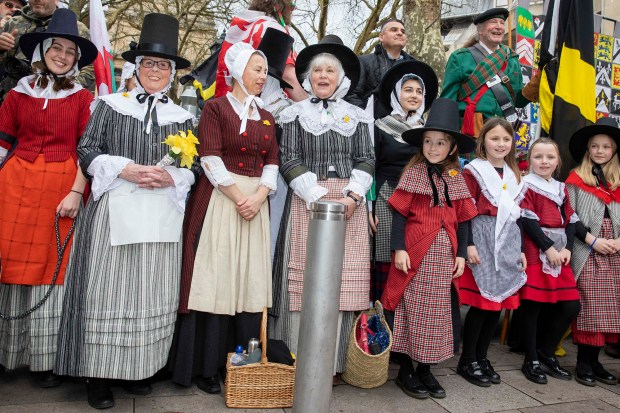
Welsh women will often dress in their national finery. The Welsh dress was a traditional farming dress with an apron topped with a distinctive tall Welsh hat. It was worn on special occasions such as going to church, and today it is kept for celebrations such as St. David's Day parades.

Parades

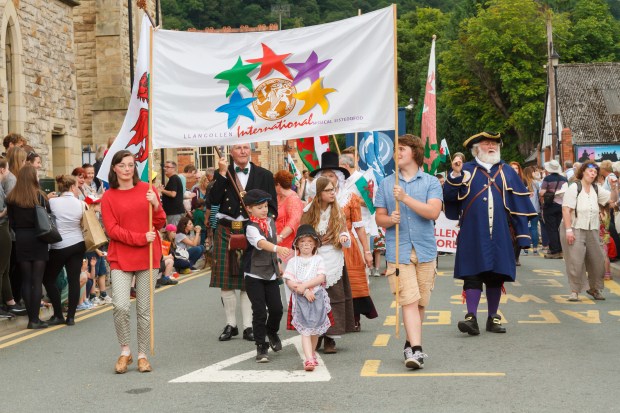
As with St. Patrick's Day, the Welsh have parades in their major cities, where you'll see the traditional dress and the red dragon proudly on display on the Welsh flag, or the flag of St. David himself, a yellow cross on a black background.

Celebrate Eisteddfod

Welsh National Eisteddfod

The name of this popular festival can be translated to "sitting together." It's a competition involving musicians and poets performing before judges and an enthusiastic crowd. In times gone by, the winner was selected by a noble, but today the festivals, which take part across the world, celebrate the Welsh culture.

Go to work

Sadly, when the Welsh petitioned the British government to recognize St. David's Day as a public holiday, their request was refused. As a result, many Welsh people have to take a day, or half-day, off work so they can celebrate their saint. By going to work today, you'll be honoring the many Welsh people who still have to work while also honoring their patron.

The US Bishops Sued The Government To Get YOUR Tax Dollars And Destroyed Themselves


Play stupid games, win stupid prizes.

The Real Role Of The Laity At Mass | Pope Pius XII

Dewi Sant (Saint David), Patron of Wales

Dewi Sant (St David) is the Patron of the Principality of Wales. As in Ireland with the shamrock on St Patrick's Day, the Welsh wear leeks and daffodils in honour of their Patron.


According to tradition, St. David was the son of King Sant of South Wales and St. Non. He was ordained a priest and later studied under St. Paulinus. Later, he was involved in missionary work and founded a number of monasteries. The monastery he founded at Menevia in Southwestern Wales was noted for extreme asceticism. David and his monks drank neither wine nor beer - only water - while putting in a full day of heavy manual labour and intense study. Around the year 550, David attended a synod at Brevi in Cardiganshire. His contributions at the synod are said to have been the major cause for his election as primate of the Cambrian Church. He was reportedly consecrated archbishop by the patriarch of Jerusalem while on a visit to the Holy Land. He also is said to have invoked a council that ended the last vestiges of Pelagianism. David died at his monastery in Menevia around the year 589, and his cult was approved in 1120 by Pope Callistus II. He is revered as the patron of Wales. Undoubtedly, St. David was endowed with substantial qualities of spiritual leadership. What is more, many monasteries flourished as a result of his leadership and good example. His staunch adherence to monastic piety bespeaks a fine example for modern Christians seeking order and form in their prayer life. His feast day is March 1.


The legendary story of Dewi Sant from Storynory, a site with stories for children, including tales of the Saints.

David’s father was the King of Ceredigion, and some say that he was the nephew of the famous English King Arthur, whose knights sat around a round table. David’s mother was a poor but beautiful young woman, and the King did not look after her. When she was ready to give birth to David, she found that she was caught outside in a storm. The sky was filled with great flashes of lightning, and there were terrifying crashes of thunder. Hail and rain were coming down everywhere, except on the spot where she got herself ready to deliver the child. All around her was dry and lit by the sun.
David was baptised by a blind monk. Some of the water from the font splashed onto his eyes, and immediately he could see.
When David grew up he became a monk, and he travelled around Wales and England. He founded monasteries and churches including the famous Abbey at Glastonbury where it is said that King Arthur is buried. You can still see the beautiful ruins of the Abbey to this day.
David told his followers to be vegetarians and, of course, they ate a lot of leeks which grow very well in Wales. The monks who joined him had to give up much more. They didn’t use animals for farming – and they even pulled ploughs themselves instead of using oxen. They weren’t allowed to own any possessions, and if one of them said “My book” he had to do a penitence, which is a kind of punishment.
Despite his tough ways, St. David became very popular – perhaps because he had the gift of working miracles. For instance, when his neighbours' land was drying up, he stuck his staff into the earth and a spring sprung out of the ground. A local ruler became very jealous of his popularity, and his wife told him to send slaves with sticks to beat David and his monks – but as they came to attack the monks, their arms lost all their strength, and all they could do was to hurl filthy insults at them. When they returned home, they found that all their cattle had died. They returned to the monks and asked forgiveness. This time when they went back, all their cattle had come back to life.
Another time, some of St. David’s monks turned against him and decided to poison his food, but a friend of his in Ireland foresaw this in a dream and he sent St. Scuthyn to warn him. There were no ships ready, to carry Scuthyn across the Irish sea to Wales, but he waded into the water and a sea monster picked him up on his back and carried him across. When he arrived he warned St. David that his cook had put some deadly poison into his bread. At dinner time, St. David broke the bread into three pieces. He gave one piece to a dog, and another to a crow – both immediately died. Then he blessed the third piece, which he ate himself. Everyone watching thought that he would surely die too – but he was perfectly alright.
His most famous miracle happened at a great religious meeting. There was a vast crowd of people in the audience, and not one of the bishops who spoke could make themselves heard – except for David. The ground beneath him rose up into a hill so that he stood high up above the crowd, and a dove landed on his shoulder. His voice rang out as clear as a trumpet. St. David is often pictured speaking with a dove on his shoulder.
David became Bishop, not just of the Welsh, but of all the Britons. At that time, the Britons often had to fight off Saxon invaders from Europe. Before one great battle, St. David told the army of the Britons to wear leeks in their hats as a kind of uniform. They won the battle, and ever since leeks have been a welsh symbol. To remember the victory, Welsh soldiers eat raw leeks on the eve of St. David’s day.
St. David lived to be more than 100 years old, and as he was dying, the monastery in which he lay was filled with angels. His last words were “Gwnewch y pethau bychain mewn bywyd,” which means, “Do the little things in life,” and to this day, it’s a common saying in Wales.
The only picture I could find
with his name in Welsh!

Happy St David's Day!

USCCB Sues Over Lo$$ of U$AID Grift, Got Themselves Canceled Instead!

The USCCB sued the Administration in an attempt to keep the cash rolling in. Instead, they've been effectively cancelled and told the cash cow has dried up.

From non veni pacem

By Mark Docherty

Whoops! That’s sure going to put a dent in the multi-billion dollar trafficking laundering!

Reposted from Fr. James Altman on X:

The USCCB, as a client of USAID, must follow the Administrative Procedures Act in a dispute. Instead some bishops filed a lawsuit. Consequently they lost their client status. In other words, they get no more of our tax dollars to aid and abet their treasonous crimes against the people.

Do NOT be fooled. As much as 74% of Catholic Charities revenues went to salaries and benefits for employees, another percentage to illegals, leaving only a smaller percentage to help poor American citizens.

The corrupt and anti-Catholic USCCB just defunded itself!!

Through their pervert abuse and cover up, and through locking faithful Catholics out of God’s churches, they already lost the financial support of the Faithful.

Now they lost the taxpayer’s money train.

Here’s the notice from the Trump administration.

Reportage from The Pillar:

State Dept. terminates USCCB migration funds

The State Department canceled a contract with the U.S. Conference of Catholic Bishops on Thursday, likely bringing to a halt a nationwide effort organized by the USCCB to provide resettlement services for refugees to the United States.

In a Feb. 26 letter, U.S. State Department comptroller Joseph Kouba told the USCCB that its financial agreement for refugee resettlement “is immediately terminated as of Feb. 27, 2025,” because the grant “no longer effectuates agency priorities.”

“Effective immediately upon receipt of this Notice of Termination, the Recipient must stop all work on the program and not incur any new costs after the effective date cited above. Payment requests for legitimate costs incurred prior to this notification are allowable.”

The government’s decision came after the USCCB filed Feb. 18 a lawsuit which challenged a federal decision to suspend federal funding for refugee assistance programs administered by various Catholic Charities outlets across the country, with the USCCB distributing funds and serving as coordinator of the programs.

https://www.complicitclergy.com/2025/02/28/in-their-haste-to-sue-trump-us-bishops-just-shot-themselves-in-the-foot/

Our Lady on Saturday ~ Saturday in Sexagesima

Today's Holy Mass from Corpus Christi Church, Tynong AUS. You may follow the Mass at Divinum Officium.

Saturday of Sexagesima Week ~ Dom Prosper Guéranger

Saturday of Sexagesima Week


From Dom Prosper Guéranger's Liturgical Year:

On the Saturday of the preceding week, which was devoted to the consideration of the fall of our first parents both in its own malice and in its sad consequences upon us, we turned our thoughts towards our blessed Lady, who, though a daughter of Eve, was by the special mercy of God preserved from the stain of original sin. Let us end this week with a like act of veneration and love towards this Immaculate Queen of heaven. We, even the most saintly among us, have not only been stained with original sin, we have the actual sins to grieve over and do penance for. This should give us a higher appreciation of her, the one single member of the human family who never committed the slightest sin. Let us turn towards her, and give expression to our feelings.

We, O Mary! have corrupted our way; we have disobeyed our Lord; we have broken His law; we have preferred our own selfish gratifications to the service we owed Him: but thou wast ever filled with His holy love, and there passed not even a shadow of sin upon thy soul, O spotless mirror of justice and holiness! Virgin most faithful! the grace of thy Son ever triumphed in thy heart. Mystical rose! the fragrance of thy virtues unceasingly ascended to His throne, changing only in its daily increase of sweetness. Tower of ivory! fair beyond measure, without one spot to mar thy purity! House of gold! thou didst ever reflect the precious gifts of the Holy Ghost. Have pity, then, upon us, for we are sinners.

We have obliged our God to repent that He made us: but in thee, dear Mother, He has ever been well pleased. Thou art the good land wherein His divine seed yielded its thousandfold of fruit: pray for us, that He give fresh fertility to our hearts, and root up from them the thorns which choke the heavenly plant. We are defiled by sin; may He, through the merits of the tears thou didst shed at the foot of the cross, mercifully cleanse us. If thy divine Son have already pardoned us, there are the consequences of our sins, which still weaken and humble us, like the sores of wounds that have been cured: take us, sweet Mother of our Jesus, under the mantle of thy tender care. We have too little dread of sin; we are so often on the verge of offending our God; oh! get courage for these poor children of thine, and firmness of resolution, and ambition for holiness of life. Thy intercession must win for us that precious devotedness to God’s honor, which kills self-love, the root of sin. Oh! accursed self-love, which may lead us to hell, who are now perhaps in the grace of thy divine Son!

The deluge, brought on by our sins, is hurrying its vengeance against mankind; and we, O Mary! are resolved to seek our refuge in the Ark of the Church, the safe shelter created for us by thy Jesus. But we presume to pray to thee for our brethren throughout the world. Our God has given thee a power to stay His anger, and to win for the guilty mortals an extension of mercy: show this power now, for our world is provoking its Master to destroy it. If the flood-gate of His just indignation burst upon the face of our earth, millions of souls that have been redeemed by the Blood of thy divine Son would be lost eternally. If the sweet dove of peace bring her olive branch only when that terrible justice is appeased, it would be too late for thy loving heart. Come before the deluge, O beautiful rainbow of our Father’s reconciliation! The love of a Mother, who is the very Queen of mercy, emboldens us to sue for universal mercy. Can the prayer of her, in whose purity and innocence the very God of holiness finds no blemish, be denied? Pray Him, then, to pardon us, and all sinners!

We select a few stanzas from the celebrated “Complaint to Mary,” composed by the monk Euthymius. The Greek Church has inserted it in her liturgy.

CANON

O blessed Lady! how shall I worthily lament over my impure life, and the multitude of my grievous sins? I know not how to address thee, most chaste Virgin! I tremble with fear; but do thou help me.

I will speak of my wickedness and my hateful sins; but where shall I begin? Alas! what will become of me, a wretched sinner? Do thou, O blessed Lady, have compassion on me before my departure from this life.

I, having gone in every path that sinner ever trod, how shall I find now the way of salvation, O Immaculate Virgin? Yet have I recourse to thy goodness; despise me not, for I repent from my heart.

My thoughts are ever on the hour of death, and on the dread tribunal; and yet an evil habit violently tempts me to sin. O most pure Virgin, do thou help me.

The deadly enemy of all that is good, seeing me poor and naked, without patron or protector, and most destitute of heavenly virtue, rushes forward that he may devour me. O blessed Lady! forbid him, and drive him far from me.

Alas, unhappy man! in the arrogance of my soul, I have defiled the image of God that was in me. Whither shall I now turn? Hasten to my assistance, O Virgin ever holy!

The choirs and hosts of Angels, the heavenly Powers, tremble in the presence of thy all-powerful Son, O Immaculate Mother! and I, who have nothing wherein to hope, am so devoid of fear!

Suffer me not, O blessed Lady! to perish in the pit, I have fallen into, of my sins. The cruel enemy sees me struggling in despair, and mocks me. Do thou stretch forth thy hand, that can so well deliver me.

Awful is the judgment of God, unhappy senseless soul! and everlasting is the punishment. But turn thee, while yet there is time, and prostrate in prayer before the Mother thy Judge and Lord. Why wouldst thou despair?

O Immaculate Virgin! the multitude of my grievous sins has set a thick darkness around me; the eyes of my soul, and my understanding, are blinded. Wherefore, I beseech thee, quickly lead me, by the brightness of thy light, to sweet freedom from my passions.

Grant me an unceasing sorrow, O blessed Lady, and a fount of tears, that I may wash away my countless sins and wounds, and gain eternal life.

Lo! I thy servant, most sinless Virgin! approach thee in deep reverence and love, for I know the power of thy prayer. Great, indeed, with her Son, is the power of the Mother’s prayer, and his heart is moved when she asks, O most blessed Mother!

O Mother worthy of the whole world’s praise! thy Son will be to me a merciful and compassionate Judge. Despise me not, but let me find favor in his sight, that he may set me on the right hand of his most just tribunal; for in thee have I put my trust.


If God Seems So Far Away Who Moved?

sermon for today. Please remember to say 3 Hail Marys for the Priest.

St Monan. Martyr

St David of Wales: Butler's Lives of the Saints

St David, Archbishop, Patron of Wales


From Fr Alban Butler's Lives of the Saints:

See his life by Giraldus Cambrensis, In Wharton’s Anglia Sacra, t. 2; also Doctor Brown Willis and Wilkins, Conc. Britan. & Hibern. t. 1.

About the year 544.

ST. DAVID, in Welsh Dewid, was son of Xantus, prince of Ceretice, now Cardiganshire. He was brought up in the service of God, and, being or dained priest, retired into the Isle of Wight, and embraced an ascetic life, under the direction of Paulinus, a learned and holy man, who had been a disciple of St. Germanus of Auxerre. He is said by the sign of the cross to have restored sight to his master, which he had lost by old age, and excessive weeping in prayer. He studied a long time to prepare himself for the functions of the holy ministry. At length, coming out of his solitude, like the Baptist out of the desert, he preached the word of eternal life to the Britons. He built a chapel at Glastenbury, a place which had been consecrated to the divine worship by the first apostles of this island. He founded twelve monasteries, the principal of which was in the vale of Ross,* near Menevia, where he formed many great pastors and eminent servants of God. By his rule he obliged all his monks to assiduous manual labor in the spirit of penance: he allowed them the use of no cattle to ease them at their work in tilling the ground. They were never suffered to speak but on occasions of absolute necessity, and they never ceased to pray, at least mentally, during their labor. They returned late in the day to the monastery, to read, write, and pray. Their food was only bread and vegetables, with a little salt, and they never drank any thing better than a little milk mingled with water. After their repast they spent three hours in prayer and adoration; then took a little rest, rose at cock-crowing, and continued in prayer till they went out to work. Their habit was of the skins of beasts. When any one petitioned to be admitted, he waited ten days at the door, during which time he was tried by harsh words, repeated refusals, and painful labors, that he might learn to die to himself. When he was admitted, he left all his worldly substance behind him, for the monastery never received any thing on the score of admission. All the monks discovered their most secret thoughts and temptations to their abbot.

The Pelagian heresy springing forth a second time in Britain, the bishops, in order to suppress it, held a synod at Brevy, in Cardiganshire, in 512, or rather in 519.1 St. David, being invited to it, went thither, and in that venerable assembly confuted and silenced the infernal monster by his eioquence, learning, and miracles. On the spot where this council was held, a church was afterwards built called Llan-Devi Brevi, or the church of St. David near the river Brevi. At the close of the synod, St. Dubritius, the archbishop of Caerleon, resigned his see to St. David, whose tears and opposition were only to be overcome by the absolute command of the synod, which however allowed him, at his request, the liberty to transfer his see from Caerleon, then a populous city, to Menevia, now called St. David’s, a retired place, formed by nature for solitude, being, as it were, almost cut off from the rest of the island, though now an intercourse is opened to it from Milford-Haven. Soon after the former synod, another was assembled by St. David at a place called Victoria, in which the acts of the first were confirmed, and several canons added relating to discipline which were afterwards confirmed by the authority of the Roman church; and these two synods were, as it were, the rule and standard of the British churches. As for St. David, Giraldus adds, that he was the great ornament and pattern of his age. He spoke with great force and energy, but his example was more powerful than his eloquence; and he has in all succeeding ages been the glory of the British church. He continued in his last see many years: and having founded several monasteries, and been the spiritual father of many saints, both British and Irish, died about the year 544, in a very advanced age. St. Kentigern saw his soul borne up by angels into heaven. He was buried in his church of St. Andrew, which hath since taken his name, with the town and the whole diocese. Near the church stand several chapels, formerly resorted to with great devotion: the principal is that of St. Nun, mother of St. David, near which is a beautiful well still frequented by pilgrims. Another chapel is sacred to St. Lily, surnamed Gwas-Dewy, that is, St. David’s man; for he was his beloved disciple and companion in his retirement. He is honored there on the 3d, and St. Nun, who lived and died the spiritual mother of many religious women, on the 2d of March. The three first days of March were formerly holidays in South Wales in honor of these three saints; at present only the first is kept a festival throughout all Wales. John of Glastenbury2 informs us, that in the reign of king Edgar, in the year of Christ 962, the relics of St. David were translated with great solemnity from the vale of Ross to Glastenbury, together with a portion of the relics of St. Stephen the Protomartyr.

By singing assiduously the divine praises with pure and holy hearts, dead to the world and all inordinate passions, monks are styled angels of the earth. The divine praise is the primary act of the love of God; for a soul enamored of his adorable goodness and perfections, summons up all her powers to express the complacency she takes in his infinite greatness and bliss, and sounds forth his praises with all her strength. In this entertainment she feels an insatiable delight and sweetness, and with longing desires aspires after that bliss in which she will love and praise without intermission or impediment. By each act of divine praise, the fervor of charity and its habit, and with it every spiritual good and every rich treasure, is increased in her: moreover, God in return heaps upon her the choicest blessings of his grace. Therefore, though the acts of divine praise seem directly to be no more than a tribute or homage of our affections, which we tender to God, the highest advantages accrue from these exercises to our souls. St. Stephen of Grandmont was once asked by a disciple, why we are so frequently exhorted in the scriptures to bless and praise God, who, being infinite, can receive no increase from our homages To which the saint replied: “A man who blesses and praises God receives from thence the highest advantage imaginable; for God, in return, bestows on him all his blessings, and for every word that he repeats in these acts, says: ‘For the praises and blessings which you offer me, I bestow my blessings on you; what you present to me returns to yourself with an increase which becomes my liberality and greatness.’ It is the divine grace,” goes on this holy doctor, “which first excites a man to praise God, and he only returns to God his own gift: yet by his continually blessing God, the Lord pours forth his divine blessings upon him, which are so many new increases of charity in his soul.”3

St Monan, Martyr, in Scotland


From Fr Alban Butler's Lives of the Saints

ST. ADRIAN, bishop of St. Andrew’s, trained up this holy man from his childhood, and when he had ordained him priest, and long employed him in the service of his own church, sent him to preach the gospel in the isle of May, lying in the bay of Forth. The saint exterminated superstition and many other crimes and abuses, and having settled the churches of that island in good order, passed into the county of Fife, and was there martyred; being slain with above 6000 other Christians, by an army of infidels who ravaged that country in 874. His relics were held in great veneration at Innerny, in Fifeshire, the place of his martyrdom, and were famous for miracles. King David II. having himself experienced the effect of his powerful intercession with God, rebuilt his church at Innerny of stone, in a stately manner, and founded a college of canons to serve it. See King’s calendar, and the manuscript life of this martyr in the Scottish college at Paris, and the Breviary of Aberdeen.

Collect of St Monan, Martyr ~ Indulgenced on the Saint's Feast (See Note)

According to the Apostolic Penitentiary, a partial indulgence is granted to those who on the feast of any Saint recite in his honour the oration of the Missal or any other approved by legitimate Authority.


V.
 O Lord, hear my prayer.
R. And let my cry come unto thee.
Let us pray.
Grant, we beseech Thee, almighty God: that the venerable feast of Blessed Monan, Thy Martyr, may through his intercession be strengthened in love of Thy Name.
Through Jesus Christ, Thy Son our Lord, Who liveth and reigneth with Thee, in the unity of the Holy Ghost, God, world without end.
R. Amen. 

Nota bene - St Monan is not celebrated on the Universal Calendar, but according to the Martyrology, today is his Feast Day. The Collect is taken from the Common of One Martyr Outside of Paschaltide.

Collect of St David of Wales, Bishop & Confessor ~ Indulgenced on the Saint's Feast (See Note)

According to the Apostolic Penitentiary, a partial indulgence is granted to those who on the feast of any Saint recite in his honour the oration of the Missal or any other approved by legitimate Authority.


V. 
O Lord, hear my prayer.
R. And let my cry come unto thee.
Let us pray.
O God our Father, Thou didst give Thy Bishop David to the Welsh Church to uphold the faith and to be an example of Christian perfection. In this changing world, may he help us to hold fast to the values which bring eternal life.
Through Jesus Christ, Thy Son our Lord, Who liveth and reigneth with Thee, in the unity of the Holy Ghost, God, world without end.
R. Amen.  

Nota bene - St 
David is not celebrated on the Universal Calendar, but according to the Martyrology, today is his Feast Day. The Collect is taken from his Propers in Wales.