It's amusing that Chesterton admired Johnson, since GKC was a Liberal and Dr Johnson was the epitome of the 18th-century Tory. In his Dictionary, he defined the Devil as "the first Whig".
From The Imaginative Conservative
By Joseph Pearce
Every admirer of the genius of Dr. Johnson will no doubt agree wholeheartedly with Chesterton’s appraisal of the great man’s importance: “Johnson was a man who happened to possess that great 18th century power of smashing driving logic, which by the way, is neglected in the modern world exactly as goodness is neglected. The two things went together, the love of truth and hatred of false argument.”
 In last week’s essay for this illustrious journal, I opined that the eighteenth century was the “worst of times” and that Jonathan Swift and Alexander Pope represented the best of that worst of times, especially in the manner in which they exposed the weakness and wickedness of their age with satirical humour expressed in the service of religion and tradition. My own view of these “worst of times” was expressed with characteristic verve and vigour by G.K. Chesterton:
What the eighteenth century lacked was colour. It put down everything in black and white. It could not understand, as the medieval illuminator understood, that things are really plainer in gold and purple than in black and white. It did not understand that there could be a positive pleasure or a positive passion about mystical things. It s an exaggeration to call it entirely irreligious; some of its very greatest men, like Johnson and even Swift, were profoundly religious. But their religion had not enough colour and therefore not enough positive joy. Even when they put up churches to Christ they were like temples to Pallas Athene; even when they wrote translations of the Psalms they sounded like translations of the Georgics. Even Voltaire put up a stone altar to God, but he would never have put up a stained-glass window to anybody. It is perhaps this absence of the pleasures of religion that we feel as the only gap in the mind of that great religious genius, who appears here as a philosopher mocking philosophers.
The “great religious genius” to whom Chesterton refers at the conclusion of these comments on the dreariness and drabness of the dark age of the misnamed “Enlightenment” was Dr. Johnson, the inimitable and indomitable wit immortalized by Boswell in his Life of Samuel Johnson.
In many respects, Dr. Johnson was to the eighteenth century what Chesterton would be to the twentieth century. Both men championed the wisdom of the ages and the wisdom of the sages against the new and fashionable ideas of their day; both employed wit and humour, paradox and playfulness, in defence of traditional common sense in a culture of philosophical faddishness and fashion. It was no wonder, therefore, that Chesterton was a great champion of Dr. Johnson. In 1903, Chesterton wrote the introduction to a new, abridged edition of Boswell’s Life of Johnson; in 1911, he introduced Samuel Johnson: Extracts from his Writings, edited by Alice Meynell; in 1922, he introduced volume four of an unabridged edition of Boswell’s Life; and in 1926 he penned the introduction to Johnson’s gently satirical “novel”, The History of Rasselas, Prince of Abissinia, from which the above quote is taken.
Johnson’s Rassalas is unquestionably one of the great works of English literature, the neglect of which is a damning indictment of the illiteracy and irrationality of our own time as the work itself was a damning indictment of the prevailing rationalist philosophy of Johnson’s own time. Chesterton’s introduction encapsulates it perfectly as a “philosophical satire on philosophy”:
In Rasselas he wrote one of those fables which were the first examples of what we now call fiction. It was the nearest he ever came to writing a novel. But in the very irresponsibility of a work of the imagination (if we can ever attribute irresponsibility of Johnson) he became conscious of the philosophical background of himself and his time; and even produced a sort of philosophical satire on philosophy.
As for the perspective from which Johnson approached modern philosophy in order to satirize it, Chesterton suggests that Johnson sees with the eyes of Aristotle, as did Chesterton himself in the form of the baptized Aristotelianism of Thomas Aquinas:
Johnson is immortal in a more solemn sense than that of the common laurel. He is as immortal as mortality. The world will always return to him, almost as it returns to Aristotle; because he also judged all things with a gigantic and detached good sense.
In 1932, Chesterton gave a speech to the Johnson Society of London in which he waxed eloquent and effusive on Johnson’s “great religious genius”:
Johnson… was a man who happened to possess that great 18th century power of smashing driving logic, which by the way, is neglected in the modern world exactly as goodness is neglected. The two things went together, the love of truth and hatred of false argument. God alone knows what Johnson would have made of modern journalism. He had that titanic intellectual power of logic, of driving things to an issue, but he had in him also the love of humility, humanity, of good and simple things, and those qualities were combined at that moment, in that age, in that person by a sort of miracle. That is why his name is loved and well loved through the ages. Never again perhaps will the stars so combine to produce such a hero of virtue and of argument.
Every admirer of the genius of Dr. Johnson will no doubt agree wholeheartedly with Chesterton’s appraisal of the great man’s importance. There is, however, a sense in which every admirer of the genius of G.K. Chesterton will be forced to disagree with Chesterton’s words. It is not true that the stars would never again combine to produce such a hero of virtue and argument. They combined once again in the person of G.K. Chesterton himself, the “great religious genius” of his own age, whose own “titanic intellectual power of logic” was brought to the defence of “the love of humility, humanity, and of good and simple things”.
__________
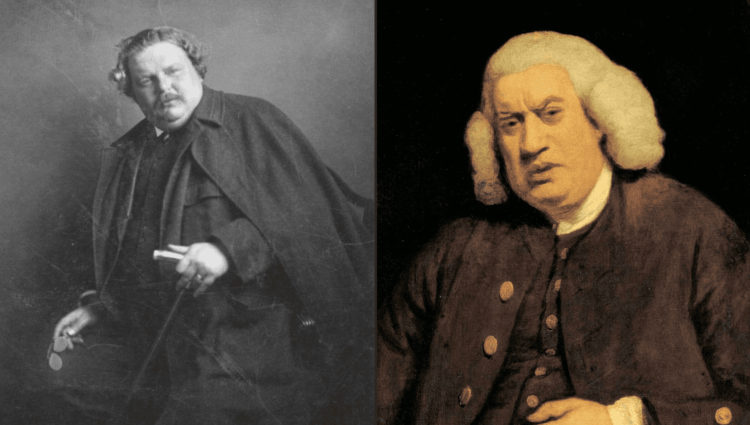
The featured image combines a picture of G.K. Chesterton by James Craig Annan, 1912, and a painting of Doctor Samuel Johnson by Joshua Reynolds. Both images are in the public domain and appear here courtesy of Wikimedia Commons.

No comments:
Post a Comment
Comments are subject to deletion if they are not germane. I have no problem with a bit of colourful language, but blasphemy or depraved profanity will not be allowed. Attacks on the Catholic Faith will not be tolerated. Comments will be deleted that are republican (Yanks! Note the lower case 'r'!), attacks on the legitimacy of Pope Leo XIV as the Vicar of Christ, the legitimacy of the House of Windsor or of the claims of the Elder Line of the House of France, or attacks on the legitimacy of any of the currently ruling Houses of Europe.