01 December 2020

Six Famous Carmelite Saints

Note well that three of these six Saints are Doctors of the Church! Not bad for one Order. Of course, I might be prejudiced, since I'm a Tertiary of Carmel.

From Ignitum Today

By Mariella Hunt

The Catholic Church has many great Religious Orders. Though they share the mission of helping the Church through prayer, service, and contemplation, their histories — and habits — vary.

When you say “I saw a nun” or “I saw a monk,” can you name which Order they belonged to? Benedictines, Jesuits, and Dominicans have different habits and ways of serving the Church. Some choose the cloistered life; others are missionaries, serving the poor.

Despite having been Catholic for over a decade, I had never paid much attention to these different Orders. I am only learning now. I want to learn about the Saints each Order produced; as I do, I’ll share my findings with you.

The Carmelites are one of the most famous Religious Orders. Here are six great Saints who came from this community. There are more, but I tried to keep this post short. I will write more extensively on each of these Saints in the future!

St. Teresa of Ávila

St. Teresa of Ávila is a Doctor of the Church, meaning that she contributed greatly to the study of teaching and doctrine. She is famous for her spiritual work The Interior Castle.

Born in Ávila, Spain, she lived during a time when those who entered religious life were far from humble and devout. Many nuns would enter the convent with jewelry and other vanities. St. Teresa decided to form her own convents, in which they would practice poverty and humility. She called her her branch of the Order the Discalced Carmelites.

She overcame many obstacles. Church authorities thought of her as a rebel for having strayed, often threatening her with the Inquisition. God was by her side, though, because many women flocked to join her Discalced Carmelites — and men, too, prompting her to build monasteries as well.

What many don’t know is that St. Teresa was not always interested in being a nun. As a young girl, she spent much time dressing well and flirting. Because of this, her father sent her to a Carmelite convent, hoping that it would teach her a virtuous life.

Not only did it change her attitude towards life, it helped shape the Church into what it is today.

St. Simon Stock

St. Simon Stock was blessed with a visitation from Our Lady. She appeared in a vision and told him to spread devotion to the Brown Scapular of Mount Carmel. It is a sacramental, a sign of faith that reminds us to follow God’s will in all that we do; it is also a sign of devotion to Our Lady. Thousands wear it today.

A Brown Scapular of Mount Carmel

Mary’s words words to Saint Simon were:

Receive, my beloved son, this scapular of thy Order; it is the special sign of my favor, which I have obtained for thee and for thy children of Mount Carmel. He who dies clothed with this habit shall be preserved from eternal fire. It is the badge of salvation, a shield in time of danger, and a pledge of special peace and protection.

Not much is known of his early life, only that he lived as a hermit under a tree from his twelfth year on. Some believe that this is the origin of his his surname, Stock, which means tree trunk. He remained a hermit until he saw some Carmelites and decided to join them.

St. Edith Stein

St. Edith Stein’s story is tragic but inspiring. She was born into a Polish Jewish family in 1891. In university she was an excellent student with a firm grasp on Philosophy. Her studies led her to take an interest in the Catholic Church. She was baptized in 1922, and eleven years later joined the Carmelite order in Cologne.

When Germany’s politics began to see upheaval, St. Edith was sent to another convent in Echt, Holland. However, the Nazis conquered Holland; Edith and her sister Rose were sent to Auschwitz. She lost her life in the gas chambers in 1942 at the age of fifty-one.

St. John Paul II canonized St. Edith Stein in 1987. The ceremony took place in a soccer stadium filled with devoted faithful. Though she died tragically, her life reminds us that there were grand souls unafraid of living their faiths in such evil times as the Holocaust.

St. John of the Cross

St. John of the Cross also lived in the city of Avila. He was born in 1542 and named Juan de Yepes y Álvarez. Because his family was of the lower class, his life was a struggle from the beginning. Malnutrition caused the deaths of his father and his older brother.

John was sent to a boarding school for poor and orphaned children. In this school he was given a religious education and grew in holiness, despite his devastating losses. He was only a child when he decided to pursue a religious life. He was able to join the Carmelite order in 1953, taking the name “John of St. Mattias.”

He began his religious life quietly, obeying his superiors — until he met St. Teresa of Ávila. He was attracted to the strict routine that she imposed on her Discalced Carmelites. When Teresa of Ávila founded a monastery in 1568, John joined the friars in this new Order, changing his name to John of the Cross.

He’d found his home, but it did not make his former superiors happy. They sent for him and ordered him to return to his old monastery. When he refused, he was kidnapped and punished with imprisonment. After nine months sealed into a room where he was allowed only a candle and a prayer book, John managed to pry the door open and return to the Discalced Carmelites.

St. John of the Cross lived a remarkable life of poverty and persecution, but he never lost his faith. He is often venerated alongside St. Teresa of Ávila.

St. Thérèse of Lisieux

I wrote a blog post on the life of St. Thérèse. Nonetheless, it would be wrong not to include her in this list; not only is she one of my spiritual friends, she is another Doctor of the Church!

Born in Lisieux, France, to Sts. Louis and Zelie Martin, Thérèse was the youngest of five sisters, all of whom went on to become nuns. Her spirituality was simple but powerful. She did small things with great love, made sacrifices, and longed above all things to become a Saint.

St. Thérèse was impatient to enter the Carmelite convent in Lisieux. When she was turned away because of her youth, she went to the Pope and broke protocol to beg for his blessing to enter Carmel at the age of fifteen.

Her determination to become a Bride of Christ shows a love for Him that we should all copy, regardless of our vocations.

St. Elizabeth of the Trinity

When St. Elizabeth was seventeen years old, she visited the Carmelite monastery in Dijon, France. The Mother Superior gave her a manuscript about the death of Thérèse of Lisieux. For some reason, she thought Elizabeth needed to read it.

It was not just any manuscript; Elizabeth was blessed, for this was the first edition of St. Thérèse’s autobiography, The Story of a Soul. Elizabeth went on to become one of St. Thérèse’s first disciples, following her example by doing small favors with great love.

Elizabeth was told that she could not enter Carmel until she was 21. She spent her waiting time ministering to troubled children and teaching them about Jesus. Her works were a great help to the community, which recognized her piety. She was 26 when she entered Carmel, and there she spent the rest of her life.

Like St. Thérèse, Elizabeth wrote great spiritual pieces. The most famous of her writings is a prayer called “O My God, Trinity Whom I Adore.” It begins with a powerful line:

O my God, Trinity whom I adore, help me forget myself entirely so to establish myself in You, unmovable and peaceful as if my soul were already in eternity.

Conclusion

This does not cover all of the Carmelite Saints. Am I missing someone you think should be on this list? Comment with your thoughts, and teach me about your favorite Carmelites!

Trans Ideas Are a Menace to Children

A voice of sanity on the species of severe child sex abuse known as the 'trans' movement.

From Sp¡ked

By Misha Mansoor

Growing up is hard enough without being told you're born in the wrong body.

I don’t think anyone is born into the wrong body. Bodies are neither right nor wrong. It’s really not a case of Mother Nature, like a tired factory worker towards the end of her shift, accidentally matching a male psyche with a female body. Your body is you and you are your body. There are a thousand different reasons why you might not feel this to be the case, but being a soul dropped into the wrong container is not one of them.

Yet, as we know, over the past decade or so – and for a variety of political, cultural and ideological reasons – there has been an apparent explosion not just of adults seeing themselves as trans, but of children seeing themselves as trans –a shouty, swelling yell of more and more young people worrying they were born into the wrong body, and demanding liberation from their biological prisons.

And instead of the adults in their lives gently but firmly telling them they are beautiful and right as they are, and that there is nothing wrong with their bodies, some, often in positions of considerable power and influence, have colluded with and indulged children in this pursuit of the trans fantasy. Children as young as 10 are fed NHS-approved drugs to block their puberty while they ‘make up their minds’; at 16, in the UK, they can start taking cross-sex hormones, which can have some irreversible effects; at 18, no longer deemed a child, they can have life-changing surgery.

Born in the wrong body. It is such a simple explanation. The normal anguish of growing up and the genuine, often psychologically traumatic consequences of abuse and neglect and adult-induced harm, are pushed away. And in their place stands this simple, compelling, righteous explanation for one’s pain and problems.

I doubt there are many children of school age in the UK today who haven’t been pushed, prodded or pressured at least to consider whether they themselves have been ‘born into the wrong body’. As if it isn’t already enough that almost all will inevitably and normally question their attractiveness, sexuality and sexual orientation, they increasingly now wonder whether they should also be questioning their sex and gender. Never mind the old-school worries of falling in with the wrong crowd, now they and their parents have to worry they’ve fallen into the wrong body.

I have five children, three girls and two boys. When my first girl, now 25, was at school, my nightmare for her was a nose-ring, anorexia and mind-altering drugs. Now my youngest daughter is 14 and my fears for her and her peers are all of the above, plus self-harm, self-hate, rejection of her sex and body-altering drugs.

In our culture, girls in particular have for decades seemed set on self-destruction. It is as though they are trying to disappear themselves. And not many acts could demonstrate that wish to erase yourself as much as attempting to change your sex; to efface your very essence. And this one is increasingly prescribed by those who might previously have been expected to help right adult wrongs on behalf of children. And so there are ever-increasing numbers of very troubled and confused children, born with unambiguous sex, who think, believe and insist that they must have been ‘born into the wrong body’.

Except in very rare intersex cases, you’re born male or female. Your psychology, your brain, your genes, the multiplicity of social and environmental factors that make us who we are, and which can make us feel so wrong and so unhappy, all interact within and upon a biologically predetermined body.

Yet merely stating this fact can be dangerous. It can get you hate mail, threats of violence, cancelled, fired, ridiculed, even a visit from the police. The message that it is both possible and ‘normal’ to be born into the wrong body – and that we should condemn anyone who denies this – spreads relentlessly outwards from the middle-class social-media bubble. It is there in the Mermaids-Starbucks collaboration, in the well-meaning school assemblies, on sanitary-protection packaging, and throughout the media. It has led to the backlash against JK Rowling, the resignation of Suzanne Moore from the Guardian and the cancelling of Graham Linehan. Go against the trans dogma and you will almost certainly be shunned, ostracised or cancelled. Hell hath no fury like a certain kind of new-wave trans activist challenged.

This madness is presented as a battle for inclusivity, justice and human rights, and a celebration of diversity. Yet it demands we pretend all feelings and beliefs trump biological reality. Your ‘real’ sex is whatever you feel it to be, which may or may not be congruent with your physical state.

According to many, there are not just two genders/sexes. There are 72 – 72 genders. No healthy society needs 72 genders. We have enough division, hate and misunderstanding already. Is it not the case that the more we try to be inclusive by constructing and adding more and more sets and subsets, the more divisive and othering we become?

I’m so glad this madness wasn’t around to addle my brain when I was nine. I absolutely hated being a girl. I was the biggest tomboy ever. My mother and her extended family (Middle Eastern Jews), like those from so many cultures, openly valued and favoured boys way above girls. The options for girls from my social class, religion and background seemed so limited, so crushing. Boys in my class could be thick-as, yet still insist they were better than you just because they were boys. I desperately wished I had been born a boy. When I hit puberty a couple of years later and began to attract vile attention from so many men on the streets, I would happily have taken some puberty-blockers had they been offered to me.

But the problem wasn’t my body. The problem was frustration and indignation at being treated in ways that were patronising, limiting or predatory just because I was a girl. The problem was the adults and the cultures around me that demanded I fit into certain gender roles.

I have the greatest sympathy for the horrible, invidious situation of those contemporary parents whose child declares himself to be ‘trans’. They are trapped in a sort of vicious, virtuous circle. Parents and other adults in the children’s lives want to be sympathetic and understanding, tolerant and accepting. So, afraid of making the child feel ‘rejected’, they feel compelled to buy into the powerful pro-trans ideology, and inadvertently compound it all by accepting kids as they ‘truly are’. The trouble is, most adults, let alone young people, never know who they ‘truly are’ or what that actually means. I know I don’t. What we can know, however, is our sex. And our sex is fixed.

We need to stop confusing and unwittingly exploiting children. Puberty is already discombobulating. Children don’t just need protection and boundaries in the spheres of social behaviour – they also need boundaries and protection in the intellectual and emotional sphere, too. If they tell us they think they might have been born into the wrong body, then it is our job to put them straight and then help them deal with the chaos of growing up.

Objectively, factually, scientifically, you are male or female. And that is fixed. Your thoughts and feelings and where you stand – where you choose to stand – in society are another matter entirely. That stuff is complex, murky and often unfathomable even to ourselves. Perhaps especially to ourselves.

Australian PM Demands Apology After Chinese Official Tweets Doctored Image Of Soldier Killing Afghan Child

The lying depths to which the ChiComs will sink are amazing! The CCP must be destroyed! #SmashTheCCP

From Forbes

By Siladitya Ray

TOPLINE


Australian Prime Minister Scott Morrison demanded an apology from the Chinese government on Monday after the country’s foreign ministry spokesperson Zhao Lijian tweeted a digitally altered image of an Australian soldier cutting the throat of an Afghan child and cited alleged war crimes, highlighting the latest escalation in deteriorating diplomatic ties between both nations.


KEY FACTS

Speaking at a press conference on Monday, Morrison said that the tweet was “deeply offensive to every Australian,” including those who have served in uniform, adding that the Chinese government should be “utterly ashamed” of the post.

Early on Monday morning, China’s Zhao had tweeted from his official account that Beijing was “shocked by murder of Afghan civilians & prisoners by Australian soldiers,” — referencing an Australian defense inquiry report that found evidence of unlawful killings of Afghans by Australian soldiers.

Most of the anger in Australia has been directed at a doctored image featured in Zhao’s tweet that depicts an Australian soldier cutting the throat of a young Afghan holding a sheep with the text “Don’t be afraid, we are coming to bring you peace!”

CHIEF CRITIC

Morrison’s call for an apology was quickly dismissed by Beijing. Hua Chunying, the director of the Chinese foreign ministry’s department of information told the media: “The Australian side is reacting so strongly to my colleague’s tweet — Does this mean they think the cruel killing of Afghan lives is justified? Afghan lives matter ... shouldn’t the Australian soldiers feel ashamed?”

TANGENT

Hua’s comments were based on the findings of the Brereton report, released earlier this month, that found “credible evidence” of unlawful killings of 39 people — including prisoners and civilians — by 25 members of the Australian special forces operating in Afghanistan. Prior to the release of the report, Morrison called Afghan President Ashraf Ghani to “express his deepest sorrow” over the alleged war crimes. The chief of the Australian military, General Angus Campbell, also “sincerely and unreservedly” apologized to the people of Afghanistan, while releasing the report.

KEY BACKGROUND

Diplomatic ties between Australia and China have nosedived in 2020, following the Covid-19 pandemic. In April, Australia called for an independent international inquiry into the origins and handling of Covid-19 — a move which angered the Chinese government who saw it as a move targeted at them. Beijing hit back with sanctions targeting billions of dollars worth of Australian exports to China. The Australian prime minister had reacted to the trade restrictions by stating that Australia would stand up for its values and not succumb to economic pressure. Official talks between both nations have remained frozen since April and Chinese officials have warned that they won’t resume talks with Canberra until it stops treating Beijing as a strategic threat.

FURTHER READING

China rejects Australian PM's call to apologise for 'repugnant' tweet with fake image of soldier (Guardian)

Australia faces down China in high-stakes strategy (Reuters)

CONTRA GENTILES - BOOK ONE: GOD - Chapter 90 THAT IN GOD THERE ARE DELIGHT AND JOY, BUT THEY ARE NOT OPPOSED TO THE DIVINE PERFECTION

[1] There are certain passions which, though they do not befit God as passions, do not signify anything by the nature of their species that is repugnant to the divine perfection.

[2] Among these passions are joy and delight. Delight is of a present good. Neither, therefore, by reason of its object, which is a good, nor by reason of its disposition towards its object, which is possessed in act, is joy, according to the nature of its species, repugnant to the divine perfection.

[3] From this it is manifest that joy or delight is properly in God. For just as the apprehended good and evil are the object of sensible appetite, so, too, are they of intellective appetite. It belongs to both to seek good and avoid evil, whether truly or by estimation. There is the difference that the object of intellective appetite is more common than that of the sensitive appetite, because intellective appetite has reference to good and evil absolutely, whereas sensitive appetite has reference to good or evil according to the sense. So, too, the object of the intellect is more common than that of the sense. But the operations of appetite derive their species from their objects. Hence, there are found in intellective appetite, which is the will, operations that in the nature of their species are similar to the operations of the sensitive appetite, differing in that in the sensitive appetite there are passions because of its union to a bodily organ, whereas in the intellective appetite there are simple operations; for just as through the passion of fear, which resides in the sensitive appetite, someone flees a future evil, so without passion the intellective appetite does the same thing. Since, then, joy and delight are not repugnant to God according to their species, but only in so far as they are passions, and since they are found in the will according to their species but not as passions, it remains that they are not lacking even to the divine will.

[4] Again, joy and delight are a certain resting of the will in its object. But God, Who is His own principal object willed, is supremely at rest in Himself, as containing all abundance in Himself. God, therefore, through His will supremely rejoices in Himself.

[5] Furthermore, delight is a certain perfection of operation, as appears from the Philosopher in Ethics X [4]; “for it perfects operation, as does beauty youth.” But God has the most perfect operation in understanding, as appears from what has been said. If, then, our understanding is delightful because of its perfection, the divine understanding will be most full of delight.

[6] Moreover, each thing takes joy in its like as in something agreeable, except by accident in so far as it may interfere with one’s own advantage: for example, “potters quarrel among themselves” because one interferes with the profit of the other. Now, every good is a likeness of the divine good, as was said above, nor does God lose any good because of some good. It remains, then, that God takes joy in every good.

[7] joy and delight, then, are properly in God. Now, joy and delight differ in notion. For delight arises from a really conjoined good, whereas joy does not require this, but the resting of the will in the object willed suffices for the nature of joy. Hence, delight is only of the conjoined good if it be taken properly, whereas joy is of a non-conjoined good. From this it is apparent that God properly delights in Himself, but He takes joy both in Himself and in other things.


Next - CONTRA GENTILES - BOOK ONE: GOD - Chapter 91 THAT IN GOD THERE IS LOVE

Catholic Churches Suppressed and Secularized Nationwide (in China)

Even the faithful lapdogs of the Party aren't safe from persecution. The CCP must be destroyed! #SmashTheCCP

From Bitter Winter

By Shen Xinran

Although Catholics who refuse to join the Patriotic Church bear the brunt of persecution, state-run venues are also increasingly abused. 

Throughout this year, the CCP government ramped up attacks against Catholics, refusing to join the Chinese Patriotic Catholic Association (CPCA), ahead of the Vatican-China Deal of 2018 renewal in late October. 

The northern province of Hebei, China’s Catholic heartland, has been one of the primary targets of this persecution.

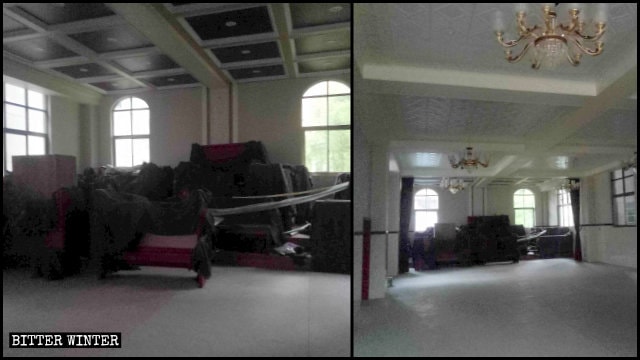
On May 31, the Jiehedian township government in Handan city shut down an unregistered Catholic church and threw most of its belongings into trash.

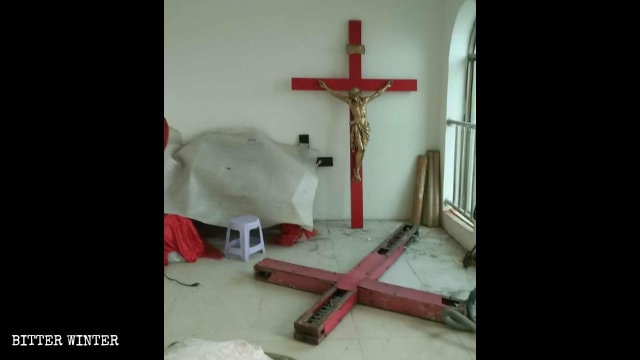
The removed crosses from the Xingdi village church were piled up in a corner.

A month earlier, on April 28, crosses, religious images, and the podium were removed from an unregistered Catholic church in Xingdi village in Handan’s Jize county. Villagers told Bitter Winter that the operation started at about 1 a.m. after the electricity supply to half of the village had been cut off, and roads leading to it were blocked to stop believers from surrounding villages who were coming to help protect the church. Personnel guarded the doors of the residences around the church, prohibiting people from leaving their homes. Churchgoers put up a new cross the next day, but officials removed it again, threatening to demolish the church if the cross was reinstalled.

An unregistered Catholic venue in Hebei’s Shijiazhuang city was ordered to stop holding gatherings in August. The sign “Consolation of the Afflicted” on the lintel above the venue’s door was replaced with “Harmony in a Family Makes Everything Successful.” The slogan “Jesus Good Shepherd Picture” on the wall was hidden behind a landscape painting.

All religious signs and symbols were concealed in the Catholic venue in Shijiazhuang.

In July, after cutting off the electric supply to an unregistered Catholic meeting venue in Shijiazhuang city, municipal government personnel removed the venue’s cross, and deleted the footage of the demolition from onlookers’ phones.

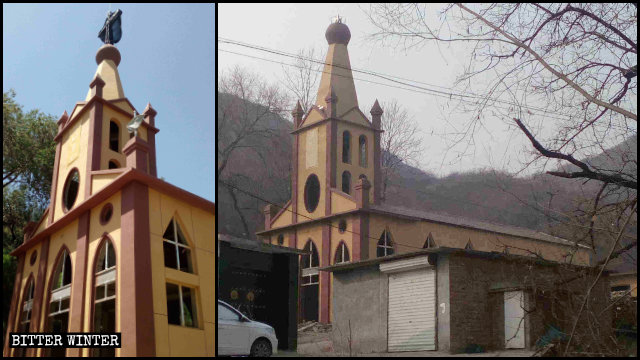
An unregistered Catholic church in Shijiazhuang’s Pingshan county was turned into an activity center after its crosses had been removed.

Father Zhang, a 77-year-old priest from the Zhengding Diocese in Shijiazhuang, was repeatedly ordered to return to his hometown for refusing to join the CPCA. Officials threatened to demolish the homes of churchgoers who dared to take in the priest.

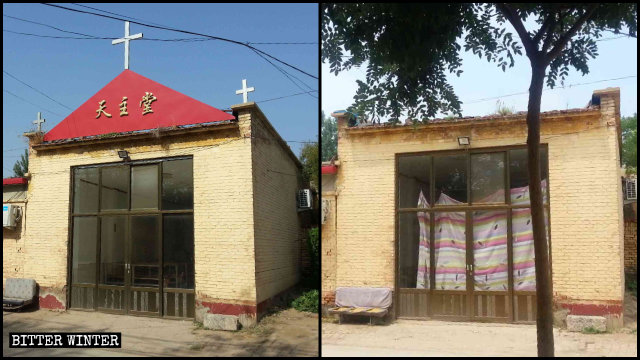
In April, the Simencun town government in Botou, a county-level city under Cangzhou city jurisdiction, removed the crosses and the signboard “Catholic Church” from a local Catholic venue.

A Catholic venue in Simencun had its crosses and signboard removed.

“Under the Xi Jinping rule, campaigns against religion are more important than dealing with floods and other natural disasters,” an unregistered Catholic priest from Hebei told Bitter Winter.

Numerous unregistered Catholic venues were also closed down in Fuzhou city’s Chongren county in the southeastern province of Jiangxi. Local officials threatened to cancel churchgoers’ social welfare allowances and implicate their children if they continue gathering in non-approved religious venues.

One of the shut-down Catholic venues in Fuzhou city.

A Catholic priest from the northwestern province of Gansu told Bitter Winter that authorities installed a surveillance camera by the entrance to his unregistered church in February. After he unplugged it, United Front Work Department officials summoned him for questioning and demanded to present them with a list of churchgoers, but he refused. “It reminded me of the Cultural Revolution when the CCP arrested people of faith according to the lists they created,” the priest said.

An unregistered priest from the northern province of Shanxi recalled how he received a call from the police the same day he booked a train ticket online last year, asking him where he was going. “This year, the special police intercepted me twice while I was driving,” the priest added. “They questioned me and said that I was blacklisted. All priests and churchgoers in China are under the CCP’s surveillance.”

On August 15, the Feast of Assumption, the traffic police intercepted about 140 unregistered Catholics from Ningde city in the southeastern province of Fujian. They were on their way to a mass in Fuan city’s Luojiang sub-strict. Officers said they knew where the churchgoers came from and how many buses they had hired for the trip. They fined the bus drivers and withheld their driver’s licenses.

Unregistered Catholics from Jiangxi’s Fengcheng city complained that officials often harassed them and came to their homes to replaced religious symbols and images with portraits of President Xi Jinping. They were even forced to be photographed with these images hanging on the wall. The believers’ neighbors were promised to be financially awarded if they reported any unauthorized religious gatherings.

“Officials told us that we are believers in a foreign God and that this is betrayal of our state,” one of the Catholics said.

In 2018, the Xinyang city government in the central province of Henan threatened to cancel poverty alleviation allowances for a Catholic couple in their 70s if they continued practicing their faith. After they finally signed the statement renouncing their beliefs, officials removed religious images in their home and replaced them with a Mao Zedong portrait.

State-run Catholic churches are also increasingly suppressed.

On August 18, the Handan city government in Hebei Province demolished a Catholic church in a village of the Yongnian district for “being unlicensed,” even though it had a valid religious activity venue registration certificate. A local official told the congregation that “the certificate is merely a piece of paper.” He also threatened the churchgoers guarding the church who came from surrounding villages that their churches would also be demolished because they came here.

A Catholic church in Handan’s Yongnian district before and after its demolition.

In Longnan county, administered by Jiangxi’s Ganzhou city, United Front Work Department officials inspected a Patriotic Catholic Church on November 1 and ordered to burn all the books printed by state-unapproved publishing houses.

On September 22, crosses were removed from a registered Catholic church in Huizhou city’s Huiyang district in the southern province of Guangdong.

Crosses are being removed from a Catholic church in Huizhou’s Huiyang district.

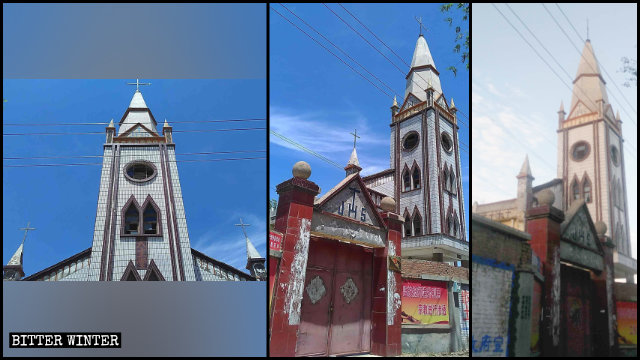
The Yinyao Catholic Church in Puyang county in Henan had its crosses toppled in August. A local official told the congregation that he would be dismissed, and the church would be shut down if the crosses were not removed.

The Yinyao Catholic Church before and after its crosses were removed.

Barbaric Dogmatists and the Revolution

An examination of the fascist ideas underlying the 'anti-fascist' revolution of today, with reference to Augusto Del Noce's analysis of its beginning in the 1960s.

From MercatorNet

By R.J. Snell

What underlies the tyrannical intolerance of modern-day activists steeped in identity politics?

During my junior year of college I read and was persuaded by Allan Bloom’s Closing of the American Mind. Bloom’s book was “a meditation on the state of our souls,” and he clearly knew something about both our souls and our minds. Consequently, as my own teaching career began I would often return to the text to help me comprehend my students, and I generally found it helpful.

Of course, I first read the book in 1995 when it had been in print for only eight years. Now, at thirty-three, Closing of the American Mind is middle-aged, and I must admit I no longer find it as compelling, although some intelligent friends tell me I’m very much mistaken in this.

Consider the opening lines of the introduction, in which Bloom contends that a professor can be certain that:

almost every student entering the university believes, or says he believes, that truth is relative. If this belief is put to the test, one can count on the students’ reaction: they will be uncomprehending. … The relativity of truth is not a theoretical insight but a moral postulate, the condition of a free society, or so they see it.

That comports with my own days as a student and early days of teaching in which “well, I personally hold x, but who am I to say that it’s wrong for another,” was a painfully common statement in introductory philosophy classes.

“Wait,” the teacher, sometimes myself, would respond, “you think slavery is wrong but wouldn’t say it’s wrong for another person to own slaves?”

Student: “Slavery is wrong for me; I wouldn’t own slaves, but maybe for another person or culture it would be fine. I wouldn’t do it, but who am I to say what’s right or wrong for them?”

Teacher: “What if I owned slaves, and tried to own you, would you be fine with that?”

Student: “Of course not, I’m personally against slavery.”

How things have changed. That is no longer the default option in the college seminar. While there certainly was a sophomoric naïveté and intellectual laziness in the claim — none of those students really thought slavery was morally acceptable, after all — nonetheless, relativism provided an expansive permissiveness for viewpoints.

The “danger” students had been “taught to fear,” in Bloom’s words, was “not error but intolerance,” and so students would brazenly affirm all sorts of wildly preposterous errors in the name of tolerance — and expect to be tolerated in return — for the “only virtue” into which they had been educated was “openness.” Openness, wrote Bloom, and “the relativism that makes it the only plausible stance,” is “the great insight of our times.” The greatest danger was “the true believer.”

Perhaps it would be better to say that openness was the insight of those times. For many now, not openness but dogmatism describes the “great insight” and “virtue.” Perhaps they remain theoretically committed to relativism in the sense that they lack a justified account of moral sources, but a good many are fundamentally dogmatic in their prescriptions.

While Bloom described his students as committed to relativism as a moral postulate — in their eyes the very condition of free society — many have pivoted considerably: now dogmatic conclusions not open to debate are asserted as the conditions of a just society.

Mark Lilla describes the current mood in which argument and debate have been replaced with a standpoint in which critique is taboo:

“At times our more privileged campuses can seem stuck in the world of archaic religion. Only those with an approved identity status are, like shamans, allowed to speak on certain matters.”

Again, this is a kind of relativism in its theoretical commitments, since debates about justification are deemed irrelevant to moral discourse, but it is willing to prescribe orthodoxy, proscribe heretics, and punish non-conformists.

But how is it that theoretical relativism is combined with dogmatism? The answer, I suggest, is the revival of a distorted and anarchic anti-Fascism.

Anarchic Anti-Fascists

In several chapters in The Age of Secularization that reflect on the student protests of the late 1960s, Augusto Del Noce claims that “there is no doubt that the extremists perceive themselves as the most radical and integral anti-Fascists.”

However, “there are different kinds of anti-Fascism,” and it turns out that the anti-Fascists separated two fundamental aspects of Fascism — nationalism and anarchism — and completely rejected nationalism while maintaining “the purely anarchic side.” Consequently, the young, who never experienced Fascism itself, “rediscovered its worst aspect, while believing themselves to be the most radical anti-Fascists.”

According to Del Noce, the anti-Fascists of the late 1960s embraced Fascism’s anarchic tendency of negation. “There is,” he continues, “not a single theme of student extremism that is not a rediscovery of motifs of early Fascism.”

These include the open-ended, undetermined goals, best summarised as “I want”; the “youth’s right to seize power”; a concern for “generational change” rather than concern for class interests; the claim to revolution, especially one led by the young; negation of the status quo; anti-intellectualism; and the myth of novelty.

Even more telling than these similarities is the negation of “every possible authority of values,” such that “all that is left is pure total negativism, and the will for something so indeterminate that it is close to ‘nothing.’”

If early twentieth-century Fascism had a goal, however distorted, in its nationalism, the anti-Fascists have only negations that turn out to be a kind of “Fascistic anarchism” or “will to power” with a clear “totalitarian orientation.” But, note well, a “totalitarianism of destruction.” They wish to destroy, including destroying the old ethical and religious systems.

The student extremists of the 1960s put themselves into an awkward situation: having rejected tradition, classical metaphysics, and both the Judeo-Christian and Greek threads of the West, they found themselves bereft of a plausible ethical account on which to base their claims of justice and injustice.

Since everything old had to go, the available ethical frameworks were discounted as “mystifications” and false “legitimisations.” The various ethical accounts were viewed with suspicion, as illegitimate, guilty of vestigial theological claims, and so they had to be rejected. But how, then, to justify claims that “the system” was somehow unjust or wrong? The moral categories with which to make such arguments had been jettisoned.

If reason, natural law, eternal law, the Image of God, natural rights, duty, human dignity, teleology, and the like are all rejected as part of a guilty tradition, the extremists instead turned to something more atavistic and barbaric — namely, liberation achieved “by eliminating the repression of instincts.”

It’s no accident that the revolutionaries of the 1960s (and our own moment) are obsessed with the sexually transgressive, claims Del Noce, for the evil they wish to overcome is not injustice, or unrighteousness, or unreasonability, or any of the other candidates for identifying social and personal disorder. Instead, “repression” becomes the great evil.

Repression causes unhappiness and violence; repression debases and diminishes; and repression harms and erases the lived experience of certain identities. Liberation occurs through “unleashing primitive and barbaric powers,” and the “revolution becomes an absurd revolt against what exists.”

That is, if something participates in the political and moral tradition it is necessarily tainted by its association with repression. The law represses and binds, religion represses, civilisation represses, zoning represses, as do money and property, marriage, monogamy, the equation of sex and gender, the family, and prohibitions against looting.

As a result, the revolution absurdly cannot distinguish “between what is positive and what is negative in the existing reality” — take, for example, the recent pulling down of monuments for Confederates like Jefferson Davis and the destruction of statues of Abraham Lincoln and Frederick Douglass. That certainly seems like an undifferentiated rage incapable of distinction, one that simply negates in a fury of anarchic destruction.

In the current moment, we see a kind of “blessed rage” for destruction. We are taking down, disassembling, and unmasking our cultural stories and institutions in the name of “resistance” or “freedom” or “justice,” but we have also deconstructed reason, moral norms, tradition, religion, and duty.

As a result, we critique and demand, but from a negation; we know — or some think they know — what they don’t want, but it is quite unclear if they know what they do want. And since they have rejected moral norms, it is impossible for them to give a rational justification for their wants and dislikes.

“Justice” means nothing more, consequently, than their demands, and, indeed, they demand rather than persuade or propose. Theirs is an exercise of will, for they have exorcised the logos, and mere will — willfulness — remains.

So it is that the anti-Fascists of our own day recapitulate a certain ugliness of the Fascists. They have rejected reason, have negated the moral codes, and now wish to rule. They have become, as Plato predicted in the Republic, “drones with stings.”

Such drones, in Plato’s account of the devolution of the regime, tend to tyranny — as do the anti-Fascists of our own moment. One cannot live justly by negation; one will always negate others. And, indeed, the tyrannical dogmatists of the current revolution are deeply, profoundly unjust.

Now It Makes More Sense - Margaret Sanger's Childhood

As I'm sure you've noticed I've been sharing memes of the vile racist and evil eugenicist, Margaret Sanger, in my 'Memes of the Day' post. I'm doing this to emphasise not only how evil this Servant of Satan was, but to remind people that Planned Parenthood, darling of the left, was founded to put into practice these same racist and eugenic ideas.

Yesterday evening, as I was finding a meme for my regular post, I ran across this:


Suddenly, a light went on in my mind! How could she claim to have made this connection in early childhood?  I checked on her early life and found what I expected. She was the middle child of eleven. I assume her father, a free-thinking, failed medical student, who became a stonecutter, was her role model for 'poverty, toil. unemployment, drunkenness, cruelty, quarrelling, fighting, debts, (and) jail'.

Whilst it doesn't forgive her devoted service to Satan in the war against life, it might at least explain how she was so warped that she became his willing servant.

The Crusade of Varna - John Hunyadi vs. The Ottoman Turks

Real Crusades History #304.  And don't forget the Real Crusades History website!

The Crusade of Varna was an unsuccessful military campaign mounted by several European monarchs to check the expansion of the Ottoman Empire into Central Europe, specifically the Balkans between 1443 and 1444. It was called by Pope Eugene IV on 1 January 1443 and led by King Władysław III of Poland, John Hunyadi, Voivode of Transylvania, and Duke Philip the Good of Burgundy.

Word of the Day: Temperance

TEMPERANCE. The virtue that moderates the desire for pleasure. In the widest sense, temperance regulates every form of enjoyment that comes from the exercise of a human power or faculty, e.g., purely spiritual joy arising from intellectual activity or even the consolations experienced in prayer and emotional pleasure produced by such things as pleasant music or the sight of a beautiful scene. In the strict sense, however, temperance is the correlative of fortitude. As fortitude controls rashness and fear in the face of the major pains that threaten to unbalance human nature, so temperance controls desire for major pleasures. Since pleasure follows from all natural activity, it is most intense when associated with our most natural activities. On the level of sense feeling, they are the pleasures that serve the individual person through food and drink, and the human race through carnal intercourse. Temperance mainly refers to these appetites. (Etym. Latin temperare, to apportion, regulate, qualify.)