02 May 2018

Cardinal Marx: Without Karl Marx, “There Would Not be any Catholic Social Doctrine”

Another article on His Eminence Reinhard, Cardinal Marx(ist), this time from LifeSiteNews, via One Peter Five.


On the occasion of the 200th anniversary of Karl Marx’ birth, Cardinal Reinhard Marx gave an interview in Germany in which he claimed that Marx unmistakably influenced Catholic social doctrine, adding that he was “impressed” by the Communist Manifesto. Karl Marx has often been referred to as the father of Communism, a political theory linked to the deaths of millions.
Cardinal Marx, one of the council of nine cardinals chosen by Pope Francis to advise him, is at the forefront of pushing what is being hailed as a “new paradigm” in the Church that departs from previous Church teaching on sexual morality (here, here, and here) and marriage.
As the news website of the German bishops Katholisch.de reports on 30 April, Cardinal Marx, the archbishop of Munich-Freising and president of the German bishops’ conference, told the Frankfurter Allgemeine Sonntagszeitung that the Communist Manifesto “quite impressed” him. That declaratory document had been written by Karl Marx and Friedrich Engels and promulgated in 1848.
In another recent interview, Cardinal Marx admitted to finding the writings of Karl Marx “fascinating,” adding that the Communist Manifesto has “an energy” and “a great language.” “One only has to read Karl Marx without prejudice, then his power will surprise,” the prelate explained. “There is an inspiration, a revolutionary impetus,” he stated.
According to Vatican News, Marx also said in his interview with the Frankfurter Allgemeine Sonntagszeitung that Karl Marx “can be very helpful” in light of the current conflicts, revolutions and wars which very well might have their roots in economic injustice. “Human rights without material participation remain incomplete,” the cardinal said. Cardinal Marx – who himself was once a professor of social ethics – also called Karl Marx “the first serious sociologist.”
Quoting yet another news source about the same interview, Marx also said about Karl Marx: “Without him, there would not be any Catholic social doctrine.” Moreover, he made it clear that Karl Marx is not responsible for the crimes of Stalinism, even though the cardinal admitted that “there is to be found [in Marx’s writings] here or there a totalitarian thought,” such as the collectivism which disrespects the individual person. However, added the cardinal, one may not put Karl Marx into a “direct connection” with the later political Marxism-Leninism, nor even the soviet prison system and work camps.
Cardinal Marx related the little story that Pope John Paul II used to call him playfully “nostro marxista” – “our Marxist.”
In an earlier text written in 2007, Cardinal Marx quoted approvingly a statement of a professor for Catholic social doctrine which says: “We all stand on the shoulders of Karl Marx.” The prelate then added that “Marx was not a mere ideologue,” claiming that Marx “did not at all propagate an anarchical overthrow.” Karl Marx, rather, wanted a “comprehensive social participation,” which “we now also call for, also on the part of the churches.”
LifeSiteNews asked Professor Konrad Löw to comment on the recent statements made by Cardinal Marx. Löw is a German professor emeritus of political science and law, and a defender of human rights who has written books on the phenomenon of totalitarianism and is himself a Karl Marx specialist. His most important book in this field is Mythos Marx und seine Macher (Myth Marx and Its Creators).
He pointed out that the Communist Manifesto calls for “violent destruction” of current political orders which will produce “mountains of corpses and streams of blood.”
“The Communists despise it to hide their intentions and purposes. They declare openly that their goals can only be reached with the help of the violent destruction of the whole heretofore existing societal order. May the ruling classes tremble!” If I picture this future, I see mountains of corpses and streams of blood – Stalin sends his greetings!”
“With such quotations, I have filled a thick book: Marx and Engels – the Fathers of Terror (Marx und Engels – Die Väter des Terrors). He who does not want to take notice of it, cannot be helped,” said Löw.

Originally published at LifeSiteNews. Reprinted with permission.

Who Started Your Church?

This is why I almost never refer to the 'Catholic Church' or 'Catholics', preferring such terms as 'Christ's Church' and 'Faithful of Christ's Church'. We are THE Church. All others are man-made, pale imitations of the One, Holy, Catholic, Roman, and Apostolic Church founded by Christ.


Xi Jinping Places Catholic Church in China Under Direct Party Control

Remember the articles from a few weeks ago about Francis betraying the Faithful of Christ's Church to the Red Slavemasters? This is what he's doing!

From One Peter Five


The decision means that the proposed Vatican-China agreement would not merely be a surrender of the Chinese faithful to the Communist Party—it would be an utter betrayal of the faith. 
On March 22, the Chinese Communist Party announced that all “religious affairs” in China would henceforth be supervised by a shadowy Party office called the “United Front Department.” The former government agency responsible for Catholic and other believers–the State Administration of Religious Affairs bureau (SARA)—has been summarily abolished.
The reorganization attracted little attention outside of China, but it is certain to have unpleasant repercussions for Chinese believers. I believe that this move means that the persecution of Catholics and other believers is about to get much more intense, perhaps rising to levels not seen since the dark days of the 1950s.
The change also means that, in all probability, the draft agreement between the Vatican and Beijing that has been under discussion for years is now a dead letter. In fact, signing it now would mean more than surrendering papal authority over the appointment of bishops to the Chinese state, as bad as that would be. Signing it now would be a betrayal of the faithful into the hands of a new Red Emperor who seems to have a particular animus towards Christians, especially Catholics, and who seems determined to suffocate and extinguish the faith throughout his empire.
It is no secret that religious liberty–despite being guaranteed by the PRC Constitution–has always been severely restricted in the People’s Republic of China. But to understand why putting religious affairs into the hands of the CCP’s United Front Department bodes so ill for Catholics you need to understand the purpose of the Department and its work.
The United Front Department was created by Chairman Mao Zedong to co-opt and control non-Communist organizations and individuals during the Chinese civil war. Its efforts were so successful that Mao called it one of the three “magic weapons” that helped to revolution to succeed. (His other two “magic weapons” were propaganda and, not surprisingly, the Red Army.)
After the civil war, the United Front Department was re-tasked with serving the Party leadership by coercing various groups, such as intellectuals and businessmen, into actively collaborating with the newly established “people’s democratic dictatorship.” Now that Catholics have been brought under the Department’s purview, the same kind of pressure will be exerted on them, and the same kind of active collaboration demanded of the Patriotic Catholic Church with the regime and its goals.
The work of the United Front Department, in other words, will not be limited to merely ensuring that Catholic bishops, priests, and laity comply with the regulations governing religious activity. If that was the only issue then SARA, which was already enforcing such regulations on Catholics, would not have been abolished.
Nor does the move simply mean that the Church will be losing the (already very limited) freedom of action it once had, although this is also absolutely the case.
Rather, putting the United Front Department in charge of religious affairs means that the Party leadership is determined to make the Patriotic Catholic Church into an active “agent of control” for the regime with a single purpose: to subvert and undermine the faith of the millions of Catholics in China, and to prevent them from spreading the faith to others, including their own children. It is nothing less than a hostile takeover—an expropriation if you will—of the Catholic Church in China.
Like Chairman Mao, Xi Jinping hungers for ironclad control over Chinese society and is turning to the United Front Department to accomplish this end. Channeling the late chairman, Xi likewise declared in his October 2017 speech to the National People’s Congress that “United Front work is an important magic weapon for the victory of the Party’s cause.”
Even Chinese officials, who are trying to sell the reorganization as a way of enhancing the “efficiency of government,” acknowledge that it is an effort to assert control over believers. “It means management of religious affairs and ethnic issues will be stepped up,” says Yang Shu of Lanzhou University. “And we could see the authorities taking a tighter grip than before.”
A tighter grip, indeed.
The new “Regulations for Religious Affairs” which came into effect on February 1, are already being rigorously enforced. Students and Party members have been warned not to participate in religious activities. Churches have been told to keep minors from attending Mass, and catechism classes and summer camps are now off-limits.
Churches continue to be defaced by having their crosses and statues removed, or even demolished entirely. Priests in the Underground Church have been ordered to register for a “clergyman certificate” so they can be monitored and supervised. Even the sale of Bibles has been banned as the United Front Department prepares a “Sinicized”—that is, Party approved—version.
Like the other organizations controlled through the United Front Department, the Patriotic Church will henceforth be expected to behave like an arm of the Chinese Communist Party in carrying out the will of the “people’s democratic dictatorship.” Homilies will be expected to praise the existing order (led by “Core Leader” Xi Jinping), and to promote the official ideology (known as “Xi Jinping thought”).
As for the Underground Church, it will simply be annihilated, insofar as it is within the regime’s power to do so.
It is not hard to see that there is an irreconcilable contradiction between the impending demands of the United Front Department and the demands of the Catholic faith.
United Front tactics will be used, as they were in the late 1950s, to complete the subversion of the Catholic Patriotic Church into an agent of the state. Then the Church itself will be used to force the ideological assimilation of all Chinese Catholics into the political order—the people’s democratic dictatorship—that Xi Jinping controls. It is impossible not to conclude that Xi’s ultimate goal is that same as Mao’s was, namely, the total eradication of this “foreign” religion from the soil of China.
The agents of this subversion will be Patriotic Catholic Bishops like Bishop Peter Fang Jianping of Tangshan, one of three compromised bishops who are members of China’s rubberstamp parliament, the National People’s Congress.
Bishop Fang eagerly promotes Xi Jinping’s call for the “sinicization of religion,” which is the idea that religion should chiefly serve the interests of the Chinese Communist Party that Xi himself leads.  The reason why Catholics should support the Party and its leader, according to Fang, is “because we, as citizens of the country, should first be a citizen and then have religion and beliefs.”
Such a formulation—which gives the Chinese Caesar pride of place–leaves no doubt where Bishop Fang’s primary loyalty lies.
Faced with a similar choice between secular and sacred authority, St. Thomas More famously said, “I am the King’s good servant, but I am God’s first.”
Bishop Fang would turn More’s affirmation of the faith on its head. He is saying, in effect: “I am God’s good servant, but I am Emperor Xi’s first.”
While it is true that the English bishops, with the exception of the martyred Cardinal John Fisher, followed Henry VIII into schism, one might add that at least Henry still claimed to be Christian.
Fang and some of his fellow Patriotic bishops, several illicitly ordained, are in effect endorsing the creation of a state church headed by a Communist dictator intent upon its destruction.
This is obviously a nonstarter for faithful Chinese Catholics, whose primary loyalty is to the Magisterium, not to the current leader of the Communist Party. While Bishop Fang may insist that all Chinese Catholics follow him into schism, it is safe to say that most will not do so. Many will continue to practice their Catholic faith in the Underground Church, while others will leave the faith entirely.
If the Vatican signs an agreement with the Party leadership accepting the newly “Sinicized” Patriotic Church, it will only exacerbate an already worsening situation. It will be seen as a rank betrayal by the Chinese faithful, and might well accelerate their exodus from the Church.
Bishop Fang’s new puppet masters at the United Front Department, on the other hand, would be delighted to have the Vatican endorse the schismatic national church that they now control. The demoralization of the faithful that would follow the signing of such an agreement would be an added bonus, since it would help them to achieve their ultimate goal: the wholesale elimination of Chinese Catholicism.
The Vatican needs to stop hobnobbing with those members of the Patriotic Church, such as Bishop Fang, who are wholeheartedly collaborating with the same Communist Party leadership that is daily tightening the screws on our co-believers in China.
Instead, the Holy Father should be leading us in offering up fervent prayers and concrete aid to the suffering Church in China. If the past is any guide, the suffering and persecution of our co-believers in China is about to get much, much worse.
Steven W. Mosher is the President of the Population Research Institute and the author of Bully of Asia: Why China’s Dream is the New Threat to World Order (Regnery) (Standard notice. If you buy this book from this link, I receive a small commission at no additional charge to you.)

Wisdom From Ven. Archbishop Fulton J. Sheen

“A new crime has arisen in the world - the crime of believing in God. … If the new crime be, to believe in God, let us all be criminals. If it be treason to any way oppose Communism, then traitors we shall be.”
~ Venerable Fulton J. Sheen: On defending Cardinal Mindszenty; Bishop Sheen Writes, 1949.

2. The Social Doctrine of John Paul I

The second essay in our series from The Just Third Way.


In the previous posting in this series, we introduced our subject by noting that Pope John Paul I was head of the Catholic Church for a bare thirty-three days — one day for every year of the traditional age of Jesus’s life on Earth . . . which has no significance of any kind whatsoever (the coincidence, that is!).  Nevertheless, John Paul I still managed to say a few things about the Church’s social teachings, at least enough to see that he was in tune with every pope since Gregory XVI, which is when Catholic social teaching emerged as a discrete discipline within the larger body of Catholic thought.

Pope John Paul I
Of course, we know that John Paul I did not have time to issue any encyclicals, social or otherwise.  All he had time for was to make a number of statements regarding his plans for the future and indicate the general direction of his thought.  That, however, is enough, given the fact that, according to the Catholic Church, doctrine may be developed and applied in many different ways, but changed in its essence, never.
Having said that, we do have to issue a caveat.  There is massive confusion today between knowledge and opinion.  The late Mortimer Adler, the “Great Books” philosopher and convert to Catholicism, noted in his book, Ten Philosophical Mistakes(1985), that far too many people cannot tell the difference between knowledge and opinion, and may not even know there is a difference — another crime to be laid at the door of modern Academia.
Consequently, many people today, even quite a large number of Catholics, are absolutely convinced that the Magisterial teachings of the Catholic Church are not only far from absolute, they are subject to change if enough people think they should be changed.  Almost as bad (if not worse) are those experts — every age has its experts, but modern mass media seem to have made anyone who can scream loudly enough into an instant expert . . . especially those who have no idea what they are talking about — who claim that of course Catholic teaching has not changed.  What has changed is our understanding of it.  Either people in the past were so stupid they did not realize the truth now revealed to the experts, or people today are so stupid, etc.
Saint Thomas Aquinas
Nowhere is this more evident than in the understanding of “social justice,” a relatively new term as such things go in philosophy — a new term describing an old thing; as far as truth is concerned, non novum sub soles, “nothing new under the sun.”  Nor does justice itself or any of the other virtues, natural or supernatural, get any better treatment.  In the New Age (which is not all that new) and modernism (which is not all that modern), all absolutes, such as virtues, rights, and even truth itself, are subject to change, redefinition, or outright abolition if those who desire the change have enough power — but more about that, later.
So how do we define justice and social justice?  Today we’ll look at the classic definition of justice and get to social justice tomorrow.  According to Aquinas, it is by justice that one renders to another his or her due by a perpetual constant will (IIa IIae, q. 58, a. 1.).  Justice directs each person in his or her relations to others according to some kind of equality or rightness (IIa IIae, q. 57, a. 1; De Veritate 23, 6.).
In somewhat more simple terms, justice means that you make certain if someone is due something, he or she gets something.  “Classic” justice is divided like all the virtues into two kinds, particular and general.
A “particular” virtue is directed at something (or, more accurately, someone) specific; like a sentence, it has a “direct object.”  You cannot owe $5 without paying $5 to someone specific or particular to satisfy the obligation.  Nor can you be owed $5 unless someone specific has incurred a debt to you of $5.  You cannot love God with Whom you have no social contact, or mankind in general, and hate your particular brother or neighbor with whom you interact socially without being a liar. (1 John 4:20)
As implied in the definition of particular virtue, a “general” virtue differs from a particular virtue in not having a direct object.  With respect to justice, “general justice” is that type of justice that “infuses” all other virtues, that motivates you to act prudently, temperately, courageously, lovingly, hopefully, and faithfully (to include the supernatural virtues as well as the natural ones) toward others, thereby rendering those others their due as fellow human persons.  “In the most extensive sense of the word ‘justice’ differs little from ‘virtue’; for it includes within itself the whole circle of virtues.” (“Justice,” Black’s Law Dictionary.)
In fact, no virtue is a true virtue unless it conforms in some way to the demands of justice.  Charity, for example, is not really charity unless the demands of justice have been fulfilled.  Refusing to treat others prudently, temperately, or with courage is to render them less than their due as human persons.  Thus, someone who dislikes another and acts imprudently toward him or her without bothering to try to become reconciled or to get to the root of the problem is a “triple threat” with respect to violating the demands of virtue, transgressing against prudence and charity in particular, and against justice in general.
In classic justice, there are two types of justice, commutative and distributive.  Commutative justice is the “justice of contracts,” and the most basic form of justice from which all other forms of justice derive.  “It consists in rendering to every man the exact measure of his dues, without regard to his personal worth or merits, i.e., placing all men on an equality.”  (Ibid.)
Distributive justice is the “justice of proportion” —
. . . that which should govern the distribution of rewards and punishments.  It assigns to each the rewards which his personal merit or services deserve, or the proper punishment for his crimes.  It does not consider all men as equally deserving or equally blameworthy, but discriminates between them, observing a just proportion and comparison. (Ibid.)
Thus, distributive justice is the justice that demands what benefits or losses are assigned to individuals in a joint endeavor in civil society.  If A contributes 80% to a project such as a business, and B contributes 20%, then — unless there is a free agreement otherwise — A receives 80% of the benefits and suffers 80% of the losses, while B receives 20% of the benefits and suffers 20% of the losses.


Father William J. Ferree, S.M., PH.D.
Due to the terminology, the final part of today’s discussion may be the one that gives the most trouble.  It has given so much trouble that in his doctoral thesis, The Act of Social Justice (1941, © 1943), and again in his pamphlet, Introduction to Social Justice (1948), CESJ co-founder Father William J. Ferree, S.M., Ph.D. noted that most philosophers have carefully avoided discussing this particular topic for at least 2,500 years . . . and it is all Aristotle’s fault.  This is because classic justice is not only divided into particular and general justice, it is divided into individual justice (commutative and distributive) and . . . “non-individual justice,” which we are calling that for reasons that will become immediately apparent.
Confusion starts with the fact that, as far as Aristotle was concerned, there is only one “non-individual justice.”  This is “general justice,” which, since it is not a particular justice, is . . . a general justice.
You see the difficulty here.  Aristotle tried to explain something in terms of itself, or at least by using the same terminology, which is a sure way to confuse the issue.  It only helped a little when he tried to explain that general justice (a general justice) when it is applied is called “legal justice,” because it is most often by the State passing good laws, and by citizens obeying them, that the common good is indirectly benefitted and the aspect of justice that permeates all other virtues has its effect. . . . which causes anotherproblem, because “legal justice” also means the administration of the law!
And that is why we are going to address the whole “problem of legal justice” tomorrow, and then only briefly, just to get our definitions and understanding straight.

IN LUMINE FIDEI: 2 MAY – SAINT ATHANASIUS (Bishop and Doctor of the...

IN LUMINE FIDEI: 2 MAY – SAINT ATHANASIUS (Bishop and Doctor of the...: Athanasius (296-373 AD), the stern defender of the Catholic Faith, was born at Alexandria in Egypt. He was made Deacon by Alexander, Bish...

IN LUMINE FIDEI: 2 MAY – WEDNESDAY IN THE FIFTH WEEK AFTER EASTER

IN LUMINE FIDEI: 2 MAY – WEDNESDAY IN THE FIFTH WEEK AFTER EASTER: Dom Prosper Gueranger: We now come to the fourth Sacrament, which may be justly called the Sacrament of Mercy. Jesus knew the weakne...

2 May, A Chesterton Calendar

MAY 2nd 

If drudgery only means dreadfully hard work, I admit the woman drudges in the home, as a man might drudge at the Cathedral of Amiens or drudge behind a gun at Trafalgar. But if it means that the hard work is more heavy because it is trifling, colourless, and of small import to the soul, then, as I say, I give it up: I do not know what the word means. To be Queen Elizabeth within a definite area— deciding sales, banquets, labours, and holidays; to be Whiteley within a certain area— providing toys, boots, sheets, cakes, and books; to be Aristotle within a certain area— teaching morals, manners, theology, and hygiene: I can understand how this might exhaust the mind, but I cannot imagine how it could narrow it. 

‘What’s Wrong with the World.’

Chesterton, G. K.. The G. K. Chesterton Collection [50 Books] (Kindle Locations 44063-44069). Catholic Way Publishing. Kindle Edition. 

3 May, The Roman Martyrology

ante diem vi Nonas Maias
May 3rd anno Domini 2018 The 18th Day of the Moon 

It is commemorated the finding at Jerusalem in the time of the Emperor Constantine of the Most Holy Cross of the Lord. 
Upon the same day, were born into the better life: At Rome, upon the Nomentan Way, the holy martyrs Pope Alexander I., [in the year 117,] and the priests Eventius and Theodulos. Under the Emperor Hadrian and the judge Aurelian, Alexander suffered chains and imprisonment, racking, tearing with hooks, and fire, and was at length put to death by small stabs over his whole body. Eventius and Theodulos were long imprisoned, then examined under torture by fire, and at last beheaded. 
At Narni, [in the year 376,] the holy Confessor Juvenal, Bishop of that see. 
At Constantinople, [in the year 313,] the holy martyrs Alexander the Soldier, and Antonina the Virgin. In the persecution under the Emperor Maximian the President Festus condemned her to a brothel Alexander awaited her there, changed clothes with her, and so enabled her to escape. For this reason they were put to the torture together, and when both had had their hands cut off, they were together cast into the fire for Christ's sake, and having so finished together their noble contending, were crowned together. 
In the Thebaid, [about the year 286,] the holy martyrs Timothy and Myra his wife. The Prefect Arian, after putting them to divers torments, ordered them to be crucified together. They hung upon the cross alive for nine days, the one strengthening the other in the faith, and so together at last finished their testimony. 
At Aphrodisia, in Karia, [in the fourth century,] the holy martyrs Diodorus and Rodopian, who were stoned to death by their fellow-citizens during the persecution under the Emperor Diocletian. 
Upon Mount Senario, near Florence, [in the thirteenth century,] the blessed Confessors Sosthenes and Uguccio, two of the seven founders of the Order of Servants of the Blessed Virgin Mary, who departed this life upon the same day and at the same hour, as they were repeating the angelic salutation, even as had been foretold to them from heaven. 
V. And elsewhere many other holy martyrs, confessors, and holy virgins.
R. Thanks be to God.

Memes of the Day


01 May 2018

Don't call terrorists 'evil'

Lloyd (Lindybeige) made this video shortly after Drummer Lee Rigby of the  Royal Regiment of Fusiliers was murdered in cold blood by two Muslims. I have to say that the title is almost click bait, but he's quite serious! Don't call terrorists 'evil', call them stupid and idiots!


Chevalier Charles Coulombe on The Legend of Prester John

A fascinating discussion of the Legend of Prester John, where it came from, how it developed, some of the history of the Nestorian Church, the Mongol Empire, and the origin of the term 'kamikaze'.


1. The Social Doctrine of John Paul I

Today, we start a series of articles from The Just Third Way, on the Social Doctrine of His Holiness Pope John Paul I, by Michael Greaney.

From The Just Third Way

Pope John Paul I was head of the Catholic Church for only thirty-three days.  Even in that short period of time, however, he made it abundantly clear not only that he was a “Vatican II pope,” but a “Vatican I pope,” with all that implies — something we hope to make clear in this brief series.

Pope John Paul I
One thing we also need to make clear is that this is not a “Catholic” analysis of the pontificate of John Paul I.  It is, rather, a “catholic” one, that is, an examination of his few statements concerning the social teachings of the Catholic Church from an Aristotelian-Thomist natural law orientation.
That being the case — and necessarily understood properly only within that context — “Catholic” social teaching applies to every child, woman, and man on the planet Earth, no ifs, ands, or buts.  To say (as one commentator did some years ago) that — and this is an exact quote — “Jews because they are Jews have nothing in common with Catholic social teaching” is to miss the whole point of Catholic social teaching by a couple of country miles, as well as to be spouting some exceptionally nauseating nonsense.
Even to call Aristotelian-Thomist natural law social teaching Catholic instead of catholic is misleading to a degree.  Of course, any Catholic who knows his or her faith would and should disagree with that statement.  Such a Catholic (at least one who knows that the Church teaches something because it’s true, it’s not true because the Church teaches it!) would naturally (and quite accurately by Catholic belief) argue that the universality of his or her Church’s social teaching is just one more instance of the universality (in the sense of fullness, not completeness) of Catholic teaching in every sphere of faith and morals.
Aristotle
That is because Catholic social thought, in common with Aristotelian-Thomist philosophy, is based on the dignity and sovereignty of the human person under God.  Nor is that a meaningless phrase that can be twisted to mean whatever someone in power wants it to mean.  It has, rather, a specific meaning based on the meaning and purpose of human life itself.
And that is?
As Aristotle put it in the opening of his Nichomachean Ethics, all things by nature seek the good.  The whole of Aristotle’s ethics — his moral philosophy — is based on that principle, and nowhere is that more true than with human beings.
That is because — per Catholic belief — each human being is made in “the image and likeness of God” . . . which does not mean we are clones of a deity.  No, it means every human being has the potential, but only the potential, to be perfect as God is perfect, “perfection” meaning absolute and complete conformity to God’s Nature.
Put another way, “the image and likeness of God” means that where God is infinitely perfect, human beings are infinitely perfectible.  The paradox of human existence is that we must strive to conform ourselves ever closer to that which is perfect, knowing all the while that we can never get there.
Now, while that is a very profound thought on which to meditate, and every human being worth his or her salt should meditate on it . . . what does it mean?  It means simply this: that the meaning and purpose of human life is to become more fully human.
Saint Thomas Aquinas
That is not a “tautology,” a statement that simply says something again, often just using different words, e.g., “an old antique” or “the reason is because.”  No, it is a reflection of the fact that where human beings have the infinite capacity to acquire and develop virtue (“human-ness”) and thereby conform more and more to their own nature, God is infinite virtue, and is-was-ever-shall-be already fully conformed to His own Nature.
(If we may insert a parenthetical comment here, we just had an example of how difficult it is even to discuss God using mere human language and concepts, and why this blog series is going to confine itself to purely human principles that apply to everyone, regardless of religious belief or lack thereof.  To say that God “is-was-ever-shall-be” is a very, very weak way of trying to convey that God hasn’t merely existed for all time, exists now, and will always exist, the concept of time itself is irrelevant to Him . . . and there we go again — is “Him” adequate in any way?  God is necessarily “outside” time altogether.  Nor can you say that God exists in all times and places at once, i.e., “God is everywhere,” for He is also “outside” place as well as time. And even saying “outside” or “apart from” isn’t right, either.  Rather than go insane trying to figure out how to talk about that which you can’t really talk about, we’ll stick to human concepts and leave God to God, as least for the purposes of this discussion.)
Returning to our point, given that the meaning and purpose of life is to become more fully human, and that we become more fully human by acquiring and developing “human-ness” or virtue (for that is what “virtue” signifies — it means literally “man-ness,” but it signifies “human-ness”), how do we acquire and develop virtue?
George Mason of Gunston Hall
As American statesman George Mason hinted in his draft of the Virginia Declaration of Rights in 1776, human beings acquire and develop virtue by exercising their rights under natural law, primarily life, liberty, and private property.  “Human dignity,” therefore, consists in respecting the natural rights of every child, every woman, and every man . . . and yet again we run up against more words that we need to understand before we can even start discussing Pope John Paul I’s social doctrine:
Common good: that vast network of institutions within which human beings as “political animals” acquire and develop virtue.
Institution: a “social habit,” a “social tool” such as an organization, law, custom, tradition, even the most important social tool (in the civil sense, not the religious), the State itself that provide the specific environment that encourages the acquisition and development of virtue.
Liberty: freedom, exemption from extraneous control.  In this context, it includes “civil liberties” enjoyed by members of a society, freedom of association, and freedom of contract.  It does not mean doing whatever you want.
Natural law: the general code of human behavior, determined by applying reason to the evidence of our senses.  Natural law consists of conforming one’s self to — that is, building the habits of — prudence, temperance, fortitude, and, above all, justice, justice being the highest natural virtue.
Private Property: property is not the thing owned, but the natural right to be an owner, and the socially defined bundle of rights that define how an owner may use what is owned within a specific set of circumstances.  The right to be an owner is absolute in every human being, while the rights of property must be limited and adapted to circumstances.  The most important rights of property are control and enjoyment of the fruits.  That is, an owner may generally do as he or she wishes with what he or she owns as long as he or she does not harm him- or herself, other individuals, groups, or the common good as a whole, and is entitled to all income generated by what is owned, just as he or she suffers any loss.
Right, Natural: a general norm based on observations of human nature that no human law may legitimately violate; fundamental human rights that must be adapted to every human circumstance without exception, and thus take an infinite number of forms, but that are inherent in each human being simply because each human being is human.  Chief among the natural rights are life, liberty, and private property.
Right: the power to do or not do some act or acts in relation to others.  A duty is the obligation to do or not do some act or acts in relation to others.  Every right has a correlative duty, just as every duty has a correlative right.  It is impossible to speak of a right without a duty laid on others, or a duty where others have no right.
That’s enough for starters.  Next week we’ll get into the definitions of justice, which is where so many people manage to get off track.  And after that we may get to a discussion of Pope John Paul I’s social doctrine . . . once we have the words and concepts we need to understand it.

IN LUMINE FIDEI: 1 MAY – SAINT JOSEPH THE WORKER

IN LUMINE FIDEI: 1 MAY – SAINT JOSEPH THE WORKER: Dom Prosper Guéranger: The Son of God, when about to descend upon this Earth to assume our human nature, would have a Mother. Th...

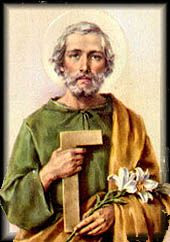
Feast of St Joseph the Worker

Prior to the Calendar reform of Ven. Pope Pius XII in 1955, today was the Feast of St Philip and St James, Apostles. It is also International Labour Day, a major holiday for nazis (who called it 'National' Labour Day), communists, socialists, and anarchists. Venerable Pius created this Feast honouring St Joseph as a workingman in order to counteract the radical left.


Interestingly, in the General Roman Calendar of 1960, which is the Calendar followed by the FSSP, SSPX, and other Traditional Institutes and Orders, and which I follow also, this is a First Class Feast, the highest rank. In the General Roman Calendar of 1969, followed by the Novus Ordo, it is an Optional Memorial, the lowest rank. Could it be that it was downgraded in order to placate Paul's friends in the communist movement?

The Hymn at Lauds of his Office:

O dawn announcing the sun
Beginning the month of flowering;
The workman's resounding hammer
Salutes the home at Nazareth.

Hail, head of the household
Beneath whom is the supreme Artificer;
Who, bedewed with salty sweat,
Exercises his father's trade.

He was placed on a high seat
nearest to his Noble Spouse;
be near now to all thy clients
who are troubled by indigency.

Strength and strife be absent!
and all defrauding of wages;
May copious nourishment of food
be limited only by moderation.

O Trinity, O Unity,
by the prayers of Joseph;
Direct in peace
all our steps and our path. 
Amen.
And, the Collect from his feast:
God, Creator of all things, who didst lay on the human race the law of labour: graciously grant; that by following the example of Saint Joseph and under his patronage, we may carry out the work thou dost command, and obtain the reward thou dost promise.
Who livest and reignest with God the Father in the unity of the Holy Spirit, one God, world without end.
R. Amen

IN LUMINE FIDEI: 1 MAY – TUESDAY IN THE FIFTH WEEK AFTER EASTER

IN LUMINE FIDEI: 1 MAY – TUESDAY IN THE FIFTH WEEK AFTER EASTER: Dom Prosper Gueranger: The third Sacrament — the Holy Eucharist — is so intimately connected with our Redeemer’s Passion that its ...

IN LUMINE FIDEI: MAY – THE MONTH OF THE BLESSED VIRGIN MARY (Mother...

IN LUMINE FIDEI: MAY – THE MONTH OF THE BLESSED VIRGIN MARY (Mother...: Dom Prosper Gueranger: Ever since our entrance upon the joys of the Paschal Season, scarcely a day has passed without the Calendar’s o...

1 May, A Chesterton Calendar

MAY 1st

LABOUR DAY

It may be we shall rise the last as Frenchmen rose the first;
Our wrath come after Russia’s, and our wrath be the worst.
It may be we are set to mark by our riot and our rest
God’s scorn of all man’s governance: it may be beer is best.
But we are the people of England, and we never have spoken yet.
Mock at us, pay us, pass us; but do not quite forget.

‘The Silent People.’

Chesterton, G. K.. The G. K. Chesterton Collection [50 Books] (Kindle Locations 44054-44062). Catholic Way Publishing. Kindle Edition.

2 May, The Roman Martyrology

ante diem vi Nonas Maias

May 2nd anno Domini 2018 The 17th Day of the Moon were born into the better life: 

At Alexandria, in the year 373, holy Athanasius, Pope of that city, most illustrious for his holiness and teaching. Nearly the whole world leagued itself together to persecute him for the Catholic Faith. He fought right stoutly against Emperors, Presidents, and Arian Bishops without number, from the time of the Emperor Constantine until that of the Emperor Valens. To escape their plots he became an outcast upon the face of the wide world, and there was nowhere left where he could hide himself in safety. He returned at last to his own church, and after many contendings and many crowns of long-suffering he passed away to be ever with the Lord, in the 46th year of his priesthood, in the time of the Emperors Valentinian and Valens. 
At Rome, the holy martyrs Saturninus, Neopolus, German, and Celestine, who suffered many things, and were at last cast into prison, where they slept in the Lord. 
Likewise the holy martyrs Exuperius and Zoe his wife, their children Cyriacus and Theodulus, who suffered under the Emperor Hadrian. 
At Seville, the holy martyr the Deacon Felix. 
Upon the same day, [in the year 489,] the holy martyr Vindemial,.
V. And elsewhere many other holy martyrs, confessors, and holy virgins.
R. Thanks be to God.


Memes of the Day