31 July 2022

Secret 1918 Vatican Archive Document Reveals Freemasonic Plot to Destroy Throne and Altar

The ultimate aim of Freemasonry since its founding has been the destruction of our Græco-Roman Catholic Civilisation as typified by 'Throne and Altar'!

From One Peter Five

By Maike Hickson, PhD


Image: Scans of the original 3-page letter from the secret Vatican Archives. We do not have authorization to publish the full contents of the letter, but the author of this report was given permission to review it in its entirety.

Dr. Michael Hesemann, a German historian of the Catholic Church, has just given an interview to Robert Moynihan’s Inside the Vatican Magazine. In this interview, which deals with the 100th Anniversary of the apparitions of Fatima, Dr. Hesemann makes the following statement:

Also in 1917, Freemasonry celebrated the 200th anniversary of the foundation of the first Grand Lodge in London in 1717. The Masonic ideology is not only based on deism, but also on the Gnostic heresy of self-salvation and “enlightenment,” and has a decidedly anti-Catholic agenda. Just in 1917, Maximilian Kolbe, one of the greatest saints of the 20th century, witnessed a Masonic procession in Rome, carrying banners with the slogan “Satan must reign in the Vatican. The Pope will be His slave.”

One year later, the German Emperor Wilhelm II was warned by German Freemasons that the Grand Orient planned to force all sovereign monarchs in Europe to abdicate – which indeed happened in 1918 – [also] to destroy the Catholic Church and to bring Europe under the control of American Big Business, according to a document I found in the Vatican Secret Archives.

Bolshevism would be the instrument of Freemasonry to reach this goal.

Indeed, 1917 was the year of the Russian [Bolshevik] revolution which ended in a massive persecution of the Church.

Also 1917 was the year of the United States’ entry into World War I, the year when the two superpowers were born, which formed the history of the 20th century for the next 74 years. [emphasis added]

Dr. Hesemann personally rejects the view that Russia has not been sufficiently consecrated to the Immaculate Heart of Mary, and denies that there is still a part of the Third Secret of Fatima missing. Nevertheless, he thinks that the message of Fatima is still with us and that some form of grave chastisement is still imminent. And this chastening might, in my view, be connected to the words quoted above: namely, the destruction of many of the European monarchies, together with the weakening and undermining of the Catholic Church. Many historic nations may also be thereby destroyed (as Our Lady implied).

Inspired by his statement that he had himself unexpectedly found an important document in the Secret Vatican Archives, I contacted Dr. Hesemann personally, and he was immediately generous and offered to share with me that original document. He has conducted extensive research at the Secret Vatican Archives since 2009. In March of 2017 and in his own preparation for the 100th Anniversary of Our Lady of Fatima, Dr. Hesemann actually published an article about this historic document in which he himself quotes the most important parts of that document.

The document which Dr. Hesemann found in the Vatican Archives files of the Apostolic Nunciature of Munich is a handwritten letter written on 8 November 1918 by the Archbishop of Cologne, Cardinal Felix von Hartmann, and addressed to the Apostolic Nuncio in Germany, Archbishop Eugenio Pacelli — who would later become Pope Pius XII. In that letter, Cardinal von Hartmann informed Archbishop Pacelli about some information that Emperor Wilhelm II just had received and which he wanted to pass on to the pope, with the help of his personal friend Cardinal von Hartmann. What follows are the most important excerpts of that historic letter:


Your Excellency,

His Majesty the Emperor just has let it be known to me “that, according to news that came to him yesterday, the Grand Orient has just decided first to depose all Sovereigns – first of all him, the Emperor – then to destroy (?) the Cathol.[olic] Church, to imprison the pope, etc and, finally, to establish on the ruins of the former bourgeois society a world republic under the leadership of  American Big Capital. The German Freemasons are purportedly loyal to the [German] Emperor (which is to be doubted!) and they informed him about it. Also England wants to preserve the current bourgeois order. France and America, however, are said to be under the full influence of the Grand Orient [Freemasonic Lodge]. Bolshevism is said to be the external tool to establish the desired conditions. In the face of such a great danger which threatens in addition to the Monarchy, also the Catholic Church; it is thus important that the German episcopacy be informed and that also the pope be warned.” So far the message of His Majesty. I have believed myself to be duty-bound to pass it on to Your Excellency, and I have to leave it up to Your judgment whether You wish to pass this message on to Rome. The stormy demand of the [German] Social Democrats that the Emperor should abdicate gives a certain confirmation to this message. May God protect us and His Holy Church in this terrible turmoil! [….] With utmost devotion and being at His Excellency’s disposal,  Cardinal Felix de [von] Hartmann.

(Source: A.S.V., Arch. Nunz. Monaco d.B. 342, fasc. 13, p. 95-96)


As Dr. Hesemann himself points out in a manuscript (written in May of 2016) which he kindly shared with me, it was only one day later that the November Revolution broke out in Germany with the consequence that the German Emperor Wilhelm II had to abdicate. The warning had come true.

Dr. Hesemann – who has authored more than 40 books and who has gained much recognition for his important research about the Armenian Genocide – concludes his report on this historic letter with the following words:

How far away we are today, 98 [now 99] years later, from such an announced [and recommended] “world republic under the leadership of American big capital,” each of us may judge for himself. The “Transatlantic Trade and Investment Partnership” TTIP would have brought the world certainly an immense step closer to that goal.

In this respect, the document from the year 1918 seems nearly prophetic. However, it does not describe the visions of a seer, but, rather, quotes a purported plan. Was such a plan of the Freemasonic Grand Orient also the blueprint for the European history of the 20th and early 21th century? That would certainly be a simplification, just like any conspiracy theory. However, one cannot deny that Freemasonry planned, nearly one hundred years ago, what afterwards has come true, and in an almost uncanny way. [emphasis added]

The Ballad of Confederate Abolitionists

The story of Southern abolitionists who fought for the Confederacy, not a story any 'woke' Leftist wants to hear! All the more reason to rub their noses in it.

From The Abbeville Institute

By Tom Daniel

I am a descendant of a family of Confederate soldiers, and I have been told I should be embarrassed.  A liberal activist told me recently that all Confederates were racist degenerates who deserve nothing except desecration of their statues and memorials.  I usually avoid deep discussions of this topic on social media, because the predicted result is that people don’t really want to learn anything new.  They just want to reinforce what they already believe so they can beat you over the head with their own politics.  In the 1999 film The Matrix, there is a pivotal scene called Red Pill/Blue Pill, and it was so transformational that it became part of our cultural lexicon.  Even Wikipedia contains a remarkably accurate description of this phenomena which it explains as follows: “a choice between the willingness to learn a potentially unsettling or life-changing truth by taking the red pill or remaining in contented ignorance with the blue pill.”  This article is offering you the red pill – it is intended as a challenge.  Southerners have been begging folks to try the red pill for quite a long time so they can take the effort to push past all the memorized slogans and learn the truth for once.

Activists started seriously targeting Confederate memorials and statues after that racist lunatic Dylan Roof went murderous in South Carolina.  The U.S. Government has been zealously taking down Confederate statues and memorials for several years, and the U.S. Military is now fully committed to renaming all bases and facilities previously named for Confederates into something more “pleasant.”  By my logic, if the United States is so ashamed of Confederates and Southerners, then I hope not one single more Southern child will volunteer for military service.  Let them start spilling Woke blood from Brooklyn, Chicago, and Seattle in their endless wars.  For that matter, I will never understand why any Southerner or Native American would ever fight for the U.S. Army – an organization that toiled mightily to destroy both cultures.  I’m also amused to see activists attempt to appropriate Native Americans into their causes, because it’s never the end result they were hoping for.  But that’s a topic for a different day.

The Daniel family patriarch that settled in south Alabama was my 4th great-grandfather, Theophilus William Daniel, who was born near Darlington, North Carolina in 1786, married Penelope Goodson in 1803 at age 17, set up the homestead in Butler County, Alabama in 1818 (Alabama became the 22nd state in 1819), raised 14 children as an Alabama farmer, was a founder of the Sweetwater Baptist Church, and was buried in the Daniel Family Cemetery near Saville, Alabama.  These are photos of Theophilus William Daniel and his wife Penelope Goodson, along with a photo of their homestead before it was torn down.  There is also a Daniel family legend that Penelope Goodson was descended from one of the many sisters of Pocahontas, but it seems like so is everybody in Virginia.

Many years ago, a Texas cousin of mine made a pilgrimage to the old Daniel family homestead in present-day Crenshaw County, Alabama, and she was researching the records of the Sweetwater Baptist Church in the library at nearby Greenville. There, she found a reference that puzzled her, because they were apparently taking up a collection to “buy our brother.”  On page 29 of the original records, dated 9th May 1829, it says, “3.  Appointed our brother, Mr. Armstrong to draw a subscription for the purpose of the purchase of our brother cesar b the association and present the same to our next conference.”

Then, on page 30, dated 13th June 1829, it says, “3.  Received the subscription from the hand of our brother Mr. Armstrong for the purpose of the purchase, made by order of our conference of our brother Cesar, a man of Colour agreeable to the 3rd article of our last conference.”  Why did they do that, and who was “cesar b?”

Cesar Blackwell (1769-1845) was a very popular, charismatic slave preacher who ministered to large, multiracial standing-room only congregations in Alabama (even though you were probably taught that this was impossible in the South).  He was bought for $625 and freed by the Alabama Baptist Association, where he became the associate preacher at the Antioch Baptist Church near Montgomery, which was a bi-racial church (something else you were probably taught was impossible).  Wait, what?  Freeing slaves in Alabama before the War?  Certainly, this must be a misprint.  Yet, according to the 1908 pamphlet Slavery Laws in Alabama, published by John V. Denson, it initially took an act of the state legislature to free a slave in Alabama, but there were so many of those petitions filed that the legislature was forced to hand over those duties to the counties.

Although the legislative records don’t always mention slaves by name in the freedom petitions, it is noteworthy that Cesar Blackwell was given a surname, which was a typical indication of a free black.  Digging into the old records is very interesting, as a number of men freed their wives and children, and even their step-children.  Additionally, the Alabama Baptist Association purchased other slaves for the purpose of freeing them, and a large number of participating members were abolitionists, including my ancestral family.  My cousin in Texas can only find one indication of a Daniel “borrowing” a slave for a temporary child care arrangement, although the slave was “rented” and never purchased.

My 2nd great-grandfather, John H. Daniel (grandson of Theophilus William Daniel), served in Company H of the 59th Alabama Infantry along with two of his brothers and three of his uncles – Zachariah, John, and Jackson.  His Uncle Zachariah J. Daniel was the company captain until he was killed at Hatcher’s Run ten days before the surrender in 1865, and his Uncle John Adams Daniel was 4th Lieutenant and present at the Appomattox Courthouse surrender.  The morning after the surrender, John Adams Daniel cut a stick from a tree, and used it as an aid in his long walk back home to Alabama, which took 30 days.  That stick is still in the possession of a descendant in Cocoa, Florida.  After returning to Alabama, John Adams Daniel became postmaster at Camp Creek, Alabama, which he renamed “Honoraville” in honor of his niece Leonora (Nora), who was Zachariah’s daughter. The community still carries that name to this day.

Prior to the War, the Daniel family in south Alabama worked a huge family farm without slaves – they didn’t need them. John H. Daniel was one of 12 children, and his father was one of 14 children, so the number of family field hands was always huge. In fact, all of them were staunch abolitionists, and continued the work of their churches to purchase slaves in order to free them several times. Oddly enough, there is even mention in the church records of a failed purchase of a slave named “Dock” who loved his master’s family too much, and didn’t want to leave them. He simply refused to be sold.  The Alabama Baptist Association would have never been able to raise the money for slave purchase and freedom without the support and generous donations of its member congregations, of which Sweetwater and my family were instrumental.  Any dissent among the church members would have resulted in church splintering, as Baptists were often notorious for splitting off and forming new churches over almost anything.

Yes, my ancestors established an abolitionist network in south Alabama in the early 19th century.  However, they were not abolitionists who dragged innocent families from their homes and hacked them to death with swords in the middle of the night.  They were abolitionists who fought proudly for the Confederacy. Tell me again how the War was all about slavery, and that all Confederates were racist degenerates who deserve no respect or memorial.

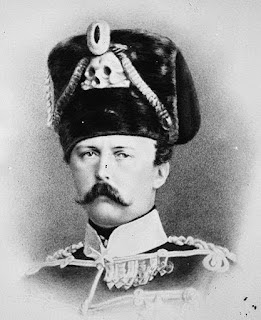
MMBattlefield Royal: Prince Friedrich Karl of Prussia

A look at a member of my least favourite European royal house, tho' they're in a tight race with the House of Orleans.

From The Mad Monarchist (1 February 2013)


A major military figure in the conflicts which brought about the unification of Germany was the Prussian Prince Friedrich Karl, the nephew of Kaiser Wilhelm I and grandson of Prussian King Friedrich Wilhelm III. He was born on March 20, 1828 in Berlin, the son of Prince Karl of Prussia and Princess Marie von Saxe-Weimar-Eisenach. His father was the younger son of King Friedrich Wilhelm III and the formidable Queen Luise von Mecklenburg-Strelitz. As his father had served as a general in the Prussian army, it was not surprising that Prince Friedrich Karl was groomed from early in life for a military career. It was his good fortune that his life coincided with the appearance of some of the most brilliant military minds in the illustrious martial history of Prussia. From 1842 to 1846, for example, his tutor was Major Albrecht Graf von Roon who would later rise to the position of Minister of War and become one of the preeminent military figures responsible for the unification of Germany under Prussian leadership. Once his term as tutor was up, the count followed Prince Friedrich Karl to the University of Bonn in 1846 as his military escort. He joined the “Corps Borussia Bonn” fraternity, which would include numerous Prussian royals as members, and in 1847 was decorated for saving the life of a child from drowning in the Rhine River.

Prince Friedrich Karl finished school in 1848 and served with the rank of captain in the Schleswig-Holstein war under General Friedrich Graf von Wrangel and he distinguished himself for his skill and dauntless courage under fire. The following year he served on the General Staff, with a promotion to major, during the campaign in Baden and was badly wounded leading the Prussian hussars in a bold charge at the battle of Wiesenthal. He recovered and earned further promotion in the peacetime army, rising to colonel in 1852, major general in 1854 and lieutenant general in 1856 as he devoted himself to studying military theory and shared his ideas with a select circle of Prussian army officers through a series of lectures and essays and in 1860 this group published a book on their proposed military reforms based largely on the ideas out forward by Prince Friedrich Karl. That same year he was posted to command the Prussian III Army Corps and the Prince was able to use this position to showcase his ideas and put them into practice.

In 1864, when Prussia went to war with Denmark, Prince Friedrich Karl (promoted to General of Cavalry) and commanded the Prussian contingent of the joint Austrian-Prussian expeditionary force. There was though some friction as the Prince clashed with chief of staff General Leonhard von Blumenthal who would be credited with winning the war and become a field marshal. Prince Friedrich Karl suffered some setbacks but himself went on to win some key victories in the Jutland campaign as commander of the allied forces after the resignation of General Wrangel. Prussian King Wilhlem I rewarded him for his exceptional service during the conflict and he cemented his status as one of the leading military figures in Prussia. In 1866 the Prince was appointed to the prestigious command of the First Army which he led in the war against Austria. Taking the field against the Austrians and Saxons in Bohemia, Prince Friedrich Karl greatly distinguished himself throughout the short conflict, particularly at the decisive battle of Koniggratz in which he and his outnumbered troops held their ground against determined Austrian attacks until Crown Prince Friedrich and his forces arrived to save the day and claim the final victory, ensuring an Austrian defeat.

The next major test came with the Franco-Prussian War in which Prince Friedrich Karl was given command of the Second Army. His forces, including the Prussian Guard, made up the right wing of the German forces and advanced from the Rhine toward Saarbruecken. However, an unauthorized move by another general brought about an unexpected battle at Spicheren which found Prince Friedrich Karl cut off from his advance units. However, the Prince kept his head and despite heavier losses from the French, still won the battle. He played a key role with a bold move at the battle of Mars-La-Tour where the Prussians again suffered higher casualties than the French but still won the day. There were similar heavy losses at the battle of Gravelotte but Prince Friedrich Karl again played a crucial part in saving a faltering section of the army and gaining a Prussian victory.

The Prince participated in the pivotal siege of Metz, another Prussian victory, and while the combined German forces advanced on Paris, Prince Friedrich Karl was sent to the Loire valley to secure Orleans and prevent other French forces from coming to the aid of Paris. He carried out these duties with his usual determination, winning more battles at Orleans and Le Mans. Because of his meritorious service, King Wilhelm I, after 1871 Kaiser Wilhelm I of course, promoted the Prince to Field Marshal and awarded him the (extremely rare) Grand Iron Cross. With the war over and the German Empire created, Prince Friedrich Karl was tasked to put his military expertise to work as Inspector-General of the army, which also enabled him to spend more time with his wife (daughter of the Duke of Anhalt) and five children. Other countries also recognized his accomplishments; Tsar Alexander II gave him the rank of Field Marshal in the Imperial Russian Army and in 1878 Queen Victoria of Great Britain made him an honorary Knight Grand Cross of the Order of the Bath. He traveled around the world for a time, however, the life of Prince Friedrich Karl was cut somewhat short when he died, at the age of 57, in Potsdam on June 15, 1885 one of the most honored military figures of the campaigns for German unification.

Bishop Challoner's Meditations - July 31st

ON THE FIRE OF HELL

Consider first, that in hell every vice shall meet with its peculiar torment. There the proud shall be debased and confounded, and trodden under foot by insulting devils. There the covetous, and the lovers of the mammon of this world shall groan under the extremity of want and misery. There the lascivious shall exchange their dark and filthy pleasures for fetid sulphur and black flames. There gluttons and drunkards shall be oppressed with an insupportable hunger and thirst, and so of the rest. But the general punishment of all the damned, and that which is most frequently inculcated in holy writ, is that they shall burn in everlasting fire. O who can endure the thought of this eternal burning in that dreadful pool of fire and brimstone? Christians, what are you doing? Do you believe this eternal fire; and do you dare to sin? If you believe it not, you are not Christians; and if you believe it, and still persist in going on in such sins as you know are the high road to this everlasting burning, you must be worse than madmen.

Consider 2ndly, that of all bodily torments which we can suffer in this world there is none more terrible than to burn alive. But alas! there is no comparison between burning here and burning in hell. All our fires upon earth are but painted flames if compared to the fire of hell. The fire of this world was made to serve us and to be our comfort; that of hell to be an instrument of God’s vengeance upon sinners. The fire of this world cannot subsist without being nourished by some combustible matter, which it quickly dispatches and consumes; the fire of hell, kindled by the breath of an angry God, requires no other fuel than sin, and on this it feeds without ever decaying or consuming. The fire of this world can only reach the body, but the fire of hell not only pierces the body through and through in all its members, and penetrates into all the inward parts with most exquisite tortures, but also reaches the soul herself in her very inmost recesses with its searching flames. Ah! who could endure such a fire as this even for one moment? How much less for an endless eternity? 

Consider 3rdly, that there is no man upon earth that has not quite lost his senses who would be willing, even for the empire of the world, to be broiled like Laurence on a gridiron, or roasted for half an hour by a slow fire, though he was sure to come off with his life. Nay, where is the man that would even venture to hold his finger in the flame of a candle for a quarter of an hour for any reward this world can give? Where is then the judgment of the greater part of Christians who pretend to believe hell-fire and yet live on with so little apprehension and concern, and that oftentimes for years together, in guilt of mortal sin, in danger every moment of falling into this dreadful and everlasting fire: having no more all this while than a hair’s-breath – that is, the thin thread of an uncertain life between their souls and a miserable eternity? Good God, deliver us from this wretched blindness, from this desperate folly and madness.

Conclude never to expose thyself to the danger of this everlasting fire by mortal sin, nor to endure any such guilt, though it were even for one moment, lest in that very moment God should break the thread of thy life and let thee drop into that fire that will never be quenched. O what mercy it is of thy God that it has not been thy case long ago!

31 July, Antonio, Cardinal Bacci: Meditations For Each Day


Little Things

1. Very few people are destined to great things by Almighty God. Most of us must offer ourselves in the relatively unimportant walks of life in which we have been placed by Providence. Only some of the Saints were endowed with exceptional virtues and miraculous powers which attracted the attention and admiration of the world. In the normal course of events Christian perfection must be acquired little by little through the practice of ordinary virtues and unspectacular good actions. There is always scope for these. An upsurge of anger can be suppressed from the motive of the love of God and of our neighbour. We can behave courteously towards people who are unsympathetic towards us or who offend us by their unmannerly conduct. We can combat pride by acts of humility and egoism by acts of charity. We can mortify ourselves in speech, in behaviour, and at table, and we can give alms to the poor, good advice to the ignorant, and comfort to the afflicted.

All these virtuous actions are insignificant in the eyes of men, but they are great in the sight of God. The blades of grass and the flowers in the meadow are tiny things, but joined together they constitute the pasture which provides nourishment for the herds and flocks. Let us perform these small actions every day and so cultivate the ordinary virtues. We shall attract the attention and favour of God, Who will help us to advance step by step towards the peak of Christian perfection.

2. Just as there are very ordinary acts of virtue, so there are very ordinary sins. But it would be rash to regard acts of deception, vanity and impatience as insignificant. Every deliberate sin is an offence against God, our highest good and our Redeemer.

How can God be indifferent to these ungrateful violations of His law? After all, even as He has assured us that a cup of cold water given in His name to a thirsty man will have its reward (Cf. Mt. 10:42), so He has assured us that not even the slightest trace of sin can enter into eternal glory. We shall not be condemned to Hell for venial sins alone, but we shall suffer a decline in grace and shall be obliged to expiate our sins either in this life or in Purgatory.

3. Our eternal salvation will probably be determined by these ordinary acts of virtue and these ordinary sins. Jesus compared the kingdom of Heaven to a mustard-seed which grows into a tree. Similarly, many Saints began their spiritual ascent by following up one simple inspiration, and many souls, perhaps, have found themselves condemned as a result of having neglected the commonplace virtues and inspirations.

Ordinary virtue may develop into heroic virtue, but if a man has neglected to train himself to act well in small matters, how will he behave in a time of great spiritual trial? Experience also teaches us that smaller vices can develop into great vices. “He who wastes the little he has will be stripped bare.” (Ecclus. 19:1) A man who is not faithful to God in little things will not be faithful in greater things. We are either going up or down in the way of perfection; it is almost impossible to stand still. If we sincerely wish to make progress, let us resolve to avoid the least suggestion of sin and to enrich ourselves daily by tiny acts of virtue.

Eastern Rite - Feasts of 31 July AM 7530

Today is the Fore-feast of the Procession of the Precious and Life-Giving Cross of the Lord and the Feast of the Holy and Just Eudocimus.
✠✠✠✠✠

The origin of this Feast is explained in the Greek Horologion of 1897: “Because of the illnesses which occur during the month of August, it was customary at Constantinople to carry the Precious Wood of the Cross in procession throughout the city for its sanctification, and to deliver it from sickness.”

On the eve (July 31), the Cross was removed from the imperial treasury and placed it upon the Holy Table of the Great Church of Hagia Sophia (which is dedicated to Christ, the Wisdom of God). From August 1 until the Dormition of the Most Holy Theotokos, there was a procession throughout the entire City, and then the Cross was placed where all the people could venerate it.

In the Russian Church, this Feast is combined with the remembrance of the Baptism of Rus' on August 1, 988. 

Knowledge of the day of the actual Baptism of Rus' is preserved in the Chronicles of the XVI century: “The Baptism of the Great Prince Volodymyr of Kyiv and of all Rus' took place on August 1.”

In the current practice of the Russian Church, the service of the Lesser Sanctification of Water on August 1 takes place either before or after Liturgy. Because of the Blessing of Water, this first Feast of the Savior in August is sometimes called “the Savior of the Water.” Along with the Blessing of Water, there may also be a Blessing of Honey (thus it is also called “the Savior of the Honey),” because, on this day, the newly-gathered honey is blessed and tasted.

Troparion — Tone 1

O Lord, save Your people, / and bless Your inheritance! / Grant victories to Right-Believing Christians / over their adversaries. / And by virtue of the Cross, / preserve Your habitation!

Kontakion — Tone 4

As You were voluntarily crucified for our sake, / grant mercy to those who are called by Your name; / make all Catholic Christians glad by Your power, / granting them victories over their adversaries, / by bestowing on them the invincible trophy, Your weapon of peace!
✠✠✠✠✠

Saint Eudocimus, a native of Cappadocia (Asia Minor), lived during the ninth century during the reign of Emperor Theophilus (829-842). He was the son of the pious Christians Basil and Eudokia, an illustrious family known to the emperor. They raised their son “in discipline and admonition of the Lord” (Eph. 6: 4), planting in his soul a sincere faith and holy virtues.

The righteous life of Saint Eudocimus was devoted to pleasing God and serving his neighbour. Having given a vow to remain unmarried and chaste, he avoided conversation with women and did not look at them. He would speak only with his own mother, whom he greatly respected. The emperor valued his virtue and talents, so he appointed Saint Eudocimus as governor of Chorziane, Armenia. Fulfilling his duty as a servant of God, Saint Eudocimus governed the people justly and with kindness. He concerned himself with the unfortunate, and with orphans and widows, and he was a defender of the common people. His personal Christian exploits which he did in secret, were known only to God.

Eudocimus pleased God by his blameless life, and the Lord called him at age 33. Lying on his deathbed, Saint Eudocimus gave final instructions to place him in the grave in those clothes in which he would meet death. Then he sent everyone out of the room and entreated the Lord that no one would see his end, just as no one saw his secret efforts during life. His attendants buried him as he had instructed them. Right after the death of Saint Eudocimus miracles took place at his grave. Many sick people were healed, and the news of the miraculous healings spread.

After 18 months, the mother of Saint Eudocimus came from Constantinople to venerate his relics. She gave orders to remove the stone, dig up the ground, and open the grave. Everyone beheld the face of the saint, bright as if alive, altogether untouched by decay. A great fragrance came from him. They took up the coffin with the relics from the earth, and they dressed the saint in new clothes. His mother wanted to take the relics of her son to Constantinople, but the Kharsian people would not clear a path for their holy one. After a certain time the hieromonk Joseph, having lived and served at the grave of the saint, transported the relics of Saint Eudocimus to Constantinople. There they were placed in a silver reliquary in the church of the Most Holy Theotokos, built by the parents of the saint.

Saint Eudocimus is considered by the Russian Church to be one of the special protectors and intercessors before God of the family hearth. He was, as his name implies, truly successful in every virtue.

Troparion — Tone 4

He who called you from earth to heaven, / keeps your body unharmed after death, holy Eudocimus; / for you lived a sober and holy life / and did not defile your flesh; / so with boldness intercede with Christ that we may be saved.

Kontakion — Tone 3

Today your honoured memory has assembled us at the holy shrine of your sacred relics; / all then who approach and venerate them / are rescued from the evil malice of demons / and are swiftly delivered from various diseases, blessed Eudocimus.

IN LUMINE FIDEI: 31 JULY – SAINT IGNATIUS (Confessor)


IN LUMINE FIDEI: 31 JULY – SAINT IGNATIUS (Confessor): Saint Ignatius of Loyola, the founder of the Jesuit Order, was born Inigo Lopez de Bicalde in 1491, Loyola being the name of his family and t...

IN LUMINE FIDEI: 31 JULY – EIGHTH SUNDAY AFTER PENTECOST


IN LUMINE FIDEI: 31 JULY – EIGHTH SUNDAY AFTER PENTECOST: Dom Prosper GuĂ©ranger: In the Middle Ages, this Sunday was called the sixth and last Sunday after the Natalis of the Apostles, that is, ...

31 July, The Chesterton Calendar

JULY 31st

The party system in England is an enormous and most efficient machine for preventing political conflicts.

'George Bernard Shaw.'


31 July, The Holy Rule of St Benedict, Patriarch of Western Monasticism


CHAPTER XLIX. Of the Observance of Lent

31 Mar. 31 July. 30 Nov.

Although the life of a monk ought at all times to have about it a Lenten character, yet since few have strength enough for this, we exhort all, at least during the days of Lent, to keep themselves in all purity of life, and to wash away, during that holy season, the negligences of other times. This we shall worthily do, if we refrain from all sin, and give ourselves to prayer with tears, to holy reading, compunction of heart and abstinence. In these days, then, let us add some thing to our wonted service; as private prayers, and abstinence from food and drink, so that every one of his own will may offer to God, with joy of the Holy Spirit, something beyond the measure appointed him: withholding from his body somewhat of his food, drink and sleep, refraining from talking and mirth, and awaiting Holy Easter with the joy of spiritual longing. Let each one, however, make known to his Abbot what he offereth, and let it be done with his blessing and permission: because what is done without leave of the spiritual father shall be imputed to presumption and vain-glory, and merit no reward. Everything, therefore, is to be done with the approval of the Abbot.

1 August, The Roman Martyrology


KalĂ©ndis AugĂºsti Luna tĂ©rtia Anno DĂ³mini 2022

August 1st 2022, the 3rd day of the Moon,

Commemorated the dedication of the Church of St. Peter-in-Chains, upon the Esquiline Mount at Rome.
Upon the same day, were born into the better life:
At Antioch, the seven holy Maccabee brethren and their mother, who suffered under King Antiochus Epiphanes. Their relics have been brought to Rome and buried in the aforesaid Church of St. Peter-in-Chains.
At Rome, [in the year 137,] the holy Virgins, Faith, Hope, and Charity, [daughters of St. Sophia, who is named under September 30,] who gained the crown of martyrdom under the Emperor Hadrian.
Likewise at Rome, upon the Latin Way, [in the third century,] the holy martyrs Bonus the Priest, Faustus, and Maurus, and nine others, of whom it is written in the Acts of holy Pope Stephen.
At Philadelphia, in Arabia, the holy martyrs Cyril, Aquila, Peter, Domitian, Rufus, and Menander, who were all crowned upon one and the same day.
At Perge, in Pamphylia, [in the fourth century,] the holy martyrs Leontius, Attius, Alexander, and six other husbandmen, who were beheaded under the President Flavian in the persecution under the Emperor Diocletian.
At Gerona, in Spain, [in the year 304,] the holy martyr Felix, who after torments of diverse kinds was ordered by the Emperor Dacian to be mangled until he gave up his unconquered spirit to Christ.
At Vercelli, [in the year 370,] the holy martyr Eusebius, Bishop of that city, who was banished by the Emperor Constantius, first to Bethshan and then into Cappadocia, on account of his confession of the Catholic faith, but at length returned unto his own Church. He suffered [a living] martyrdom under the persecution of the Arians. His memory is chiefly kept upon the 15th day of December, which is that of his ordination as Bishop.
At Paris, [in the year 287,] the holy martyr Justinus.
At Vienne, [in the year 136,] holy Verus, [fifth] Bishop [of that see.]
At Winchester, in England, [in the year 984,] holy Ethelwold, Bishop [of Winchester, and Confessor.]
In the district of Lisieux, [in the department of Calvados, France,] the holy Confessor Nemesius.
V. And elsewhere many other holy martyrs, confessors, and holy virgins.
R. Thanks be to God.

Memes of the Day


30 July 2022

The Moral Virtues

Lesson Four of Virtue, with Fr Aquinas Guilbeau, OP, MDiv, STL, STD, Assistant Professor of Moral Theology, Pontifical Faculty of the Immaculate Conception, and Prior of the Priory of the Immaculate Conception.


Like his ancient and patristic forebears, St. Thomas showcases the cardinal virtues as the building blocks of human flourishing and happiness. Prudence, justice, fortitude, and temperance, as habits of intellect, will, and passion, perfect man’s external actions and internal movements, which according to St. Thomas render not only his pursuits but also his person good.

New St Gallen Group Meets As Francis Unleashes Loyalty Oath

Signs that Francis' allies are getting ready to choose the next pope emerge, and Francis has a new loyalty oath that few have noticed.

A Spiritual Manual of Christian Militancy

This looks as if it should be read alongside St François de Sales's An Introduction to the Devout Life and Dom J.B. Chautard's Soul of the Apostolate.

From One Peter Five

By Prof. Roberto de Mattei

A concise and profound manual of spiritual life, without rhetoric and without compromise: an antidote to modern, nebulous and sentimental pseudo-spirituality. This is Lived Christianity, the magnificent text by Dom François de Sales Pollien, just published by Calx Mariae Publishing in the first English edition (London: 2022).

Joseph Pollien was born on 1 August 1853 in Chèvenoz, near Annecy, Haute-Savoie (France), into a deeply Christian family. He was ordained in 1877 and on 4 October 1884 entered the Grande Chartreuse in Grenoble as a postulant, where he pronounced his first vows on 1 November 1885, taking the name of Francis of Sales (1567-1622), in devotion to the great Savoyard saint. He was coadjutor (i.e., guest master and spiritual adviser) in several charterhouses, became prior at Mougères in 1901, and at PleterjĂ© (now in Slovenia) in 1911.

In 1914, at the outbreak of the First World War (1914-1918) he was transferred to the Carthusian Monastery of Serra San Bruno, in Calabria (south of Italy), where he remained until his death on 12 February 1936. Brother Benoît du Moustier (1898-1974), who had known him at Serra San Bruno, provides a telling description of the personality and contemplative soul of the Carthusian writer:

In the last years of his life Fr Pollien no longer had a voice to take part in singing the Divine Offices of his Order. But when the Creed was intoned in the Conventual Mass, the tall old man would shake himself, stand upright and, with his eyes dulled as if fixed on beauties invisible to other mortals, ecstatically sing with what remained of his voice, his Creed, for him the evocative summary of those mysteries that he had, during his long life, with so much diligence and love, studied, meditated upon and contemplated.

The Scriptures and SS. Augustine, Thomas Aquinas, and Francis of Sales, but also the masters of the counter-revolutionary school, such as Count Joseph de Maistre (1753-1821) were his favorite reading material. He was the author of many works, including La Vie intĂ©rieure simplifyĂ©e [he preferred unifiĂ©e ] et ramenĂ©e Ă  son fondement, edited in 1894 by Joseph Tissot (1840-1894). This was a spiritual classic that contributed greatly to the renewal of ascetical and mystical doctrine in the first quarter of the 20th century.

In Lived Christianity, Dom Pollien offers a programme of life for those who want to be serious and militant Christians:

There can be no half measures, no mediocre men, no half Christians: it is all or nothing. We deal in certainties, rigorous conclusions, cause and consequence, and we accept everything without batting an eyelid, proceeding with the coolness of reason and with the ardour of the Faith. No calculating interests! Vile pretexts and fearful distinctions are banned. Principles, absolute principles! Integral Christianity in the absolute fullness of its truth (p. 12).

In the life of men and in the life of societies, everything must always be traced back to principles.

Christian society must be rebuilt; and, to rebuild it, the first thing which is required is to straighten out one’s ideas. As long as we do not have upright ideas, we will walk wrongly, because man walks according to his ideas. It is the idea that makes the man.

According to Pollien, there are no more men today because there are no more ideas, there are only words.

Do you want to be a man? Get away from words, and have ideas, that is, profound visions of things. And in order to have profound visions of things, it is necessary to see them as they are, and as God made them, and as they are guided by God (p. 58).

The appeal is recurrent in its pages: “I beg you, be a man of principles; it is the only way to be someone and to do something” (p. 92). “Only principles make men — and things — nothing is done without principles”(p. 185). “Firmness in principles, gentleness in means: this is the seal of truth. Principles, absolute principles! Integral Christianity in the absolute fullness of its truth” (p. 185).

The man of principles is a simple man, who does not lose himself in details, because he knows the priority of things, the difference between the end and the means. His prayer and meditation are not complicated verbal mechanisms, because prayer, in its essence, is not a formulary, it is a movement of the soul and not a movement of the lips.

In essence, prayer — the spirit of prayer — is the impulse towards and return to God, it is receiving God and life with God. And it is in this sense that Our Lord said that prayer must always continue and never cease (Lk 18:1). Insofar as you understand me, you must strive to become a reflective and praying man who routinely combines reflection with prayer throughout the day. And you must come to do so in a movement of simple, easy, practical life, equally devoid of naturalism and sentimentality, equally far from exaggeration and dissipation (p. 172).

At the heart of Dom Pollien’s spirituality is a continuous examination of conscience, made from a simple look in the heart.

To better understand the simplicity of this spiritual operation, which is needed to ensure a good course for your life, remember that your purpose is essentially one: to glorify God; that your journey is essentially one: to follow the will of God; that the multiple dispositions and movements of your soul must be dominated by grace, and that the main formative disposition of your piety is docility to God. What, therefore, must the glance assure you of? Of the existence of this dominant disposition in you, which commands everything (p. 179).

Dom Pollien wants to form Soldiers of God, active and contemplative, who fight on earth to conquer Heaven.

God and the Church ask for defenders, but true defenders; those who will never take a step back; those who know how to be faithful until death; those who are trained in all the severities of discipline, to be ready for all the heroic struggle (p. 192).

Tonight, at an evening dedicated to the ‘battle of ideas,’ an English edition of Lived Christianity by Dom François de Sales Pollien will be presented by Calx Marie Publishing at the Brompton Oratory in London. See details here.

Liberalism is a Sin - Chapter 14 Liberalism and Freethought

In our day the Catholic world, with as much justice as reason, attributes impiety to the quality of freethought, whether in a person, a journal or an institution. Freethinker is an odious epithet which few are willing to accept, but which many justly bear in spite of their protestations. They chafe under the appellation of the word, but find no inconvenience in being all that it implies. Persons, societies, books, governments which reject, in matters of faith and morals, the only and exclusive criterion of the Catholic Church are Liberals. They acknowledge themselves to be Liberals, they feel honored to be so recognized, and never dream of scandalizing anybody except us terrible irreconcilables.

Now change the expression; instead of Liberals call them freethinkers they resent the epithet as a calumny and grow indignant at the insult, as they term it. But why this excruciating tenderness, this delicate sensitiveness over the variations of a simple term? Have you not, dear friends, banished from your conscience, your books, your journal and your society all recognition of the supreme authority of the Church? Have you not raised up as sole and fundamental criterion of your conduct and your thought your own untrammeled reason?

Very properly then do you say that you are Liberal and no one will dispute the title with you. But you should remember that (77) the very principle, which makes you Liberal, constitutes you freethinkers. Every Liberal, no matter of what degree or shade, is ipso facto a freethinker, and every freethinker, as odious as the title may seem according to social conventionalities, is only a logical Liberal. He is simply a Liberal following his premises to their conclusions. This doctrine is as precise and as exact as a mathematical proposition. It is based on the laws of the strictest logic. It is a simple syllogism, whose premise is Liberalism and whose conclusion freethought.

Let us illustrate. You are a Catholic more or less open to false allurements and as a punishment for your sins, you belong to a Liberal society, say, of a literary character. Consider a moment and ask yourself the following question: Would I continue to belong to this Athenaeum, if tomorrow it should proclaim itself publicly and boldly a society of free thought? What response would your conscience and your shame dictate? Would you not at once withdraw from its membership? As a Catholic you could take no part in its proceedings.

Again; you subscribe for a journal, read it without scruple, although it bears a Liberal title and speaks and reasons accordingly. Would you continue your subscription (78) if all of a sudden it should place upon its title page the following heading: Journal of Free Thought. Well, this moderate or violent Liberal journal has been for years nothing more nor less than a free thinker, and you have been imbibing its poison under the delusion of a word.

Ah! Of how many prejudices would we rid ourselves if we only reflected a little on the meaning of words! Every society, whether scientific, literary or philanthropic, constituted on Liberal lines, is freethinking. Every government Liberally organized is freethinking. To reject with disgust the name and not the substance is blindness. Any institution, no matter what be its character, established in complete independence of the magisterium of the Faith, is freethinking. Catholics cannot consistently belong to them. Membership there means rebellion against the Church.

In all such institutions Liberalism reigns and, in consequence, freethought. No Catholic can remain a Catholic and affiliate with them. We are Catholics all in all or not at all. We cannot dwell in an atmosphere where God is not. There is no true spiritual life where Jesus Christ is not, and He has given His promise to be with His Church forever. Who abides not in Him, lives in the outer darkness. (79)

How much do perverse Catholics serve the Devil by obstinately clinging to such associations and participating in their works! In the folly of their ignorance, which they assert against the wisdom of the Church, they harden their consciences to the practical guidance of the Holy See and blindly enlist in the service of an enemy whose cunning deludes them into the slavery of Hell under the disguise of freedom! They forget that the truth alone makes them free. To know and serve God is the only freedom, and Liberalism completely severs the bond which links man to God. With a just and rational horror does a good Catholic regard Liberalism. Ultramontanism will never cause you to loose your soul; Liberalism is a broad road to the infernal abyss.

The Tail That Wags the Dog

One Mad Mom takes a look at the German attempt to copy the heresiarch Luther and split the Church in Germany a second time.

From One Mad Mom

Awww…Isn’t this sweet? James Martin, Essjay’s new baby just posted a nice “!@#$%^ you” to the Holy Father. Remember when Luther wanted some readjustments? Yeah, it’s like that.

German synod should propose “clear readjustment” of church teaching on homosexuality

Marc Frings / July 17, 2022

“Everything was already said in WĂ¼rzburg!”

And as you will see, they go on to explain that it wasn’t. The excuse for that? Oh, it wasn’t on the radar back then. (That might be because it’s a total affront to God’s creation of man and woman, but whatever.)

We Germans, who have been on the Synodal Path since the end of 2019, often hear this reminder. In fact, at the joint synod of the German dioceses convened in WĂ¼rzburg, Bavaria, between 1971 and 1975, 18 resolutions were passed on many different sets of topics. Some demands were implemented, while others were delegated to Rome and remain unanswered to this day.

There might be a reason for that. While some things are definitely wonky in Rome, the gates of hell and all…

But, if you look up the themes and the reform concerns of the Synodal Path in the documentation of the WĂ¼rzburg Synod, it is noticeable that by no means “everything” has already been said (and decided).

They nicely leave out that Rome intervened to condemn their resolutions, they wanted to ignore Rome and +Ratzinger, and those with sanity walked out.

An equivalent to the current synod’s working text entitled “Official Reassessment of Homosexuality” cannot be found in the WĂ¼rzburg text, because the noun “homosexuality” did not appear even once in the almost 800 pages. One can conclude from the WĂ¼rzburg appendix that, in the preliminary phase of settling on a topic within the general theme of “marriage and family,” questions about “sexuality before and outside of marriage and homosexuality” were discussed, but apparently they did not find their way into the final deliberations of the synod.

Uh, maybe because it was one insanity too far?

The following anthropological presuppositions were postulated at the time: “It is good that you exist … In the sexual encounter, love in a partnership acquires its own bodily-sensual expression. The joy in a spouse, the will to be there for one another and to be loyal to one another, can be experienced in sexual encounters.” On the importance of sexuality in marriage and family, the synod said: “Sexuality is one of the forces that determine human existence.”

Could they give a darn link to anything? Nope. They’re just going to put out drivel and hope you accept it. If  you want to know what the heretics think, this article gives you a pretty good view: https://www.ncregister.com/blog/influential-german-lay-catholic-reveals-radical-goals-methods-of-synodal-way 

They long to be the tail that wags the dog. They want what they want and hang truth and beauty.

This reticence—not only among Catholics, but within 1970s German society in general—has given way to a style of discussion that takes the WĂ¼rzburg considerations one step further. At least that’s how I understand the Synodal Path. This is a conscious statement against the current Catholic catechism, which has been critical and disparaging of homosexuality since the mid-1970s and still reproaches homosexual activity as sin.

Stating a truth is not disparaging. Homosexual activity IS a sin. It’s truth. The Germans want to see all sin accepted (or at least the sins they like). At least he admits that it’s the activity and not the attraction that is a sin, unlike Fr. Martin, who is still trying to walk the line and obfuscate. At least the Germans are “Here it is, deal with it!” They’re kind of as twisted as Hitler. Godwin’s Law works sometimes, especially when people are trying to disfigure truth.

Meanwhile, the magisterium has recognized that homosexuality is an orientation—not something chosen.

Oh, let’s pause at this obfuscation. The Church very carefully makes a distinction in “deep-seated.”

2358The number of men and women who have deep-seated homosexual tendencies is not negligible. This inclination, which is objectively disordered, constitutes for most of them a trial. They must be accepted with respect, compassion, and sensitivity. Every sign of unjust discrimination in their regard should be avoided. These persons are called to fulfill God’s will in their lives and, if they are Christians, to unite to the sacrifice of the Lord’s Cross the difficulties they may encounter from their condition. 

More on that later.

Catholics are increasingly being pushed into cognitive dissonance if they seriously try to reconcile official church positions on homosexuality with their own real lives. For children and young people today, it is completely normal to be confronted with queer identities among fellow students, teachers and friends.

Yes, it definitely is. I was just talking with a priest friend of mine about how tragic it is for the youth of today live under the normalizing of this. While there are some with deep-seated tendencies, most are just trying to fit into the “Lord of the Flies” land where you are canceled if you disagree. They have literally become slaves and have talked themselves into all sorts of things, not realizing that the Church’s teachings offer them true freedom. Back when I was a teen, all these things were unthinkable, and we lived a far simpler, less confusing and, quite honestly, less angry life. Now they have to get in line and participate when, in reality, they long for the right order. And now Germany wants to participate in the chaos for the sake of money. They think it’ll bring people (and more importantly to them, money) back to their cabal. Why would the youth of today do that when they can keep their money and sleep in on Sunday? Why? This is the folly of the old 70’s club.

So, it is only logical that the “basic text” of the responsible synodal forum (i.e., the text that forms the theological framework around the more practical texts on questions of sexuality and partnership), demands a clear readjustment. Here is an example from the “basic text” that was discussed: “The recognition of the equality and legitimacy of non-heterosexual orientations, their practices and relationships, as well as the elimination of discrimination based on sexual orientation, is urgently required.”

Oh, there’s zero logic there. ZERO. Less than zero. One thing that does make sense is that a Fr. Martin-friendly organization would totally and utterly put forth this garbage.

From the perspective of society as a whole, “long overdue” would also be an appropriate formulation. Gay and straight relationships strive for the same values ​​and face the same challenges: fidelity and permanence on the one hand, and alienation and declining desire on the other. All couples experience success and failure, and regardless of their sexual orientation, the church should always stand by their side to support them and convey a message of welcome.

Umm, no. Those who accept the current teachings of the Church are striving to serve God. Those who reject them are trying to serve themselves. Those are starkly different values. One wants to bend their will around God and the other wants to bend God around their will. It’s cruel to the latter. People can go on to say “It’s mean, mean, mean,” but the Church has always had the goal of bringing people to heaven and helping them overcome their sins – me included. The Germans now want us to make people cozy with their pet sins. They could be encouraging us to reach out to each other and struggle together in whatever our sin is but, instead, they encourage people to enter into relationships that are contrary to God’s design.
 
Yes, we should welcome all, but we should not give a pass to anyone’s sin. That is cruel, and society shows us this creates utter chaos. First it was gay activity. Then it was lesbian activity. Then it was anything stinking goes, now including the push for everyone to accept pedophilia and people magically becoming the opposite sex. And, by the way, can we say that Fr. Martin tacitly approves by printing such articles? Yes. We. Can. He’s been in obfuscation mode for years and he’s still letting others do his dirty work, but this is a site he approves of. He can’t continue to hide behind “Well, I’m just posting one man’s opinions.” because when you repeatedly do so without correction, you can’t hide anymore.

The church must claim to be a home for all people.

When has it not? It’s not, however, a home where people get to punch holes in the walls and knock down the support beams. It’s a home to bring people to God and His Truth. Anything short of that is failing all faithful no matter the sin in which they desire to partake. You are the one who is divisive of the faithful.

Discrimination and homophobia can have no place where people want to feel safe. Queer Christians do not want to be treated like this, and heterosexual Christians do not feel represented by a church that presents itself in this way.

This is his error on full display. This isn’t a queer/heterosexual issue. This is a faithful/not faithful issue. Feeling “safe” is not something this Church obliged to present. This is a Church of martyrs. The only thing we can feel safe about is that if we don’t die in mortal sin, we shall see the face of God. The Church does not exist to make me feel represented nor anyone else. Your narcissistic tendencies are on full display.

Such a change in the position of the magisterium cannot take place in a local church, but it can give it an important impetus. For this reason, the synodal assembly in September will discuss a text that recommends that the pope examine more precisely and reassess church doctrine on homosexuality.

Because, gee, he’s never heard that before from anyone inside or outside the Church. “You must give us change Church teaching to how we want it!” has been the rally cry of the lost since the Church began.

Every human being was created by God with his sexuality and … this created being has an inviolable dignity. Sexual orientation is an inseparable part of every human person.

The heresy of Gnostic Dualism on high here. Let me help you. Our bodies are a reflection of our souls. They aren’t a mistake. They aren’t confused. As created by God they are a perfect reflection of each other. Where the water gets muddied is when sin enters in and satan confuses. Congratulations. You fell for it. Don’t feel bad, both Fr. Martin https://onemadmom.foedus.co/heresy-of-the-day-dualism/ and Cardinal Marx are totally into it too. https://onemadmom.foedus.co/cardinal-whats-it-with-you-and-sin-marx/


“It is not self-chosen and it cannot be changed,” says the proposed text. It could be argued that this makes up for what has long since found its way into the Old Testament with the 2016 common translation of the Bible.

PROVE. IT. Or at least you have to prove it to those who came out of the lifestyle and who have testified to the fact that they were just following the crowd. Again, there’s a difference between deep-seated and transient. The “You must be gay forever” crowd really needs to stop. Again, stop trying to imprison people into something when they don’t have to be. The “freedom” you are providing is tantamount to slavery.

It is no longer written “man and wife he created them,” but rather “male and female he created them” (Gen 1:27). As a matter of creation theology, this marks the fact that sexual identity is more complex than a purely biological understanding.

There’s sexual identity (what God gave you) and sexual confusion. There’s really no complexity other than the one you create.

#OutInChurch

While the Synodal Path, according to its self-understanding, deals with the systemic causes of sexual abuse and its cover-ups, countering them with concrete demands for reform, other initiatives have additionally energized the discourse in the German local church. Especially conspicuous is the #OutInChurch campaign, which was launched in January 2022 by 125 queer Catholics who themselves were (or are) in the service of the church.

Remember when people were just Catholic?

By means of personal testimonials and a television documentary, they drew attention to their concerns. Their demands include self-evident matters: “As LGBTIQ+ people we want to be able to live and work openly in the church without fear.” They denounce discrimination in certain professions and in the church, defamatory teaching on sex, the lack of blessing for queer people and couples and the denial of sacraments. And they call on the church to face its own responsibility and guilt.

The big question is, “Why would you have any fear if you are publicly embracing the teachings of the Church?” Uh, maybe because they have no intention of that? Thank goodness they’re finally admitting it. I’d love it if the Church would just declare any sin I commit peachy. Who wouldn’t? Sadly, it would be to the peril of my mortal soul. That is THE BIGGER PICTURE the Germans tend to overlook because, and I’m guessing here, they don’t believe in the immortal soul. Never mind all those miracles that attest otherwise. We’re done here so do whatever. The Church very much has a responsibility to lead souls to everlasting life with God in heaven and the only guilt it should feel is when it fails to do so, as 99% of the German Church. You’ve been espousing this crud for decades, Germany. For all your winks and nods, people are leaving your Church in droves. You are in free fall but, yeah, let’s continue down that path.

“All couples experience success and failure, and regardless of their sexual orientation, the church should always stand by their side to support them and convey a message of welcome.”

Translation? All people sin so we should just give them a cookie and a smile and send them on their way.

The reaction was immense. In the first half of the year, the documentary, which is available online, received the most clicks of all programs in the ARD media library, and the media reported intensively on a national and regional level. German public conversation quickly focused on the most practical of the demands: a revision of church labor law and an abolition of the duties of loyalty formulated therein, which are particularly controversial because of the questionable nature of the individual’s own relationship status.

What? People who agree with people agree with them? Unheard of.

This is something that many employers, in an informal fashion, had long since broken with, having simply ignored “deviations” on the part of potential employees. Although a majority of diocesan vicars general quickly spoke up and announced the suspension of the basic order, a legally binding implementation of a revised Catholic labor law is still pending. This should be in place by autumn. We will see whether all dioceses will adopt this new version.

 What? Catholic employers ignore something? Again, unheard of.

The Catholic Church in Germany, both directly and indirectly, employs 750,000 people. With the implementation of this new labor law, bishops can prove how important including queer employees is to them. It would be a strong sign against discrimination and homophobia. No one wants to be subject to the arbitrary decisions of individual managers, and no one should fear potential changes at the management level.

Oh, please, tell us how it would be a sin. Cite the Church teaching. Are you trying to tell me now that all homosexual teachers must be hired and can now teach how great homosexual (and beyond) activity is? Of course it is when you abolish duties of loyalty to Church teaching. Not that they aren’t already, but now the church in Germany will welcome groomers.

Through the #OutInChurch campaign, 125 people have publicly come out. However, many people do not dare take this step because there is no culture of welcome; they simply do not have enough trust in the professional environment to reveal their own identity. Changing laws is not enough to achieve this broader acceptance. It requires a process of change that must provide mandatory training for employees and employers.

No culture of welcome? With the German bishops? I mean, how much more welcoming do they need to be? Not entirely sure I want the answer to that. I fear most are already practicing that form of “welcome.”

Also, the local German church should not make itself smaller than it is.

Money. Money. Money.

It may be that, in other parts of the world, a church review of Catholic sexual teaching is not a top priority. But a global campaign for human rights in order to lead a self-determined life without restrictions should have top priority for the German local church. It is not without reason that the work of our Catholic relief organizations and campaigns is an important pillar of the German church. In this way, a contribution can be made to naming homophobia and discrimination as such and to fighting conversion therapies.

You will all do as Germany. Got it?!

People should not underestimate these actions, especially in countries whose governments continue to recognize church authorities. We are not only talking only about the Global South, as European Union members, with whom we form a community of values, also discriminate against queer people by law and with church support. Here, the German local church must be loud, demanding and progressive. Such a commitment is already open to the bishops.

Loud and proud. Loud and proud. Honestly, the idea of the German bishops infecting the rest of the Church is repulsive. I’m thinking more than a few people are like “Germany! Go home. You’re drunk and we’ve learned from the whole Nazi thing.”

Even if I am convinced that the majority of the synodal assembly will speak out in favor of a revision of the church’s catechism, as I described above, such a decision is not a prerequisite for the German episcopacy to influence the universal church.

FAT CHANCE. Nobody likes the spoiled child in the family.

It is often heard that the church should enable “safe spaces,” where queerness can be lived, free from discrimination and the pressure to justify itself. From my point of view, such safe spaces can be only an intermediate step. The church as a whole must be a safe space in order to meet people with different sexual identities. LGBTQ people are— like all Christians—a blessing for the community. Or, in the words of the WĂ¼rzburg Synod: “It is good that you exist.”

Blech. Look, I don’t care who you are. I’ve had all types in my house. I knew they were all types and I welcomed them anyway. That said, they never abused that hospitality in my house either. I wouldn’t expect to be able to hold them accountable outside my house, though. These types of articles are where the division comes in. They want people to walk into the Church and be able to do whatever the heck they want. That’s not kind. That’s not loving. That’s not respectful. We have very loving reasons for not wanting people (including ourselves) to have an easy time sinning and it’s not because we aren’t safe, aren’t loving, or are phobic about this or that. We believe they have an everlasting soul. So, if you are living the lifestyle and are reading this, please understand that we are not the enemy. You may not agree with us, but you have to at least acknowledge that it comes from love, not hate. Would it be easier to just let you do you? Absolutely. The problem is, we love you. We can no less do this than let our children touch the hot burner without trying to stop them.

This article, edited for length and clarity, was translated from the German by Robert C. Collins, S.J. The original German-language version can be found here.

Well, thank goodness because it did go on with the same old usual load of hooey.