Someone once said that if Arthur didn't exist, a historical figure did who fought his battles and did much of what the legends claim for the King of the Britons.
From The Imaginative Conservative
By Joseph Pearce
And did those feet in ancient time
Walk upon England’s mountains green:
And was the holy Lamb of God,
On England’s pleasant pastures seen!And did the Countenance Divine,
Shine forth upon our clouded hills?
And was Jerusalem builded here,
Among these dark Satanic Mills?William Blake
Not facts first, truth first.
G. K. Chesterton
The Historical Arthur and the Gawain Poet by Andrew Breeze (164 pages, Lexington Books, 2023)
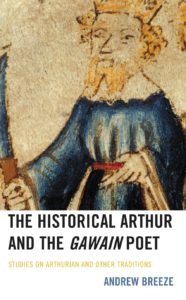 The quest for King Arthur is as elusive and enigmatic as is the quest for the holy grail. Who was King Arthur? More to the point, was King Arthur? Did he really exist? Or is he merely a figment of the fertile and fervid imaginations of our medieval forebears? And does it matter? These questions come to mind as we open the pages of The Historical Arthur and the Gawain Poet by Andrew Breeze, a British scholar who is a professor of philology at the University of Navarre in Spain.
As the title of this newly published volume indicates, Professor Breeze’s focus is the “real-life” Arthur, the factual Arthur who might really have lived, as well as the additional quest for the identity of the fourteenth-century poet who wrote the Arthurian epic, Sir Gawain and the Green Knight.
Dr. Breeze offers answers to several of the questions with which we began.
Was King Arthur? Yes, says Dr. Breeze, he was. “We can be sure that Arhtur really existed,” he insists.
Who was King Arthur? He was a sixth century warrior who defeated his enemies in the north of Britain, in what is now the northernmost parts of England and the southernmost parts of Scotland. Dr. Breeze even places him more precisely as “a warrior of the 530s”. His name is of Latin origin, from Artorius, but he was not a Roman. He was a Romanized Celt, influenced culturally by the four centuries of Roman occupation which had ended in the previous century. He would probably have been bilingual in Latin and British, the latter of which is the ancestor language of modern Welsh, Cornish and Breton.
It seems, therefore, if Dr. Breeze’s meticulous historical detective work is to be believed, that King Arthur is a fact and not merely a figment of the imagination. But where does this leave the legendary King Arthur who is the “figment of the fertile and fervid imaginations of our medieval forebears”? Does the existence of the factual Arthur destroy his fictional counterpart? Where does it leave Geoffrey of Monmouth’s legendary “history”, or the Welsh tale Culhwch and Olwen, or the Arthurian romances of the French poet, Chrétien de Troyes, all of which date from the twelfth century? Where does it leave Sir Gawain and the Green Knight, which dates from the fourteenth century, or Thomas Malory’s Morte d’Arthur, from the late fifteenth century? Does it leave them dead and buried or do they have a life of their own?
Although Professor Breeze’s book begs these questions, the answer to them is beyond the scope of his research. We need to close his important book, therefore, and look for answers elsewhere.
There is no better way to begin than with the dawn of the Christian presence in Britain. According to pious legend, Sir Joseph of Arimathea brought the Christ Child to England, a myth that inspired the lines of William Blake’s poem with which we raised the curtain on these musings. Did those feet in ancient time walk upon England’s mountains green? Was the holy Lamb of God on England’s pleasant pastures seen? Did the Countenance Divine shine forth upon England’s clouded hills? Presumably not, it must be conceded, even though extensive trade routes existed between the Eastern Mediterranean and southwest England at the time of Christ and had done so for more than a thousand years prior to Christ.
The point is not so much whether the Christ Child set foot on England’s green and pleasant land as that the people of England desired so much that he should have done so that they began to tell stories, using their fertile and fervid imaginations to express their wishful thinking.
The same can be said of the story of the holy grail.
In another pious legend, it is said that the first Christian missionaries to England were led by Joseph of Arimathea, arriving in 63AD, only thirty years after the Crucifixion, and that he brought with him the holy grail, which was either the cup used at the Last Supper or was the cup into which the blood of Christ had flowed after His side was pierced by the lance. In terms of the mundane facts, it is very likely that the first Christian missionaries arrived shortly after the Roman Conquest, making the date of 63AD entirely plausible. Less plausible, of course, is that the mission to England was led by Joseph of Arimathea, and less plausible still that he brought the holy grail with him.
Such implausibility was no obstacle to the wishful thinking and fertile imagination of our ancestors. They wanted the pious legend to be true and were not likely to let the absence of the facts get in the way of their desire for miraculous truth. Over the years and the centuries, the seeds of the pious legend grew into an epic tree of tales in which the quest for the holy grail became symbolic of the quest for heaven, just as the slaying of dragons was emblematic of the conquest of sin. Such heavenly truths transcended mundane facts.
Is this wishful thinking merely quixotic? Does it remind us of Cervantes’ lean and foolish knight who forever rides in vain? Perhaps so, but isn’t it better to believe in Don Quixote’s impossible dream than to live in the cynic’s never ending nightmare?
In order to affirm heavenly desire over nihilistic negation, let’s conclude with the second half of William Blake’s Arthurian call to arms:
Bring me my Bow of burning gold:
Bring me my arrows of desire:
Bring me my Spear: O clouds unfold!
Bring me my Chariot of fire!I will not cease from Mental Fight,
Nor shall my sword sleep in my hand:
Till we have built Jerusalem,
In England’s green & pleasant Land.
__________
The featured image is the title page of The Boy’s King Arthur, drawn in 1922 by N.C. Wyeth, and is in the public domain, courtesy of Wikimedia Commons.

No comments:
Post a Comment
Comments are subject to deletion if they are not germane. I have no problem with a bit of colourful language, but blasphemy or depraved profanity will not be allowed. Attacks on the Catholic Faith will not be tolerated. Comments will be deleted that are republican (Yanks! Note the lower case 'r'!), attacks on the legitimacy of Pope Leo XIV as the Vicar of Christ, the legitimacy of the House of Windsor or of the claims of the Elder Line of the House of France, or attacks on the legitimacy of any of the currently ruling Houses of Europe.