Today is International Talk Like a Pirate Day. As the History Guy says, whenever an episode features pirates, "Don't all good stories involve pirates?"
From The Imaginative Conservative
By David Deavel, PhD
Howard Pyle did not give us the sounds of pirates that make talking like a pirate so much fun. He did, however, imprint on our imaginations what they looked like.
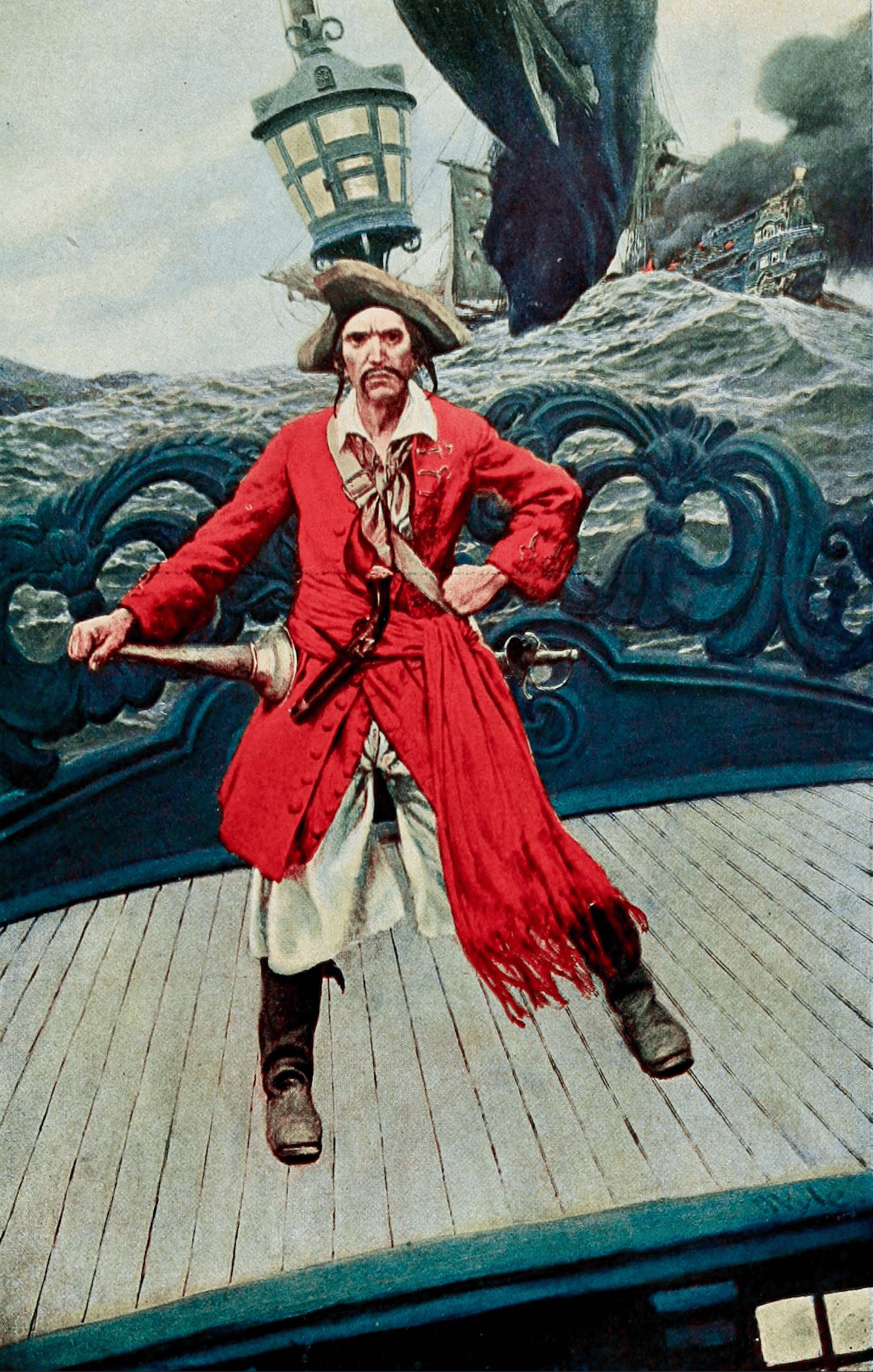 Of the world’s “holidays,” Talk Like a Pirate Day (or, to use its full name, International Talk Like a Pirate Day) is probably not high on most people’s list. It was promulgated in 1995 by two guys in Oregon named John Baur and Mark Summers who were playing racquetball. One injured himself and said, “Aaarrr!” Given the associations of this phrase with stereotypical piratical conversation, the two decided that a day (September 19 was chosen) should be established in which all talked like pirates. What they mean, the scholars say, is to talk in the dialect of the West Country, meaning South West England.
Yet, whether it is widely celebrated is less interesting than its premise that we all know—or think we do—what pirates sound like. We also all think we know what pirates look like. Where did our images come from? They came from that genius of American art, illustration, and children’s fiction, Howard Pyle.
Raised in the straight-laced Quaker world, Pyle could see the attractions of stepping out of the ordinary, secure life of virtue. “Why is it that a little spice of deviltry,” he began one essay, “lends not an unpleasantly titillating twang to the great mass of respectable flour that goes to make up the pudding of our modern civilization?” Further on, he queried whether “every boy, for instance” would not obviously “rather be a pirate captain than a Member of Parliament?”
The essay, which was used as the preface to the posthumous collection of his buccaneering history, fiction, and illustrations known as Howard Pyle’s Book of Pirates, did admit that the answer to these questions and others like them can be answered with reference to “the unregenerate nature of most of us,” but Pyle could not simply write off the boyish and human attraction to pirate lore: “Courage and daring, no matter how mad and ungodly, have always a redundancy of vim and life that recommend them to the nether man that lies within us, and no doubt his desperate courage, his battle against the tremendous odds of all the civilized world of law and order, have had much to do in making a popular hero of our friend of the black flag.”
Add to the courage and daring in the face of great odds the attractions of adventure and even that “lust for wealth” that we all share in. The origins of piracy in the “semilawful buccaneering of the sixteenth century,” itself an “evolution from the unorganized, unauthorized warfare of the Tudor period,” recall a different and wilder time in which the New World was indeed still new, and figures such as Sir Francis Drake could seize “immense, stupendous wealth” without government authorization, but also without punishment or reprimand.
The first item collected in Howard Pyle’s Book of Pirates is historical. “Buccaneers and Marooners of the Spanish Main,” published in 1887 by Harper’s Magazine, was one of the journalistic essays that Pyle, like many a great artist has before and since, wrote to make ends meet in between his larger projects of painting, illustration, and fictional creation. While they might be seen as superfluous or make-work assignments, his biographer Henry C. Pitz believed Pyle thrived on adding such different tasks to his regular work, even if they were often only of “passing interest” in the long run: “There were times when it appeared that his nature demanded two contrasting problems at the same time.”
The journalistic pieces also allowed him to work out topics of interest and illustrate them. “Buccaneers and Marooners of the Spanish Main” includes the first of those images of pirates that formed our own understanding of how pirates look and dress. Pyle would go on to write a great many fictional stories about real and imagined pirates. The other seven chapters of Howard Pyle’s Book of Pirates include shorter and longer (originally book-length) tales of Captain Brand, Blueskin, and others.
Modern readers may not find all the stories to be top-notch. Even Pitz, in evaluating Pyle’s writing in this genre, found that much of it was good but not exceptional in terms of plot, structure, and character. Tales they are, often well told, and thrilling, perfect for what they were made for. “They were suited to the boundaries of an adventure tale,” Pitz writes, adding that Pyle’s adventure writing’s strength was in establishing “settings” and “a feeling of place.” What made and makes them worthwhile is the combination of words and pictures that blend Pyle’s taste for the romantic with his “secondary craving for realism.”
As a young man in Maryland, Pyle studied ships on the Eastern seaboard. As an adult, he traveled to the Caribbean to know how sand and sunlight appear. He did realism with the best of them, with plenty of research to back up his choices. And when he didn’t have concrete details locked down, he used his imagination. Writer Theodore Carter quotes Stephanie Plunkett, chief curator at the Norman Rockwell Museum, who described Pyle’s method of creation: “Since visual imagery documenting the appearance of early pirates was scant at best, Howard Pyle examined antique prints and manuscripts while perusing his personal archive of historical costume records to create convincingly seductive portrayals of pirates that were drawn largely from his imagination.”
So convincing were they that they established the images permanently in the modern mind. As art historian Dr. Lauren Kilroy-Ewbank writes, “From Treasure Island to Captain Hook or Johnny Depp as Captain Jack Sparrow in Pirates of the Caribbean movies, Pyle’s images are the direct inspiration.” As she notes, though it was Pyle’s student N. C. Wyeth who illustrated Stevenson’s Treasure Island, he too was drawing on Pyle’s understanding and previous illustrations.
While pirates in reality wore “practical clothes that would not get caught in ropes and would dry quickly while also keeping them warm,” and earlier artists depicted them merely in rich clothing, Dr. Kilroy-Ewbank writes that Pyle gave them a much more dramatic garb: “sashes, bandanas, tricorn hats, and bright red additions.” These elements he borrowed largely from the Roma, traditionally known as Gypsies, who captured the imagination of the 19th century with their colorful scarves, sashes, and jewelry.
Pyle did not give us the sounds of pirates that make talking like a pirate so much fun. He did, however, imprint on our imaginations what they looked like. It may seem odd that a former Quaker ended up as the iconographer for those civilized society designated legally as hostis humani generis—enemies of the human race. The greatest artists, however, often see what is good even in the worst of people and situations. Civilizational pudding can take a little spice of deviltry, especially if the emphasis is on the courage and adventure that are themselves goods we all wish to possess.
__________
The featured image is “Illustration from p. 297 of Howard Pyle’s Book of Pirates (1921),” and is in the public domain, courtesy of Wikimedia Commons.

,_p._297.jpg)
No comments:
Post a Comment
Comments are subject to deletion if they are not germane. I have no problem with a bit of colourful language, but blasphemy or depraved profanity will not be allowed. Attacks on the Catholic Faith will not be tolerated. Comments will be deleted that are republican (Yanks! Note the lower case 'r'!), attacks on the legitimacy of Pope Leo XIV as the Vicar of Christ, the legitimacy of the House of Windsor or of the claims of the Elder Line of the House of France, or attacks on the legitimacy of any of the currently ruling Houses of Europe.