Dr Chalberg is one of the foremost contemporary Distributists, and he made a career of one-man shows portraying G.K. Chesterton on stage.
From The Imaginative Conservative
By Chuck Chalberg, PhD
Popping up all over the country are chapters of the Catholic Land Movement, which is a distributist-inspired and Chesterton-inspired attempt to revive the economic vision of Pope Leo XIII. Grounded in conversion and conviction, such a movement is growing.
 Is it time—or already past time—to consider something that was once called distributism as an alternative to what has long been called capitalism, or what is still being called socialism? Distributism was the name given to this alternative better than a century ago. The idea was to get property and some measure of economic independence distributed into the hands of as many people as possible.
Here we are in 2026, and long-discredited ideas of socialism are making a comeback. Suddenly forgotten are its past failures, as well as Margaret Thatcher’s great line that the trouble with socialism is that you eventually run out of other people’s money. Nonetheless it’s still being sold, and sold as the next logical, even inevitable, step taken in accordance with something called the arc of history.
Also forgotten are the long-ago efforts of Democrats like Harry Truman and Hubert Humphrey to separate socialists, fellow travelers, “no enemies to the left” popular fronters, and yes, even communists from their party. And today? Today those very same forces are being welcomed into today’s version of a “big tent” Democratic Party.
Who knows, but maybe Karl Marx will yet be proven right, and all without an armed rebellion. After all, he did predict that capitalism would eventually lead to socialism—nay that socialism was the inevitable offspring of capitalism.
Capitalism and socialism. Are these the only two possible and/or legitimate alternatives? English writer and philosopher G.K. Chesterton didn’t think so, and he was far from alone. At the same time, he did suspect that Marx was right. Or at least he worried that Marx would be proven to be right in that capitalism would lead to socialism.
Chesterton’s answer was to borrow from the encyclical, Rerum Novarum, authored by the last Pope Leo, namely Leo XIII. Operating on the Catholic principle of subsidiarity, Pope Leo opposed both large-scale capitalism and state-controlled socialism. The basic idea of subsidiarity was to keep as much as possible as local as possible. And the starting point was always the family.
Chesterton agreed. As far as he was concerned, the real battle was not between capitalism and socialism, but between, as he put it, one version of “centralization” and a counter-version of “centralization.”
In opposition to both forms of centralization, Chesterton helped create what he called the Distributist League in the 1920s. It was not a political party, but an advocacy organization. Politics, he thought, ought to be the left to the politicians, since they were the only people “dull enough not to be bored by it all.”
Chesterton also thought that “capitalism” was the wrong term to describe the new reality of large-scale economic organizations. With his tongue firmly in cheek, he proposed that this new reality ought to be called “proletarianism,” since it was creating so many unpropertied wage earners, or “wage slaves,” which was Chesterton’s preferred term. Chattel slavery had finally been abolished in the British Empire and in the United States, so now it was time to abolish wage slavery as well.
His further objection to the term “capitalism” was that it was too inclusive. In attempting to describe something presumably specific, it wound up failing to describe anything in particular. After all, he observed, Lenin and Stalin and the Bolsheviks were actually capitalists. It was just that they, and they alone, controlled all the capital.
In a book titled “What’s Wrong with the World,” written shortly before the Great War of 1914-1918, Chesterton posited two mythical figures, Hudge and Gudge. Hudge was the socialist, and Gudge was the capitalist. In reality they were less opposed to one another than in essential agreement with one another. They both sought centralized power and control above all else. More than that, they were often in league with one another in that pursuit.
Therefore, they both worked against the family. And without the family, wrote Chesterton, “we are all helpless before the state.”
Calling it the “The Dreadful Duty of Gudge,” Chesterton contended that Gudge, the capitalist, had already weakened the domestic bonds that Gudge, the conservative, now claimed that he wanted to tighten. And Hudge, the socialist-progressive? He sought to build a world in which the family would essentially become irrelevant. In any event, Hudge regarded the family as an institution that he was convinced that we would one day “gloriously outgrow.”
In order to avoid a post-family future, Chesterton thought that England–and presumably the United States–needed a “change as vast and great as socialism.” In a few other , Chestertonian words, if property was to be saved, property had to be distributed. And if the family was to be saved, the nation had to be “revolutionized.”
Chesterton himself was neither a man of the left or the right. Instead, he thought it was time to get beyond left and right. He sometimes complained that he spent half his time explaining to the capitalists that he was not defending communism and the other half explaining to communists that he was not defending capitalism.
He was, however, a committed defender of private property. A pickpocket, he once suggested, might well be described as a believer in private enterprise, but it would be an “exaggeration” to call him a believer in private property. And the socialist solution to such activity? As far as he was concerned, it amounted to the outlawing of pockets.
Chesterton’s solution was distributism. But questions and problems remain. The first one is obvious. Who does the distributing? And then how is that done? Chesterton was not calling for either a dictatorship or a revolution, but he was calling for a change that no doubt was more fundamental than socialism. In fact, he more than occasionally worried that a socialist future would leave things essentially the same, perhaps even “horribly the same.”
Any real and lasting change would have to be of the bottom-up variety. As he saw it, that sort of change was quite possible then. In all likelihood, he would say that that same sort of change remains possible today. More than that, Chesterton thought that the possibilities for bottom-up change were much greater in so-called capitalist countries than they would be in socialist countries, including the Soviet Union.
At the same time he didn’t think that the Soviet Union would survive, simply because it ran against a very human desire, namely the desire to own things, especially a piece of property. No doubt the Soviet Union did manage to survive a whole lot longer than he thought it would. But he was surely right to contend that it would not last.
Whether its demise could be explained by the absence of any significant measure of individual ownership is another matter entirely. But Chesterton was not wrong to question the reasonableness of centralization, whether of the Soviet variety, or of the British or American variety for that matter. Nor was he mistaken to point to the unreasonableness of it all.
More than that, when it came to looking to the future in general, Chesterton simply thought that it was absurd to believe that continued centralization would solve anything. It might continue, but it would not end well, if only because the “soul strives for simplicity.”
A convert to Catholicism, Chesterton thought that the most sensible solution was to “return to the teachings of the Church,” and specifically to the principle of subsidiarity. Otherwise, there will eventually be a return to some form of “slavery.” Either “return” will one day occur because further centralization will inevitably lead to either “calamity” or “collapse.”
Chesterton never claimed to know whether or when either calamity or collapse might occur, but he was convinced that one or the other would happen. At the same time, he was hopeful that such a future could still be avoided. Would hopefulness be enough? No one, including Chesterton, knew. But he did know what hope was; it was hoping when “everything seemed hopeless.” He was also convinced of something else—namely that calamity or collapse could only be avoided by “conversion and conviction.”
Popping up all over the country, including my home state of Minnesota, are chapters of the Catholic Land Movement, which is a distributist-inspired and Chesterton-inspired attempt to revive the economic vision of Pope Leo XIII. Grounded in conversion and conviction, such a movement is growing. One can only hope that this growth will continue and, therefore, this movement will be on hand to help our society avoid either calamity or collapse. And if it fails to do so, if our future is to be one of calamity and/or collapse, this movement will continue to adhere to the “teachings of the Church” and thereby continue to point a way to a future better able to resist either calamity or collapse–or any version of slavery.
***
John C. “Chuck” Chalberg once performed as G.K. Chesterton.
__________
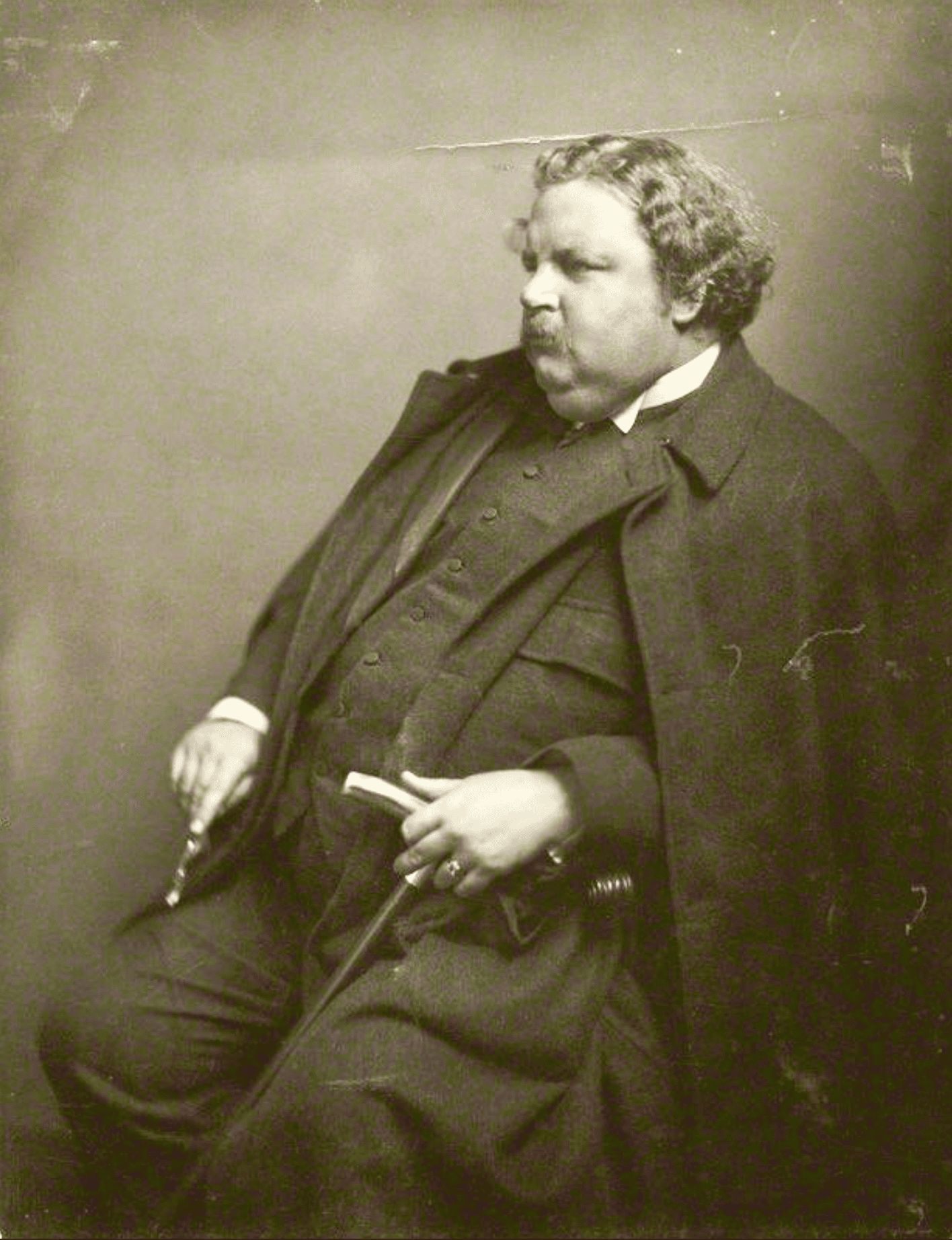
The featured image is “Picture of Gilbert Keith Chesterton, by James Craig Annan, 1912,” and is in the public domain, courtesy of Wikimedia Commons.

No comments:
Post a Comment
Comments are subject to deletion if they are not germane. I have no problem with a bit of colourful language, but blasphemy or depraved profanity will not be allowed. Attacks on the Catholic Faith will not be tolerated. Comments will be deleted that are republican (Yanks! Note the lower case 'r'!), attacks on the legitimacy of Pope Leo XIV as the Vicar of Christ, the legitimacy of the House of Windsor or of the claims of the Elder Line of the House of France, or attacks on the legitimacy of any of the currently ruling Houses of Europe.