From The Imaginative Conservative
By Joseph Pearce
In “The Brothers Karamazov,” the man of God has the last laugh. Dostoevsky also has the last laugh, and it is at the devil’s expense. The joke is on Satan and those fools who fall for his lies.
In my book, Classic Literature Made Simple: Fifty Great Books in a Nutshell, I endeavoured to encapsulate the moral integrity and formal entirety of each of the books selected in around a thousand words. This was obviously a challenge, especially in the case of longer and convoluted works, such as The Divine Comedy, Don Quixote and The Lord of the Rings. One major work that was not included was The Brothers Karamazov by Fyodor Dostoevsky, which ranks alongside the masterpieces of Dante, Cervantes and Tolkien in terms of its importance to Western civilization and in terms of its length and convolutedness. It will be a real challenge, therefore, to place this mammoth tome into the idiomatic nutshell.
As the title indicates, the core of Dostoevsky’s magnum opus are the three Karamazov Brothers, Dmitri, Ivan and Alyosha. Each represents a character trait common to humanity which is taken to an extreme, almost to the extremity of the grotesque or of the caricature. Dmitri is ruled by unbridled emotional passion; he is the headless heart. Ivan is governed by a passionate intellect, shackled to an ideological and idolatrous atheism; he is the heartless head. Alyosha is ruled by the love of God and neighbour; he places his head and heart, his reason and his love, at the service of others.
As the story unfolds, we come to see how ideas, and the attitudes that are the consequence of ideas, impact the lives and cause the deaths of both the innocent and the guilty. Dmitri tramples on others in pursuit of his obsessive erotic passion, which he calls “love”. Ivan takes his philosophical atheism to its logical and theological extreme in the proclamation of the dictum that “if there is no God, everything is permitted”, which he calls “reason”. Alyosha, caught in the midst of this madness, is the true lover and the real lover of truth. He shows true love in his self-sacrificial service to others, and he shows his love of truth in the Orthodox fusion of faith and reason which is the very light of his love and the light of his life.
Although the three brothers are at the core of the story, they cannot be seen or understood clearly except in the light, or perhaps in the shadow, of the presence of their father, Fyodor Pavlovich Karamazov. Like his son, Dmitri, Fyodor Karamazov has allowed his life to be governed by the pursuit of erotic desire. Unlike his son, however, he has no real sense of honour. He abandons himself and everyone else on the reckless quest to gratify every lustful urge. He is neglectful of the needs of his sons, as he had been neglectful of the needs of his two wives. This abuse of his sons through neglect and through the bad example of his drunken and debauched behaviour causes two of them to loathe him, adding to the angst and animus of the plot. As for the youngest son, Alyosha, he loves his father, pitying him in his weakness and in his abject slavery to the sins to which he had become addicted. Alyosha’s ability to love his abuser is due primarily no doubt, and aside from the grace of God, to the other father figure in his life and the other father figure in the novel. This is Father Zosima, the Elder and spiritual adviser in the local monastery, who had been Alyosha’s mentor. It is Father Zosima who models true fatherhood in the love he has for all his spiritual sons and in the way in which he lives in conformity to the virtuous wisdom that he preaches. He illuminates in his very person the inseparability of wisdom and virtue, of sanity and sanctity, which is the mark of the saint. It is this same fusion of sanity and sanctity which we see in Alyosha, in the choices he makes and in the example he gives to others. He is the light of love shining forth in the dismal darkness and destructiveness of sin; or rather, as he would himself insist, it is the light of the love of God shining forth through him, without which he could do nothing.
One other key character must be mentioned, partly because of the crucial role he plays in the novel but also because he is presumably the other member of the Karamazov family, albeit an illegitimate member. This is Pavel Fyodorovich Smerdyakov, the son of Stinking Lizaveta, a mute and mentally retarded woman who had been raped, presumably by Fyodor Karamazov, and had died homeless and alone during childbirth. Smerdyakov, whose very name means “son of the stinking one”, carries the stench associated with his mother and with the circumstances surrounding his birth. Resenting the ordure which he bears as a birthmark and the odour of scandal which surrounds him, Smerdyakov becomes embittered and cynical. As a servant of the Karamazov household, working as Fyodor Pavlovich’s cook, he is contemptuous of others and despises religion. The one person whom Smerdyakov admires is Ivan, whose atheism attracts him and whose dictum that “everything is permitted” greatly influences him. Ivan’s hardheaded godlessness becomes a malevolent presence in the coldhearted and calculated actions of Smerdyakov.
The unholy alliance of Ivan’s hardheaded ideas and Smerdyakov’s coldhearted actions would become the catalyst for catastrophe. Pride precedes and precipitates a fall. And yet, and crucially, the catastrophic does not conclude the novel. On the contrary, the cataclysm is merely the prelude for the redemptive finale. Ivan and Smerdyakov discover that their godless creed cannot silence the voice of conscience, which calls for law and order from out of the depths of their lawless and disordered souls. As for the conclusion we’re meant to reach as we reach the conclusion of the novel, it is to be found on the final page, in the final lines, in which the joyful laughter of Alyosha is accompanied by the ecstatic and exulted cries of a chorus of children.
Alyosha the childlike has the last laugh. The man of God has the last laugh. Dostoevsky also has the last laugh, and it is at the devil’s expense. The joke is on Satan and those fools who fall for his lies. As for the little children, they will live happily ever after in the place of everlasting laughter, enjoying the divine comedy which rises like a phoenix of faith from the death of tragedy.
___________
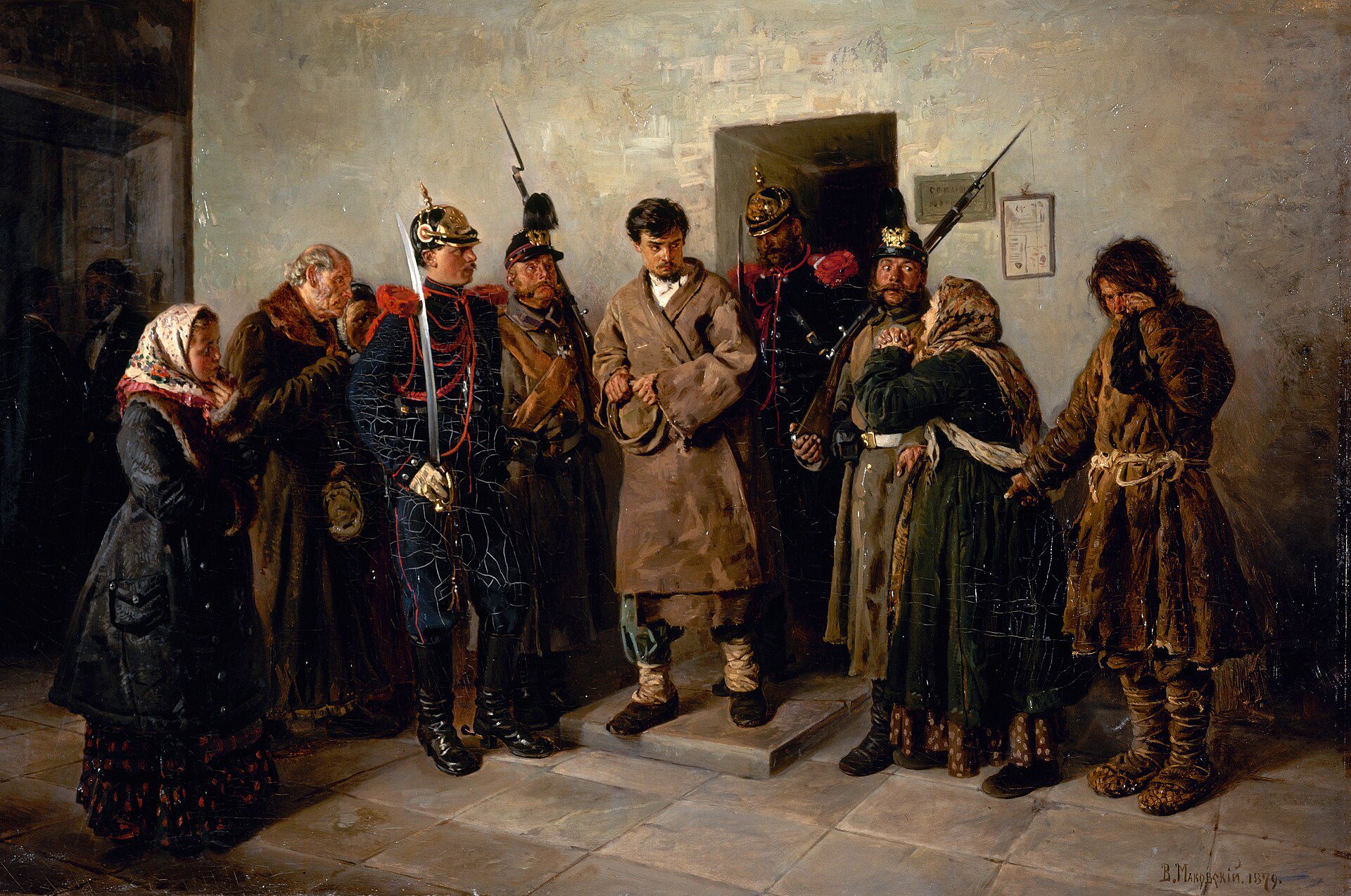
The featured image is “The Convicted Man” (1879), by Vladimir Makovsky, and is in the public domain, courtesy of Wikimedia Commons.

No comments:
Post a Comment
Comments are subject to deletion if they are not germane. I have no problem with a bit of colourful language, but blasphemy or depraved profanity will not be allowed. Attacks on the Catholic Faith will not be tolerated. Comments will be deleted that are republican (Yanks! Note the lower case 'r'!), attacks on the legitimacy of Pope Leo XIV as the Vicar of Christ, the legitimacy of the House of Windsor or of the claims of the Elder Line of the House of France, or attacks on the legitimacy of any of the currently ruling Houses of Europe.