When I read Kirk, I wonder what he would have thought of America in the years since he died. Would he still think it a Platonic anamnesis?
From The Imaginative Conservative
By Bradley J. Birzer

In his new book, Michael Lucchese shows us that Russell Kirk believed that America—in world history and in God’s providence—served as a Platonic anamnesis, a thing that forces us to remember what is eternal, good, true, and beautiful, through right reason in the very womb of time itself.
Russell Kirk on America: How to Understand the Legacy of 1776 (234 pages, Creed and Culture Books, 2026)
Ave, Michael Lucchese!
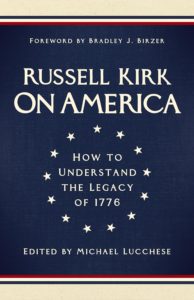 All of us at The Imaginative Conservative are more than familiar with the work of Dr. Russell Amos Kirk (1918-1994), the founder of post-war conservatism. He is the guiding light of TIC, and we exist, in many ways, to promote as well as expand upon his thought on a multitude of things from literature to liturgy.
Lucchese’s name is not quite as well known as Kirk’s, but, someday, it will be. Lucchese is not only his generation’s Kirk, but he’s also the very future of conservatism. His latest book, an edited collection with a beautiful introductory essay by the author, Russell Kirk on America: How to Understand the Legacy of 1776 (Creed and Culture Books), is not merely just one new book in a long line of books to be published in the summer of 2026, it is an event, in and of itself.
Physically, the book is a thing to behold—well bound on high-quality paper and with a gorgeous page layout. The book has heft. The press, Creed and Culture, is especially to be commended for this epicurean gift.
But, it is the insides, the very soul of the book, that matters most. And, Lucchese has brilliantly channeled Kirk on the most important non-religious subject of this year: America as she quickly approaches her 250th birthday. Lucchese has pulled together Kirk’s various writings on America, with topics ranging from the meaning of the Declaration of Independence and the Constitution, to the republican significance of Abraham Lincoln and Ronald Reagan, to the letters of Nathaniel Hawthrone and Mark Twain. Lucchese has expertly drawn these various writings from unpublished speeches, book chapters, and published articles, often difficult to find.
Not just the founder of post-war Conservatism, Kirk was also an American original, the most individual of non-individualists, and he was one of the greatest commentators to assess America, her character, and her legacy.
What exactly was America to Kirk? Taking many of his ideas from the Austrian philosopher Eric Voegelin, Kirk believed that America—in world history and in God’s providence—served as a Platonic anamnesis, a thing that forces us to remember what is eternal, good, true, and beautiful, through right reason in the very womb of time itself.
Yet, for Kirk, this was a humbling thing, not an excuse for prideful ejaculations. Rather than a “shimmering and strident” America, Kirk desired a moral, virtuous, and happy one (as in free to pursue one’s excellences within community). To be sure, we were a “City Upon a Hill,” but this was as much a burden as a blessing. The city upon a hill, Jesus taught us, cannot be hidden, and its light must shine forth into and across the world. As such, every action it takes will be scrutinized, every good replicated, but every sin exaggerated by witnesses.
For Kirk, then, America, uniquely, had a destiny. Though a believer in natural rights, Kirk focused much more on our duties and obedience to the natural law. Few peoples in the world had ever experienced the holy cultural trinity of freedom, justice, and order. But, America, according to Kirk, had gotten these things right. Not only did America properly balance political life with social and cultural life, but it also balanced the needs of the individual human person against the needs of the community. Neither of these things should be easily or readily dismissed, but rather praised and magnified.
Did, then, America spring from nothing? Of course not. Through his many works, some scholarly and some popular, Kirk argued that America owed an immense debt to the Greco-Roman world, the Judeo-Christian religion, and the English experience of common law. While we might take the names and ideas of the republic from the ancient world and especially from Rome, we take our practical experience of liberty under law directly from the English. And, of course, it would be hard to fault Kirk on this observation. After all, each of the original thirteen colonies adopted the Anglo-Saxon common law as its own, as did the United States, expressed through Congress and especially witnessed in the Northwest Ordinance of 1787. Kirk, though, never gives pride of place to politics. Even his much-lauded Conservative Mind was not supposed to be an expression of the political, but rather of the artistic, literary, cultural, and educational. In a similar vein, Kirk notes rightly that many of America’s greatest cultural achievements to be found in art and education come from the Greeks, the Romans, and, especially the Stoics.
One should never get the idea, however, that Kirk is so patriotic as to be uncritical. Indeed, for Kirk, patriotism demands criticism. He is especially critical of the growth of the American Leviathan, especially after the Progressive period, the growth of American empire, especially after the Second World War, and the decay of primary, secondary, and higher education, especially in the twentieth century. Each erodes the things that make America special, that allowed it once to serve as the great anamnesis of Western civilization. In our present world, not only must we shrink government (thus, grow civil society), we must combat the ideologues of the left and the right, as well as reinstitute classical norms of education. Each, for Kirk, will be an immense challenge. But, even at Kirk’s darkest, he believes there is hope in the future. Kirk saw such hope with Washington at the beginning of all things, Lincoln in the middle of all things, and Reagan near Kirk’s very end. For Kirk, Reagan especially, embodied hope and audacity. After all, the only thing we have to do to have hope… is to be hopeful. It is the very character of the virtue to see a bettering of things.
Once again, let me praise Michael Lucchese. This might be his first great offering to the republic and to Western civilization, but it most certainly will not be the last. We can expect many great and extraordinary things from him. Ave, Michael.
__________
The featured image is “Portrait of a Farmer” (1943), by NC Wyeth, and is in the public domain, courtesy of Wikimedia Commons.

No comments:
Post a Comment
Comments are subject to deletion if they are not germane. I have no problem with a bit of colourful language, but blasphemy or depraved profanity will not be allowed. Attacks on the Catholic Faith will not be tolerated. Comments will be deleted that are republican (Yanks! Note the lower case 'r'!), attacks on the legitimacy of Pope Leo XIV as the Vicar of Christ, the legitimacy of the House of Windsor or of the claims of the Elder Line of the House of France, or attacks on the legitimacy of any of the currently ruling Houses of Europe.