.png)
From One Peter Five
By Timothy Flanders, MA
O Immaculata, I submit these words to you, as my editor-in-chief. If there is anything here contrary to the Roman faith, or against truth or charity, let these words be destroyed or brought to none affect. Mary, conceived without sin, pray for us who have recourse to thee, especially the enemies of Holy Church!
The SSPX and the Holy See have now made more statements. First, on Fatima Day the Office Formerly Known as Holy released this statement:
With regard to the Priestly Fraternity of Saint Pius X, we reiterate what has already been communicated. The episcopal ordinations announced by the Priestly Fraternity of Saint Pius X do not have the requisite papal mandate. This act will constitute “a schismatic act” (John Paul II, Ecclesia Dei, no. 3) and “formal adherence to the schism constitutes a grave offence against God and entails the excommunication established under Church law” (ibid., 5c; cf. Pontifical Council for Legislative Texts, Explanatory Note, 24 August 1996).
The Holy Father continues in his prayers to ask the Holy Spirit to enlighten those responsible for the Priestly Fraternity of Saint Pius X so that they may reconsider the extremely grave decision they have taken.
From the Vatican, 13 May 2026
In response, the SSPX, the next day, on the Feast of the Ascension of Our Lord, May 14th, the SSPX published a “Declaration of Catholic Faith addressed to His Holiness Pope Leo XIV by Fr. Davide Pagliarani Superior General of the Priestly Society of Saint Pius X”
Here is the text in full:
—————————————————————-
Most Holy Father,
For more than fifty years, the Society of Saint Pius X has endeavoured to set before the Holy See a matter of conscience in the face of the errors that are destroying Catholic faith and morals. Regrettably, all the discussions entered into have remained without result, and none of the concerns expressed have received any truly satisfactory response.
For more than fifty years, the only solution truly considered by the Holy See has appeared to be that of canonical sanctions. To our great regret, it seems to us that canon law is thus being used, not to confirm in the Faith, but to lead away from it.
In the text that follows, the Society of Saint Pius X is glad to express to You, filially and sincerely, its devotion to the Catholic Faith, concealing nothing, either from Your Holiness or from the Universal Church.
The Society places this simple Declaration of Faith in Your hands. It seems to us to correspond to the minimum indispensable to be in communion with the Church, and to truly call ourselves Catholics and, consequently, your sons.
We have no other desire than that of living and being confirmed in the Roman Catholic Faith.
“Thus, remaining firmly rooted and established in the true Catholic Faith, strive always to be worthy ministers of the divine Sacrifice and of the Church of God, which is the Body of Christ.
For, as the Apostle says: ‘all that is not of faith is sin’,[1] schismatic and outside the unity of the Church.”[2]
DECLARATION OF CATHOLIC FAITH
In the Name of Our Lord Jesus Christ, divine Wisdom, the Word Incarnate, Who willed one sole religion, Who rendered the Old Covenant definitively null and void, Who founded one sole Church, Who triumphed over Satan, Who conquered the world, Who remains with us until the end of time and Who shall come again to judge the living and the dead.
He, the perfect Image of the Father, the Son of God made man, was appointed the sole Redeemer and Saviour of the world through the Incarnation and the voluntary offering of the Sacrifice of the Cross. Our Lord satisfied divine justice by shedding His Most Precious Blood, and it is in that Blood that He established the New and Eternal Covenant, abolishing the Old. He is therefore the sole Mediator between God and men and the sole way to come to the Father. Only he who knows Him knows the Father.
By divine decree, the Most Holy Virgin Mary has been directly and intimately associated with the entire work of Redemption; to deny this association — in the terms received from Tradition — is therefore to alter the very notion of Redemption as willed by divine Providence.
There is only one Faith and one Church by which we may be saved. Outside the Roman Catholic Church, and without the profession of Faith that she has always taught, there is neither salvation nor remission of sins.
Consequently, every man must be a member of the Catholic Church in order to save his soul, and there is but one baptism as the means of being incorporated into her. This necessity concerns the whole of humanity without exception and embraces without distinction Christians, Jews, Muslims, pagans, and atheists.
The mandate received by the Apostles, to preach the Gospel to every man and to convert every man to the Catholic Faith, remains binding until the end of time and responds to the most absolute and most pressing necessity in the world. “He that believeth and is baptized, shall be saved: but he that believeth not shall be condemned.”[3] Therefore, to renounce the fulfilment of this mandate constitutes the gravest of crimes against humanity.
The Roman Church alone possesses simultaneously the four marks that characterize the Church founded by Jesus Christ: Unity, Holiness, Catholicity, and Apostolicity.
Her unity flows essentially from the adherence of all her members to the one true Faith, faithfully preserved, taught, and handed down by the Catholic hierarchy throughout the centuries.
The denial of even a single truth of the Faith destroys faith itself and renders radically impossible all communion with the Catholic Church.
The only possible path to restoring unity among Christians of different confessions consists in the urgent and charitable appeal addressed to non-Catholics to profess the one true Faith within the one true Church.
The Catholic Church can in no way be regarded or treated on an equal footing with a false form of worship or a false church.
The Roman Pontiff, the Vicar of Christ, is the sole possessor of supreme authority over the whole Church. He alone directly confers on the other members of the Catholic hierarchy jurisdiction over souls.
“The Holy Ghost was not promised to the successors of Peter that they might make known, by His revelation, a new doctrine, but that, by His assistance, they might inviolably keep and faithfully expound the revelation transmitted by the Apostles, that is, the Deposit of the Faith.”[4]
To a unique Faith there corresponds a unique form of worship, the supreme, authentic, and perfect expression of that same Faith.
The Holy Mass is the perpetuation in time of the Sacrifice of the Cross, offered for many and renewed upon the altar. Although offered in an unbloody manner, the Holy Sacrifice of the Mass is essentially expiatory and propitiatory. No other form of worship offers perfect adoration. No other form of worship that is not ordered to it is pleasing to God. No other means is sufficient for the sanctification of souls.
Consequently, the Holy Sacrifice of the Mass can in no way be reduced to a mere commemoration, to a spiritual meal, to a sacred assembly celebrated by the people, to the celebration of the Paschal mystery without sacrifice, without satisfaction of divine justice, without expiation of sins, without propitiation, and without the Cross.
The help afforded to souls by the Sacraments of the Catholic Church is sufficient in every circumstance and in every age to enable the faithful to live in a state of grace.
The moral law contained in the Decalogue and perfected in the Sermon on the Mount is the only one practicable for obtaining the salvation of souls. Every other moral code — founded, for example, on respect for creation or on the rights of the human person — is radically insufficient to sanctify and save souls. In no way can it replace the one true moral law.
Following the example of St. John the Baptist, true charity obliges us to warn sinners and never to renounce the means necessary to save their souls.
He who eats the Body of Our Lord and drinks His Blood whilst in a state of sin eats and drinks his own condemnation, and no authority can alter this law contained in the teaching of St. Paul and in Tradition.
Sins of impurity that are against nature are of such gravity that they always and in every circumstance cry to God for vengeance, and are radically incompatible with every form of authentic Christian love. Such a ‘lifestyle’ can therefore in no way be recognized as a gift from God. A couple practising this vice must be helped to free themselves from it, and can in no way be blessed — formally or informally — by ministers of the Church.
The submission of institutions and nations, as such, to the authority of Our Lord Jesus Christ flows directly from the Incarnation and the Redemption. Therefore, secularism of institutions and nations constitutes an implicit denial of the divinity and universal kingship of Our Lord.
Christendom is not a mere historical phenomenon, but the only order willed by God among men.
It is not for the Church to conform herself to the world, but for the world to be transformed by the Church.
It is in this Faith and in these principles that we ask to be instructed and confirmed by Him Who has received the charism to do so. With the help of Our Lord, we would rather die than renounce them. It is in this immutable Faith that we desire to live and die, in the hope that it may give way to the direct vision of the immutable eternal Truth.
Menzingen, 14 May 2026,
on the Feast of the Ascension of Our Lord
Davide Pagliarani
—————————————————-
The Dogma of the Faith
Thus the SSPX. Without any doubt – everything contained in this confession is entirely Catholic, and much of it is dogmatic (perhaps all? let the theologians tell us the theological notes of each proposition). These are the truths of the Faith which every Catholic parent is bound by duty to pass down to their children, without any permission needed from any cleric, since, as Vatican II itself says, parents, as kings and queens of their small kingdoms, are “the first preachers of the faith to their children” (Lumen Gentium, 11).
Therefore, on the one hand, how can the Holy Father have any problem reconciling the SSPX? How is it possible that German bishops can promote heresy and these good Catholic priests, who submit this orthodox confession to the Holy Father, are treated like heretics? How is it possible that sodomites are blessed while the orthodox priests are condemned? Woe to you that call evil good, and good evil (Is. v. 20).
Conspicuous by its Absence
On the other hand, we note what is conspicuous by its absence in the SSPX declaration of faith. The statement says that it is “concealing nothing” and yet the most controversial positions of the SSPX are missing, namely, its official position that the Novus Ordo Missae (that is, the ritual of the Pope himself), is, per se, even if celebrated perfectly, a “a poison harmful to the faith,” and therefore the faithful should stay home instead of attending the Holy Sacrifice in the new rite.
The other position is less official, but was cited by Archbishop Lefebvre in his consecration sermon of 1988, when he stated that the new rite bishops “due to their doubtful intentions, confer doubtful sacraments.” This Sacramental theology is in error, and the Holy Office has explicitly rejected this error before the new rite existed. The decree from the Holy Office clarified that sacramental intention is extremely minimal, much more minimal than what Archbishop Lefebvre says in his writings and sermons (again, see the cited article with all the citations).
It is strange, indeed, that the SSPX has concealed these positions of their priestly society. As I said before, I do not see how the SSPX can be accepted by the Holy Father if the SSPX literally warns their own faithful from attending the rite of the Mass that the Holy Father himself celebrates! This is not to deny all the issues with the Novus Ordo Missae – but rather to point out that the Novus Ordo Missae, as celebrated in Rome by the Pope, is much more reverent and beautiful than the vast majority of Novus Ordo Masses celebrated in North America (the so-called “Suburban rite”). But the SSPX insists that, in theory, one should deprive one’s self of Sacramental grace even at the Pope’s own Mass, rather than attend a reverent Novus Ordo.
As I said before, I’m not a theologian, I’m just a Catholic father. But that position seems quite untenable to me, due to the fact that there exists a metaphysical abyss between the human-divine elements of the Novus Ordo (those things that make it “bad”) and the Body, Blood, Soul, and Divinity of Our Lord Jesus Christ, present in the Novus Ordo by the SSPX’s own admission. Therefore I will continue to teach my children to prize Sacramental Grace as the greatest gift of God in this life, which must be sought out to be received worthily, by perseverance in mental prayer, more than any other thing on this earth. To abstain from Sacramental grace, due to a superficial abhorrence of superficial elements in the liturgy, seems to be recipe for disaster, according to the Eucharistic prayer of St. Symeon the New Theologian:
O Thou Ransom of my failing,
I entreat Thee to receive me,
So that I may now partake of
Thy life-giving, blameless Myst’ries,
And not suffer condemnation; That as Thou didst say, Thou mightest
Dwell with me, who am thrice-wretched;
Lest that foul deceiver find me
All bereft of Thy divine grace,
And most guilefully seduce me,
And with scheming cunning lure me
From Thy words which make me Godlike.
The Law Charity Excludes a Negative Interpretation of All Parties
However, if we apply the law of charity[5] to this, we must assume the best intentions on every side unless there is evidence otherwise. We do have an indication that Cardinal Tucho “Heal Me with Your Mouth” Fernández is indeed not acting in good faith, since his brother Cardinal Zen said bluntly that Fernández “intends to dismantle the traditions of the Church.” We know who His Eminence is – hopefully our impression is false (somehow), but we have a reasonable and pious reason to distrust Fernández, according to the virtue of caution, which means to see and foresee future evil.
With Pope Leo, however, we do not have manifest evidence that he should be distrusted. Rather, we have evidence that Pope Leo has an open heart to all, listening to and meeting with all of Pope Francis’s enemies (like Cardinal Burke).
Nevertheless, if this is true, then why has the Holy Father not met with the SSPX? Perhaps he has been misinformed or deceived (like Pius XI was about Padre Pio), or perhaps he is informed and his judgement is to lay down the axe of excommunication – and this action is justice in the eyes of God. Or perhaps Pope Leo is indeed a Neo-Modernist. (It is alarming that the Holy Father has not sacked Fernández at this point, and permitted him to publish Mater Populi Fidelis, which seemed to be a pet project of His Holiness, Pope Francis.)
But then again, things are not always as they seem. We don’t have all the facts. We don’t know these men’s hearts. Let us assume the best about Pope Leo unless we have manifest evidence otherwise. Let’s assume the best and hope for the best, because Jesus is ascended to His Throne.
As for the SSPX, we can assume the best and hope for the best. My only concern here is that the SSPX’s adherence to the Neo-scholastic “neo-tradition” fails to account for the decline of theology before Vatican II, and thus results in an obtuse evaluation of Tradition vis-à-vis Vatican II (for example, the traditional eastern positions), as the text of Lefebvre’s biography and his other writings suggest.
Further, applying the law of charity again, we can assume that the concealment of the SSPX’s more controversial positions is 1.) a prudent decision and 2.) an openness of heart. It is prudent to not mention those things, because the most important dogmas of the faith are contained in this profession – these dogmas are the whole point, and these are the dogmas that are being questioned directly or indirectly by recent popes and bishops everywhere.
But if we continue to apply the law of charity, we can also hope that the SSPX is making a distinction between its controversial opinions and these dogmas. In other words, by failing to mention those positions, they are declaring that these opinions are not dogma. And they’re not dogma, let’s be clear. Moreover, no matter how wrong are these positions the SSPX espouses (and yes, I do think they are wrong), the Holy See has tolerated so many intolerable positions – not only of the German heretics – but over the centuries in so many theological debates between the Franciscans and Dominicans, the Jesuits and Dominicans and so many others. So it’s not unreasonable to set aside those positions and focus on the most important dogmas.
What this seems to suggest is that the SSPX is willing to forego these positions as outside “the minimum indispensable [propositions] to be in communion with the Church, and to truly call ourselves Catholics and, consequently, your sons.” Therefore, no one should think the SSPX is intentionally trying to obfuscate here. That would be an uncharitable assumption without any evidence.
Dialogue: Our Only Hope
The only path forward is dialogue. Do you know what dialogue is? As we say in the States, “Don’t believe the hype.” Dialogue is dialogos. It means Socratic dialogue, as Pope St. Paul VI himself said “Before we can convert the world-as the very condition of converting the world-we must approach it and speak to it” (Ecclesiam Suam, 68). I wrote a 500-page book showing how, when Christians abandon dialogos – face to face conversations – they inevitably sin against truth and charity. And the first great model of this dialogos is St. Athanasius, who practiced “True Ecumenism.”
Among Christians, the dialogos may be defined as “an act of humility whereby two or more parties penetrate and subordinate themselves to the truth.” If we fail to follow the path of dialogos, the SSPX and Rome will continue to talk past each other. I see the same thing happening here with the SSPX as happened between the Syriacs and the Greco-Romans, between the Miaphysites and the Chalcedonians, between the Greeks and Latins, between the Ultramontanists and the Minimalists, between the Neo-Scholastic Dominicans and the Ressourcement Jesuits. Only when we embrace the fact that “being is communion,” then we can understand our brother, understand his actual view point, and understand the truth. History proves this truth, again and again. Only dialogos reveals what is in your heart.
Every Parent is a King or Queen of a Small Kingdom: Let’s Act Like It
But meanwhile, as lay noblemen and women, we can make our own declaration. Let’s remember that the lay apostolate concerns the Kingdom of God. Lay men and women who are parents participate in a unique way in the Kingship of Christ, since we wield the “temporal sword” for the sake of the King of Kings. This is the essence of the lay apostolate of our forefathers. We don’t have to work out all these clerical questions of papal mandates and the order and jurisdiction of bishops. At OnePeterFive, I will continue to publish various views on the SSPX. But I’ll “stay in my lane,” as we say in the States, which is the lay apostolate – to subordinate all things in temporal society to the Sacred Heart of Jesus as King.
A Lay Apostolate Confession of Faith
Most Holy Father, Vatican II teaches us that we are the “first preachers of the faith to our children,” (Lumen Gentium, 11) and that, moreover, “The laity derive the right and duty to the apostolate from their union with Christ the head; incorporated into Christ’s Mystical Body through Baptism and strengthened by the power of the Holy Spirit through Confirmation, they are assigned to the apostolate by the Lord Himself” (Apostolicam Actuositatem, 3).
Therefore, since Vatican II condemns Liberalism as “that ominous doctrine” (Lumen Gentium, 36) we will continue in the lay apostolate to build Christendom, which is according to our forefathers, “the only order willed by God among men.” This is because, as Vatican II teaches again, “the laity, by their very vocation, seek the kingdom of God by engaging in temporal affairs and by ordering them according to the plan of God” (Lumen Gentium, 31).
We do this all for the sake of God’s greater glory and the salvation of the souls of our children. We do not need to ask permission from any cleric for this – pope, bishop, or priests – since we have been “assigned to the apostolate by the Lord Himself.” Nevertheless we beseech you, Holy Father, let us once again join the Two Swords for the sake of souls and society. VIVA CRISTO REY!
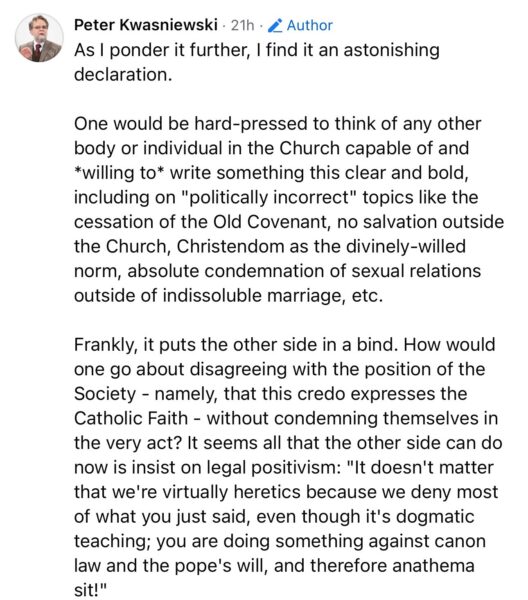
Update: Friday May 15, 6:39pm EST. This comment from our contributing editor is a rather astute analysis of both the politics and the dogmatics:
[1] Rom. 14:23.
[2] Roman Pontifical, Admonition to ordinands to the subdiaconate
[3] Mark 16:16.
[4] Pastor Aeternus, ch. 4
[5] “[U]nless we have evident indications of a person’s wickedness, we ought to deem him good, by interpreting for the best whatever is doubtful about him… He who interprets doubtful matters for the best, may happen to be deceived more often than not; yet it is better to err frequently through thinking well of a wicked man, than to err less frequently through having an evil opinion of a good man, because in the latter case an injury is inflicted, but not in the former” (II-II q60 a4 ad1).

No comments:
Post a Comment
Comments are subject to deletion if they are not germane. I have no problem with a bit of colourful language, but blasphemy or depraved profanity will not be allowed. Attacks on the Catholic Faith will not be tolerated. Comments will be deleted that are republican (Yanks! Note the lower case 'r'!), attacks on the legitimacy of Pope Leo XIV as the Vicar of Christ, the legitimacy of the House of Windsor or of the claims of the Elder Line of the House of France, or attacks on the legitimacy of any of the currently ruling Houses of Europe.