Today is Great & Holy Monday & the Feast of Our Venerable Father John Climacus, Author of The Ladder of Divine Ascent.
✠✠✠✠✠
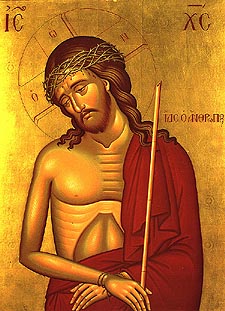
Holy Week: A Liturgical Explanation for the Days of Holy Week
3. MONDAY, TUESDAY, WEDNESDAY: THE END
These three days, which the Church calls Great and Holy have within the liturgical development of the Holy Week a very definite purpose. They place all its celebrations in the perspective of End Times; they remind us of the eschatological meaning of Pascha. So often Holy Week is considered one of the “beautiful traditions” or “customs,” a self-evident “part” of our calendar. We take it for granted and enjoy it as a cherished annual event which we have “observed” since childhood, we admire the beauty of its services, the pageantry of its rites and, last but not least, we like the fuss about the Paschal table. And then, when all this is done we resume our normal life. But do we understand that when the world rejected its Savior, when “Jesus began to be sorrowful and very heavy... and his soul was exceedingly sorrowful even unto death,” when He died on the Cross, “normal life” came to its end and is no longer possible. For there were “normal” men who shouted “Crucify Him” who spat at Him and nailed Him to the Cross. And they hated and killed Him precisely because He was troubling their normal life. It was indeed a perfectly “normal” world which preferred darkness and death to light and life.... By the death of Jesus the “normal” world, and “normal” life were irrevocably condemned. Or rather they revealed their true and abnormal inability to receive the Light, the terrible power of evil in them. “Now is the Judgment of this world” (John 12:31). The Pascha of Jesus signified its end to “this world” and it has been at its end since then. This end can last for hundreds of centuries, but this does not alter the nature of time in which we live as the “last time.” “The fashion of this world passeth away...” (I Cor. 7:31).
Pascha means passover, passage. The feast of Passover was for the Jews the annual commemoration of their whole history as salvation, and of salvation as passage from the slavery of Egypt into freedom, from exile into the promised land. It was also the anticipation of the ultimate passage—into the Kingdom of God. And Christ was the fulfillment of Pascha. He performed the ultimate passage: from death into life, from this “old world” into the new world into the new time of the Kingdom. And he opened the possibility of this passage to us. Living in “this world” we can already be “not of this world,” i.e. be free from slavery to death and sin, partakers of the “world to come.” But for this we must also perform our own passage, we must condemn the old Adam in us, we must put on Christ in the baptismal death and have our true life hidden in God with Christ, in the “world to come....”
And thus Easter is not an annual commemoration, solemn and beautiful, of a past event. It is this Event itself shown, given to us, as always efficient, always revealing our world, our time, our life as being at their end, and announcing the Beginning of the new life.... And the function of the three first days of Holy Week is precisely to challenge us with this ultimate meaning of Pascha and to prepare us to the understanding and acceptance of it.
1. This eschatological (which means ultimate, decisive, final) challenge is revealed, first, in the common troparion of these days:
Troparion—Tone 8
Behold the Bridegroom comes at midnight,ox
And blessed is the servant whom He shall find watching,
And again unworthy is the servant whom He shall find heedless.
Beware, therefore, O my soul, do not be weighed down with sleep,
Lest you be given up to death and lest you be shut out of the Kingdom.
But rouse yourself crying: Holy, Holy, Holy, are You, O our God!
Through the Theotokos have mercy on us!
Midnight is the moment when the old day comes to its end and a new day begins. It is thus the symbol of the time in which we live as Christians. For, on the one hand, the Church is still in this world, sharing in its weaknesses and tragedies. Yet, on the other hand, her true being is not of this world, for she is the Bride of Christ and her mission is to announce and to reveal the coming of the Kingdom and of the new day. Her life is a perpetual watching and expectation, a vigil pointed at the dawn of this new day. But we know how strong is still our attachment to the “old day,” to the world with its passions and sins. We know how deeply we still belong to “this world.” We have seen the light, we know Christ, we have heard about the peace and joy of the new life in Him, and yet the world holds us in its slavery. This weakness, this constant betrayal of Christ, this incapacity to give the totality of our love to the only true object of love are wonderfully expressed in the exapostilarion of these three days:
“Thy Bridal Chamber I see adorned, O my Savior
And I have no wedding garment that I may enter,
O Giver of life, enlighten the vesture of my soul
And save me.”
2. The same theme develops further in the Gospel readings of these days. First of all, the entire text of the four Gospels (up to John 13: 31) is read at the Hours (1, 3, 6 and 9). This recapitulation shows that the Cross is the climax of the whole life and ministry of Jesus, the Key to their proper understanding. Everything in the Gospel leads to this ultimate hour of Jesus and everything is to be understood in its light. Then, each service has its special Gospel lesson :
On Monday:
At Matins: Matthew 21: 18-43—the story of the fig tree, the symbol of the world created to bear spiritual fruits and failing in its response to God.
At the Liturgy of the Presanctified Gifts: Matthew 24: 3-35: the great eschatological discourse of Jesus. The signs and announcement of the End. “Heaven and earth shall pass away, but my words shall not pass away....”
“When the Lord was going to His voluntary Passion,
He said to His Apostles on the way:
Behold, we go up to Jerusalem,
And the Son of Man shall be delivered up
As it is written of Him.
Come, therefore, and let us accompany Him,
With minds purified from the pleasures of this life,
And let us be crucified and die with Him,
That we may live with Him,
And that we may hear Him say to us:
I go now, not to the earthly Jerusalem to suffer,
But unto My Father and your Father
And My God and your God,
And I will gather you up into the heavenly Jerusalem,
Into the Kingdom of Heaven....”
(Monday Matins)
Troparion — Tone 8
Behold the Bridegroom comes at midnight, / and blessed is the servant whom He shall find watching, / and again unworthy is the servant whom He shall find heedless. / Beware, therefore, O my soul, do not be weighed down with sleep, / lest you be given up to death and lest you be shut out of the Kingdom. / But rouse yourself crying: Holy, Holy, Holy, are You, O our God! / Through the Theotokos have mercy on us!
Kontakion — Tone 2
You know that this is the last hour, O wretched soul, / and fear the cutting of the fig tree. / Work diligently therefore at the talent given to you / keep watch and pray: / Let us not remain outside the bridal chamber of Christ.
✠✠✠✠✠

Saint John of the Ladder is honoured by Holy Church as a great ascetic and author of the renowned spiritual book called THE LADDER, from which he is also called “of the Ladder” (Climacus).
There is almost no information about Saint John’s origins. One tradition suggests that he was born in Constantinople around the year 570, and was the son of Saints Xenophon and Maria (January 26).
John went to Sinai when he was sixteen, submitting to Abba Martyrius as his instructor and guide. After four years, Saint John was tonsured as a monk. Abba Strategios, who was present at Saint John’s tonsure, predicted that he would become a great luminary in the Church of Christ.
For nineteen years Saint John progressed in monasticism in obedience to his spiritual Father. After the death of Abba Martyrius, Saint John embarked on a solitary life, settling in a wild place called Thola, where he spent forty years laboring in silence, fasting, prayer, and tears of penitence.
It is not by chance that in THE LADDER Saint John speaks about tears of repentance: “Just as fire burns and destroys the wood, so pure tears wash away every impurity, both external and internal.” His holy prayer was strong and efficacious, as may be seen from an example from the life of the God-pleasing saint.
Saint John had a disciple named Moses. Once, the saint ordered his disciple to bring dung to fertilize the vegetable garden. When he had fulfilled the obedience, Moses lay down to rest under the shade of a large rock, because of the scorching heat of summer. Saint John was in his cell in a light sleep. Suddenly, a man of remarkable appearance appeared to him and awakened the holy ascetic, reproaching him, “John, why do you sleep so heedlessly, when Moses is in danger?”
Saint John immediately woke up and began to pray for his disciple. When Moses returned in the evening, Saint John asked whether any sort of misfortune had befallen him.
The monk replied, “A large rock would have fallen on me as I slept beneath it at noon, but I left that place because I thought I heard you calling me.” Saint John did not tell his disciple of his vision but gave thanks to God.
Saint John ate the food which is permitted by the monastic rule but only in moderation. He did not sleep very much, only enough to keep up his strength, so that he would not ruin his mind by unceasing vigil. “I do not fast excessively,” he said of himself, “nor do I give myself over to intense all-night vigil, nor lay upon the ground, but I restrain myself..., and the Lord soon saved me.”
The following example of Saint John’s humility is noteworthy. Gifted with discernment, and attaining wisdom through spiritual experience, he lovingly received all who came to him and guided them to salvation. One day some envious monks reproached him for being too talkative, and so Saint John kept silence for a whole year. The monks realized their error, and they went to the ascetic and begged him not to deprive them of the spiritual profit of his conversation.
Concealing his ascetic deeds from others, Saint John sometimes withdrew into a cave, but reports of his holiness spread far beyond the vicinity. Visitors from all walks of life came to him, desiring to hear his words of edification and salvation. After forty years of solitary asceticism, he was chosen as igumen of Sinai when he was seventy-five. Saint John governed the holy monastery for four years. Toward the end of his life, the Lord granted him the gifts of clairvoyance and wonderworking.
At the request of Saint John, igumen of the Raithu monastery (Commemorated on Cheesefare Saturday), he wrote the incomparable LADDER, a book of instruction for monks who wished to attain spiritual perfection.
Knowing of the wisdom and spiritual gifts of Saint John of Sinai, the igumen of Raithu requested him to write down whatever was necessary for the salvation of those in the monastic life. Such a book would be “a ladder fixed on the earth” (Gen. 28:12), leading people to the gates of Heaven.
Saint John felt that such a task was beyond his ability, yet out of obedience he fulfilled the request. The saint called his work THE LADDER, for the book is “a fixed ladder leading from earthly things to the Holy of Holies....” The thirty steps of spiritual perfection correspond to the thirty years of the Lord’s age. When we have completed these thirty steps, we will find ourselves with the righteous and will not stumble. THE LADDER begins with the renunciation of the world and ends with God, Who is love (1 John 4:8).
Although the book was written for monks, any Christian living in the world will find it an unerring guide for ascending to God, and support in the spiritual life. Saint Theodore the Studite (November 11 and January 26), Sergius of Radonezh, Joseph of Volokolamsk, and others relied on THE LADDER as an important guide to salvation.
The twenty-second step of THE LADDER deals with various forms of vainglory. Saint John writes: “When I fast, I am vainglorious; and when I permit myself food in order to conceal my fasting from others I am again vainglorious about my prudence. When I dress in fine clothing, I am vanquished by vanity, and if I put on drab clothing, again I am overcome by vanity. If I speak, vainglory defeats me. If I wish to keep silence, I am again given over to it. Wherever this thorn comes up, it stands with its points upright.
A vain person seems to honour God but strives to please men rather than God.
People of lofty spirit bear insult placidly and willingly, but only the holy and righteous may hear praise without harm.
When you hear that your neighbour or friend has slandered you behind your back, or even to your face, praise and love him.
It is not the one who reproaches himself who shows humility, for who will not put up with himself? It is the one who is slandered by another, yet continues to show love for him.
Whoever is proud of his natural gifts, intelligence, learning, skill in reading, clear enunciation, and other similar qualities, which are acquired without much labor, will never obtain supernatural gifts. Whoever is not faithful in small things (Luke 16:10), is also unfaithful in large things, and is vainglorious.
It often happens that God humbles the vainglorious, sending a sudden misfortune. If prayer does not destroy a proud thought, we bring to mind the departure of the soul from this life. And if this does not help, let us fear the shame which follows dishonor. “For whoever humbles himself shall be exalted, and whoever exalts himself shall be humbled” (Luke 14:11). When those who praise us, or rather seduce us, start to praise us, let us recall our many sins, then we shall find that we are not worthy of what they say or do to honour us.”
In THE LADDER Saint John describes the ascent toward spiritual perfection, which is essential for anyone who wishes to save his soul. It is a written account of his thoughts, based on the collected wisdom of many wise ascetics, and on his own spiritual experience. The book is a great help on the path to truth and virtue.
The steps of THE LADDER proceed gradually from strength to strength on the path of perfection. The summit is not reached suddenly, but gradually, as the Savior says: “The Kingdom of Heaven suffers violence, and the violent take it by force” (Mt.11:12).
Saint John is also commemorated on the fourth Sunday of Great Lent.
Troparion — Tone 8
By a flood of tears, you made the desert fertile / and by your longing for God you brought forth fruits in abundance. / By the radiance of miracles you illuminated the whole universe. / O our holy Father John Climacus, pray to Christ our God to save our souls.
Kontakion — Tone 1
You offered us your teachings as fruits of everlasting freshness, / to sweeten the hearts of those who receive them with attention. / O blessed and wise John, they are the rungs of a ladder, / leading the souls of those who honor you from earth to Eternal glory in Heaven!

No comments:
Post a Comment
Comments are subject to deletion if they are not germane. I have no problem with a bit of colourful language, but blasphemy or depraved profanity will not be allowed. Attacks on the Catholic Faith will not be tolerated. Comments will be deleted that are republican (Yanks! Note the lower case 'r'!), attacks on the legitimacy of Pope Leo XIV as the Vicar of Christ, the legitimacy of the House of Windsor or of the claims of the Elder Line of the House of France, or attacks on the legitimacy of any of the currently ruling Houses of Europe.