✠✠✠✠✠

Saturday is the day which the Church has set aside for the commemoration of Catholic Christians who have departed this life in the hope of resurrection and eternal life. Since the Divine Liturgy cannot be served on weekdays during Great Lent, the second, third, and fourth Saturdays of the Fast are appointed as Soul Saturdays when the departed are remembered at Liturgy.
In addition to the Liturgy, kollyva (wheat or rice cooked with honey and mixed with raisins, figs, nuts, sesame, etc.) is blessed in church on these Saturdays. The kollyva reminds us of the Lord’s words, “Unless a grain of wheat falls into the earth and dies, it remains alone; but if it dies, it bears much fruit” (John 12:24).The kollyva symbolizes the future resurrection of all the dead. As Saint Simeon of Thessalonica (September 15) says, man is also a seed which is planted in the ground after death, and will be raised up again by God’s power. Saint Paul also speaks of this (I Cor. 15:35-49).
It is also customary to give alms in memory of the dead. The angel who spoke to Cornelius testifies to the efficacy of almsgiving, “Your prayers and your alms have ascended as a memorial before God” (Acts 10:4).
Memorial services for the dead may be traced back to ancient times. Chapter 8 of the Apostolic Constitutions recommends memorial services with Psalms for the dead. It also contains a beautiful prayer for the departed, asking that their voluntary and involuntary sins be pardoned, that they be given rest with the Patriarchs, Prophets, and Apostles in a place where sorrow, suffering, and sighing have fled away (Isaiah 35:10). Saint John Chrysostom mentions the service for the dead in one of his homilies on Philippians and says that it was established by the Apostles. Saint Cyprian of Carthage (Letter 37) also speaks of our duty to remember the martyrs.
The holy Fathers also testify to the benefit of offering prayers, memorial services, Liturgies, and alms for the dead (Saint John Chrysostom, Saint Cyril of Jerusalem, Saint John of Damascus, etc.). Although both the righteous and those who have not repented and corrected themselves may receive benefit and consolation from the Church’s prayer, it has not been revealed to what extent the unrighteous receive this solace. It is not possible, however, to transfer a soul from a state of evil and condemnation to a state of holiness and blessedness through the Church’s prayer. Saint Basil the Great points out that the time for repentance and forgiveness of sins is during the present life, while the future life is a time for righteous judgment and retribution (Moralia 1). Saint John Chrysostom, Saint Gregory the Theologian, and other patristic writers concur with Saint Basil’s statement.
By praying for others, we bring benefit to them, and also to ourselves, because “God is not so unjust as to forget your work and the love which you showed for His sake in serving the saints...” (Heb. 6:10).
Troparion — Tone 8
Only Creator, with wisdom profound, You mercifully order all things, / and give that which is needed to all men: / Give rest, O Lord, to the souls of Your servants who have fallen asleep, / for they have placed their trust in You, our Maker and Fashioner, and our God.
Kontakion — Tone 8
✠✠✠✠✠
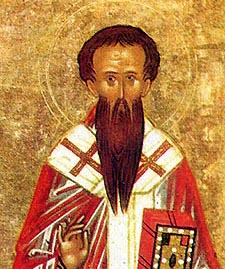
Saint Basil the Confessor was a monk and suffered during the reign of the iconoclast emperor Leo the Isaurian (717-741). When persecution started against those who venerated holy icons, Saint Basil and his companion Saint Procopius of Decapolis (February 27) were subjected to much torture and locked up in prison. Here both martyrs languished for a long while, until the death of the impious Emperor.
When the holy Confessors Basil and Procopius were set free along with other venerators of holy icons, they continued in their monastic struggles, instructing many in the Catholic Faith and the virtuous life. Saint Basil died peacefully in the year 750.
Troparion — Tone 1
Dweller of the desert and angel in the body, / you were shown to be a wonder-worker, our God-bearing Father Basil. / You received heavenly gifts through fasting, vigil, and prayer: / Healing the sick and the souls of those drawn to you by faith. / Glory to Him who gave you strength! / Glory to Him who granted you a crown! / Glory to Him who through you grants healing to all!
Kontakion — Tone 2
(Podoben: “Seeking the highest...”)
You received a revelation of God from on high, O wise one, / and withdrew from the midst of the world’s tumult. / You lived the monastic life with honour, / receiving the power to work miracles and heal diseases by grace, / most blessed and holy Basil.

No comments:
Post a Comment
Comments are subject to deletion if they are not germane. I have no problem with a bit of colourful language, but blasphemy or depraved profanity will not be allowed. Attacks on the Catholic Faith will not be tolerated. Comments will be deleted that are republican (Yanks! Note the lower case 'r'!), attacks on the legitimacy of Pope Leo XIV as the Vicar of Christ, the legitimacy of the House of Windsor or of the claims of the Elder Line of the House of France, or attacks on the legitimacy of any of the currently ruling Houses of Europe.