24 October 2026

Why Modernists Hate the Feast of Christ the King

An online friend's take on why the modernists felt compelled to destroy the Feast of Christ the King, radically changing the prayers, and moving its date. (permissu auctoris)


From The Catholic Esquire

We know Modernists hate the Feast of Christ the King because of what they did to it. To understand why Modernists hate the Feast of Christ the King, it is necessary to see what the feast really stands for and then we can more fully appreciate and interpret their actions. In doing so, we will see that the Modernist hates the Feast of Christ the King because in their arrogance and pride they believe they are above the authority of Christ and the deposit of faith.

Purpose of the Feast

After nearly a century of dogmatic explication and teachings concerning the role Christ’s kingship should play in the modern world, it was Pope Pius XI in 1925 that solidified this body of authoritative teachings and instituted the Feast of Christ the King, which was to be celebrated annually on the last Sunday of the month of October.

Notice Pius XI did not make up this feast day out of whole cloth. It was a culmination of decades of explicitly clear teachings from multiple pontificates, grounded in Holy Scripture, that emphasized the need to make Christ and his teachings an essential part of our political and social life—both our public and private lives. We commonly refer to this as the Social Kingship of Christ.

For example, Pope Gregory XVI, in his 1832 encyclical Mirari Vos, warned Bishops of modern trends attempting to weaken the “sanctity and indissolubility” of marriage. He also recognized that the Church was afflicted by indifferentism, essentially a rejection of Christ’s saving action on the Cross, in which it was erroneously claimed that “it is possible to obtain eternal salvation of the soul by the profession of any kind of religion, as long as morality is obtained.”

Blessed Pope Pius IX continued these strains of thought in his 1864 encyclical Quanta Cura in which he addressed the “absurd principle” of a society attempting to govern itself without religion. We can see Pius IX’s thoughts more clearly when we review his Syllabus of Errors, in which he condemns the following proposition:

“Human reason, without any reference whatsoever to God, is the sole arbiter of truth and falsehood, and of good and evil; it is law to itself, and suffices, by its natural force, to secure the welfare of men and of nations.” (Syllabus of Errors, para. 3)

Pope Leo XIII likewise made papal pronouncements on the role of Christ and His Church in public life in numerous encyclicals applying Catholic social teaching to various social ills and public policy problems.  Leo recounted the days before the protestant revolt and the so-called Enlightenment

“when States were governed by the philosophy of the Gospel. Then it was that the power and divine virtue of Christian wisdom had diffused itself throughout the laws, institutions, and morals of the people, permeating all ranks and relations of civil society.” (Immortale Dei, Para. 21).

Leo would lament that over the course of the nineteenth century,

“the authority of God is passed over in silence, just as if there were no God; or as if He cared nothing for human society; or as if men, whether in their individual capacity or bound together in social relations, owed nothing to God[.]” (Immortale Dei, para. 25)

Pope St. Pius X, also building upon the foundations laid by prior pontificates, strongly condemned legislation in France in 1905 mandating the separation of church and state:

“that the State must be separated from the Church is a thesis absolutely false, a most pernicious error…this thesis inflicts great injury on society itself, for it cannot either prosper or last long when due place is not left for religion…Hence the Roman Pontiffs have never ceased, as circumstances required, to refute and condemn the doctrine of the separation of Church and State”  (Vehementor Nos, para. 3).

This is just a sampling of the prior teachings from the Holy See that set the stage for Pope Pius XI to institute the Feast of Christ the King in his encyclical Quas Primas. By 1925, it was clear that Christian morality was being excluded from both private and public affairs. Citing to Holy Scripture where Christ’s kingship is established in numerous passages (see e.g. Luke 1:32-33, Matthew 25: 31-40, John 18:37, Matthew 28:18), Pius declares it must surely be right then “with every token of veneration salute her Author and Founder in her annual liturgy as King and Lord, and as King of Kings.”

And what is the nature of Christ’s kingship? Certainly, this kingship is a spiritual one and concerned with spiritual things. But that does not mean Christ must be excluded from our social and political life either. Pius goes on to state,

“It would be a grave error, on the other hand, to say that Christ has no authority whatever in civil affairs, since, by virtue of the absolute empire over all creatures committed to him by the Father, all things are in his power. Nevertheless, during his life on earth he refrained from the exercise of such authority, and although he himself disdained to possess or to care for earthly goods, he did not, nor does he today, interfere with those who possess them. Non eripit mortalia qui regna dat caelestia (emphasis added).” (Quas Primas, para. 17).

We know that Christ does not exercise his rightful direct temporal power over civil governments; rather, he charges our elected politicians and leaders with the duty to honor, defend, and implement His kingdom here on earth. Yes, it is OUR job to influence our society and culture in order to bring it in line with requirements of the natural and divine laws. The Kingship of Christ, in other words, is not an excuse to accommodate our lives to the secular, godless world we find ourselves living in while waiting for Christ to fix all of this at the end of time. No—WE are supposed to be working for the Kingdom in the here and now—for the good of souls!

How would the celebration of a liturgical feast help hasten the return of civil society to Christ’s dominion?

“Nations will be reminded by the annual celebration of this feast that not only private individuals but also rulers and princes are bound to give public honor and obedience to Christ. It will call to their minds the thought of the last judgment, wherein Christ, who has been cast out of public life, despised, neglected and ignored, will most severely avenge these insults; for his kingly dignity demands that the State should take account of the commandments of God and of Christian principles, both in making laws and in administering justice, and also in providing for the young a sound moral education (emphasis added.)” (Quas Primas, para. 32).

Is there any doubt what the purpose of the Feast of Christ the King was supposed to accomplish? Pius XI, consistent with the Church’s Holy Tradition and Holy Scripture, sought to remind the faithful that Christ’s kingship extends not only over the spiritual realm but the earthly one as well, including our political and social lives. This means that Christ demands we follow His commandments in our personal lives as well as upholding the divine and natural laws in civil affairs, no matter how unpopular or counter-cultural those positions may be. We must uphold the sanctity of marriage, defend innocent life, protect children from evil influences, and develop civil laws that support morality and the natural law.

Modernizing the Feast of Christ the King

And now you can see why the Modernist infiltrators of the Church needed to rid themselves of this Feast of Christ the King.

As author Michael Davies so aptly stated,

“It was the insistence of the Pope upon the social reign of Christ the King—on the fact that states, as well as individuals, must submit themselves to His rule—which caused such embarrassment to the bishops of the world (and nowhere more so than in the United States), which has resulted, as Hamish Fraser expressed it, in Quas Primas‘ becoming the greatest non-event in the history of the Church.” (Michael Davies, The Reign of Christ the King, Tan Books (1992), e-book 253).

That’s right, the Feast of Christ the King was embarrassing to the hierarchy who desperately sought the approval of secular civil leadership and protestants; certainly, it was inconsistent with the idea of a new world order grounded in principles of the Enlightenment, public vice, and liberalism. Pius XI’s feast pointed the faithful back to a time when the natural moral law was defended and upheld in various Christian kingdoms in association with the Catholic Church who guarded the souls of Christian subjects. Such ideas were simply incompatible with modern, respectable world opinion and so this feast (and what is stood for) became unacceptable as well.

At this point, many would would note that all the Vatican did was move the feast to a different day! What’s the big deal?!

Hat tip to Dr. Peter Kwasniewski who turned me on to this bit of important information. Pope Paul VI did not just move the Feast of Christ the King to a different date and change its name, he replaced it entirely! That’s right, Paul VI abolished Pius XI’s Feast of Christ the King and replaced it with the Solemnity of Our Lord Christ, King of the Universe. Here is the Latin with a rough English translation, contained in the Calendarium Romanum from 1969 where the new feast day was declared:

Ultima dominica per annum fit sollemnitas D. N. I. C. universorum  Regis, loco festivitatis institutae a Pio Papa XI, a. 1925 et ultimae dominicae octobris assignatae. Hac ratione, momentum quoque eschatologicum huius dominicae meliore in luce ponitur.

My rough translation (non-official) translation:

“The Solemnity of Our Lord Jesus Christ King of the Universe occurs on the last Sunday of the liturgical year in place of the feast instituted by Pope Pius XI in 1925 and assigned to the last Sunday of October. For this reason, the eschatological importance is brought to light.”

As Dr. Kwasniewski pointed out, the use of the Latin word “loco” is significant because it shows Pope Paul VI intended to replace not just transfer Pius XI’s Feast of Christ the King. The new Solemnity was designed to replace the old feast with a new one that on the surface appeared to be the same feast [probably to avoid alarm from the rigid traditionalists!] but was designed to take the focus off of Christ’s temporal authority over civil affairs and redirect it to Christ’s everlasting Kingdom that will be perfected at the end of time. As Dr. Kwasniewski also pointed out, Paul VI’s changes removed the feast from appearing to conflict with Reformation Day, also celebrated at the end of October by protestants.  

Modernists Hate What “Christ the King” Stands For

Of all the innovations and distortions that modernist infiltrators have imposed on the Catholic Church, the effective suppression of Pope Pius XI’s 1925 Feast of Christ the King in exchange for Pope Paul VI’s 1969 Solemnity of Our Lord Christ, King of the Universe is one of the most glaring and shameful examples.

This transformation (actually replacement) of the 1925 Feast for the 1969 Solemnity is a fascinating example of how Modernist thought fuels the Antichurch and shines a light on how the Modernist churchman views the role of Catholicism in society. If you think this is much ado about nothing, just remember to ask yourself: did Paul VI HAVE to change the feast day? If not, then WHY was it changed?

He changed it because the Modernists do not believe real Catholicism has anything to contribute to the way society is governed. In fact, it hinders mankind’s progress they think. They believe the will of man is the sole guiding principle for how society, government and politics should operate. Christ apparently is just watching all of this from Heaven and will assert His authority one day at the end of time and just confirm with approval all the great things these brilliant geniuses are doing now. Of course, we don’t really have to worry about what Christ wants in the here and now! Wrong.

We have seen this play out with glaring examples just over the past two years with the rise of the Great Reset and COVIDism as the Vatican and the world’s bishops surrendered their authority and duty to protect the Sacrifice of the Holy Mass to global elites and their politicians. We see a shining example of this when the same hierarchy shamed and forced faithful Catholics into injecting their bodies with abortion-tainted poisons to avoid conflict with secular ideals. We saw parish priests forcibly remove pregnant mothers from Mass and refuse sacraments to the faithful in effort to comply with health department requirements and an evil CDC political agenda. There are so many other examples.

This complete cowardly surrender of the Church’s (and by extension Christ’s) authority in the face of secular pressure can only happen if you reject the idea that Christ’s commands and the Gospel can and should play a role in the way our civil society operates. It’s an affront to the Church and to Christ Himself, to whom we all owe our ultimate allegiance.

All of this goes to show that defeating Modernism within the Church matters because it affects what happens in civil society as well as eternal souls. How we worship, including our feast days, reflects our faith. Our faith must guide us in our lives. Our faith demands that we restore Christ to His throne and defeat the Great Reset. In doing so, we begin the long process of restoring Christendom. Viva Cristo Rey!

Learning To Love This Land

I love Wilber, Nebraska, and these United States. I don't agree with their form of government, but that has nothing to do with my attachment to them.

From the Front Porch Republic

By Frank DeVito

As time passes, I realize [that] this idea of loving one’s home, one’s land, one’s place often threatens to exist more as an abstract idea than as a lived reality.

The love of one’s local place should be a foundational part of a conservative worldview. In order to conserve what is good and true and beautiful, you have to be rooted in a place where those transcendental values are real and concrete.

I first learned to love a place by example, by the great love with which my wife’s family loves the little piece of eastern Pennsylvania we call home. With every year that we live in this county, I gain a deeper appreciation for the people, the roads, the forest-covered little mountains both to the north and south that make our region a “Valley.” I have turned down interesting job opportunities over the years because they would move me to Washington, DC or Philadelphia, but I will not go. I fully intend to die in the county in which I now live, and I hope my children and my children’s children will do the same.

I have reflected particularly on this need to be intergenerationally rooted in a place in recent weeks, since the death of Wendell Berry. Jayber Crow was perhaps the most profound influence, after my wife’s family, that made me take this rootedness, this love of one’s home, seriously in my own life. There is something not only romantic or beautiful but profoundly human about knowing a place, a community, a people, a landscape so well that they become part of the very fabric of your being.

But as time passes, I realize the extent to which this idea of loving one’s home, one’s land, one’s place often threatens to exist more as an abstract idea than as a lived reality. Conservative intellectuals may truly embrace the idea of localism from their positions in metropolitan think tanks or manicured suburbs. And that intellectual embrace is a good thing. But as we see from the genius of Wendell Berry’s experience, until one really knows a bit of particular land, appreciation for the love of place can only go so deep. Berry was able to write as a prophet of place because he knew his own place, from the neighbors to the very soil, over the course of a very fruitful lifetime.

I am learning this myself, not just in my mind but in my lived reality, by engagement with my own land. I am originally a product of the suburbs, growing up just over the New York border in southwestern Connecticut—essentially an extension of the NYC commuter suburbs. Gardens were decorative. Front lawns were small enough to mow with a push-mower in under a half hour. Landscaping was an outsourced endeavor. And I took that mentality with me as an adult: my inclination is to pay someone to do house projects or yard work as often as possible.

Yet, two years ago we moved from the small house our family had outgrown to the home and property where I plan to spend the rest of my life. It is still in a neighborhood, in a sense. But it is different: while we only have an acre of property, it is not a typical suburban lot. The edges are thick with pines and black walnuts. The sloping yard has large sections of various flowering bushes and wild raspberries. Dozens of species of birds come and go. Families of eagles and hawks perch on the high tower in an adjacent field. And before we got a German Shepherd, groundhogs burrowed around the edges of the property, and foxes and raccoons vied for access to our henhouse. It is a small property, but it is wild.

A northeastern suburbanite by upbringing, I initially balked at the idea of spending evenings after the kids go to bed or Saturday afternoons tending to this little bit of nature, sawing branches and pulling weeds and bringing order from nature’s chaos. I’m a writer and an amateur intellectual, after all. Can’t someone else do the landscaping?

But my wife was (correctly) convinced that this was our land, our property, and it needed our care. So little by little, we got to work. The tall lines of pine trees, our natural barrier between the road on one side and the neighboring lot on the other, were in danger of dying. The lower branches were bare; the trunks were lined with vines choking the trees to death. So we started fighting back. As I began firing up the chainsaw and cutting through the layers of dead branches, we got to the heart of the problem. Poison ivy climbing the tree trunks. Virginia creeper wrapping itself among the branches. Mulberries growing up from the undergrowth and smothering the once-mighty pines. There was a diverse, fascinating array of wilderness attempting to return our property from a well-cultivated lot to a thick, dense forest.

While I admittedly still prefer my desk and my books to a pair of gloves and hedge clippers, I have begun learning to love this work. More accurately, I love the land. What was once simply the yard around the house that I purchased has become more intimately my land, my place. I know which trees are more likely to attract invasive vines, and I know the different species of vine. I am starting to tell which plants are dead and which can be revived if properly cared for. And I (finally) know the difference between Virginia creeper and poison ivy.

This is not merely an exercise in identifying wildlife. Being from a place is not merely about knowing who your neighbors are or appreciating the local businesses and accents and customs. It is about being intimately familiar with every detail of the place. My land is not merely mine because I hold the deed. Ultimately, God is master of everything. He gives us ownership of property, yes. But we are stewards. It would be a weak hold on my property to merely occupy the space without knowing it intimately. Every bush that attracts butterflies, every type of bird that perches in our branches, every invasive plant vying for control of our little forest, is part of what God has given me. I must tend it, love it, bring order to it. And to do that, I must know it. Hands that do not pull weeds, tend plants, and accept the occasional thorn are not the hands of one who actually knows his place.

Perhaps this reality sheds light on the wisdom of the founders of this country originally limiting voting rights to owners of property. Property ownership was not a mere status symbol, a sign of wealth. Those who owned property were intimately tied to the land and, therefore, to the place of which they were a part. Renters come and go; owners are part of the place. They know it. They tend it. Therefore, they have a vested interest in the laws that govern it and bring about its good.

Not everyone necessarily has to cut dead branches, pull Virginia creeper out of pine trees, and plant fruit trees on their property to love their land and their place. But there is a deep reality to be found here: God has given each of us a place in this life that He owns but asks us to steward and tend. That reality, that love of a place, is hard to access by reading and thought alone.

As I look out on the trees, observe the flora and fauna around the four corners of the property I am blessed to have, and feel the dull ache of a splinter in my left index finger, I feel deeply what it is to be from a place. This is my place. I tend it. I care for it. I love it. And because of that, I can appreciate with a depth I have never before experienced what it means to be intimately tied to the land, to home.

Bishop Challoner's Meditations ~ October 25th

ON THE VICE OF SPIRITUAL SLOTH

Consider first, that spiritual sloth is a most pernicious evil, whether we consider it in a more general acceptation as a laziness of spirit, or a backwardness, negligence, and carelessness, with regard to all the things of God and Christian virtues, with a loathing and repugnance to the taking of any pains for the acquisition of them; or, as it is taken by divines, when they number it amongst the seven capital sins - a particular indisposition of the soul with regard to the love of God, opposite to the virtues of godliness, devotion, and prayer, and a loathing, as it were, of divine love in the soul. The former is a more extensive evil, an enemy to all virtues in general, by opposing them all, and a mother or nurse of all other vices, by letting them all in, and nourishing them all in the soul. The latter is particularly opposite to the divine virtue of charity, the queen of all virtues, and to the glory of God's name and his kingdom in our souls. And therefore when it is considerable in its kind, it is a great mortal sin, by reason of its direct opposition to divine love, which it banishes from the soul. And no wonder, for if it be a great crime to oppose the spiritual good of our neighbour, by envying or resisting the reign of the love of God in his soul, it must be no less criminal to withstand and oppose the coming of the kingdom of God's grace and his love into our own souls. 

Consider 2ndly, the numberless evils that flow from the vice of spiritual sloth, when once it possess the soul; more especially in the way of sins of omission, such as the neglect of prayer and of all other religious exercise, the keeping away from the sacraments, and consequently the stopping up, or turning off from the soul all the channels of divine grace, and laying her open, unguarded, and defenceless to all her enemies. And thus the slothful soul is made a daily prey to Satan and to sin, and lives, in a manner, without God. Hence the daughters of this spiritual sloth, according to St. Gregory, are, 1. Despair, or giving up the cause of God and of the soul, so as to have neither hope nor concern for one's eternal salvation; 2. Pusillanimity or cowardice, dreading or flying from the least pains or labour in the service of God; 3. A numbness of soul with regard to all the divine precepts; 4. Malice, or an aversion to all sanctity, and to the professors of it; 5. A rancour, or an indignation against all such as seek to bring us to God. and lastly, a dissipation of mind turned away from the things of God, and always running after creatures. From these unhappy fruits you may judge of the worthlessness of the tree which produces them, and learn to dread so pernicious a vice.

Consider 3rdly, that this vice of sloth is the more dangerous, because like the rest of the spiritual sins it lies deeper in the soul, and is easier overlooked, by such as will not take the pains to think, and to examine well the state of their interior. Carnal sins are more easily discovered, because their guilt carries with it greater shame in the eyes of men, which makes it fly in the face of the sinner, and he cannot disguise it, but spiritual sins are more heinous in the eyes of God, though not much considered by men, and often not regarded at all. And thus, as thousands live and die under the mortal guilt of the spiritual vices of pride, envy, hatred, or covetousness, unregarded and unrepented of, so 'tis to be feared thousand live and die under the mortal guilt of spiritual sloth, unregarded and unrepented of. For what other judgment can we make of those slothful servants whom the gospel so loudly condemns? Or what can be said in favour of them, who being sent into this world upon no other business but to learn to love and to serve their God, through this unhappy sloth live and die, without so much as once seriously thinking upon this great business, much less putting it into execution?

Conclude to look well to thyself, and to examine thyself well, how thy heart stands affected with regard to the glory of God's name, the advancement of his kingdom within thee, and the reign of his love. If this be what thou seekest in the first place, all is well; but if thou admittest of a loathing or repugnance to this, and givest the preference in thy heart to anything else, assure thyself that the demon of spiritual sloth possesses thy soul, and that God has no share in thee.

25 October, Antonio, Cardinal Bacci: Meditations For Each Day


“Deliver Us From Evil”

1. “Deliver us from evil. Amen.” This is our last request in the Lord’s Prayer. God is our Father, Creator, and Redeemer, Who cannot desire our ruin, but only our welfare. Nevertheless, He wishes us to ask Him every day to deliver us from evil.

We ask God to deliver us from evil of any kind. There is nothing to prevent us from beseeching Him to save us from physical ills, such as sickness or hardship or any of the other many afflictions of life. God loves us and therefore does not wish us to have to suffer. He loves us, however, as He knows best, and so desires our true welfare. He knows that suffering and sorrow are our necessary heritage in life. They are the salt which preserves us from corruption.

It would be fatal for us to be always happy in this world, for then we should forget God and our true everlasting happiness. By all means let us ask humbly for deliverance from bodily ills, but let us not complain if God does not grant our request. He alone knows what is best for us now and in the future.

Finally, when we ask God to rescue us from material evils, we should do so in a spirit of submission and resignation to His holy will. “Thy will be done on earth as it is in Heaven.” We should keep in mind the words of Jesus Christ. “If anyone wishes to come after me, let him deny himself, and take up his cross daily, and follow me.” (Luke 9:23) Where are we to follow Him? To Calvary, of course. We must suffer and die as He did. Only afterwards can we achieve everlasting happiness.

Deliver us from evil, therefore, O God. Deliver us if possible from bodily and from earthly ills, but let Your will be done. We realise that there is a purpose in suffering, the mission of which is to purify us and lead us more easily to You. We shall thank You if You hear our plea, but we shall be no less grateful if it pleases You to reject it.

2. When we ask God to deliver us from evil, we should think chiefly of the real evil, which is spiritual. All other evils are insignificant in comparison with sin, which is an offense committed against God , our only good. Sin robs us of His grace, which is the supernatural life of the soul, deprives us of His friendship, and is an act of ingratitude towards our supreme Benefactor.

When we pray to God to deliver us from evil, we should renew our determination to avoid sin by every means in our power. Prayer is futile unless it is accompanied by the resolution never to offend God again. Our prayers and good resolutions will draw God’s favour and will strengthen our bond of intimacy with Him.

3. Deliver us, O God, from the evil of the eternal damnation. Sin is the greatest evil, but as long as we are on earth it is an evil which can still be remedied, for God in His infinite mercy is always ready to forgive us and to restore us to His divine friendship if we sincerely repent. In Hell, however, there is no further remedy, for there the mercy of God has been superseded by His infinite justice. Where the tree falls, there it must lie forever. Such dreadful unhappiness is barely conceivable.

Deliver us from sin, O God; deliver us from a bad death; deliver us from Hell. Help us to love You more and more and to serve You more faithfully so that we may one day enjoy Your blessed company for all eternity. Amen.

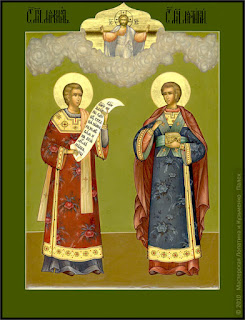
Byzantine Saints: Martyrs Marcian and Martyrius, the Notaries of Constantinople


Eastern Rite ~ Feasts of 25 October AM 7534

Today is the Feast of the Holy Martyrs and Notaries Marcian and Martyrius.
✠✠✠✠✠

The Martyrs Marcian and Martyrius, Notaries of Constantinople served in a Constantinople cathedral. Marcian was a reader and Martyrius a subdeacon. They both performed in the capacity of notaries, i.e. secretaries, for Patriarch Paul the Confessor (November 6).

Arian heretics expelled and secretly executed the righteous Patriarch Paul. His throne was given to the heretic Macedonius. The heretics attempted to entice Saints Marcian and Martyrius over to their side by flattery. They offered them gold and promised to consecrate them as archbishops, but all the efforts of the Arians were in vain.

Then the impious threatened to slander them before the emperor and sought to intimidate them with torture and death. But the saints steadfastly confessed the Catholic Faith, as handed down by the Fathers of the Church. Marcian and Martyrius were sentenced to death. Before death, the martyrs prayed, “Lord God, Who has invisibly created our hearts, and directed all our deeds, accept with peace the souls of Your servants, since we perish for You and are considered as sheep for the slaughter (Ps 32/33:15; 43/44:22). We rejoice that by such a death we shall depart this life for Your Name. Grant us to be partakers of life eternal with You, the Source of life.” After their prayer, the martyrs, with quiet rejoicing, bent their necks beneath the sword of the impious (+ ca. 335).

Their holy bodies were reverently buried by Catholic Christians. Later, by decree of Saint John Chrysostom, the relics of the holy martyrs were transferred to a church built in their honour. Believers here were healed of many infirmities through the prayers of the saints, to the glory of the One Life-Creating Trinity.

Troparion — Tone 3

In holy zeal, you dispelled the error of Arius / and proclaimed the Trinity, one in essence. / Holy Martyrs Marcian and Martyrius, / unshaken bulwarks of the Catholic Faith, / entreat Christ our God to grant us His great mercy.

Kontakion — Tone 4

(Podoben: “As You were voluntarily raised...”)
From your youth you were good athletes, wise Marcian and Martyrius, / vanquishing the Arian heretics; / you kept the faith perfect by following in the footsteps of your bishop and teacher Paul, / therefore, you are worthy to be with him in eternal life, / as respected defenders of the Holy Trinity.

IN LUMINE FIDEI: 25 OCTOBER – SAINTS CHRYSANTHUS AND DARIA (Martyrs)


IN LUMINE FIDEI: 25 OCTOBER – SAINTS CHRYSANTHUS AND DARIA (Martyrs): Chrysanthus and Daria were husband and wife, noble by birth, and still more by their faith which Daria had received together with bapti...

IN LUMINE FIDEI: 25 OCTOBER – CHRISTUS REX (CHRIST THE KING)


IN LUMINE FIDEI: 25 OCTOBER – CHRISTUS REX (CHRIST THE KING): This feast was instituted by Pope Pius XI in the Holy Year of 1925 to salute the Author and Founder of the Church as “King and Lord” and ...

25 October, The Chesterton Calendar

OCTOBER 25th

If a thing is worth doing, it is worth doing badly.

'What's Wrong with the World.'

25 October, The Holy Rule of St Benedict, Patriarch of Western Monasticism

CHAPTER XVIII. In what order the Psalms are to be said

24 Feb. (if it be leap-year; if not it is added to the preceding day). 25 June. 25 Oct. 

The order of psalmody for the Day-Hours being now arranged, let all the remaining 25 Psalms be equally distributed among the seven Night- Offices, dividing the longer Psalms among them, and assigning twelve to each night. Above all, we recommend that if this arrangement of the Psalms be displeasing to anyone, he should, if he think fit, order it otherwise; taking care in any case that the whole Psalter of a hundred and fifty Psalms be recited every week, and always begun afresh at the Night-Office on Sunday. For those monks would shew themselves very slothful in the divine service who said in the course of a week less than the entire Psalter, with the usual canticles; since we read that our holy fathers resolutely performed in a single day what I pray we tepid monks may achieve in a whole week.

26 October, The Roman Martyrology


S
éptimo Kaléndas Novémbris Luna quinta décima. Anno Dómini 2026
October 26th 2026, the 15th day of the Moon, was born into the better life:
At Rome, the holy martyr, Pope Evaristus, who dyed the Church of God with his blood under the Emperor Hadrian.
In Africa, the holy martyrs Rogatian the Priest and Felicissimus, who were crowned with a glorious martyrdom in the persecution under the Emperors Valerian and Gallienus. Holy Cyprian writeth of them in his epistle unto the Confessors.
At Nicomedia, (in the persecution under the Emperor Decius,) the holy martyrs Lucian, Florius, and their Companions.
On the same day, holy Quod-Vult-Deus, Bishop of Carthage, whom the Arian king Genseric embarked along with his clergy in unseaworthy ships without oars or sails, but beyond all hope he arrived at Naples and there died in exile as a Confessor.
At Narbonne, the holy Confessor Rusticus, Bishop (of that see,) who enlightened the times of the Emperors Valentinian and Leo.
At Salerno, (in the seventh century,) holy Gaudiosus, Bishop (of that see.)
At Pavia, (in the year 1229,) holy Fulke, Bishop (of that see.)
At Hildesheim, in Saxony, the holy Confessor Bernward, Bishop (of that see,) whose name Celestine III numbered with those of the Saints.
Also (at Policastro, in the sixth century,) the holy Sub-deacon Quadragesimus, who raised a dead man to life, (as is related by the blessed Pope Gregory.)
℣. And elsewhere many other holy martyrs, confessors, and holy virgins.
℟. Thanks be to God.

Meme of the Moment

Today is the Feast of Christ the King.

Traditional Catholic Evening Prayers in English | October


Traditional Catholic evening devotional prayers to close your day with your mind, heart, tongue, and soul on our Lord! The month of October is dedicated to the Most Holy Rosary of the Blessed Virgin Mary. Begin and end each day with prayer and make a sincere commitment this month to pray the Rosary every day! This video is a compilation of many traditional evening prayers Catholics say, and should not be considered a replacement for those who have an obligation to pray the Divine Office evening prayers.

Compline

From St Thomas Aquinas Seminary. You may follow the Office at Divinum Officium.

Byzantine Saints: Martyr Syncletica and Her Two Daughters

St Evergistus, Bishop of Cologne: Butler's Lives of the Saints

First Vespers for the Feast of Christ the King

From the Canons Regular of the New Jerusalem. You may follow the Office at Divinum Officium.

Summa Contra Gentiles, Book III: XXIV How Even Things Devoid of Knowledge Seek the Good

From Contemplating History


Saint Thomas Aquinas (1225 – 7 March 1274), was a Doctor of the Church, Philosopher, Theologian, Jurist, Dominican Friar, and Priest. Known as Doctor Angelicus "Angelic Doctor," and the Doctor Communis "Universal Doctor" his writings serve as a defense and proof of the validity of Christ's authority over all. The Summa contra Gentiles (also known as Liber de veritate catholicae fidei contra errores infidelium, "Book on the truth of the Catholic faith against the errors of the unbelievers"). The Summa contra Gentiles consists of four books. The structure of Saint Thomas's work is designed to proceed from general philosophical arguments for monotheism, to which Muslims and Jews are likely to consent even within their own respective religious traditions, before progressing to the discussion of specifically Christian doctrine.
Book III discusses providence and the human condition, that is good and evil acts, human fate and intellect and the relation of created beings to the creator. Whether you are a history enthusiast, a student of religion, or simply curious about the impact of the Roman Catholic Church on the world, this playlist is designed to provide an informative and engaging journey through its captivating past. Subscribe to the Contemplating History channel for more educational content and immerse yourself in the rich tapestry of history.

Answer

What happens when AI becomes super intelligent? In 1954, Frederic Brown had this answer. Is it becoming true in our day and age?

✠✠✠✠✠


By Fredric Brown


Dwar Ev ceremoniously soldered the final connection with gold. The eyes of a dozen television cameras watched him and the sub-ether bore through the universe a dozen pictures of what he was doing.

He straightened and nodded to Dwar Reyn, then moved to a position beside the switch that would complete the contact when he threw it. The switch that would connect, all at once, all of the monster computing machines of all the populated planets in the universe – ninety-six billion planets – into the super-circuit that would connect them all into the one super-calculator, one cybernetics machine that would combine all the knowledge of all the galaxies.

Dwar Reyn spoke briefly to the watching and listening trillions. Then, after a moment’s silence, he said, “Now, Dwar Ev.”

Dwar Ev threw the switch. There was a mighty hum, the surge of power from ninety-six billion planets. Lights flashed and quieted along the miles-long panel.

Dwar Ev stepped back and drew a deep breath. “The honor of asking the first question is yours, Dwar Reyn.”

“Thank you,” said Dwar Reyn. “It shall be a question that no single cybernetics machine has been able to answer.”

He turned to face the machine. “Is there a God?”

The mighty voice answered without hesitation, without the clicking of single relay.

“Yes, now there is a God.”

Sudden fear flashed on the face of Dwar Ev. He leaped to grab the switch.

A bolt of lightning from the cloudless sky struck him down and fused the switch shut.

The Holy Rosary

Saturday, the Glorious Mysteries, in Latin with Cardinal Burke.

What Happened to Romania's Royal Family After the Monarchy Fell?

From The Last Dynasty

St Thomas Aquinas on Faith and Reason

With Fr Dominic Legge, OP, JD, STL, STD, Assistant Professor of Systematic Theology and Director of the Thomistic Institute.

Blessed Charles of Austria Saw War As “Appalling” and Strove for Peace

His Feast was on Wednesday the 21st. He is also sometimes known as the Peacemaker because of his strenuous efforts to end the Great War.


From Aleteia

By Philip Kosloski

Bl. Charles of Austria was confronted with the First World War and did all in his power to try to end the horrors of war.

When it comes to war, some political leaders thirst after it, while others do all they can to put an end to it. Blessed Charles of Austria was a leader who did everything in his power to advocate for peace, not desiring revenge or power, but to end the war that broke out before he succeeded to the throne.

His uncle, Archduke Franz Ferdinand, was assassinated in 1914 in what became the catalyst for World War I. Then his grand-uncle, Emperor Franz Joseph, died in 1916, and Blessed Charles was next in line to become emperor.

Europe was in the midst of World War I and Blessed Charles was now given great responsibility and could dictate how the war would progress. His first thought was to work for peace.

Bl. Charles the Peacemaker

In his accession speech, Bl. Charles said, "I will do all within my power to banish the horrors and sacrifices of war at the earliest possible date and to win back for my peoples the sorely missed blessings of peace."

Initially he tried to secretly negotiate peace with France, but the peace talks failed and the war continued to progress.

Then he fully supported a peace initiative that was put forth by Pope Benedict XV. He wanted the war to end, but unfortunately, the other European leaders did not accept it and pushed forward.

Pope John Paul II praised the example of Blessed Charles and his search for peace during his beatification homily:

To his eyes, war appeared as "something appalling." Amid the tumult of the First World War, he strove to promote the peace initiative of my Predecessor, Benedict XV. From the beginning, the Emperor Charles conceived of his office as a holy service to his people. His chief concern was to follow the Christian vocation to holiness also in his political actions. For this reason, his thoughts turned to social assistance. May he be an example for all of us, especially for those who have political responsibilities in Europe today!

In the end Emperor Charles was exiled after the conclusion of World War I, as other political leaders saw him and his empire as a threat, instead of recognizing his honest search for peace.

Bl. Charles is a great example of a truly Christian leader who did not seek war for his own glory, but who did all he could to negotiate peace, even when everyone else was not listening.

Good News! Ancient Rite of Mass Buried by the Deformation Restored

The Use of Sarum is back!

Bishop Schneider's TLM Pilgrimage Banned From the Vatican


Even praying in St Peter's is now forbidden to the TLM pilgrims.

Without Uniforms, How Did Medieval Armies Tell Which Side a Soldier Was On?

From SandRhoman History


In a medieval battle, mistaking friend for foe could have deadly consequences. Medieval armies used different identifying marks, depending on the time and place, to distinguish individual fighters, groups within an army, and entire armies in the heat of battle. In this video, we’ll take a look at them.

SandRhoman History explores the visual and organisational strategies medieval armies employed to maintain cohesion and prevent friendly fire. The analysis covers the significance of group formations, standardised heraldry, unique battle cries, and specific field insignia used to distinguish allies from adversaries in the heat of combat.

Bibliography Barber, Richard, The Reign of Chivalry. Newton Abbot 1980. Bradbury, Jim, The Routledge Companion to Medieval Warfare. London/New York 2004. Edge, David, and Paddock, John Miles, Arms and Armor of the Medieval Knight: An Illustrated History of Weaponry in the Middle Ages, Greenwich 1991. Groebner, Valentin, Defaced: The Visual Culture of Violence in the Late Middle Ages, New York 2004 [Source description]. Keen, Maurice (ed.), Medieval Warfare. A History, Oxford 1999. Prietzel, Malte, Warfare in the Middle Ages: Actions, Memories, Meanings, Paderborn 2006. Rogers, Clifford J., Soldiers’ Lives Through History: The Middle Ages, Westport 2007.

Traditional Catholic Morning Prayers in English | October


Traditional Catholic morning prayers to lay a strong foundation for the rest of your day! The month of October is dedicated to the Most Holy Rosary of the Blessed Virgin Mary. I hope these prayers increase your devotion to Our Lady of the Rosary this month, to help us meditate on the events in the life of Christ and draw us closer to her Divine Son, Jesus Christ. Begin each day with morning prayer!
This video is a compilation of many traditional evening prayers Catholics say, and should not be considered a replacement for those who have an obligation to pray the Divine Office morning prayers.

This Proves the SSPX Is Right

From I Miss Christendom

Why St Raphael Is Associated With Healing of Body and Soul

Today in the Traditional Calendar is his Feast Day. In the new Calendar, it has been suppressed and rolled into St Michael and All Angels on 29 September.


From Aleteia

By Philip Kosloski

One of the most powerful intercessors in Heaven for healing is St. Raphael the Archangel, whose name reveals his unique mission.

Every angel has a particular mission that he has received from God. St. Gabriel, for example, was given the privilege of announcing the Incarnation to the Blessed Virgin Mary.

St. Raphael the Archangel was also given a mission by God and it is revealed in the meaning of his name.

Meaning of Raphael

The Catholic Encyclopedia explains the name of this archangel: "(Raphael = 'God has healed')."

This makes sense, as his only direct appearance in the Bible is in a story about physical and spiritual healing.

In the Book of Tobit, St. Raphael reveals himself as a healer of mind, body and spirit. The first part of the biblical story narrates the life of Tobit, a righteous Jewish man who took upon himself the burial of the dead even when it was forbidden by his Assyrian captors. Tobit became blind after bird droppings fell into his eyes. The blindness lasted for several years and sent Tobit into a deep anguish, creating in him a desire to die.

At the same time there was a woman named Sarah who was tormented by a demon. She married seven times, but each time her bridegroom was killed by the demon on their wedding night, before the marriage could be consummated. She too was deeply depressed and wished for death.

Tobit sent his son, Tobias, to find a cure for his blindness. The young man was accompanied by a traveling companion, who was the Archangel Raphael in disguise, Eventually, Raphael and Tobias stopped at the home of Tobit's kinsmen -- the parents of Sarah. Tobias and Sarah fell in love, and on their wedding night Tobias' pledge of chaste love, stirred by Raphael's angelic power, defeated the demon.

Returning home with his bride, Tobias caught a fish at Raphael's direction. At home, Tobias laid the fish's liver on Tobit's eyes and his blindness was healed. At the marriage feast of Tobias and Sarah, the family turned to thank Raphael, who only then revealed himself as an archangel.

His angelic mission on earth is to heal, which is very important for those suffering in any way.

He is still invoked by many for physical and spiritual healing.