28 February 2023

The Clique of Saint Anselm Conducts the War Against Ancient Mass

This vipers' nest of modernist enemies of Tradition is where Andrea Grillo teaches. He has been called the mind behind Traditionis Custodes.

From Rorate Cæli

By Luisella Scrosati

(Published at "Daily Compass" of La Nuova Bussola Quotidiana on February 27; source)

From secretary Viola to the undersecretaries García Macías and Marcjanowicz, including Ravelli and Midili who lead the pontifical celebrations: they all come from the same Sant'Anselmo University and all only act animated by ideological shortsightedness and blindness to reality. That's who is waging war on the ancient Mass.

Any person, even those less intellectually endowed, is capable of understanding that the crusade waged against the ancient rite, from Traditionis Custodes to the recent Rescriptum, is nothing more than a desire for revenge, a blind fury full of animosity. It is a matter of simple observation: the Catholic Church finds itself almost bloodless, with bishops hailing homosexuality, 'pampered' priests abusing nuns and being protected by the highest echelons, convents forcibly closed, churches and seminaries increasingly empty, Catholics fleeing the Church.

Excluding Poland, in Western countries at least weekly attendance at Mass is well below 50%: shamefully, Italy home to the Vatican is at 34%, but still makes a good impression compared to Spain (27%), Austria (17%), Germany (14%), and the two tailenders, France and the Netherlands, where not even one in ten Catholics goes to Sunday Mass.

In this scenario, the Dicastery of Divine Worship thinks it’s a good idea to waste time and resources on lambasting those who do go to Mass, but to a rite that is not consonant to them. In any company, the Prefect of the aforementioned Dicastery, Msgr Arthur Roche, would have been fired on the spot: not only incapable of revitalising the market, but also incompetent enough to sterilise the few healthy branches that exist.

On closer inspection, Roche's only problem is that he is the wrong man in the wrong place, which is not a small detail. His total lack of liturgical preparation is no mystery; but at the time, the only vacant place he could go to was Divine Worship, vacated by Cardinal Sarah; and so Roche has had to settle in there, like a boatman presiding over a meeting of mountain guides.

The result is that others are in control of Divine Worship; and these others all have one thing in common: they come from the Pontifical Athenaeum of Saint Anselm. Starting with the Secretary, Monsignor Vittorio Viola, who has taught Liturgy there since 2000 and still holds the professorship as Lecturer in Sacramental Liturgy. Then the two Undersecretaries, Msgr Aurelio Garcia Macias and Msgr Krzysztof Marcjanowicz, both with doctorates in Liturgy from Saint Anselm itself. A decidedly unusual situation in a Dicastery of the Roman Curia, where the various theological, philosophical, and liturgical schools should be represented, and which instead is heavily guarded at the top by the gang of Saint Anselm.

But the invasion of Saint Anselm is even greater. To replace Msgr Guido Marini, ordained bishop and appointed to lead the diocese of Tortona, we find the Brianza-born Msgr Diego Giovanni Ravelli, who also holds a licence and a doctorate from Saint Anselm. And the Liturgical Office of the Vicariate of Rome could not be missing. Holding the post of Director since 2011, and in charge of the diocese's liturgical celebrations (from 2019), is Carmelite Fr Giuseppe Midili, a great friend of Fr Marko Ivan Rupnik, also a licentiate and doctorate holder at the Athenaeum, where he is Ordinary Professor of Liturgical Pastoral.

Evidently for these gentlemen from Saint Anselm, the liturgy must have been something very theoretical, since they are unable to face the reality that afflicts our churches; and also very ideological, given the blinded wrath against young people, children, families, who in their minds all end up under the label of "opponents of the Council", just because they love the ancient Rite.

Christophe Dickès, French historian and journalist, brother of the poet Damien, attempts to bring these desk-bound liturgists back to reality with a splendid article that appeared in no less than the columns of Le Figaro (English here). Dickès points out that the problem with this pontificate seems to be the small traditionalist world, which in France, where it is particularly widespread, represents about 4% of Catholics; hence, "a minority within a minority". A minority evidently considered subversive, since dangerously those who belong to it teach "the catechism to their children, making them learn the Ten Commandments and the prayers that Catholics must know", and with considerable sacrifices try to preserve their children from the "cancel culture", sending them to private or parental schools, which they have to self-finance.

These families love attending the ancient Mass. All snobs? All anti-Conciliar? All Lefebvrians? In truth, after their priestly ordinations in 1988, these people "wanted to show their fidelity to the Holy See by manifesting their spiritual needs, as permitted by Canon Law (Can. 212§ 2)”. Fidelity that today is repaid with resounding slaps.

But what do they find in the Mass in the ancient rite? There, Dickès acknowledges, there is “a spirituality and a sacredness” that is less evident in the rite approved by Paul VI. Moreover, it is decidedly "a less clerical rite", a rite in which all "personalism is banished: the faithful pray in a face-to-face with God", without the priest claiming to be their interface.

It is indeed curious that precisely during the pontificate that has made synodality its fixation -- under the motto 'Widen the space of your tent!” --and anti-clericalism its uniform, it is precisely they who are being hit. And without mercy. No one thought of receiving a delegation from them, to listen to their requests, to meet their needs, as it is the precise duty of pastors to do. Nothing. Only two representatives of the St Peter Fraternity were received. "As for the laity, the priests' mothers, aged 50 to 65, who walked 1500 kilometres from Paris to Rome to lay a petition at the feet of the Vicar of Christ, were received for barely three minutes. 1500 kilometres for a handful of seconds”.

A behaviour that reveals the false rhetoric that has now become the rule in Rome: it is said that everyone must find a place in the Church, but not the 'Tridentines'; there is talk of valuing the laity, but not those who attend the traditional Mass; there is a scramble to show how much families and children are appreciated and loved, but only those who go to the 'new Mass' or perhaps do not even set foot in church. No welcome, no mercy, no listening to those who are called "indietristas" (‘backward-looking’) every week; towards those at the Latin Mass there seems to be only one command: "re-educate them. By hook or by crook. Synodality seems to be in fashion, but 'they' have but one right: that of suffering in silence”, 'Dickès concludes.

There seems to be a peculiar version of the parable of the prodigal son in Rome, where the father chases away the eldest son because he is tired of having him stay with him all the time.


Tuesday After the First Sunday of Lent

Today's Holy Mass from Corpus Christi Church, Tynong, VIC, AU. You may follow the Mass @ Divinum Officium.

Benefits of Traditional Lenten Practices

A sermon for today. Please, remember to say 3 Hail Marys for the priest.

Collect of St Romanus of Condat, Abbot & Confessor - Indulgenced Today (See Note)

According to the Apostolic Penitentiary, a partial indulgence is granted to those who on the feast of any Saint recite in his honour the oration of the Missal or any other approved by legitimate Authority.


V. O Lord, hear my prayer.
R. And let my cry come unto thee.
Let us pray
O God, who dost gladden us with the annual feast of Blessed Romanus, Thy Confessor, mercifully grant that whilst honouring the anniversary of his death, we may also imitate his deeds.
Through Jesus Christ, thy Son our Lord, Who liveth and reigneth with thee, in the unity of the Holy Ghost, God, world without end.
R. Amen.

I would assume that this indulgence also attaches to the recitation of the Troparion and Kontakion of the Saint of the day in the Eastern Calendar which are in my Eastern Rite post at 00.06.

Nota bene - St Romanus is not celebrated on the Universal Calendar, but according to the Roman Martyrology, today is his Feast Day. The Collect is taken from the Common of Confessors.

Sad Journey of the ‘Muslim Priest’

Fr Hilarion is a friend of mine on FB. He has chosen the path to hell with his apostasy. Please, pray for his return to the Faith before he faces Judgement!

From Catholic Answers via the WayBackMachine

By Todd Aglialoro

Be wary of claims that Islam and Christianity aren't actually that different

There’s an old joke about “dialogue sessions” between Catholics and Muslims: they get together and agree that “Catholicism and Islam have a lot in common, especially Islam.”

I thought of this while reading the sad story of Fr. Hilarion Heagy: a former Orthodox priest who converted to Eastern Catholicism, only to abandon it all—the priesthood, Catholicism, Christianity—for Islam. Taking the name Said Abdul Latif, he began blogging about his religious journey since last fall and just a couple of days ago “went public” with his apostasy.

His blog comments strike me as emblematic of what may happen when we grow too attached to the concept of “ecumenical jihad”: the idea that mere sectarian or even interreligious disagreements are a distant second in importance to the need for religious believers to band together and combat secularism. Or as Latif quotes a Muslim source on his blog: “It is even recorded in authentic traditions of the Prophet that at the end of time the truly pious among the Christians will unite with the People of the Qur’an and fight their common enemy, irreligion.”

Since Islam has no true revelation of its own, it’s forced to appropriate authentic Jewish and Christian revelation and twist it to suit its purposes. Then it turns around and claims that the Bible and the Gospels are in fact the perversions—of authentic Muslim revelation about salvation history and Jesus’s ministry (the record of which is lost). This is why it’s so important for Muslim apologists (and their Christian fellow-travelers) to hammer the point that there is actually very little difference between the two religions. If good Christians (like Fr. Heagy) are just a nudge away from being good Muslims, that’s a validation for Islam’s claims.

Case in point: a recent email from a Muslim asserting that Muslims “accept ALL of the Prophets that Christians also believe in . . . believe that Jesus Christ is the Messiah, revere and honor the Blessed Virgin Mary, and believe in the Bible.”

As you can read in our book Not Peace But a Sword, making common cause is fine as far as it goes, but it must not cause us to downplay the very real and important differences between Islam and Christianity. Such downplaying can lead to indifferentism, which leads us from the Faith. And there are real pragmatic limits to how successful our cooperation can be in fighting secularism and the culture of death, because of the differing principles upon which Christians and Muslims base their support for traditional marriage, unborn human life, religious freedom, and so on.

Indeed, the priest formerly known as Hilarion Heagy hints at a key theological difference as one of his motivators, citing a Muslim mystic’s assertion about God’s nature:

None can know Him; only He can know Himself. He sees Himself by Himself; He conceives Himself by Himself; He knows Himself by Himself. None other than He can see Him. None other than He can know Him. That which hides Him is His oneness. None but He can hide Him. The veil that hides Him is His own being.

This unknowability, this radical transcendence—making impossible true human communion with the divine—is a core feature of Islamic theology that distances it from Christianity not by sliver but by a chasm. To which G.K. Chesterton replies, with greater eloquence I think:

Western religion has always felt keenly the idea “it is not well for man to be alone.” The social instinct asserted itself everywhere as when the Eastern idea of hermits was practically expelled by the Western idea of monks. So even asceticism became brotherly; and the Trappists were sociable even when they were silent. If this love of a living complexity be our test, it is certainly healthier to have the Trinitarian religion than the Unitarian. For to us Trinitarians (if I may say it with reverence)—to us God Himself is a society. . . . [T]his triple enigma is as comforting as wine and open as an English fireside; that this thing that bewilders the intellect utterly quiets the heart: but out of the desert, from the dry places and the dreadful suns, come the cruel children of the lonely God; the real Unitarians who with scimitar in hand have laid waste the world. For it is not well for God to be alone.

The Reliquary of Knowledge and the Mystery of St. Maurus

'[T]here exists an antithesis between two traditions: that of ‘civilisation’ and ‘culture.’' I'd never really thought about it in those terms, but yes, and I fall on the side of 'culture'.

From The European Conservative

By Brian Patrick Bolger

The incredible story of the reliquary of St. Maurus makes The Raiders of the Lost Ark seem like a sequel to The Sound of Music. It is a story of biblical proportions.

History has shown us that there exists an antithesis between two traditions: that of ‘civilisation’ and ‘culture.’ Civilisation, which finds repose in the hearts of the French, the Americans, and the English, embodies a notion of ‘progress,’ the betterment of humanity, and a missionary notion of Westernisation. By contrast, the idea of ‘culture,’ historically more rooted in Germanic or Italian sensibility, is integral to a particular country’s pride and nature. Civilisational countries presuppose a set of recognised, universal values that are worthy of export. The civilisational emphasises the commonality amongst peoples; the Germanic notion sees particularity as the leitmotif. This, however, is not to be seen in a chauvinistic or nationalist way. It reflects a history of acquired destiny. Civilisational states show a history of (relative) isolation; their borders are determined and settled. On the other hand, ‘cultural’ states have witnessed the flow and ebb of empire building and dissolution; the borders shifting and swelling and morphing like a Heraclitan river. They may also have achieved independence and nationality at a later stage.

Therefore, Samuel Huntington’s Clash of Civilisations, which sees the liberal world opposed to an Islamic one, misses the real divide. A more nuanced view sees historical societies embedded in historicism versus ahistorical or cyclical societies. That is, the ‘end of history’ Hegelian forms versus the cyclical traditional society. Spirit and destiny work as a bulwark to colonial ungrounded progressivism. There within can be seen the large tensions and fragility of pseudo-statal organisations such as the EU. Within it the liberal largesse of the centralised metropolis dominates the civilisational state; the metropolitan elites are often oblivious to the countryside. The city-rural divide is indicative of the Janus-faced nature of civilisational states. Countries such as Hungary and Poland are in essence ‘cultural’ states forced into a diabolical pact with the Mephistopheles in Brussels. Civilisational entities espouse external ideals such as reason, technological advancement, and science. Cultural states embody the sentiments of a nation, its ‘soul’ and particular values. For Spengler this difference was symptomatic of historical stages—where, in a cyclical fashion, cultures fade into civilisation, the decadent stage. Civilisations are the ‘old age’ of dying cultures until, finally, the soul of the culture becomes ‘forgotten.’

We have in this era of liberal ascendancy a phenomenon of infantile iconoclasm. We see Christianity, liberalism’s progenitor, being devoured, Kronos-like, by the very liberality which it passed down. Statues toppled, streets renamed, as the cadres of the cultural revolution destroy the vestiges of their own culture. However, the dawn of iconoclasm is nothing new; it accompanies the rigidity of proselytizing ideologies. It is in Henry VIII’s dissolution of the monasteries, the French Revolution, and the horrors of Mao’s Cultural Revolution. The background to these modern tendencies arises from a degeneration of the intellectual ever since the Renaissance and Enlightenment candle snuffers put out the light of intuitive intellectualism and metaphysics. This was carried out in the use of reason as the guiding light of a new secular cult of progress. From antiquity, ideas were often synthesised along the Silk Road routes, for example. Classical Greece mixed with the incense of Zoroastrianism and Islam. Christianity exchanged iconography with Buddhism. Tradition was born and renewed in this cyclical dialectic. The coming of rationalism and the rise of the individual (as a requisite for modern industrialisation) established the need for a utilitarian conception of science and society. Metaphysical epistemology was discarded for the efficiency mode. In this, tradition was a burden, a wound on civilisation, hence the iconoclasm of the modern. 

Aligned to the clash of the civilisational/culture states is their particular views of history. The modern sees all the ills in society as being ‘from’ history. For traditional societies history was cyclical, ‘tolerated’; history had a metahistorical foundation which fit into a fixed view of the cosmos. They were founded on Nietzsche’s ‘amor fati,’ that sense of fate and destiny, which meant a toleration for events and pressures. Therefore, the arrival of Genghis Khan was interpreted by Christians as the fulfilment of the prophecy of Ezekiel, the coming of a new David. However, by the 17th century, ideas of a Christian linear view of history began to emerge. It is then that modern man gets tied up in what Mircea Eliade described as ‘the terror’ of history. Progress is seen as essential and linked to a new scientific world view. It becomes linear. Therein history becomes superfluous and can be discarded. The terrors of history; the wars and the atrocities can be justified in ‘historicism’ as a means to an end. The ‘Universal Spirit’ of Hegel, the golden age of Marx, ‘the end of history’ liberal utopia- they take history away from people. 

The problem for modern man is that freedom is more and more restricted; that is, the modern man cannot ‘make’ history as this making becomes confined to fewer and fewer elite groups. Consequently, the modern fiction of freedom becomes an historical trap—the end of history and the path to paradise is just one more five-year plan away, just one more cultural revolution nearer, in the next election. It is this feeling of ‘powerlessness,’ of the restriction of freedoms by technology and progress, that produces the fracture and dissonance within the modern, who, dragged along by historicism, has no way of escaping history. Whilst earlier civilisations found solace in the repetition of agricultural seasons, the annual renewing of life, the chance to start over, modern man is shackled to the boat to the promised land. This produces a formless existence, without teleology, and an angry, destructive society where the source of all ills is random events in history; slavery, colonies, individuals. Therefore, history must be shattered and its icons demolished. The new partisans of the 21st century, without faith and without an escape from history, have become nihilistic.

In A Canticle for Liebowitz by Walter M. Miller, an eerily prescient scenario of nuclear war results in an era of the Simplification, a back-to-zero levelling down and renunciation of knowledge. A hidden order of Albertian monks attempt to preserve the remnants of civilisation whilst two states, The Asian Coalition and the Atlantic Confederacy bring the world to nuclear war again. The book is an ominous read for the present situation—the three stages of the book corresponding to the three stages of history; the age of faith, the age of reason, and the contemporary nihilistic age. One of the main themes, amidst this cyclical recurrence, is the preservation of knowledge from the onslaught of modernity.

In the contemporary world this can be seen in the struggle to preserve the reliquaries, or shrines, of saints. The incredible story of the reliquary of St. Maurus makes The Raiders of the Lost Ark seem like a sequel to The Sound of Music. It is a story of biblical proportions. A Benedictine monk of the 6th century, St. Maurus, founded the Glanfeuil Monastery in France and was renowned for miraculous feats. However, it was his remains, sealed in a complex medieval reliquary of gold and diamonds, the size of a large antique table, depicting the apostles, which became the focus of a 2,000-year-old mystery.

The shrine, reputed to hold both the remains of St. Maurus and of St. John the Baptist, was built in the 13th century by the wealthy Rumigny family and laid in St. John the Baptist Church in Florennes. From then on it survived the plundering, fires, and attacks on monasteries. It lay hidden and silent in the sacristy despite the violence of the French Revolution and resurfaced in 1838 when it was bought by Alfred de Beaufort for 2,500 francs from the local church council. The Beaufort’s moved the reliquary to Petschau (now Bečov nad Teplou, Czech Republic) in 1889. Unfortunately, the huge fortress in West Bohemia sat in the region of the ill-fated Sudetenland and in 1945 the Beaufort family, who had been members of the Nazi party in Germany, were forced to flee the castle following the Beneš decrees. However, the Beauforts, wary of the communist iconoclasts, hid the reliquary below the floor of the chapel. The oaken core, decorated with gilded copper figurines, golden filigree, and an assortment of jewellery stones and ancient gems was, unbeknown to the country, the second most valuable antique of the Czech realm, after the crown jewels, but it lay rotting in the soil. An American treasure hunter, Danny Douglas, perhaps in liaison with Beaufort-Spontin, attempted to purchase in 1984 a ‘secret’ object, location unknown, from the Czech state for 250,000 dollars. But, incredibly, just days before the signing of a contract, Czech investigators dug up the floor of the chapel and discovered one of the greatest jewels of the Middle Ages, along with 100 bottles of vintage French cognac. The reliquary now sits again, atop of the hill, its magnificence restored, and on public display. 

So the shrines are not merely antiques to be saved and restored ; they also embody ideas of tradition and culture, saved from the age of the nihilist. As society now shifts from culture to civilisation to nihilism, where the Church of England cannot define a woman, where society resembles Bentham’s panopticon (circular prison), the protectors of tradition are reduced to fear and trembling in the world of liberal iconoclasm. Plato claimed that it was ‘reason’ which was the saviour of mankind; in his ‘allegory of the cave’ man is shackled in the dark cave of superstition. The role of the philosopher kings is to lead men from the cave to the sunlight. However on this journey, through antiquity and the Enlightenment, man has become blinded by science and materialism. In this descent into nihilism, the jailors have led the people back down into Plato’s cave.

Monarch Profile: Emperor Hiep Hoa of Viet-Nam

A look at the occupant of the Golden Dragon Throne in the 1800s when France was establishing its protectorate over the Empire of Vietnam.

From The Mad Monarchist (6 August 2012)


Nguyen-Phuc Hong Dat, who would be the sixth emperor of the Nguyen Dynasty of Vietnam, was born Prince Nguyen-Phuc Ung Thang on November 1, 1847 in the Forbidden City of Hue. He was the youngest son of HM Emperor Thieu Tri and had a normal upbringing for a Nguyen prince, he was kept mostly in the comfortable seclusion of the “Great Within” and was given a traditional Confucian education by the appropriate mandarins. In 1865 he was raised to the rank of Duke of Lang and no one, in those days, expected there would be any chance that he would ever come to the throne. However, dramatic changes were coming for the ‘Land of the Ascending Dragon’ and coming very quickly. France was looking to offset British gains in the Far East and had taken an interest in Vietnam since the time of King Louis XVI. For Emperor Napoleon III the road to Indochina was paved by the many Catholic missionaries who had been at work in the country for some time. The Nguyen Dynasty first showed great tolerance and even favor to the Christians but the two sides eventually had their problems.

France rushed to defend the missionaries, there was a rebellion in Vietnam, land had to be ceded to France to end the war with them so the rebellion could be crushed and added to all this drama was the fact that Emperor Tu Duc had no sons. Upon his death the succession came to be manipulated by three regents and there were struggles for power and in 1883 Vietnam saw no less than three emperors take their turn on the Golden Dragon Throne. In the year of 1883 Vietnam was in the grip of an immense crisis. Earlier, the Vietnamese had called on Imperial China for help in dealing with the French but, to the shock of everyone in the neighborhood, the army of the massive Qing Empire was defeated by the French who then became the acknowledged masters of the region. The Vietnamese were somewhat divided over how to deal with this situation. Some wanted to ally with the French, survive by staying in their good graces, while others would have nothing to do with the “foreign devils” other than to destroy them and anything they brought with them, be it their trade goods or their religion.

This, the effort to fend of France while struggling internally for power, was the cause of the rapid turnover in the imperial succession. After the death of Emperor Tu Duc the throne had gone to Nguyen Duc-Duc but he reigned for only three days, not long enough to even be given reign-name. To replace Duc-Duc (who would soon be murdered) the powerful regents Nguyen Van Tuong and Ton That Thuyet (Tran Tien Thanh being the less ambitious third), after a great deal of fretting and threats and arguments, decided to enthrone the 37-year-old cousin of the “3-Day King” and son of Thieu Tri. Prince Ung Thang was an upright man, not ambitious but very proud. He knew, as most at court did, of the dubious reputation of the regents and he had seen what sad fate had befallen his cousin Nguyen Duc-Duc. The Prince wanted nothing to do with the regents and their plots and schemes and the regents were not extremely enthusiastic about him either. However, the prince was finally persuaded to accept the throne by the very astute and very powerful Grand Empress Dowager Tu Du. She was the second wife of Emperor Thieu-Thri, mother of Emperor Tu Duc and the woman about whom it was said that she only had to lift her little finger and the whole world would tremble. So, with that, no matter how much the regents wanted to get rid of him and no matter how reluctant he was, the Prince took the reign-name of Hiep Hoa and was formally enthrone as the Son of Heaven and Emperor of the Great South on July 30, 1883.

Problems continued to fester between the pressure from France on one hand and the ambitious schemes of the regents on the other. It was on August 30, 1883 that Emperor Hiep Hoa saw the troublesome sign of a blue-hued sun, interpreted as foretelling doom. This omen soon proved correct as French ships under Admiral Courbet blocked the Perfume River leading to Hue and began bombarding the Vietnamese coast. By the power of canon France forced a protectorate treaty on the Emperor. Of course, they tried to be as civil as possible about the whole affair. Admiral Courbet told Emperor Hiep Hoa, “We have no intention to annex your country but you must accept our protection. This is the only way your dynasty can survive.” The Emperor did not need his court astrologers to tell him what that meant and Hiep Hoa had no choice but to sign the document, the Harmond Treaty, making France “protector” and master of Vietnam’s foreign relations.

Many of the mandarins at court were outraged by this and, even though they had done nothing to save the situation, blamed the Emperor for giving in to the French, totally ignoring the fact that the Emperor had little choice in the matter. But the blame was placed on him, particularly by the two most ambitious regents who portrayed themselves as the champions of national independence and the Emperor as the man who had given in to the “foreign devils”. They ignored their own inactivity, even ignored the French for the time being, and placed all responsibility on the Emperor. The regent Ton That Thuyet (who had brought down Emperor Duc-Duc) had sufficient power at court and audacity to insult Emperor Hiep Hoa to his face, in front of the entire court. When Hiep Hoa tried to assert his authority, the regent refused to kowtow to him, a shocking breach of protocol and defiance of imperial authority. This was serious and fearing (rightly so) for his life, Hiep Hoa had no one to turn to but the French protectorate for help. He had signed the treaty with the French and so now called on them to save him from the power-hungry regents. Unfortunately for the Emperor, Ton That Thuyet found out about his secret diplomatic dealings and on November 28, 1883 had the Emperor, Son of Heaven himself, arrested and confined.

For Hiep Hoa, all of his worst fears about taking the throne had been realized. A show trial was organized, in a strictly private, “closed court” session in which Ton That Thuyet charged his Emperor with all sorts of ridiculous things such as wasting government money, failing to follow the “advice” of the regents (in other words he refused to be ruled by them) and most seriously of plotting with the “foreign devils” by signing the Harmond Treaty with France. Naturally, no consideration was given to the fact that the Emperor had been almost literally forced at gunpoint to sign the treaty, neither was any consideration given to the fact that Vietnam would have faced certain destruction and defeat and the overthrow of the Nguyen Dynasty if they had refused to ‘play ball’ with France. But it was never meant to be a fair trial anyway and the result was a forgone conclusion. Regicide was not unknown but it was still considered an ugly business and best avoided but it effectively came to the same thing as Emperor Hiep Hoa was forced to commit suicide by taking poison. He was essentially given the option of taking the honorable way out rather than being executed. So it was that Emperor Hiep Hoa died on November 29, 1883 and afterwards all those who had been loyal to the Emperor were likewise murdered by Ton That Thuyet and Nguyen Van Tuong. When their fellow regent Tran Tien Thanh protested against such cruel and repressive measures the other two regents had him assassinated as well and the crisis in Vietnam continued.

Bishop Challoner's Meditations - February 28th

TUESDAY, FIRST WEEK IN LENT

ON THE EXAMINATION OF THE STATE OF OUR INTERIOR

Consider first, the dreadful mischiefs that follow from our not knowing the true state of our own souls! Alas! what would it avail us to have all other sciences, and to know all things else, if we should not know what passes within ourselves, and so should want this most necessary of all sciences, the knowledge of ourselves? Ah! how many are there in the world who pass their whole lives in mortal sin, and yet, for want of looking into themselves, are not aware of it! How many imagine themselves to be alive, 'and have the name of being alive, and yet are dead!' Apoc. iii. 1. How many imagine their souls to be rich and wealthy, and to stand in need of nothing, and they know not that in the very truth, and in the sight of God, 'they are wretched, and miserable, and poor, and blind, and naked!' Apoc. iii. 17. 'O from my hidden sins cleanse me, O Lord; and from the sins of others spare thy servants.' Ps. xviii. 13.

Consider 2ndly, that to prevent so great an evil every Christian ought often to examine into the true state of his interior, and consider seriously what are the real dispositions of his soul, especially with regard to his God. He cannot be in the state of grace, or in the way of salvation, if he love not God above all things. Reflect, O my soul, is there nothing thou lovest more than God? Is there nothing that takes place of him in thy affections? How comes it, then, that commonly God is so seldom thought on in the course of the day? How comes it that upon every occasion worldly honour, temporal interest, sensual pleasures, the gratifying thyself or the world, make thee turn thy back on him? The true lover is ever thinking on the subject of his love, and never better content than when in company and conversing with his beloved. Is thy love of God such as this? Art thou resolutely determined, for no consideration whatever, for no honour, no interest, no pleasure, no human respect, no fear, no love - for nothing, in fine, that the world can give or take away, to be disloyal to thy God? If not, the love of God is not in thee, and thou art none of his. This is the best rule by which thou mayest know whether thou really lovest God or not. But then, to know thy true disposition in this regard, examine thy works: 'If you love me,' saith the Lord, 'Keep my commandments.' St. John xiv. 15.

Consider 3rdly, that thou must also examine, how thy soul stands affected with regard to thy neighbour. For here is another great branch of the Christian duty, in which his soul is no less interested, and in which too many deceive themselves; O my soul, art thou just in thy thoughts, words, and works, to thy neighbour? Dost thou live up to the rules of charity in this regard? Art thou not censorious in thy judgments, bitter in thy speeches, hasty and passionate in thy carriage to him? Dost thou never injure him in his reputation by backbiting and detraction, in his honour by affronts, in his friends by tale-bearing, and in the peace of his mind by derision or contempt? Art thou just in all thy dealings with him? Dost thou pay his dues? Dost thou keep any thing from him unjustly? Dost thou do by him, in whatever station of life he may be, as thou wouldest be done by, if thou wert in his place? Is there no rancour in thy heart against any one soul upon earth? No secret hatred, malice, or envy? Examine thyself well upon all these heads, in which millions affect to deceive themselves to their eternal perdition.

Conclude to labour seriously for the knowledge of thyself; that thou mayest effectually amend thy life and secure thy soul. For why shouldest thou suffer thyself to be any longer blindfolded by passion, or affected ignorance, with evident danger of falling down the dreadful precipice which leads to a miserable eternity.

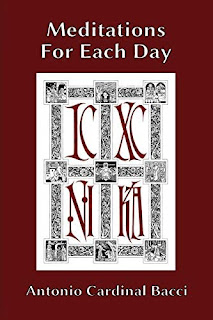
28 February, Antonio, Cardinal Bacci: Meditations For Each Day

The Examination of Conscience

1. Remember the key to wisdom: "Know yourself." These words were written in Greek in golden letters on the fronton of the temple of the Delphic Apollo. They were the basic rule of the moral doctrine of Socrates and other philosophers. But if we are to know ourselves well, we must examine ourselves thoroughly. We must place ourselves before ourselves without any concealment or deception and judge ourselves fairly and severely. The examination of conscience is recommended not only by spiritual writers of the Church, but also by pagan philosophers. Seneca's famous words in this regard are worth meditating. "Anger will disappear or subside," he says, "when you know that you have to present yourself for judgment every day. Is there any finer custom than this daily examination of conscience? What peace follows from this examination of ourselves! How tranquil, wise and free the mind becomes, whether it has been praised or reproved, when it has acted as its own secret investigator and critic and has examined its own behaviour. I use this exercise and put myself on trial every day. When the lights are out and silence has fallen... I look back over the entire day and review my words and actions. I hide nothing from myself; I omit nothing. Why should I be afraid of any of my errors when I can say to myself: Take care not to do this again; this time I forgive you." (De Ira, III, 36.)

2. Pope St. Pius X holds greater authority for a Christian. In his "Exhortatio ad Clerum" he strongly recommends the examination of conscience especially at the close of the day. This examination, he says, is necessary for priests, but it is no less necessary for the laity. He recalls the apt words of St. Augustine: “Judge your own conscience. Demand an account from it. Dig deep and rend it apart. Discover all the evil thoughts and intentions of the day... and punish yourself for them.” (Expos. in Ps. 4, n.8) He also quotes the equally relevant words of St. Bernard. “Be a searching inquirer into your own integrity of life; examine your conduct every day. See how much you have advanced, or how much you have fallen back... Learn to know yourself... Place all your faults before your eyes. Stand before yourself, as if it were before somebody else, and you will find reason to weep over yourself.” (Meditat., Cap. 5 de quotidiano sui ipsius examine) The saintly Pontiff concludes his inspiring address as follows: “Experience has proved that anyone who makes a strict examination of his thoughts, words and actions, is more firmly resolved to hate and avoid what is evil and wholeheartedly to love what is good.” (Acta Pii X, IV, p. 257)

3. It is necessary and profitable, therefore, to end the day with an examination of conscience made in the presence of God. Enter into ourselves; examine our thoughts, words and actions. Examine also the motives behind our actions and see whether they have been distorted or really directed towards God. Examine the sins we have committed, so that we may beg for pardon and form resolutions to do better. See whether we have prayed fervently or distractedly and half-heartedly. See if we have co-operated with the graces and good inspirations which we have been given. See if we have improved or grown worse in our efforts to do good. See if we have been dissipated or close to God. From a close examination of this kind we shall draw an incitement to humility and repentance, as well as to greater determination in the future.

Eastern Rite - Feasts of 28 February AM 7531

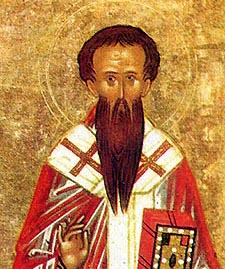
Today is the Feast of Our Venerable Father and Confessor Basil, Ascetical Companion of Procopius.
✠✠✠✠✠

Saint Basil the Confessor was a monk and suffered during the reign of the iconoclast emperor Leo the Isaurian (717-741). When persecution started against those who venerated holy icons, Saint Basil and his companion Saint Procopius of Decapolis (February 27) were subjected to much torture and locked up in prison. Here both martyrs languished for a long while, until the death of the impious Emperor.

When the holy Confessors Basil and Procopius were set free along with other venerators of holy icons, they continued in their monastic struggles, instructing many in the Catholic Faith and the virtuous life. Saint Basil died peacefully in the year 750.

Troparion — Tone 1

Dweller of the desert and angel in the body, / you were shown to be a wonder-worker, our God-bearing Father Basil. / You received heavenly gifts through fasting, vigil, and prayer: / Healing the sick and the souls of those drawn to you by faith. / Glory to Him who gave you strength! / Glory to Him who granted you a crown! / Glory to Him who through you grants healing to all!

Kontakion — Tone 2

(Podoben: “Seeking the highest...”)
You received a revelation of God from on high, O wise one, / and withdrew from the midst of the world’s tumult. / You lived the monastic life with honour, / receiving the power to work miracles and heal diseases by grace, / most blessed and holy Basil.

IN LUMINE FIDEI: 28 FEBRUARY – TUESDAY OF THE FIRST WEEK OF LENT

IN LUMINE FIDEI: 28 FEBRUARY – TUESDAY OF THE FIRST WEEK OF LENT: Epistle – Isaias lv. 6‒11 In those days, Isaias the prophet spoke, saying: “Seek ye the Lord while He may be found; call upon Him while ...

28 February, The Chesterton Calendar


FEBRUARY 28th

The wise man will follow a star, low and large and fierce in the heavens, but the nearer he comes to it the smaller and smaller it will grow, till he finds it the humble lantern over some little inn or stable. Not till we know the high things shall we know how lovely they are.

'William Blake.'

28 February, The Holy Rule of St Benedict, Patriarch of Western Monasticism

CHAPTER XXIII. Of Excommunication for Offences

28 Feb. 30 June. 30 Oct.

If any brother shall be found contumacious, or disobedient, or proud, or a murmurer, or in any way transgressing the Holy Rule, and contemning the orders of his seniors; let him, according to our Lord’s commandment, be once or twice privately admonished by his elders. If he do not amend, let him be rebuked in public before all. But if even then he do not correct himself, let him be subjected to excommunication, provided that he understand the nature of the punishment. Should he, however, prove incorrigible, let him undergo corporal chastisement.

1 March, The Roman Martyrology


Kaléndis Mártii Luna nona Anno Dómini 2023

On the morrow we keep the feast of the holy Confessor David, Archbishop of Caerleon upon Usk.
March 1st 2023, the 9th day of the Moon, were also born into the better life:

At Rome, two hundred and sixty holy martyrs whom for Christ's name's sake the Emperor Claudius first condemned to dig sand outside the Salarian Gate, and then to be shot to death with arrows in the amphitheatre.
Likewise the holy martyrs Leo, Donatus, Abundantius, Nicephorus, and nine others.
At Marseilles, [in the year 290,] the holy martyrs Hermes and Hadrian.
At Heliopolis, [in 114,] the holy martyr Eudocia [of Samaria, now Balbek in Turkey-in-Asia,] during the persecution under the Emperor Trajan. She was baptized by Theodotus, Bishop of [Heliopolis,] and, armed for the battle, the President Vincentius ordered her to be smitten with the sword, and thus she received the crown of martyrdom.
Upon the same day, the holy martyr Antonina. During the persecution under the Emperor Diocletian she laughed at the gods of the Gentiles, for the which cause she was diversely tortured, shut up in a barrel, and drowned in the marsh at the city of Cea.
At Werdt, [in the year 713,] holy Swibert, Bishop of that city, [Apostle of the Frisians,] who in the time of Pope Sergius preached the gospel to the Frisians, Hollanders, and other peoples of Lower Germany.
At Angers, [in the year 550,] the holy Confessor Albinus, Bishop of that see, a man of eminent graces and holiness.
At Mans, [in the year 687,] the holy Siviard, Abbot [of Saint Calais.]
At Perugia is commemorated the translation [in the year 547] of the holy martyr Herculanus, Bishop of that see, of whom mention is made upon the 7th day of November. He was beheaded by order of Totila, King of the Goths, and it is written by holy Pope Gregory that, forty days after his head was cut off, head and body were found united again, as though the iron had never touched him.
V. And elsewhere many other holy martyrs, confessors, and holy virgins.
R. Thanks be to God.

27 February 2023

St Peter Julian Eymard on Whether It’s Better To Be a Bad Catholic or a Good Protestant


People often say, "It is better to be a good Protestant than a bad Catholic." That is not true! That would mean that one could be saved without the true faith. No. A bad Catholic remains a child of the family, although a prodigal; and however great a sinner he may be, he still has a right to mercy. Through his faith, a bad Catholic is nearer to God than a Protestant, for he is a member of the household, whereas the heretic is not. And how hard it is to make him become one! (The Real Presence, NY: Blessed Sacrament Fathers, 1938, p.245).

Compline

From St Thomas Aquinas Seminary. You may follow the Office at Divinum Officium.

Monday of the First Week of Lent ~ Dom Prosper Guéranger

The Holy Rosary

Monday, the Joyful Mysteries. From St Thomas Aquinas Seminary.

As Synodality Summit Looms, Navigating a Papacy’s Imperial Phase

The title says it all. The logical Law of Non-contradiction means that you can not have synodality and a Dictator Pope at the same time.

From Crux

By John L. Allen Jr

ROME – When Pope John Paul II marked his 25th year in office in 2003, American Catholic theologian Richard McBrien spoke for many liberal critics in opining that the pontiff’s legacy was decidedly mixed, with the biggest negative being “his re-centralization of authority in the papacy at the expense of the [Second Vatican Council’s] teaching on collegiality.”

Of course, John Paul II was seen as a conservative. The presumption in many quarters was that with the transition to the more progressive Pope Francis, the Vatican II vision of collegiality, meaning shifting control over many matters away from Rome and toward local bishops, finally would be realized.

Early on Francis seemed to fuel those expectations, saying in 2015 that the Catholic Church could use a “healthy decentralization.” With his much-vaunted “Synod of Bishops on Synodality,” Francis and his aides have said they want consultation and shared decision-making to become a core characteristic of ecclesiastical life.

Yet several stories of late seem to tell a somewhat different tale.

In a move that has once again stirred the hornet’s nest of traditionalist Catholic sentiment, Pope Francis this week issued a rescript, meaning a legal decree, requiring local bishops to obtain Vatican permission before granting permission to celebrate the pre-Vatican II Latin Mass in parish churches or allowing priests ordained after July 16, 2021, to use the older rite.

Conservative news outlets have already noted the contrast between the pope’s decentralizing rhetoric and the clearly centralizing thrust of the rescript. In all honesty, it’s not the only example.

Two days later, Francis issued another legal instrument, this one a motu proprio, regarding the financial patrimony of the Holy See. In essence, the decree stipulates that all assets of institutions created by departments of the Roman Curia, or by other entities linked to the Holy See, belong to the Vatican and are subject to the pope’s control.

Last August, in issuing a financial report, the Secretariat for the Economy identified 92 such “entities,” including the major basilicas in Rome – St. Mary Major, St. Paul Outside the Walls, St. John Lateran, in addition to St. Peter’s – as well as a whole series of foundations, institutions and funds created over the years.

Technically, these are Vatican bodies and thus subject to the pope. In reality, however, most have long operated with significant autonomy, and personnel came to think of assets as theirs to manage and utilize as they see fit. It’s a bit of a rude awakening, therefore, to wake up and discover that nope, they’re “trustees,” not “owners.”

Or, consider a rescript issued last June specifying that before erecting a new group as a “public association of the faithful,” with a view toward becoming a religious order, a diocesan bishop must first obtain Vatican permission. That ruling built on an earlier edict from 2020 requiring bishops to get permission before erecting a new religious community of diocesan right, which, in turn, amplified a 2016 rescript requiring them to at least consult the Vatican.

Heretofore, all those steps could be taken by a diocesan bishop on his own, with the Vatican entering the picture only if the new order wanted to be recognized as of “pontifical,” not simply “diocesan,” standing. Now, the Vatican has to be involved from the very beginning.

Also, consider a couple of storylines out of Italy in just the last few days involving two small convents of religious sisters.

In the first case, two Poor Clare nuns were expelled from religious life by Vatican decree for refusing to abandon their convent on Italy’s posh Amalfi Coast, where the property is estimated to be worth $50-$60 million. Citing declining numbers, the Vatican ordered the convent closed and appointed an overseer to dispose of the property.

The two nuns didn’t want to leave, among other things saying they wanted to care for a 97-year-old sister who’s been living in the convent since 1955. The defiance led to the order of expulsion.

Some 270 miles to the north, 13 Benedictine sisters are facing a similar threat after defying a Vatican order to replace their Mother Superior. The sisters have barricaded themselves in the convent, putting a padlock on the main gate and cutting off phone lines, hoping that a canonical appeal against the Vatican decree somehow will succeed.

In the abstract, one might wonder why the Vatican is engaging in what can’t help but seem micro-management, since, under other circumstances, these standoffs likely would have been left to the religious orders and dioceses involved to sort out, on the grounds that the stakes are just too small.

What gives? Why is the pope of “healthy decentralization” seemingly presiding over an increasingly imperial papacy?

In Francis’s defense, some of these centralizing measures are a reflection of his desire for reform.

Asserting control over new religious orders, for instance, is partly a response to the fact that an alarming number of these outfits have been caught up in abuse scandals. Asserting ownership of all assets linked to the Vatican likewise is seen as a way of ensuring that Francis’s new accountability and transparency measures reach these entities too, however remote they may be from day-to-day papal activity.

Yet beyond reform, there are almost certainly other factors at work, one of which is structural and the other psychological.

Structurally, executives of whatever political stripe generally seek to enhance the authority of the executive branch. In his acclaimed book The Imperial Presidency, Arthur Schlesinger identified both FDR, a Democrat, and Nixon, a Republican, as architects of greatly expanded executive authority in the United States.

It’s only in a hyper-polarized age it would surprise anyone that both a conservative and a liberal pope seem to like papal authority, in roughly equal measure.

Here’s the psychological bit: Most new popes, especially those who’ve led dioceses for a while, probably come into office believing most other bishops think like them. After all, they’ve just been elected by a two-thirds vote in the College of Cardinals, and most of their bishop-friends likely share their views (which is probably why they’re friends to begin with).

Based on the assumption that “most bishops” want what the pope wants, it’s easy to advocate decentralization and collegiality.

Over time, however, every pope has to reckon with the fact that there are significant pockets of bishops who don’t actually share their agenda. John Paul II had his Cardinal Carlo Maria Martini, just as Pope Francis has his Cardinal Gerhard Müller – and in both cases, Martini and Müller weren’t speaking just for themselves.

As popes begin to hear time’s winged chariot hurrying near, it becomes less natural to defer to the judgments of a fissiparous and unpredictable body of some 5,000 Catholic bishops around the world, and more tempting simply to rule by decree.

A growing cross-section of observers believe we’ve now entered that phase of the Francis era. How this operational dimension of the papacy will be reconciled with the ecclesiological concepts likely to be articulated by the looming Synod on Synodality, therefore, will be fascinating to track.

Tennessee Lawmakers Pass Bills To Ban ‘Gender Transitions,’ Drag Shows for Minors

Hip, hip hurrah! Could sanity slowly be returning to our mentally ill, hypersexualised, and depraved society? We can only hope and pray!

From LifeSiteNew

By Ashley Sadler

The bill to ban transgender surgeries for minors cleared the House in a sweeping 77-16 vote. The measure banning drag shows for minors passed by a similar 74-19 margin.

NASHVILLE (LifeSiteNews) — Tennessee lawmakers this week passed bills to ban “gender transition” surgeries and drugs for minors and to outlaw the performance of sexually-charged drag shows for children. The state’s Republican governor is expected to sign both measures into law.

Both bills were passed by the Republican-controlled House of Representatives on Thursday. 

The bill to ban transgender surgeries for minors cleared the House in a sweeping 77-16 vote. The measure banning drag shows for minors passed by a similar 74-19. 

With Thursday’s legislative actions Tennessee is on track to be the fifth state with a total ban on surgical and pharmaceutical gender interventions for children and the first to ban obscene drag shows for minors, according to The Hill.

Introduced by Republican House Majority Leader William Lamberth and Senate Majority Leader Jack Johnson, the measure to outlaw so-called “gender-affirming” care for children will make it illegal to perform surgeries or prescribe puberty blocking or cross-sex hormone drugs to children under the age of 18 in the Volunteer State.

The language of the legislation makes it explicit that any surgical or pharmaceutical intervention “for the purpose of enabling a minor to identify with, or live as, a purported identity inconsistent with the minor’s sex” would be illegal in Tennessee. 

Children who suffer from real physical disabilities that require similar surgeries or medications are not excluded from accessing those interventions in the law.

“Children do not need these medical procedures to be able to flourish as adults,” Lamberth said. “They need mental health treatment. They need love and support, and many of them need to be able to grow up to become the individuals that they were intended to be.”

For its part, the bill to ban drag shows for minors was brought by Senate Majority Leader Johnson and Rep. Chris Todd. 

Shows featuring “male or female impersonators who provide entertainment that appeals to a prurient interest” would be included under the new measure, as well as “[s]hows with topless dancers, go-go dancers, exotic dancers and strippers,” according to the report.

Gov. Lee is anticipated to approve both laws.

In reference to the bill banning mutilating surgeries and destructive drugs for children, Lee’s press secretary Jade Byers told Catholic News Agency that “the governor appreciates the work of Leader Johnson and Leader Lamberth to protect children and intends to sign the bill when it reaches his desk.”

Impetus for the bill addressing transgender medical interventions for children reportedly goes back to the dogged activism of Catholic Daily Wire podcaster and Tennessee resident Matt Walsh, whose Septe1mber exposé of Nashville’s Vanderbilt University Medical Center revealed the institution was mutilating minors with “gender transitions,” something its leaders reportedly viewed as a “huge money maker.”

Republicans lawmakers demanded answers from Vanderbilt following Walsh’s bombshell report, leading to the institution’s October 2022 decision to “pause” its so-called “gender affirming” procedures for minors.  

RELATED: Vanderbilt Medical Center to pause mutilating gender surgeries for minors following scandal

After Walsh’s investigation, Lee also spoke out against the transgender mutilation of children.

“We should not allow permanent, life-altering decisions that hurt children,” the governor said. “With the partnership of the General Assembly, this practice should end in Tennessee.”

Advocates of the sexual indoctrination and mutilation of children have expressed outrage and threatened to sue the state if Lee puts his signature to the measures.

Pro-LGBT lobby group Human Rights Campaign denounced the Republican lawmakers as “extremist,” arguing that their moves to protect children were deliberate efforts to make “life harder and more dangerous for trans kids.”

The American Civil Liberties Union (ACLU), its Tennessee affiliate, and LGBT group Lambda Legal are vowing to file a lawsuit against the state over the laws, The Hill reported. 

While the battle is likely far from over, Walsh struck a hopeful tone Thursday when news broke that the bill to ban the transgender mutilation of children had passed.

“We’re fighting. We’re winning. And we aren’t even close to done,” he said.

“I’m all about being realistic. Nobody would accuse me of optimism,” he continued. “But the fact is that in the fight against gender ideology we have put one win on the board after another. We were way behind when we started so there’s a lot of ground to cover, but momentum is on our side.”