31 October 2020

31 October, Antonio, Cardinal Bacci: Meditations For Each Day

Motives of Humility

1. Humility is the most necessary and the most difficult of the virtues. It is the most necessary because it is the foundation of the entire Christian edifice of spiritual perfection. No stable structure can be built without a firm foundation.


This virtue is also necessary because God gives His grace only to the humble, and without His grace we can gain no supernatural merit. “God resists the proud but gives grace to the humble.” (James 4:6) Humility is, moreover, the most difficult of the virtues. It is hard to renounce one's possessions and give them away to the poor in accordance with the evangelical counsel. It is harder to renounce one's wayward instincts and passions. It is even harder, however, to renounce one's own ego with all its immoderate desires. Nevertheless, this is what Christian humility demands of us. We must deny ourselves and acknowledge our nothingness. We must recognise that it is folly to glory in things which do not belong to us, but are merely gifts from God.

It is necessary to practise the virtue of humility continually if we are to become humble. For this purpose it is useful to meditate on the motives which should inspire us to humble ourselves both before God and before men. Our sins constitute one of these motives. All that we are and all that we have in the physical and in the supernatural order are gifts from our Creator and Redeemer, but sin belongs to us alone.

It is we ourselves who are responsible for sin, because in direct opposition to His will we abused the faculties which God gave us. This is surely a reason for humiliating ourselves; sin, which is an offence against God and is our spiritual ruination, is the only thing which we can claim as properly belonging to us. Unfortunately, we have committed innumerable sins in thought, word, deed, and omission; alone and in public, by day and by night, as children and as adults; against the commandments of God, against the precepts of the Church, and against the obligations of our state in life. Our whole existence has been marred by offences and acts of ingratitude against God, our greatest Benefactor.

2. Another motive for humility is our deficiency in virtue. We have received many gifts from God, but what use have we made of them? We have received gifts of nature and of grace, good inspirations, good example, and precious time and opportunity for doing good. On those occasions when the voice of God spoke most clearly in our hearts, we made good resolutions and promised to abandon sin and to walk with greater fervour in the way of perfection. Unfortunately, however, we continue to lag behind. This is a new motive for humbling ourselves and for beseeching from God the gift of perseverance.

3. Finally, there is the transient nature of mortal life. One illness is enough to carry us to the grave, there to rot and to be eaten by worms. It is sufficient for the capillary vessel of the brain to be burst in order to render us incapable of forming a single thought or of uttering a single word. We imagine that we are very important, whereas in fact we are insignificant before God and before the mighty universe. Let us do our best, therefore, to be humble. If we can become as little children, God will be pleased with us and will make us members of His kingdom. “Unless you turn and become like little children, you will not enter into the kingdom of heaven.” (Mt. 18:3)

IN LUMINE FIDEI: 31 OCTOBER – VIGIL OF ALL SAINTS ( ALL HALLOWS EVE)

IN LUMINE FIDEI: 31 OCTOBER – VIGIL OF ALL SAINTS ( ALL HALLOWS EVE): Dom Prosper Guéranger: Let us prepare our souls for the graces Heaven is about to shower upon the Earth in return for its homage. Tomorro...

31 October, A Chesterton Calendar


HALLOW E'EN

If we ever get the English back on to the English land they will become again a religious people, if all goes well, a superstitious people. The absence from modern life of both the higher and the lower forms of faith is largely due to a divorce from nature and the trees and clouds. If we have no more turnip ghosts it is chiefly from the lack of turnips.

'Heretics.'

The Holy Rule of St Benedict, Father of Western Monks

CHAPTER XXIV. What the measure of excommunication should be

1 Mar. 1 July. 31 Oct.

The measure of excommunication or chastisement should be meted out according to the gravity of the offence, the estimation of which shall be left to the judgment of the Abbot. If any brother be found guilty of lighter faults, let him be excluded from the common table. And this shall be the rule for one so deprived: he shall intone neither Psalm nor antiphon in the Oratory, nor shall he read a lesson, until he have made satisfaction. Let him take his meals alone, after those of the brethren so that if, for example, the brethren eat at the sixth hour, let him eat at the ninth: if they eat at the ninth, let him eat in the evening, until by proper satisfaction he obtain pardon.

1 November, The Roman Martyrology

Kaléndis Novémbris Luna quinta decima Anno Domini 2020

The morrow is the Feast of All the Saints. This famous feast was instituted to be held every year throughout the whole city of Rome, in honour of the Blessed Virgin Mary, Mother of God, and of all the holy martyrs, by Pope Boniface IV, after he had consecrated to Christian worship the temple called the Pantheon or Temple of all the gods. And the same festival was afterwards being kept in diverse ways in diverse churches, when Gregory IV decreed that it should be solemnly observed for ever throughout the universal Church upon the first day of November, in honour of all the Saints.
November 1st 2020, the 15th day of the Moon, were born into the better life:

At Terracina, in Campania, (in the reign of the Emperor Diocletian,) the holy Deacon Caesarius, who suffered many days in prison, and was afterwards put into a sack, along with the holy Priest Julian, and cast into the sea.
At Dijon, the holy Priest Benignus, who was sent into Gaul to preach the Gospel by blessed Polycarp, under the Emperor Marcus Aurelius. He was put to many most grievous torments by the judge Terence, who commanded at last that his neck should be struck with an iron bar and a lance thrust through his body.
Upon the same day, the holy handmaiden Mary, who was accused of Christianity, under the Emperor Hadrian. She was grievously lashed, racked, and torn with hooks, and so suffered martyrdom.
At Damascus, suffered the holy martyrs Caesarius, Dacius, and five others.
In Persia, under King Sapor, the holy martyrs John the Bishop and James the Priest.
At Tarsus, under the Emperor Maximian, holy Cyrenia and Juliana.
(At Clermont,) in Auvergne, holy Austremonius, the first Bishop of that see.
At Paris, (in the fifth century,) deceased the holy Marcellus, Bishop (of that see.)
At Bayeux, in the time of Childebert, King of the Franks, holy Vigor, Bishop (of that see.)
At Tivoli, the holy Monk Severinus.
In the Gatinais, (in the fourth century,) the holy Confessor Maturin.
V. And elsewhere many other holy martyrs, confessors, and holy virgins.
R. Thanks be to God.

Memes of the Day


30 October 2020

How Can We Bring Sanity to the Devotees of This Transgenderism Cult?

So, the trans cult is caused by 'social contagion', or in other words mob peer pressure, like the Tide Pod Challenge.

From MercatorNet

By  Dianna Kenny

The madness of crowds is a recurring theme in history. This is the latest

Dianna Kenny is a Sydney psychologist. One of her many interests is gender dysphoria. MercatorNet interviewed her recently about her latest research paper on social contagion.


MercatorNetThe number of teenagers who believe that they are in the wrong body and need to change to the opposite sex is exploding, especially for girls. What’s the conventional wisdom? What’s your explanation?

Dianna Kenny: The conventional wisdom is greater focus and awareness of the prevalence and issues associated with transgenderism and effective advocacy from the trans lobby.

My explanation is that we are all susceptible to social contagion, but not equally. Young people are more prone to social contagion, particularly during adolescence, a time during which peers and peer acceptance become very important and in the case of troubled young people, exceed the need for parental affirmation.

MercatorNetIn your research, you cite an astonishing statistic: that the proportion of American teenaged males between 13 and 17 who identify as transgender is 140 times the number of adult males – and 350 times greater for females. Is this credible?

Please don’t shoot the messenger! According to DSM 5 (2013) (Diagnostic and Statistical Manual of the American Psychiatric Association), population estimates for natal adult males range from 0.005% to 0.014%, and for natal females, from 0.002% to 0.003%. However, about 0.7 percent of 13 to 17-year-olds living in the United States identify as transgender according to the Williams Institute at the University of California, Los Angeles, School of Law. This estimate is between 140 (males) and 350 (females) times higher than that for adult males and females.

Epidemiological studies are still lacking so no strong conclusions about the prevalence of GID in children and young people can be drawn. 

MercatorNetSocial contagion is recognized as a cause of the spread of anorexia nervosa amongst teenaged girls. Why is the desire to have medical treatment for gender dysphoria seen as a completely different case? How can it be stopped?

It is not a completely different case because both conditions are a result of solipsism as well as underlying psychopathology, which is uniquely characteristic to each condition.

Transgender advocates state that in transgenderism — the belief/assumption that one has been born in the wrong body — the body must be aligned to one’s gender belief, not one’s belief to one’s biological body. They assume that the mind is “correct” in its perceptions and beliefs and the body is diseased and must be treated.

Transgenderism is a disorder of assumption and like other disorders of assumption, is solipsistic. Solipsism is the belief that ideas that arise in the mind are true and cannot be questioned. For example, those with anorexia nervosa believe that they are fat when in fact they are emaciated. People with body image dysphoria engage in endless plastic surgery to correct their perceived ugliness, when their appearance falls well within the norms for their culture. Those with body integrity identity disorder (BIID) perceive one or more of their limbs or organs as alien to the rest of their body and wish to have it amputated or paralysed. If refused surgery, they may self-mutilate.

Can we, as a society, condone the amputation or paralysis of healthy limbs in people with BIID? In the same vein, is the amputation of a healthy penis and healthy breasts ethically justifiable? Disorders of assumption are disorders of perception. Disorders of perception belong in the domains of psychology, psychiatry, and psychotherapy, not endocrinology or mutilating surgery.

MercatorNetHow can it be stopped?

Transgenderism is now big business. Big pharma is benefiting by skyrocketing sales in puberty blocking medications and cross sex hormones. Surgeons who are specialising in mutilating surgery now have long waiting lists and vastly increased incomes. Gender clinics are proliferating around the world, with millions of dollars expended in their establishment.

Sadly, because most institutions who should be talking sense to the transgender lobby have readily and sycophantically fallen in behind their faulty science to the point that school curricula have been changed to accommodate gender fairies and gender unicorns and lessons that tell young children that they can choose their gender.

The courts are almost always making rulings in favour of transgender treatment and allowing 14 and 15-year-old girls to have their breasts removed. Politicians have also been stung by the social contagion virus and we are increasingly observing the passing of ill-conceived and flawed legislation permitting the proliferation of the madness.

I am afraid that we are dealing with a runaway train.

MercatorNetWhy are girls so vulnerable?

We don’t have good answers to this question. It is certainly the case that proportions of adolescent girls presenting to gender clinics way outnumber the proportion of adolescent boys. It is noteworthy that up to the age of 10, we do not see this gender disparity in referrals.

So it must have something to do with girls being more susceptible to social contagion, or perceiving maleness as more attractive than femaleness. But these are only hypotheses at this point. We have no reliable data to help us understand the reasons why this is so.

MercatorNetYou point out that Oregon permits 15-year-olds to “transition” without their parents’ permission – and there is no age limit if their parents agree. Is legislation like this the goal of trans activists?

Yes!

MercatorNetIs there evidence that people who begin to transition as teens regret their decision in later life?

There certainly is. We know that children placed on the mutating transgender train beginning with social transition in childhood (prepubertally) are much more likely to commence puberty blockers, who in turn are much more likely to take cross sex hormones compared with children who are permitted to follow their own biologically driven puberty with none of these interventions.

Figures vary across studies about rates of desistance, but many are converging on a figure around 88% of young gender dysphoric individuals will desist by late adolescence or early adulthood and come to accept their biological sex. Many of these young people will eventually identify as gay.

MercatorNetYou’ve said that “Transgenderism is a cult and must be curtailed forthwith”. Those are pretty strong words. How do you think that it can be curtailed?

There have been psychic epidemics through the ages. As they gain momentum they are very difficult to stop. Once ignited, they have to run their course, in which wiser, more considered voices rise above the din of the slavish cultists and call for a return of sanity. This usually does not happen until thousands of people have been destroyed or injured in the process. It happened during the Inquisition in the Middle Ages and during the “recovered memories of ritual sexual abuse” pandemic in the 20th century, with many others in between. It has been called “the madness of crowds.” In our times, social media is a super-spreader so we are facing a mighty foe.

Scott Morrison: Dismal With Daniel Andrews, Feeble on Freedom

The sad tale of the totally ineffective Prime Minister, Scott Morrison, and the wannabe Red dictator Premier, Dan Andrews.

From the Spectator│Australia

By Rocco Loiacono

Ahead of question time in federal parliament yesterday there were two contrasting speeches given. In response to a motion moved by opposition leader Anthony Albanese celebrating Victoria’s reopening after defeating a second wave of coronavirus infections, Treasurer Josh Frydenberg, himself a Victorian, declared this was a victory for the people of the state. “It’s their victory and no one else’s”, he thundered. “The Victorian people have suffered so much, the pain, the cost, the loss of Victorian people. It should have never have come to this. The comparison is not with the United Kingdom, the comparison is not with the United States, the comparison is with New South Wales, Queensland, Tasmania, and South Australia.” Frydenberg added that children in Victoria had lost six months of schooling and 800 people had died. “It all comes back to the failures in hotel quarantine for which we still do not have any answers to,” he roared.

When the Prime Minister rose to speak to the motion, it could not have been more different. While warning that Australia should not embrace a “future of lockdowns” to manage the virus, he added: “Borders and lockdowns are not demonstration or evidence of success… they are evidence of outbreaks that have got out of control. They are evidence of things that have not gone as they should. We saw the issues of contact tracing and we saw Victoria descend into what was a cataclysmic second wave of this virus,” he said. Tellingly, however, Scott Morrisson said it was the “right decision of the Victorian Premier” and his government to impose the lockdown measures.

This insipid justification of the greatest violation of fundamental rights in Australia’s history by the Prime Minister should not come as a surprise. In fact, it is true to form, given his, and many of his fellow ministers’ silence, which goes as far back as March this year, in the face of governments around Australia imposing draconian measures which are a cure that is far worse than the disease.

As has been pointed out repeatedly, the overall ratio of coronavirus-related deaths when compared with other causes of death is minimal. In this regard I cite the group of 13 medical practitioners who wrote to the Victorian Government in August, urging it to lift stage 4 lockdowns and review its policy since the blanket approach was harming the general population. They urged the government to focus on the aged, the most vulnerable segment of the population, rather than continuing with stage 3-4 lockdowns for the whole community for no apparent scientific reason. In the letter, the doctors said specialist referrals from GPs had fallen dramatically as a result of patients fearing they would get sick if they went out. “As a direct consequence of this delay, many will have poorer prognoses. This has especially been the case with three consultants who treat cancer,” they wrote. “We now know that whilst COVID-19 is highly contagious, it is of limited virulence. We are told that since March 2020, 565 Victorian patients have died either with or from the virus (numbers as at 31 August). This compares with annual Victorian deaths of approximately 10,000 patients with cardiovascular disease and 11,000 with cancer.” The doctors also warned: “It is our professional opinion that the stage 4 lockdown policy has caused unprecedented negative economic and social outcomes in people, which in themselves are having negative health outcomes.”

Victorians have just now been allowed, with small steps, out of the harshest restrictions of any country in the world, which were imposed for four months, only as a result of the staggering incompetence of the Andrews government. Parallels have been appropriately drawn between George Orwell’s 1984 and the state of affairs in Victoria, where curfews and surveillance, not only via drones but even of social media sites, is ubiquitous to ensure any opposition is crushed. Unfortunately for Victorians, the “state of emergency” will now continue until March 2021. In fact, the Victorian Parliament has only sat effectively once since March, and that is to consider the extension of the “state of emergency”.

I need not remind readers of the disgraceful episodes that have emerged from Melbourne in recent months – episodes that one might have expected to see in Ceauşescu’s Romania, not in the Australia my forebears came to in search of a better life for themselves and for their children. Priests are being warned by police they will be arrested if they infringe the lockdown to administer the last rites to dying parishioners. Pregnant women are harassed in parks and even in their own homes and charged with “incitement”. Grandmothers chatting in a park are confronted by six police officers and have their phones confiscated. Unarmed women are dragged brutally from their cars. We have seen riot police, in full (black) gear (including Darth Vader-style helmets) as if they are going to quell a prison uprising, vastly outnumber (by 2 to 1, according to reports) and violently shove unarmed, peaceful protesters through the Queen Victoria Market. Add to this the sickening incidental episode of the mentally ill young man rammed by a police vehicle and then stomped on his head by police.

I also need not remind readers that the Victorian Government and Police had no issue with a Black Lives Matter protest attended by 10,000 people in Melbourne, marked by a lack of social distancing and face masks, giving them the proverbial “nod and wink” to demonstrate, even though Chairman Dan has said repeated that protests are unlawful. As Caroline Overington asked in The Australian on 3 September, police did not ask the mother handcuffed in her own kitchen, Zoe Buhler, in a reasonable and sensible manner, to take her social media post down? How many of the Black Lives Matter supporters got arrested, for posting, before their protest got the go-ahead? None. Why did their protest get the go-ahead, while all others are banned?

However, perhaps what is even more disturbing than all of this is the refusal of the Prime Minister to criticise Daniel Andrews in keeping with his strong belief in “national leadership unity”. The Prime Minister has publicly backed the Victorian Premier, including his imposition of de facto martial law across the state. Indeed, Morrison not only has refused to criticise the Victorian Premier for being unable to stop the spread of the virus, he has further encouraged political arbitrariness and oppression in Victoria by, in his own words, “encouraging the Victorian government to ensure that there are appropriate penalties for those who do break public health notices.” Therefore, by saying that the oppressive lockdown was the “right decision”, the Prime Minister is being consistent in his authoritarian bent.

Morrison’s lack of criticism of the other State Premiers must also be condemned. Queensland is effectively closed because Annastacia Palaszczuk wants to be a hero. How heroic is it, will someone tell me please, for a state to be open for AFL footballers and officials, but where sons and daughters are refused entry into the state, even if they come from places in Australia that have not recorded corona infections in more than a month, to see their dying fathers and attend funerals? How heroic is it when a mother pregnant with twins, who lives near the Queensland border, cannot cross it to get urgent medical treatment, but instead has to travel 16 hours to Sydney and as a result, tragically lose one of her babies? Morrison only spoke up about these outrages when it became politically expedient, due to the fact that there is an election to be held in Queensland this coming weekend.

In WA, we have a Premier who has effectively decided he does not want to be a part of the Commonwealth. However, Mark McGowan was caught with his proverbial pants down a fortnight ago by his own Chief Health Officer who told a parliamentary committee that he had advised the government that travel bubbles with some states were feasible, but the advice had not been followed. To save face, the Premier resorted to shameless fearmongering in The West Australian, which is building up a cult of personality around McGowan that is scarily starting to resemble that which surrounded a certain Georgian peasant named Djughashvili during his rule of the Soviet Union. The Premier claimed one of his great fears was that coronavirus would return to WA and that he would have “mass deaths on his conscience”. Excuse me? WA has had NO community transmission of coronavirus since April 11, more than six months. Marxist Mark claims he wants to protect the health of Western Australians, yet the mental health costs of shutting the State off from the rest of the country are staggering. A very significant number of FIFO workers who drive WA’s mining industry are from interstate, yet for seven months children have not been held by their fathers and families have not been able to be together in the same room. Funerals, weddings have been missed, dying grandparents have not been able to see their children and grandchildren for one last time. Yet, as recently as the Diggers and Dealers conference in Kalgoorlie earlier this, McGowan trotted out once more, as he has done ad nauseum, the secessionist line that the WA mining industry “funds the nation” and that “Western Australia still subsidises the rest of the nation under the GST deal even as it is currently constructed.” It is on the back of those interstate FIFO workers that the WA economy is being propped up, yet McGowan insists on playing politics with their lives, brazenly using fear to convince West Australians that the hard border is the only way to protect them from a horrible death and that the monsters from the East want to take our money away.

What has been Mr Morrison’s response to this squalid political bastardry? Capitulation, with a faintly expressed hope that WA will open up by Christmas. One would rightly expect the Liberal party to stand up for the Constitution, yet on Mr Morrison’s orders the Commonwealth has withdrawn from the High Court challenge to the WA border closure. As Janet Albrechtsen noted in The Australian only oday:

Australians might reasonably expect Morrison to test an issue of major national significance for its constitutional implications. Shutting state borders will become an unfortunate precedent for the future. And, as day follows night, the threshold for doing so again will get lower and lower. It won’t be a once-in-a-generation pandemic that leads to borders closing next time. In other words, a functioning federation is at stake.

I wrote in a previous article for this publication about the ‘quiet Australians’ being scared into submission by this Prime Minister, the same quiet Australians who gave his government an unexpected victory at the May 2019 elections. Along with economic management, always at the forefront of an election contest, issues of freedom of speech and religious freedom were considered to be important in the government’s unexpected victory. However, those same quiet Australians would have reason to feel aggrieved, since the Morrison Government’s record on freedom of speech and religion issues is nothing short of lamentable, coronavirus or not. 

Let us not forget this is the only democracy in the world which has prohibited its citizens from leaving the country. We are now in the company of Cuba and North Korea. Remember on 19 August when the Prime Minister proudly trumpeted he wanted to make any coronavirus vaccine mandatory before having to back-track less than 12 hours later? Over the last seven months we have witnessed state and federal governments needlessly instil a sense of fear into most Australians, effectively facilitating the transformation of these governments into elected dictatorships. The operative silence of the Prime Minister and his government at the insidious attacks on fundamental freedoms in this country need explanation. Case in point, we have heard very little, as one might have expected, from the Commonwealth Attorney-General, who as the first law officer of the nation, should be vociferous in defending the Constitution and the rule of law, not stand idly by while they are being trashed. Only Josh Frydenberg, as noted above, has spoken up with any vehemence. Unfortunately, even before the arrival of the Wuhan virus, the Morrison Government has form when it comes to issues of freedom of speech and religious freedom.

With regard to religious freedom, the Morrison Government promised before the last election it would enact a Religious Discrimination Bill to protect religious organisations from anti-discrimination legislation so that they could employ people on the basis that they respected the tenets of the faith professed by that organisation. The Bill would also be aimed at protecting and people of faith generally from the same legislation that would undermine their right to practise their faith in their everyday lives, so for example, if such people posted on social media quotes or otherwise published views espousing their religious beliefs, they could not be accused of, and prosecuted for, discrimination. This arose out of the prosecution of the Catholic Archbishop of Hobart, Julian Porteous, for declaring his (and thus the Catholic Church’s) opposition to same-sex marriage under Tasmania’s anti-discrimination laws. The federal government has had two rounds of consultation with religious groups and released a second exposure draft of the legislation, yet the Bill has not progressed through the Parliament.

Another area where the federal government has failed to act is against the transgender ideology. In June, Health Minister Greg Hunt refused to support a joint federal/state inquiry into what advice is being given by gender clinics to parents of young children and to young people under 18 presenting for treatment. As noted by Moira Deeming in this publication, the increasing numbers of children and young people presenting to gender clinics is very concerning. The Royal Children’s Hospital’s Gender Service, Melbourne reported a 250-fold increase in new referrals to their service between 2003 and 2017 – from 1 to 250. Queensland and the Australian Capital Territory have now made “gender conversion” practices illegal. Victoria will soon follow suit. This is despite the evidence provided by a significant majority of medical professionals that almost all affected children will revert to an identity congruent with chromosomes through puberty. All that is needed in the great majority of cases is ‘watchful waiting’ in expectation of natural reversion, supported by individual and family counselling, and appropriate administration of psychiatric care. This view is supported by many individuals who have experienced a positive change from properly given and appropriate therapy. Under the above-mentioned legislation, access to such therapy will be denied and anyone with influence involved in a child’s life risks incarceration if they do not embrace “affirmative therapy”.

Why then is the government — and the Prime Minister in particular — so hostile to the exercise of fundamental freedoms?

To find a possible answer, we must go back as far as March 2017, when he was Treasurer in the Turnbull government. At this time, attempts were being made to amend section 18C of the Commonwealth Racial Discrimination Act 1975, which prohibits an act that is reasonably likely to “offend, insult, humiliate or intimidate” someone because of their race or ethnicity. It had been Coalition policy to either repeal this law or amend it significantly, since it infringes the implied right in the Australian Constitution of freedom of political communication given that the language and emotions 18C targets – offence, insult and humiliation – go far beyond what is required in the international treaties most directly supporting this Act, they being the International Covenant on Civil and Political Rights (ICCPR) and the International Convention on the Elimination of All Forms of Racial Discrimination (ICERD).

During the debate on the legislation to amend the Act, Morrison told The Sydney Morning Herald that changing section 18C would not help reduce unemployment or improve any other economic metric. He said at the time: “As a senior figure in this government … I know this issue doesn’t create one job, doesn’t open one business, doesn’t give anyone one extra hour. It doesn’t make housing more affordable or energy more affordable. I don’t see any intersection between that issue and those priorities.”

Well, as we have seen this year, oppressive measures to counter coronavirus which have failed to protect those most vulnerable and the Prime Minister’s support for them, have created economic disaster and numbers of unemployed not seen since the early 1990s. The fact is that this appalling result has been achieved with authoritarian provisions in denying the fundamental human rights of Australians, yet at the same time expecting their total obedience and acquiescence. 

The Prime Minister’s weak criticism of the Victorian government in the parliament while at the same time justifying is actions is consistent with that of a man who has in the past displayed his authoritarian tendencies on several occasions.

Scott Morrison’s gratitude for the ‘quiet Australians’ who returned his government can only be described as hollow words by a hollow man. I would go so far as to argue that, as Australia faces its biggest economic and social crisis since World War II, the biggest threat, along with Dictator Dan, to our democracy, the freedoms that underpin it, along with the physical, economic and social well-being of Australians, is in fact the Prime Minister himself.

Dr Rocco Loiacono is Senior Lecturer at Curtin University Law School.

Unapproved Buddhist Books Confiscated and Burned

Lest anyone think that it's only Christianity that the ChiComs are trying to destroy, no, it's all religions! The CCP must be destroyed! #SmashTheCCP #BoycottBeijing2022

From Bitter Winter

By Zheng Jie

Local authorities across China confiscate from temples and shops materials that are not sanctioned by the state and investigate their distribution channels.

The Ganlu Temple in Bayannur city’s Linhe district is the largest Chinese Buddhist temple in Inner Mongolia Autonomous Region. From last October to February this year, officials from the local Culture Bureau, Publicity Department, and other government institutions inspected the temple twice. A monk in the temple told Bitter Winter that the officials confiscated hundreds of thousands of printed materials, CDs, and books, including those by Venerable Master Chin Kung and essential Buddhist classics, like the Śūraṅgama Sūtra and the Chinese Buddhist Canon. All these materials were produced by companies not approved by the Chinese government.

Guanlu Temple’s Hall of Great Strength.

“These texts teach people to be compassionate; they are not political at all,” the monk said. “The government confiscates them aiming to control religion.”

Buddhist texts were also confiscated from the Daguangming Temple in Bayannur. A monk in the venue said that the temple now doesn’t have enough scriptures for worshipers to read. He is worried that fewer people would come to the temple.

Since the start of the year, the CCP has been intensifying efforts nationwide to clear out all unapproved Buddhist texts from temples as “illegal publications.”

In early March, the Zhouji township government in Shangqiu city’s Liangyuan district in Henan Province confiscated and burned all unapproved publications found in the Lingtai Temple. “The temple’s monks never incited people to go against the government,” a local Buddhist said. “The government’s actions are despicable.”

On August 2, local authorities ordered to burn books by Master Chin Kung and the Dalai Lama in the Ciyun Temple in Liaoning Province’s Lingyuan city. “The books were put on seven pickup trucks and taken outside the temple. They were burned until 8 p.m. the next day,” a monk from the temple remembered.

The books from the Ciyun Temple were turned to ashes.

The burnt books are replaced with books on Xi Jinping Thought and traditional Chinese culture.

The abbot in a temple in Donggang, a county-level city in Liaoning, said that officials ordered the venue to remove all religious elements and replace them with posters featuring Xi Jinping’s quotes and traditional Chinese culture. All books by Chin Kung and other Buddhist masters had to be burned as xie jiao literature. The abbot managed to hide over one thousand books.

The temple had to burn more than a thousand Buddhist books.

This summer, the Religious Affairs Bureau in Tonghua, a prefecture-level city in the northeastern province of Jilin, ordered the Bailian Temple to burn all printed materials and CDs that were issued without the government’s approval.

“Diesel oil was poured over books and CDs piled in a large heap,” a monk recalled. Instead of them, books, like Xi JinpingThe Governance of China100 Pieces of Patriotic Prose, and alike, were displayed in the temple.

“The Communist Party fully controls all religions in China. If we go against Xi Jinping, our temple will be demolished,” the monk added.

Buddhist books in the Bailian Temple were replaced with books by Xi Jinping.

Local governments also investigate distribution channels for unapproved Buddhist materials.

“Religious Affairs Bureau officials said that Buddhist books are contraband,” said a Buddhist supply store manager from Jinshan town, administered by the prefecture-level city of Chifeng in Inner Mongolia.

Another Buddhist store manager in Jinshan said that local officials posted a notice on the store’s wall, demanding to remove all Buddhist books from shelves, threatening to fine and close the store otherwise.

“Each Buddhist supply store used to carry piles of books and CDs by Chin Kung, Haitao, Huilv, Da’an, and other Buddhist masters. But not anymore,” explained a Buddhist supply store manager in Chifeng’s Pingzhuang town.

According to an employee at a copy shop in Heilongjiang Province’s Mishan city, authorities often inspect their business, looking for religious materials. “Not a single sheet of religious texts is allowed to be copied,” he explained.  

CONTRA GENTILES - BOOK ONE: GOD - Chapter 58 THAT GOD DOES NOT UNDERSTAND BY COMPOSING AND DIVIDING

[1] Through the same means we can also show that the divine intellect does not understand in the manner of a composing and dividing intellect.

[2] For the divine intellect knows all things by knowing its own essence. Now it does not know its own essence by composing and dividing, since it knows itself as it is and there is no composition in it. It does not, therefore, know in the manner of a composing and dividing intellect.

[3] Moreover, what is composed and divided by the intellect is of a nature to be considered separately by it. For there would be no need of composition and division if by apprehending the essence of a thing we grasped what belonged in it and what did not. If, then, God understood in the manner of a composing and dividing intellect, it would follow that He did not consider all things by one intuition but each thing separately. We have shown the contrary of this above.

[4] Furthermore, there can be no before and after in God. But composition and division come after the consideration of the essence, which is their principle. Hence, composition and division cannot be found in the operation of the divine intellect.

[5] Again, the proper object of the intellect is what a thing is. Hence, in relation to what a thing is the intellect suffers no deception except by accident, whereas as concerns composition and division it is deceived. So, too, a sense dealing with its proper sensibles is always true, but in other cases it is deceived. But in the divine intellect there is nothing accidental, but only that which is substantial. In the divine intellect, therefore, there is no composition and division, but only the simple apprehension of a thing.

[6] Furthermore, in the case of a proposition formed by a composing and dividing intellect, the composition itself exists in the intellect, not in the thing that is outside the soul. If the divine intellect should judge of things in the manner of a composing and dividing intellect, the intellect itself will be composite. This is impossible, as is clear from what has been said.

[7] Again, the composing and dividing intellect judges diverse things by diverse compositions, for the composition of the intellect does not exceed the terms of the composition. Hence, the intellect does not judge the triangle to be a figure by the same composition by which it judges man to be an animal. Now, composition or division is a certain operation of the intellect. If, then, God considers things by means of composing and dividing, it will follow that His understanding is not solely one but many. And thus His essence, as well, will not be solely one, since His intellectual operation is His essence, as was proved above.

[8] But it is not on this account necessary for us to say that God does not know enunciables. For His essence, being one and simple, is the exemplar of all manifold and composite things. And thus God knows through His essence all multitude and composition both of nature and of reason.

[9] With these conclusions the authority of Sacred Scripture is in harmony. For it is said in Isaiah (55:8): “For My thoughts are not your thoughts.” Yet it is said in a Psalm (93:11): “The Lord knows the thoughts of men,” which thoughts evidently proceed through composition and division in the intellect.

[10] Dionysius likewise says: “Therefore, in knowing itself, the divine wisdom knows all things-the material immaterially, the divisible indivisibly, and the many unitedly” [ De div. nom. VII, 2].

Next - CONTRA GENTILES - BOOK ONE: GOD - Chapter 59 THAT THE TRUTH OF ENUNCIABLES IS NOT EXCLUDED FROM GOD

Did the Inquisition Conduct Witch Trials?

Real Crusades History #271. And don't forget the Real Crusades History website!

Did the Inquisition of the Middle Ages target witches?


Poland’s Pro-Abortion Mob

More on the baby killers' rage at the outlawing of abortion in Poland and their riotous mobs. The police are protecting the Catholics who are protecting their Churches.

From The American Conservative 

By Rod Dreher

This has not been widely reported in the US, but my Polish readers are telling me that things are erupting there over the nation’s Constitutional Tribunal’s recent abortion ruling. The New York Times gives background:

Prior to Thursday’s ruling by the Constitutional Tribunal, Poland had permitted terminations only for fetal abnormalities, in case of a threat to a woman’s health or in the case of incest or rape. But in practice, the overwhelming majority of legal abortions — 1,074 of 1,100 performed last year — resulted from fetal abnormalities.

However, the latest court ruling held that abortions for fetal abnormalities violate the Constitution — a decision that cannot be appealed.

Still, this category of abortions represents only a small fraction of those obtained by Polish women. Many already go abroad for abortions or have them illegally. Common obstacles to legal termination include lengthy waits and doctors refusing to perform them.

Doctors in Poland can refuse to perform a legal abortion and may also refuse to prescribe contraception on religious grounds. And there is very little financial and psychological support for families of disabled children, who are left to fend for themselves once the child is born.

In the court ruling, the tribunal’s president, Julia Przylebska, said that allowing abortions for fetal abnormalities legalized “eugenic practices.” Because Poland’s Constitution guarantees the protection of human life, she added, termination based on the health of a fetus amounted to “a directly forbidden form of discrimination.”

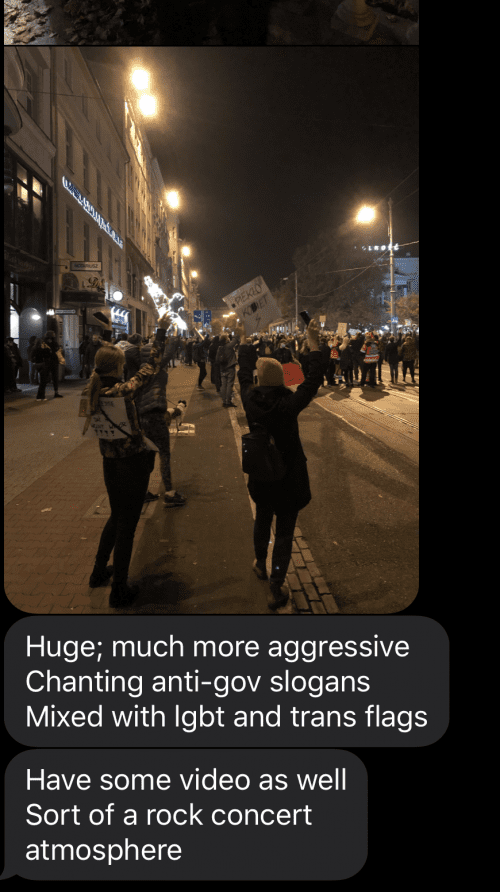
Protesters are demanding that the court reverse itself and a growing number are also calling for liberalization of the abortion law. Protests have spread from cities to towns and villages and women’s groups have found support from some unlikely corners, including taxi drivers, farmers and coal miners, all with their own grievances against the government.

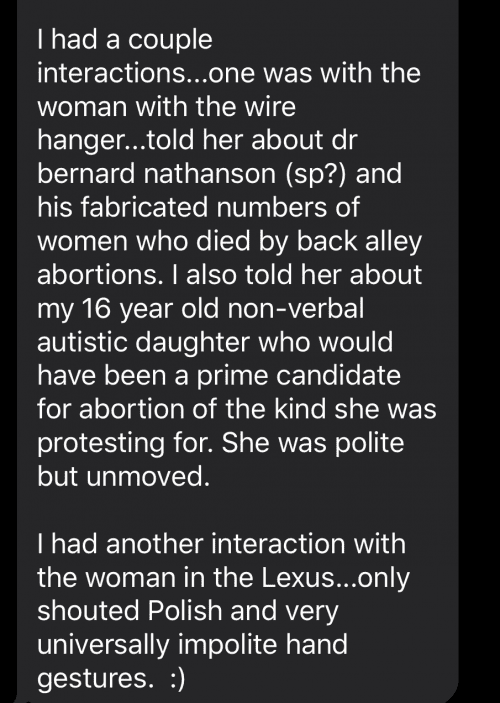
One reader has been at protests in Warsaw and elsewhere in the country. From his texts and photos:

A different Polish reader writes to share something he wrote on Facebook, about how pro-abortion Poles are reacting:

He continues:

You’ll need to google translate for more info, but Wojciech Cejrowski (one of the good guys, Catholic, against all abortion) is saying hell is howling and blaspheming in reaction to this decision.
It’s as if an exorcism is being performed on a possessed person, the way these feminazis are behaving.

Father Marcin Kowalski, a Polish priest, writes in National Catholic Register that the Polish supreme court issued its ruling on the feast day of Pope St. John Paul II. He goes on:

The decision of the Constitutional Tribunal eliminating the patho-embryological premise of abortion has raised a lot of controversy in Poland. Poland already had one of the most restrictive abortion laws in the world, which was established on the basis of a social compromise in the 1990s. It allowed abortion as a result of a threat to the mother’s health, rape and damage or serious illness of the unborn child. The first two premises were maintained; only the third was questioned as unconstitutional.

Statistics show that in 2017, out of about 1,200 abortions, about 1,000 were performed for patho-embryological or eugenic reasons. The mere suspicion of an unborn child being disabled led to pressure on the mother to abort her child. It could be done at virtually any stage of pregnancy. It has also been advised in situations that involve babies with Down syndrome. In the latter case, social awareness of the need to protect the lives of these children and respect for them is growing. After all, every March 21 we celebrate World Down Syndrome Day. In this respect, the ruling of the Constitutional Tribunal meets the social awareness and expectations.

So Poland has outlawed eugenic abortions. That is why the crowds are on the streets. And in the churches, disrupting masses (see photos here). Here, embedded in a tweet, is a startling image:

Polish readers, please send more details about what’s happening in your country. I don’t want to offer a comment until I better understand the issue. Obviously my strong sympathy is with the pro-life side, but I want to know more before I say anything else.

In Poland, Clash Erupts Between Culture of Life and Culture of Death

Not that you'll see it in the MSM, but mobs of baby killers are protesting, rioting, and desecrating Churches in Poland. Our Lady of Częstochowa, Queen of Poland, Pray for your people!

From the National Catholic Register

By Fr Marcin Kowalski

Poland’s Constitutional Tribunal has outraged the left in Europe with its Oct. 22 ruling.

The Polish Constitutional Tribunal ruled Thursday — the feast of Pope St. John Paul II — that killing babies in the womb on the pretext of “fetal defect or incurable illness” is unconstitutional. The judges ruled that the right to the protection of life is a fundamental human right enshrined in Poland’s Constitution.

The role of the legislator is therefore to protect the life of an unborn child, which is more important than its health and well-being. According to Polish law, abortion is still allowed in cases of rape and when a pregnancy threatens the mother’s life.

The tribunal ruled out abortions that are based on genetic mutations, such as Down syndrome, in prenatal tests. This decision is in line with the Ten Commandments, which is a universal law, and God's law, which should constitute the basis of human laws. In antiquity, Jews and Christians were known for not abandoning or killing their own children. We are faithful to the teachings of Jesus and the standards of moral conduct that result from it. Jesus in Matthew 18:10 teaches: “Take care that you do not despise one of these little ones; for, I tell you, in heaven their angels continually see the face of my Father in heaven.”

The decision of the Constitutional Tribunal eliminating the patho-embryological premise of abortion has raised a lot of controversy in Poland. Poland already had one of the most restrictive abortion laws in the world, which was established on the basis of a social compromise in the 1990s. It allowed abortion as a result of a threat to the mother's health, rape and damage or serious illness of the unborn child. The first two premises were maintained; only the third was questioned as unconstitutional.

Statistics show that in 2017, out of about 1,200 abortions, about 1,000 were performed for patho-embryological or eugenic reasons. The mere suspicion of an unborn child being disabled led to pressure on the mother to abort her child. It could be done at virtually any stage of pregnancy. It has also been advised in situations that involve babies with Down syndrome. In the latter case, social awareness of the need to protect the lives of these children and respect for them is growing. After all, every March 21 we celebrate World Down Syndrome Day. In this respect, the ruling of the Constitutional Tribunal meets the social awareness and expectations.

Abortion policy is a sign of the civilization of death, as Pope St. John Paul II wrote. His teaching and testimony of life are still an important point of reference for us Poles. The ruling of the Constitutional Tribunal was interpreted by many in Poland as a victory of the civilization of life, a civilization that protects the dignity of every human life, a sign of fidelity to our Christian roots, to the Gospel and to the teachings of John Paul II.

It should be added that Pope Benedict and Pope Francis also radically emphasize their opposition to abortion. It is a barbaric law that contributes to the murder of millions of innocent children around the world. At the same time, Poland remains under pressure from the surrounding European countries, where the existing abortion laws are more liberal. The attitude of our authorities and society is treated as “uncivilized” and contrary to human rights, i.e. the rights of women and men to end the life of their unborn child. The issue of abortion is also treated as political and instrumentalized by attributing the ruling of the Constitutional Tribunal to the government and conservative Law and Justice Party. It is a distorted and harmful image. A group of about 100 parliamentarians from three political options and parties asked about the constitutionality of the abortion law. This issue should be separated from politics. We also see that there is a need for social education in this respect, greater presence in the mass media and reaching out to young people with reason.

We have a lot of work ahead of us to educate and convince others that killing an unwanted child is wrong. Just as you don't kill the wounded, the weak and the elderly, you shouldn't kill the most vulnerable, unborn children. The fight for their lives will not be easy, but we read it as a clash between the civilization of life and death — a clash in which a Christian has a duty to take the side of life.

Dogged – Catholic – Realism

Nominalism, little known, but it haunts our world destroying all that is Good, and True, and Beautiful.

From The Catholic Thing

By Dr Anthony Esolen

Some of our hierarchs speak as if the moral law as regards sex, marriage, and family life were a bitter constraint, to be acknowledged perhaps, but also to be transcended in the name of Christian liberty and charity. It is as if they believed what Nathanael Hawthorne himself did not, that our society is a step away from that of the grim hypocritical Puritans who pinned the scarlet A on the breast of Hester Prynne.

We, of all people – a fractious collection of dispirited hedonists, who channel what should be hatred of sin into hatred of people who commit the few sins we still recognize, or of people who fall afoul of “laws” we have invented to separate right-thinking sheep from wrong-thinking goats.

Such hierarchs have an unreal interpretation of the moral law. They are nominalists and voluntarists, perhaps without knowing it. They speak as if God has happened to declare, let us say, that fornication is wrong, but that there is nothing in the nature of the act that makes it wrong, and that must hurt or ruin the person who engages in it and the society that shrugs at it or, worse, promotes it.

Nothing is good or bad, says the skeptical Hamlet of our time, but thinking makes it so – thinking, or the latest theological fad, to be picked up at a bargain from ever new and improved Catholic journals, Catholic theological societies, and Catholic hierarchs themselves. “But Daddy!” cries the petulant daughter, showing off a skirt that is more air than cloth, “It’s all the rage in America!”

We Catholics, however, are supposed to have a realist view of sin and moral health, just as we have a realist view of disease and physical health. Lung cancer does not magically vanish if we call it a chest cold. Clogged arteries do not magically open if we say we are blessed with an alternative form of circulation. The good doctor loves his patients in his implacable opposition to cancer and heart disease. The timid doctor doesn’t.

I am not talking about what will happen to the person who dies without having repented of grave sins. I am talking about what does happen to him, inevitably, as surely as bleeding follows from a thrust of the knife. Nor is he the only victim. You cannot hurt one member of the body without hurting the others. It baffles me that those hierarchs friendly to socialism in politics and economics do not see this.

If I were a saint, I could say with the psalmist that I love the law of the Lord for its own sake and meditate upon it day and night. That would be like gazing upon the sun. But I can say that I love the law of the Lord for the lovely things it illuminates. I love it for the world it makes possible, if we confess it as a people and try to follow it as best we can.

Again I am doggedly realist, with an incarnate imagination, as I believe the faith and the Scriptures instruct me to be. Jesus says, “Suffer the little children to come unto me, and hinder them not, for of such is the kingdom of heaven.” What Christian heart does not glow warm to hear those words?

But I am fool enough to believe that they imply that a life rich in children is a life most blest. I like children. I like to see them running and shouting about the streets and in the fields and down the trails in the woods. I want them to play on my grass. I am moved by their innocence.

But we have no chance, none, of enjoying that child-rich world unless we acknowledge those salutary laws that protect marriage and family life. Nor do we have that world now. We have silence, empty fields, and all manner of disease put before the gaping eyes of children – their imaginations raped, and never, on this side of the grave, to be whole and pure again. .

Jesus says that all of the law and the prophets may be summed up in one commandment: “You shall love the Lord God with all your heart and mind and soul and strength, and you shall love your neighbor as yourself.” I am again too much of a realist to conclude immediately that the law implies support of a foreign policy objective regarding a nation ten thousand miles away.

Maybe it does, maybe it doesn’t, but it surely implies the goodness of neighborhood. Where am I going to learn to love my neighbor, if not among those who really are near me? But how can I do that, unless there are real neighborhoods, full of people who know one another, because they see one another all the time?

And how can that be, unless marriage is stable and nearly universal and prolific, so that you get to know not only the people who live near you, but some of their kindred too? Where are all the people, most of our daylight hours?

Jesus compares the kingdom of God to a wedding feast, such a feast as witnessed his first miracle; such a feast as is the mysterious climax of Scripture itself. I am fool enough to believe that it is a sign of a gravely sick society that marriages are so late and so prone to dissolution.

What should we have expected? The moral law kept men and women from their worst impulses. It protected them from themselves and from each other. Obliterate the law, and what do we see? No one really knows what a man is, or a woman, or that they are for one another. The joy is gone. The perception of the beauty of each sex is gone. What else should we have expected?

Hierarchs – I do not like the gray and impersonal and bitter and child-poor world you seem to have accepted. It is no foretaste of heaven.

Word of the Day: Grottaferrata

GROTTAFERRATA. Basilian monastery, about three miles from Frascati, Italy, founded in 1004 by St. Nilus, a Calabrian Greek. Long a center of Greek ritual and learning, it became a national monument in 1874. Since then extensive catacombs belonging to the monastery have been discovered; they had been untouched since the early days of Christianity.

How a Conservative Should Oppose Socialism and Liberalism

Sir Roger (R+I+P) was a powerful voice of sanity in our modern world. He is sorely missed.

From The Imaginative Conservative

By Sir Roger Scruton, FBA, FRSL

Post-war intellectuals have inherited two major systems of political thought with which to satisfy their lust for doctrine: liberalism and socialism. It is testimony to the persistence of the dichotomizing frame of mind that, even in Eastern Europe, the “world conflict” that endured for seventy years was frequently seen in terms of the opposition between these systems. And because they are systems, it is often supposed that they are organically unified—that you cannot embrace any part of one of them without embracing the whole of it. But let it be said at the outset, that, from the standpoint of our present predicament, nothing is more obvious about these systems than the fact that they are, in their presuppositions, substantially the same. Each of them proposes a description of our condition, and an ideal solution to it, in terms which are secular, abstract, universal, and egalitarian. Each sees the world in “desacralized” terms, in terms which, in truth, correspond to no lasting common human experience, but only to the cold skeletal paradigms that haunt the brains of intellectuals. Each is abstract, even when it pretends to a view of human history. Its history, like its philosophy, is detached from the concrete circumstance of human agency, and, indeed, in the case of Marxism, goes so far as to deny the efficacy of human agency, preferring to see the world asa confluence of impersonal forces. The ideas whereby men live and find their local identity—ideas of allegiance, of country or nation, of religion and obligation—all these are, for the socialist, mere ideology, and for the liberal, matters of “private” choice, to be respected by the state only because they cannot truly matter to the state.Only in a few places in Europe and America can a person call himself a conservative and expect to be taken seriously. The first task of conservatism, therefore, is to create a language in which “conservative” is no longer a term of abuse. This task is part of another, and larger, enterprise: that of the purification of language from the insidious sloganizing which has taken hold of it. This is not a simple enterprise. Indeed, it is, in one sense, the whole of politics. As the communists realized from the beginning, to control language is to control thought—not actual thought, but the possibilities of thought. It is partly through the successful efforts of the communists—aided, of course, by a world war which they did not a little to precipitate—that our parents thought in terms of elementary dichotomies. Left-Right, Communist-fascist, socialist-capitalist, and so on. Such were the “terms of debate” that we inherited. To the extent that you are not “on the Left,” they implied, then to that extent are you “on the Right”; if not a Communist, then so much nearer fascism; if not a socialist, then an advocate of “capitalism,” as an economic and political system.


If there is a basic dichotomy that presently confronts us, it is between us—the inheritors of what remains of Western civilization and Western political thinking—and the purveyors of dichotomies. There is no such opposition as that between Left and Right, or that between communism and fascism. There is simply an eternal alliance—although an “alliance of the unjust” who are always ready to violate the terms that bind them—between those who think in terms of dichotomies and labels. Theirs is the new style of politics, the science which has in truth replaced “politics” as it has ever been known. Theirs is a world of “forces” and “movements”; the world perceived by these infantile minds is in a constant state of turmoil and conflict, advancing now to the Left, now to the Right, in accordance with the half-baked predictions of this or that theorist of man’s social destiny. Most of all, the dichotomizing mind has need of a system. It seeks for the theoretical statement of man’s social and political condition, in terms of which to derive a doctrine that will answer to every material circumstance.

Each system is also universal. An international socialism is the stated ideal of most socialists; an international liberalism is the unstated tendency of the liberal. To neither system is it thinkable that men live, not by universal aspirations but by local attachments; not by a “solidarity” that stretches across the globe from end to end, but by obligations that are understood in terms which separate men from most of their fellows—in terms such as national history, religion, language, and the customs that provide the basis of legitimacy. Finally—and the importance of this should never be underestimated—both socialism and liberalism are, in the last analysis, egalitarian. They both suppose all men to be equal in every respect relevant to their political advantage. For the socialist, men are equal in their needs, and should therefore be equal in all that is granted to them for the satisfaction of their needs. For the liberal, they are equal in their rights, and should therefore be equal in all that affects their social and political standing.

I must say at once that I have more sympathy for the liberal than for the socialist position. For it is based in a philosophy that not only respects the reality of human agency, but also attempts to reconcile our political existence with the elementary freedoms that are constantly threatened by it. But—whatever its worth as a philosophical system, liberalism remains, for me, no more than that—a constant corrective to the given reality, but not a reality in itself. It is a shadow, cast by the light of reason, whose existence depends upon the massive body which obstructs that light, the body of man’s given political existence.

This given political existence defies the four axioms of liberalism and socialism. It is not secular but spiritual, not abstract but concrete, not universal but particular, and not egalitarian but fraught with diversity, inequality, privilege, and power. And so it should be. I say that it is spiritual, for I believe that the world as man understands it—the Lebenswelt—is given to him in terms which bear the indelible imprint of obligations that surpass his understanding. He is born into a world that calls on him for sacrifice, and that promises him obscure rewards. This world is concrete—it cannot be described in the abstract unhistorical language of the socialist or liberal theorist without removing the skin of significance that renders it perceivable. The world of the socialist and the world of the liberal are like dead skeletons, from which the living skin has been picked away. But this actual, living, social world, is a particular thing, a vital thing, and it must, if it is to flourish, distribute its life variously and unequally about its parts. The abstract equality of the socialist and the liberal has no place in this world, and could be realized only by the assertion of controls so massive as to destroy themselves.

In order to justify, and indeed to win, its war with reality, the intellectual mind has developed an annihilating language with which to describe it. All political realities are described a-historically, as though they could be established anywhere, at any time. Thus the peculiarly Polish phenomenon of “Solidarity” is squeezed into the abstract forms dictated by the theory of “liberal democracy.” It is even seen as a kind of socialism, especially by French intellectuals for whom nothing is good which cannot be given a socialist name. The example is minatory. If we are to return to reality, we must search for a language that is scrupulous towards the human world.

One generality, however, is useful to us, precisely because, behind it, a thousand particularities lie hidden. I refer to the idea of legitimacy. To their immense credit, liberals have tried to provide an alternative idea of legitimacy—one with which to challenge the historical entitlements that were to be extinguished by the triumph of their system. The first, and final, condemnation of communism is that it has dismissed the whole idea of legitimacy with a cavernous laugh. It is not my concern to argue with the liberal, some of whose ideas must eventually be incorporated into any philosophical theory of legitimate government. I wish only to suggest a non-liberal alternative, that will be free from the contagion of theory.

Among the many dichotomies that have pulverized the modern intelligence, that—due, I suppose to Weber—between legitimacy and legality, between “traditional” and “legal-rational” modes of authority, has been the most damaging. Only if law is misunderstood, as a system of abstractions, can legality be regarded as an alternative to—rather than as a particular realization of—legitimacy. But abstract law is, for that reason, without lasting force.

Legitimacy is, quite simply, the right of political command. And this right includes the exercise of law. What confers this right over a people? Some would say their “choice.” But this idea overlooks the fact that we have only the crudest instruments whereby choices are measured, and these choices concern only the most fortuitous of things. Besides, what leads people to accept the “choice” that is thrust upon them by their fellows, if not a prior sense that they are bound together in a legitimate order?

The task for the conservative is to find the grounds of political existence concretely, and to work toward the re-establishment of legitimate government in a world that has been swept bare by intellectual abstractions. Our ultimate model for a legitimate order is one that is given historically, to people united by their sense of a common destiny, a common culture, and a common source of the values that govern their lives.

The liberal intelligentsia in the West, like the erstwhile Communist intelligentsia in the East, has persistently refused to accept the givenness of human existence. It has made life, and in particular political life, into a kind of intellectual experiment. Seeing the unhappiness of man it asks, what has gone wrong? And it dreams of a world in which an abstract ideal of justice will be made reality. It looks everywhere for the single solution that will resolve conflicts and restore harmony everywhere, whether on the North Pole or at the Equator. Hence, the total inability of liberalism to provide a solution to those who are afflicted by totalitarian illegitimacy. The liberal begins from the same assumption as the totalitarian, namely, that politics is a means to an end, and the end is equality—not, it is true, material equality, but moral equality, an equality of “rights.” Democracy is the necessary result of this liberal ideal, since democracy is the final realization of political equality. For the liberal, the only way to oppose the totalitarian is by slow, steady democratization of the social order.

Who can doubt the appeal of that idea? But it neglects the one, inescapable fact. I cannot see my own life as the liberal wishes to see political life. I cannot see my own life as an experiment. Nor can I regard my obligations as created entirely by my free, responsible actions. I am born into a situation that I did not create, and am encumbered from birth with obligations that are not of my own devising. My basic debt to the world is not one of justice but of piety, and it is only when I recognize this fact that I can be truly myself. For only in relation to my given situation can I form those values and social perceptions that give me strength, at last, to experiment with freedom.

Any genuine account of our sentiments of legitimacy must begin from the recognition that piety precedes justice, both in our lives and in our thinking, and that, until we have attached ourselves to a place and people, and begun to think of them as “our own,” the claims of justice, and the superstition of equality, are entirely without meaning for us. But this attachment to place and people is not chosen: it is not the outcome of some liberal reflection on the rights of man, nor is it conceived in the experimental spirit that is so important to the socialist program. It is given to us, in the very texture of our social existence. We are born into the obligations of the family, and into the experience of ourselves as parts of a larger whole. Not to recognize the priority of this experience is to concede the major premise of totalitarian thinking, which is that political existence is nothing but a long term experiment. There is a particular view, still popular among left-wing intellectuals in the West, that the Soviet system was “socialism gone wrong.” This thought expresses precisely the major political danger of our times, which is the belief that politics involves a choice of systems, as a means to an end, so that one system may “go wrong” while another “goes right.” The truth is that socialism is wrong, precisely because it believes that it can go right—precisely because it sees politics asa means to an end. Politics is a manner of social existence, whose bedrock is the given obligations from which our social identities are formed. Politics is a form of association which is not a means to an end, but an end in itself. It is founded on legitimacy, and legitimacy resides in our sense that we are made by our inheritance.

Hence, if we are to rediscover the roots of political order, we must attempt to endorse the unchosen obligations that confer on us our political identity, and which settle for a Pole that he cannot be governed from Moscow, or for a Falkland Islander that he cannot be legitimately governed from Buenos Aires.
+++
It is worth pausing to mention another, and rival, generality that has been of some service to the left-liberal intellectual in our time, in his endeavor to wipe out the past, and to find a basis for political obligation that looks only to the present and the future. This is the idea of the “people,” as the fount of legitimate order. The idea is usually combined with the fantasy that the intellectual has some peculiar faculty of hearing, and also articulating, the “voice of the people.” This self-delusion, which has persisted unaltered since the days of the French Revolution, expresses the intellectual’s concern to be reunited with the social order from which his own thinking has so tragically separated him. He wishes to redeem himself from his “outsideness.” Unfortunately, however, he succeeds in uniting himself not with society, but only with another intellectual abstraction—“the people”—designed according to impeccable theoretical requirements, precisely in order to veil the intolerable reality of everyday life. “The people” does not exist. Even if it did exist, it would be authority for nothing, since it would have no concrete basis on which to build its legitimacy. Nobody can speak for the people. Nobody can speak for anyone. The truth, however, strives to be uttered, and may find expression, now on these lips, now on those.

Unlike “the people,” the nation is not an abstraction. It is a given historical reality. It is made particular and immediate in language, custom, religion, and culture. It contains within itself the intimation of a legitimate order. This, I believe, should always be remembered, even by those—and that includes most of us now—who hesitate to adopt the straightforward nationalism that emerged from the Congress of Vienna and which at first pacified, but subsequently destroyed, our continent.
+++
But surely, you will say, is there not another source of legitimacy—one that does not require the support of those pious obligations that seem to commit us to so much on the basis of so little? Is there not a legitimacy to be found in democracy, that will one day replace the appeal to piety?

That is a large question. But two things need to be said in response to it. First, “democracy” is a disputed term, and nobody knows quite what it means or quite how to secure it. Should we wait until all the paradoxes of social choice have been resolved before formulating our political commitments?

Second, what people have appreciated in democracy is not periodic collective choice—for what is so estimable in the fact that the ignorant majority every now and then chooses to be guided by a new party, toward goals that it understands no better than it understood the goals of the previous one? What is appreciated are certain political virtues, which we rightly associate with British and American democracy, but which existed before democracy, and could be established elsewhere without its aid. These virtues are the following:

(i) Limited power: no one can exercise unlimited power when his projects stand to be extinguished by an election.

(ii) Constitutional government: but what upholds the constitution?

(iii) Justification by consent.

(iv) The existence of autonomous institutions, and the free association that makes them possible.

(v) Rule of law: in other words, the possibility of adjudicating every act, even when it is the act of an official—even when it is an act in the name of the sovereign power.

(vi) Legitimate opposition: in other words, the right to form parties, and to publish opinions, which oppose the government; and the right to contend openly for power.

Political theorists are familiar, of course, with those matters, and this is not the place to discuss them in detail. But it is worth summarizing their import. Taken together, those six features of government mean, not democracy, but rather constitutional limitation. To put it more directly, they denote the separation of the state (which isthe locus of legitimate authority) from those who hold power by virtue of the state. Those who wield power can be judged in terms of the very offices that they hold. This is surely an essential part of true political order. It is also an indispensable part of any fully elaborated legitimacy. Indeed, we can see legitimacy in the modern state as composed of two parts: a root, which is the pious attachment that draws people together into a single political entity; and a tree which grows from that root, which is the sovereign state, ordered by the principles that I have advocated. In this state, power is held under conditions that limit it, and in a manner that makes it answerable to those who may suffer from its exercise. This state shows the true flowering of a “civil society”—a public life that is open, dignified, and imbued with an instinctive legality. Such legality grows from and expresses the legitimacy that is stored in its root. It is this upper, visible part of the legitimate polis that is so evidently destroyed by the political doctrines of our time. But its destruction is made possible, not so much by the elimination of democracy, as by the stifling of the spontaneous source of legitimate sentiment from which it feeds.

Democracy can, of course, sustain the six political virtues that I have listed. But it can also destroy them. For all of them depend on the one thing that democracy cannot provide, and which is hinted at in the question that I have added to number (ii): authority. What prompts people to accept and be bound by the results of a democratic election, or by the existing law, or by the limitations embodied in an office? What, in short, gives rise to the “public spirit” that has so signally vanished from the institutions of government in much of modern Europe? Surely it is respect—forinstitutions, for procedures, for the powers and privileges that are actually enjoyed. This respect is derived from the sense that these powers, privileges, and procedures reflect something that is truly “ours,” something that grows from the social bond that defines our condition. Here lies the authority of the actual: that it is seen to contain within itself the residue of the allegiance which defines my place.
+++
What now is true legality? I have already hinted at a distinction between abstract and concrete law, and have implied that only the latter can truly fill the vacuum of legitimacy that presently lies before us. Concrete law is exemplified at its best in the English tradition of common law—law made by judges, in response to the concrete problems that come before them, and in which principles emerge only slowly, and already subject to the harsh discipline of the actual. Any law that is the upshot of serious judicial reasoning, founded in precedents and authorities, bears the stamp of an historical order; it also remains responsive to the reality of human conflicts, and constitutes a genuine attempt to resolve them, rather than to dictate an intellectually satisfying solution which may be unacceptable to the parties. This kind of law encapsulates the true source of legal authority, which is the plaintiff’s belief that justice will be done, not abstractly, but in his particular case, in light of the particular circumstances that are his, and which are perhaps even uniquely his. For concrete law to exist in any form, there must be judicial independence. And once there is judicial independence there is all that anyone has reasonably aspired to under the banner of “the rights of man.” For there is the assurance that justice may be done, whatever the power that seeks to extinguish it.

There are two major threats to concrete law. One is the abolition of judicial independence. This was accomplished by the Communist Party, in the interests of an “abstract” justice—an “equality” of reward—which must inevitably conflict with the concrete circumstances of human existence. The second threat is the proliferation of statute law—of law by decree, law repeatedly made and re-made in response to the half-baked ideas of politicians and their advisors. All such law is fatally flawed: the Communist Party rested its entire claim to legality in the generation of such laws, while removing the only instrument—judicial independence—that could make them into genuine laws, rather than military injunctions.

Liberalism has always appreciated the importance of legality. But liberal legality is an abstract legality, concerned with the promotion of a purely philosophical idea of “human rights.” What value are human rights, without the judicial process that will uphold them? And besides, in resting one’s faith in this beguiling abstraction, does one not also give to one’s enemy another bastion against the recognition of his illegitimacy? Is it not possible for him to say that he upholds human rights—only different rights? (The right to work, for instance, or a right to a stake in the means of production.) If one looks back to the French Revolution, one sees just how easy it is for the doctrine of “human rights” to become an instrument of the most appalling tyranny. It suffices to do as the Jacobins did—to abolish the judiciary, and replace it by “people’s courts.” Then anything can be done to anyone, in the name of the Rights of Man.

In response to liberalism, therefore, it is necessary to work for the restoration of the concrete circumstances of justice. But the concrete law that I have been advocating is very unlike anything that either a socialist or a liberal would approve. It preserves inequalities, it confers privileges, it justifies power. That, however, is also its strength. For there always will be inequalities: there always will be privilege and power. Those are nothing but the lineaments of every actual political order. Since inequalities, privileges, and powers exist, it is right that they should coexist with the law that might justify them. Otherwise they exit unjustified, and also uncontrolled.

Republished with gracious permission from the Intercollegiate Review (Spring 1993).

This essay appeared originally appeared here in February 2012 and appears here again in memory of the great Sir Roger Scruton (born February 27, 1944), who died on January 12, 2020.