31 July 2019

31 July, Antonio, Cardinal Bacci: Meditations for Every Day

Little Things

1. Very few people are destined to great things by Almighty God. Most of us must offer ourselves in the relatively unimportant walks of life in which we have been placed by Providence. Only some of the Saints were endowed with exceptional virtues and miraculous powers which attracted the attention and admiration of the world. In the normal course of events Christian perfection must be acquired little by little through the practice of ordinary virtues and unspectacular good actions. There is always scope for these. An upsurge of anger can be suppressed from the motive of the love of God and of our neighbour. We can behave courteously towards people who are unsympathetic towards us or who offend us by their unmannerly conduct. We can combat pride by acts of humility and egoism by acts of charity. We can mortify ourselves in speech, in behaviour, and at table, and we can give alms to the poor, good advice to the ignorant, and comfort to the afflicted.
All these virtuous actions are insignificant in the eyes of men, but they are great in the sight of God. The blades of grass and the flowers in the meadow are tiny things, but joined together they constitute the pasture which provides nourishment for the herds and flocks. Let us perform these small actions every day and so cultivate the ordinary virtues. We shall attract the attention and favour of God, Who will help us to advance step by step towards the peak of Christian perfection.

2. Just as there are very ordinary acts of virtue, so there are very ordinary sins. But it would be rash to regard acts of deception, vanity and impatience as insignificant. Every deliberate sin is an offence against God, our highest good and our Redeemer.

How can God be indifferent to these ungrateful violations of His law? After all, even as He has assured us that a cup of cold water given in His name to a thirsty man will have its reward (Cf. Mt. 10:42), so He has assured us that not even the slightest trace of sin can enter into eternal glory. We shall not be condemned to Hell for venial sins alone, but we shall suffer a decline in grace and shall be obliged to expiate our sins either in this life or in Purgatory.

3. Our eternal salvation will probably be determined by these ordinary acts of virtue and these ordinary sins. Jesus compared the kingdom of Heaven to a mustard-seed which grows into a tree. Similarly, many Saints began their spiritual ascent by following up one simple inspiration, and many souls, perhaps, have found themselves condemned as a result of having neglected the commonplace virtues and inspirations.

Ordinary virtue may develop into heroic virtue, but if a man has neglected to train himself to act well in small matters, how will he behave in a time of great spiritual trial? Experience also teaches us that smaller vices can develop into great vices. “He who wastes the little he has will be stripped bare.” (Ecclus. 19:1) A man who is not faithful to God in little things will not be faithful in greater things. We are either going up or down in the way of perfection; it is almost impossible to stand still. If we sincerely wish to make progress, let us resolve to avoid the least suggestion of sin and to enrich ourselves daily by tiny acts of virtue.

IN LUMINE FIDEI: 31 JULY – SAINT IGNATIUS (Confessor)

IN LUMINE FIDEI: 31 JULY – SAINT IGNATIUS (Confessor): Saint Ignatius of Loyola, the founder of the Jesuit Order, was born Inigo Lopez de Bicalde in 1491, Loyola being name of his family an...

31 July, A Chesterton Calendar

JULY 31st

The party system in England is an enormous and most efficient machine for preventing political conflicts.

‘George Bernard Shaw.’

Chesterton, G. K.. The G. K. Chesterton Collection [50 Books] (Kindle Locations 44680-44682). Catholic Way Publishing. Kindle Edition.

1 August, The Roman Martyrology

Kaléndis Augústi Luna prima Anno Domini 2019

August 1st 2019, the 1st day of the Moon, 

Commemorated the dedication of the Church of St. Peter-in-Chains, upon the Esquiline Mount at Rome. 
Upon the same day, were born into the better life: 
At Antioch, the seven holy Maccabee brethren and their mother, who suffered under King Antiochus Epiphanes. Their relics have been brought to Rome and buried in the aforesaid Church of St. Peter-in-Chains. 
At Rome, [in the year 137,] the holy Virgins, Faith, Hope, and Charity, [daughters of St. Sophia, who is named under September 30,] who gained the crown of martyrdom under the Emperor Hadrian. 
Likewise at Rome, upon the Latin Way, [in the third century,] the holy martyrs Bonus the Priest, Faustus, and Maurus, and nine others, of whom it is written in the Acts of holy Pope Stephen. 
At Philadelphia, in Arabia, the holy martyrs Cyril, Aquila, Peter, Domitian, Rufus, and Menander, who were all crowned upon one and the same day. 
At Perge, in Pamphylia, [in the fourth century,] the holy martyrs Leontius, Attius, Alexander, and six other husbandmen, who were beheaded under the President Flavian in the persecution under the Emperor Diocletian. 
At Gerona, in Spain, [in the year 304,] the holy martyr Felix, who after torments of diverse kinds was ordered by the Emperor Dacian to be mangled until he gave up his unconquered spirit to Christ. 
At Vercelli, [in the year 370,] the holy martyr Eusebius, Bishop of that city, who was banished by the Emperor Constantius, first to Bethshan and then into Cappadocia, on account of his confession of the Catholic faith, but at length returned unto his own Church. He suffered [a living] martyrdom under the persecution of the Arians. His memory is chiefly kept upon the 15th day of December, which is that of his ordination as Bishop. 
At Paris, [in the year 287,] the holy martyr Justinus. 
At Vienne, [in the year 136,] holy Verus, [fifth] Bishop [of that see.] 
At Winchester, in England, [in the year 984,] holy Ethelwold, Bishop [of Winchester, and Confessor.] 
In the district of Lisieux, [in the department of Calvados, France,] the holy Confessor Nemesius. 
V. And elsewhere many other holy martyrs, confessors, and holy virgins.
R. Thanks be to God.

Memes of the Day


30 July 2019

Church Militant Headlines — July 30, 2019

Stupich seems to have 'mislaid' $195,000,000, Bishop Strickland of Tyler, TX stands up for the Faith.


The Vortex — The ‘World’ Is NOT Good

Michael Voris discusses the modernist embrace of the world (ruled by Satan, of course) and the inevitable damage to the Church.


What You Need to Know About St. Benedict and His Medal

Before I became a Catholic, I was a Confrater (the term in the English Congregation and the Anglicans for an oblate) of St Benedict. I started in the Church as an Obl.O.S.B., before I found my home in Carmel.

I still carry the Medal of St Benedict on my Rosary and on the small Scapular I wear whist laundering my Tertiary's Scapular.

From the National Catholic Register

By Angelo Stagnaro 

Pope Benedict XIV solemnly approved and recommended the use of the medal to the faithful in 1742.


Most people, Catholics included, don't realize how indebted the Church, Europe and the world are to St.
Benedict of Nursia. The very presence of his monks in their monasteries became a stabilizing, civilizing factor no matter where they planted themselves. It was from these centers of great learning and prayer that monks and nuns went about their zealous work of evangelizing. It should be pointed out that many of Europe's greatest cities started out as little more than ramshackle Benedictine monasteries. “Munich” is the German word for “monk.” “Monaco” on the French Riviera, is the Italian word for “monk.”

As Christ is the vine, the Benedictines are the branches. Like kudzu, you simply drop monks off someplace and run. Hopefully you won't get trampled in their evangelical wake.

It's a pity so many Westerners, including Catholics, are ignorant of all that Benedict and his merry band of followers, many of whom labored in holy obscurity, have done for Christendom. One hardly finds any mention of them in high school history books so thoroughly have secularists and anti-religionists remove all mentions of these hardy, pious monks from world history.

Nearly all of these monasteries hosted monastery schools for youngsters. Many of these schools ultimately become universities―the world's first universities. That's right: the Catholic Church started the word's first universities.

St. Benedict of Nursia, Italy (A.D. 480-543), the twin brother of St. Scholastica, is the Father of Western Monasticism. His Rule came to be the basis of organization for many religious orders, including the Franciscans and Dominicans.

For this and many others reasons, I've wanted to procure a St. Benedict Medal for myself, and for all of those who begged me to get them one, from St. Benedict's birthplace. Now, anyone could get one via the internet but that was much too pedestrian for me. For me, it was a bit of a pilgrimage and a bit of a treasure hunt.

As St. Benedict is invoked against evil, his medals are considered particularly efficacious against it. This is the medal the Church uses when she’s had just about enough.

The medal itself has an important prayer used in the Rite of Exorcism, in abbreviated form, on one side and an image of St. Benedict on the other. Apparently, that's all that's necessary to ward off evil.

The story of the medal is startling. Apparently, some monks sought out Benedict who had been living as a hermit in a cave for three years near Naples, Italy. He agreed, but he warned them he would urge them to greater piety and asceticism if he took the job.

Some of the lazier, more dissolute monks wanted him out of the picture, so they conspired to poison his bread and wine. Mystically warned of the treachery, Benedict made the Sign of the Cross over the food and the plot was foiled. At his blessing, the cup of wine shattered and he commanded the two crows who always accompanied him to carry off the poisoned bread depositing it in a place where it couldn’t harm anyone.

Originally, the medal was in the form of a cross and Catholic tradition teaches that Bruno of Egisheim-Dagsburg, the future Pope Leo IX, when he was a young Benedictine, nearly died of a snake bite. He attributed his eventual recovery to that Benedictine cross. He was emaciated and even lost the ability to speak and most people gave up on him. It was then when Bruno received a vision of a luminous ladder that reached to Heaven. Upon the ladder, he saw St. Benedict holding a radiant cross with which he touched Bruno instantly curing him. The apparition promptly disappeared.

When he became pope in A.D. 1049, Leo IX redesigned it as a medal to which he attributed blessings and indulgences. St. Vincent de Paul had a strong devotion to this sacramental and asked his Sisters of Charity to attach the medal to their rosary beads, which remains a common custom even today.

Pope Benedict XIV solemnly approved and recommended the use of the medal to the faithful in 1742.

The medal in current use is the Jubilee medal designed by the monk Desiderius Lenz, of the Beuron Art School. He designed it in 1880 for the 1400th anniversary of the birth of St. Benedict under the supervision of the prior of Montecassino, Very Rev. Boniface Krug (1838-1909) of Monte Cassino, Italy. Monte Cassino was given the exclusive right to strike this medal, with which special Jubilee indulgences were attached. The Jubilee Medal was first produced at St. Martin's Archabbey, Beuron, Germany, at the request of Prior Boniface who was a native of Baltimore and originally a monk of St. Vincent Archabbey, Latrobe, Pennsylvania, until he was chosen to become prior and latter archabbot of Monte Cassino.

Once struck in Germany, the medals spread over Europe and the world. They were first approved by Benedict XIV in his briefs of Dec. 23, 1741 and March 12, 1742.


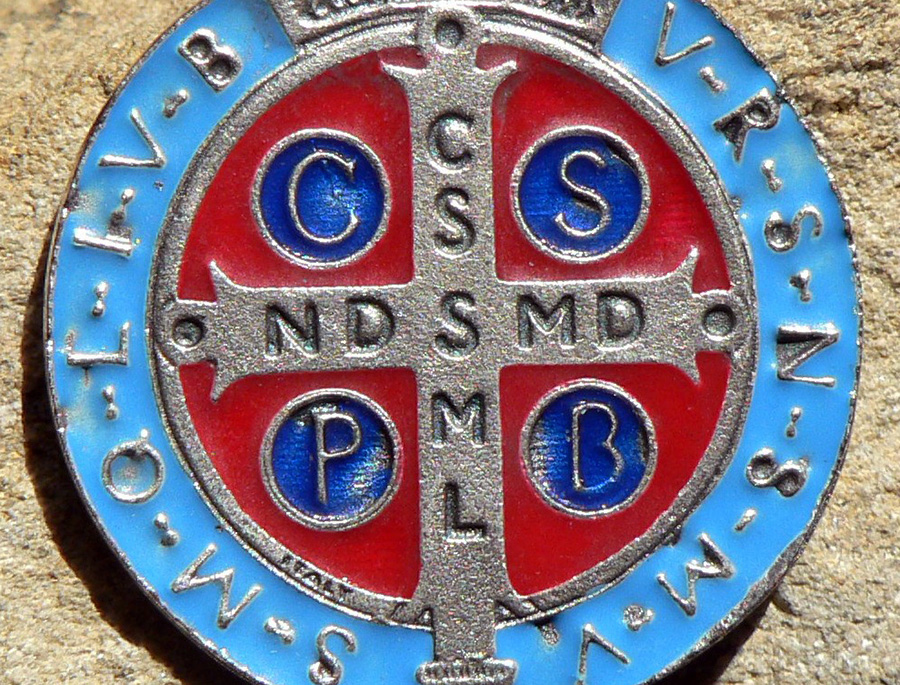
On the front of the medal is St. Benedict holding a cross and his rule. To one side is a poisoned cup and a raven on the other―both references to a Benedictine hagiography mentioned earlier. Above the cup are the words:

Crux sancti patris Benedicti
(The Cross of [our] Holy Father Benedict)
Surrounding St. Benedict are the words:
Eius in obitu nostro praesentia muniamur!
("May we be strengthened by his presence in the hour of our death")
This is a reference to the saint being a Patron of a Happy Death along with St. Joseph. On the back is a cross with the letters C S S M L - N D S M D. these are the initials of the words:
Crux sacra sit mihi lux! Non draco sit mihi dux!
("May the holy cross be my light! May the dragon never be my overlord!")
The larger letters, C S P B, stand for:
Crux Sancti Patris Benedicti
("The Cross of [our] Holy Father Benedict").
Surrounding the back of the medal are the letters V R S N S M V - S M Q L I V B which refer to the prayer of the Rite of Exorcism:

Vade retro Satana! Nunquam suade mihi vana! 
Sunt mala quae libas. Ipse venena bibas!
("Begone Satan! Never tempt me with your vanities!
What you offer me is evil. Drink the poison yourself!")

Finally, at the top is the word PAX which means "peace."

Though lay people, and most priests, are forbidden to conduct exorcisms, they are permitted to use the St. Benedict Medal to ward off evil. One is allowed to:
  1. wear the medal around the neck;
  2. attach it to one's rosary;
  3. kept in one's pocket or purse;
  4. attach it to one's keychain;
  5. affixed to one's car or home;
  6. placed in the foundation of a building;
  7. affixed to the center of a crucifix, usually behind the corpus.
According to Dom Gueranger, the medal is considered effective in:
  1. asking for inner peace/spiritual healing;
  2. asking peace between individuals or between nations of the world;
  3. curing bodily afflictions especially as protection against contagious diseases;
  4. destroying the effects of witchcraft and all other diabolical and haunting influences;
  5. healing those who are suffering from wounds or illness;
  6. obtaining the conversion of sinners, especially when they are in danger of death;
  7. offering protection against storms and lightning;
  8. protecting children from nightmares;
  9. protecting a mother and her children during childbirth;
  10. protecting animals infected with plague or other maladies;
  11. protecting fields infested by harmful insects;
  12. protecting or otherwise counter the effects of poison;
  13. protecting those persons who are tempted, deluded or tormented by evil spirits.
A Crucifix/St. Benedict Medal combination is called “The Cross of a Happy Death”—not only because of the exorcizing properties of the Medal and the image of Christ's Body, but because of St. Benedict's particular patronage based on his death of which Pope St. Gregory the Great (A.D. 540-604) described in his Dialogue:
Six days before [Benedict] left this world, he gave orders to have his sepulcher opened, and forthwith falling into an ague, he began with burning heat to wax faint; and when as the sickness daily increased, upon the sixth day he commanded his monks to carry him into the oratory, where he did arm himself receiving the Body and Blood of our Savior Christ; and having his weak body held up betwixt the hands of his disciples, he stood with his own hands lifted up to heaven; and as he was in that manner praying, he gave up his spirit.
A plenary indulgence is granted, under the usual conditions, to one who, at the hour of his death, kisses, touches, or otherwise reverences the Crucifix/St. Benedict Medal combination and commends his soul to God's care and protection.

A St. Benedict medal may be blessed by any bishop, abbot, priest or deacon, not necessarily a Benedictine (Instr., 26 Sept. 1964; Can. 1168). However, I was on a quest, and I can be pretty obstinate when I want to be. I wanted medals that had been specifically blessed/exorcised by the Abbot of the Monastero di San Benedetto in Norcia. I was in Umbria doing research for a novel I'm writing and wanted to make sure I saw Norcia. This monastery is located near the ruins of the house where St. Benedict and his sister St. Scholastica lived.

The monastery also sells CDs of their music and Birra Nursia―a surprisingly excellent beer which has only now been made available in the US―which I highly recommend.

The abbot was gracious enough to give me a handful of them with the admonition that I should be generous in giving them to people in spiritual need. I bring them wherever I go.

Like all sacramentals, this medal serves to remind us of God and His place in our lives. It reminds us to serve Him and love our neighbor. It's absolutely not a charm or talisman to bring “good luck” or repel evil, as that would be blasphemy. The medal has no intrinsic “magic ability.” (It should be pointed out that all power in the universe is in God's hands and doesn't reside elsewhere. In other words, people who claim to have magic powers are deluded and/or lying.)

To be clear, the medal has no power in and of itself. It is, after all, only so much aluminum or silver. To act as if it's magical is sacrilege and assuredly the best way to make sure you don't receive its spiritual benefits. Rather, its graces and favors are due to our faith in the Jesus Christ, Our Redeemer, to the efficacious prayers of St. Benedict, (James 5:16) and to the abundant blessings which the Church has bestowed upon those who wear and pray with the Medal.

This medal is highly esteemed by the Church and it’s often given to those who are spiritually afflicted or harassed.

We are assured extraordinary favors by combining the medal with special devotions in honor of St. Benedict often on Tuesdays. The Way of the Cross is also highly recommended and often associated with a devotion to the saint.

As it would be a simony to sell a St. Benedict Medal or, in fact, any sacramental, Benedictines will gladly give them to you for free. If you were to offer a donation secretly or at a later time, it would go a long way to help the monks with their apostolate.

Once you’ve procured a medal, make sure you keep I with you. When it’s used in faith, it will surely bring you to a greater love and appreciation of God.

‘It Hath Hated Me before You’: Interview with Fr. Vaughn Treco, Excommunicated for Preaching the Faith

Fr Treco was 'excommunicated' for the 'crime' of simply being a Catholic and preaching the Faith from the pulpit.

From One Peter Five 

By Christopher Laurence 

“Christ was crucified on earth and the Church is crucified in time, and the Church is crucified by all of us, by her members most particularly because She is a Church of sinners.” —Flannery O’Connor.
There is quite a lot of talk these days about heresy and scandal in the hierarchy of the Church, of bishops having disdain for tradition and aversion to hearing immemorial truth in any form. There once were whispers and now are shouts about some ethereal “spirit of Vatican II” and the myriad points of destruction it has left in its wake. All easy enough to dismiss as hysteria or the crying of odd “ultra-traditionalists” pining away for archaic liturgical minutiae which no modern person would miss.
However, if this is all simply backroom traddie chatter, then the very real case of Fr. Vaughn Treco is difficult to understand. I had the opportunity to get the full story of what transpired for Fr. Treco over his infamous homily, in his own words. He lays out the events that led him to composing it and, before that, what formed him in the Faith in such a way that he was able to recognize the dangers which made the homily necessary. What follows are parts of this story, and they are compelling, indeed. (The full text of my interview with Fr. Treco is linked at the bottom of this article.)
A homily such as Fr. Treco’s is foreign to the ear of many a modern Catholic (though this shouldn’t be the case), so I asked him what the impetus was for composing such a thing.
“When the McCarrick affair broke,” said Father, “and I saw my parishioners beginning to wonder about whether or not this crisis that the Church was in was ever going to end, and I saw their sense of spiritual being fading, that caused a great concern to me as a pastor. And so I was confronted with the reality that I would have to address this. When I listened to the reports about the fall of the once great cardinal archbishop of Washington, D.C., what amazed me was how the narrative, at least in the public media, seemed to presuppose more or less sociological reasons for this crisis. None of these answers seemed satisfactory to me, because although it was weighing heavily upon everyone, it seemed that few people wanted to ask questions about the deeper sources of the crisis.”
Seeing no spiritually satisfying answers being readily offered, Fr. Treco felt a pastoral responsibility. He continued: “So I guess more than anything else, in any immediate sense, it was a concern for the spiritual well-being of my parishioners in the midst of this crisis. That’s the genesis of my homily.”
Considering the weight of what he would attempt to address, Father knew he could not afford to mince words, nor could he speak frivolously.
“Up until the day on which I gave the homily, I probably listened to it in excess of five hundred times. And that’s not an exaggeration. I had many opportunities to think and reflect on and reconsider language, specific words. By the time the homily was done, there was no word that I had not carefully thought about.”
I was curious whether Father Treco had any hesitation about initially delivering this homily, or later having it published by The Remnant.
“In the most profound sense, I would say no, not really. My initial response to them [The Remnant] was, ‘A homily is a public act, a proclamation, and so if I were going to give it to my parishioners, if I felt comfortable giving it to them, why would I hesitate to give it to others?’ So Michael Matt at The Remnant said if I wanted to, they could publish the homily anonymously and in that way protect me from any fallout that would come, because he suspected [it] might. And I said, ‘You know, while that might be the safe road, that would also be the coward’s road.'”
And so Father’s homily was published to The Remnant’s YouTube channel, where, as of the writing of this article, it has been viewed (as of this writing) over 58,000 times. From there, the story continues — with Fr. Treco being removed from his position at St. Bede’s by Bishop Steven J. Lopes. I asked Father about the manner and circumstances in which he was made aware of his removal and what possible reasons were given for this step.
“I think it was January the 15th, 2019, I received an email from Bishop Lopes to which was attached the letter in which he informed me that he had withdrawn my faculties to preach and to hear confessions and concerning the change in the administration of the mission parish of St. Bede’s the Venerable.
“There are several assertions that Bishop Lopes made in either the letter or the decree. The first is that I asserted that the Council itself [the Second Vatican Council] was a departure from Catholic Tradition and that [it] was devoid of magisterial weight. The simple answer is, I never made either of those statements. The second is that I asserted that Popes Paul VI, John Paul II, and Benedict XVI set aside the mandate given to them by Our Lord Jesus Christ so that the popes therefore do not exercise legitimate authority in the Church. The third assertion that [Bishop Lopes] makes is that I urged the faithful by extension to treat as suspect the Ordinary and Universal Magisterium of the Church after 1963, or that I incited animosity toward the Apostolic See.
“The fourth assertion was that … publishing my homily on a website known for ‘extreme views’ and the fact that my homily retrieved so much attention in digital and social media made it superfluous for any penal investigation to prove its veracity. That’s quite an assertion. Again, it is unmerited. First of all, ‘The Remnant’ is not known for extreme views, unless you consider Catholic orthodoxy extreme.
“The fifth assertion made is that I said that the Council taught errors and departed from the true Catholic Faith and that I refused to reaffirm the Profession of Faith made prior to my ordination. Those two facts are just plainly false.
“The sixth assertion is that my refusal to retract the ‘erroneous propositions’ of my homily indicates that I continue to hold schismatic positions contrary to the Catholic Faith. This is contained in the decree that was received after I pleaded with [Bishop Lopes] to provide me with the specific statements that were contrary to Catholic Faith. This assertion is again without merit.
“The final assertion that Bishop Lopes makes is that he officially warned me that the censure of suspension would be imposed if I did not publicly recant my erroneous doctrinal positions and return to communion with the Roman Catholic Church by the 28th of January, 2019.”
Being that the “erroneous doctrinal positions” which Father Treco was said to have made were never defined for him, it was impossible for him to recant them. And so, while these events were taking place, veiled from the public, the distressing rumor that Fr. Treco had been excommunicated was circulating. As much as I was fearful of the answer I might receive, I asked Father if this was indeed the case.
“The answer to this question is a simple ‘yes.’ On the 30th of March, 2019, Bishop Stephen J. Lopes, bishop of the Personal Ordinariate of the Chair of St. Peter, issued a decree of excommunication against me for the delict of schism. It appears that whoever runs the emails or sends out the emails to the Ordinariate priests inadvertently failed to delete my name from the list of priests who were to receive the notification of my excommunication. So I actually was notified by way of an email that was sent out at 3:30 A.M. on the first Monday of April — four days before I received the actual letter and decree of excommunication.”
So that the gravity of this is made clear, it is necessary to state what the effects of excommunication are: “Res sacrae, ritus, communio, crypta, potestas, praedia sacra, forum, civilia jura vetantur” (loss of the sacraments, public services and prayers of the Church, ecclesiastical burial, jurisdiction, benefices, canonical rights, and social intercourse).
Excommunication is the most dreadful temporal punishment a properly formed Catholic can imagine — more harrowing than being imprisoned or tortured or exiled from your homeland, because those things affect only the body, but excommunication has implications for the very life of the soul.
As one might expect, now having confirmation that this injustice had taken place, I wanted to know what recourse was left for Father.
“I have had the good fortune of wonderful canonical and superlative brother priestly council throughout this process. My canonical counsel has pursued all available recourse, and he has done it adroitly, promptly, and we have simply not heard anything from Bishop Lopes throughout this period. But the time frame in which a petition for hierarchical recourse gets a response from the Congregation for the Doctrine of the Faith could be anywhere from a year to many years. And so, in a sense, what we have to do now is simply wait. But we are continuing our pursuit, and we will continue this pursuit and exhaust every means available to us to secure justice for me under natural and ecclesiastical law.
“And so now we pray. When people ask me what my need is, I always say my chief need is prayer. It remains important, but it was particularly important during that time when I was not permitted access to the sacraments. [A]ny Catholic who understands the vital role the sacraments play in the sustaining of the State of Grace, life in the soul, [knows that] it was a terrible burden. And so it was good to have so many people praying for me and also letting me know that they were praying for me. There’s been a tremendous outpouring of spiritual affection and commitment to prayer on my behalf. And I believe that the persistence and the growth of holiness that suffering can become the occasion of was aided significantly by the prayers of the faithful on my behalf, and I am profoundly grateful for them.”
Thinking about the content of Fr. Treco’s homily and how venomous the reaction to it was, I began to wonder how receptive the American Church is to the preaching of unfiltered tradition. I asked Father if he feels there are any pulpits in America today where an Archbishop Sheen,  Monsignor Ronald Knox, Cardinal Newman, or Saint John Vianney would be welcomed to preach.
“Certainly, I believe that there are pulpits. Are there many? I do not know how many. Who knows? Do I wish those would increase? Yes. And it is my prayer that many more priests will do it. I mean, our very salvation depends on it. ‘Woe to me if I do not preach the Gospel,’ the Apostle says [1 Cor. 9:16]. If it’s woe to St. Paul, oh, my gracious, how much more woe is it to us if we would not do it?
“So yes, I believe that there are pulpits in the Catholic Church in America where the homilies of Archbishop Fulton Sheen or Monsignor Ronald Knox or Cardinal John Henry Newman or Saint John Vianney would be quite welcome. In fact, I would say the people of God are starving for that type of clear and forthright exposition of the Catholic religion. And I think priests would be surprised if they did it. Some would be run out of town, for sure, and not just by the laypeople who attend Mass, but by their bishop. But so be it. So be it.
“It is certainly the case that much of the Catholic Church in America from the head down has become hostile to the faithful, unfiltered proclamation of the Catholic Tradition. That is clear. But no matter how dark the time is, we are not given an excuse to do anything less than to proclaim the Gospel, proclaim the unfiltered Catholic Faith, to those under our charge or to any who would hear us. If we do not teach it, we will be held accountable and some of us, many of us, will lose our souls forever.”
I asked Father whether this antipathy for the unfiltered truth, which is spreading from the hierarchy, could somehow be a misguided reflection of presumed pastoral need, or if it is simply a way to undermine traditional faith.
“I have come to an increasingly firm conviction that the state of the lay faithful is a reflection not of where they wish to be, but of where they have been led. So any antipathy that I encountered in them in response to hearing the unfiltered tradition, I’ve always assumed that that was because of prior formation. I would say things and people would be shocked, and then they would say, ‘Well, how could you say that?,’ and I’d say, ‘It’s the Catholic Faith.’
“Given the current state of the lay faithful in the Catholic Church and the apparent cowardice of many Catholic priests — even good ones — to proclaim with clarity and conciseness that doctrine of Christ, I think that is why we are where we are. The demise of faith, the loss of faith, the cowardly quasi-embrace of the Faith, is a product of the failure of priests to do what the Apostle says: ‘Faith cometh by hearing, and hearing the Word of God’ [Rom. 10:17]. How can they believe without a preacher? We should not be surprised that so many no longer believe. Because so few priests preach the unfiltered Catholic Tradition.”
In light of what has transpired for Fr. Treco, and in hearing from those familiar with his story, they and I were desirous of a message of hope. And so I asked Father what he might say to the faithful who feel the Barque of Peter has been violently tossed about by the storm, and who fear they may be washed overboard.
“Dear Brother, it is beyond doubt that the Barque of Peter has been violently tossed about by the storm. The only way you miss this is if you’re not in the Barque. But if you’re in the Barque, you could not help but notice the tossing and the turning of the Barque. And the threatening waves that splash against and over and into it. This is not just a sentiment or feeling of people. This is the objective fact.
“In the Gospel, Jesus says to the apostles something that’s profound and simple, and it seems as though, as St. Mark narrates it, it’s almost a side comment: ‘Let us go to the other side.’ And the apostles and Jesus get into the boat, and Jesus rapidly takes a pillow and goes to sleep. And a violent storm erupts. And Jesus stays sleeping. He’s not sleeping because he’s indifferent. He’s sleeping because even the side comments of God are a promise that cannot fail. And He had said, ‘Let us go to the other side.’
“Those who gaze upon waves and are dependent upon Dramamine to keep their stomach settled in the storm rather than calling upon the mercy of God have made the mistake of taking their eyes off the promise. We’re going to get to the other side. That’s a certitude of faith. There’s no reason to lose hope. The God-Man has said it. Yes, we are going to be seasick. Yes, we are going to feel dizzy. Yes, we are going to be shaken by the storms that buffet against us. We will feel the splash of the waves against our face. We will feel the heat of lightning bolts that come very near the Barque, and we will feel the tossing and turning.
“But this boat will not sink. Even if the hands that are supposed to be steadying the boat begin to take up axes and saws against the very wood of the Barque. We are going to get to the other side. And Jesus may appear to us to be asleep. But He could afford to sleep, because He’s already made us the promise. And He expects us to believe Him. The disciples thought that they needed some specific act of God to get them across the sea. But Jesus was disappointed by their lack of faith. Lack of faith in what? Lack of faith in the word that He had said: ‘Let us go to the other side.’ We’re going to get there.
“And what can we do? What can we do personally? Pray. Pray like we’ve never prayed before. Read the Scriptures. Know them back and front. Study the Catholic Faith. Know it in its details. And as you learn it, believe it. This is our duty. It’s also the way of our salvation. Those who are ignorant to their faith will quickly lose it. But those who diligently seek true knowledge of the true Faith and entrust themselves to that faith, to the doctrine of Jesus Christ, perennially taught by the Catholic faith, will increase in their level of calm, and they’ll feel less anxiety by the fact that the Lord seems to be asleep. Because they will be reminded that He said, ‘Let us go to the other side.’
“I’ve been asked if I am troubled by my situation. At some level, I would say ‘yes,’ but for the most part, no. And the reason is simple. None of this is a surprise to Jesus. The Lord knew when I spent those ten weeks or more preparing for my homily, He knew what would happen. None of this took Him by surprise. It may have taken me by surprise, but it did not take Him by surprise. He knew the response it would provoke. And He also knew that He would provide the grace to remain calm. Because He’s promised to those who would be faithful to Him; we’ll get to the other side. So do not lose heart. It is your Father’s good pleasure to give you the Kingdom of God. Let Him give it to you. And as if the promise of the God-Man is not enough, Our Lady has said, ‘My Immaculate Heart will triumph.’ So we have it from Our Savior. And we have the promise from Our Lady. What more do we need?”
Editor’s note: The full interview with Fr. Treco can be accessed here.

Heretical Priest’s Association Repeats Rebellion of Korah, Dathan, and Abiram

The Association of United States Catholic Priests (AUSCP) is at it again, pushing modernism in an attempt to destroy the Church.

From The Lepanto Institute 


By Michael Hichborn


Three-thousand, four-hundred years ago, three men charged Moses and Aaron with “clericalism,” and led a rebellion against them. The Book of Numbers chapter 16 says that Korah, Dathan and Abiram:
took two hundred and fifty Israelites who were leaders in the community, members of the council and men of note, and confronted Moses.  Holding an assembly against Moses and Aaron, they said, “You go too far! The whole community, all of them, are holy; the LORD is in their midst. Why then should you set yourselves over the LORD’s assembly?”
One month ago, an assembly of the heresy-minded Association of United States Catholic Priests (AUSCP) initiated an identical rebellion against Holy Mother Church.  Echoing the sentiments of Korah, Dathan and Abiram that Moses and Aaron “set [themselves] over the Lord’s assembly,” the AUSCP levels a charge of “clericalism” against the Catholic Church’s hierarchical structure.  Repeating the three rebels in the claim that “the whole community, all of them, are holy; the Lord is in their midst,” the AUSCP posits that “clericalism” imposes a sort of caste system, driving a wedge between priests and laymen.
For the past few weeks, the Lepanto Institute has produced several reports on the actions and positions taken by the AUSCP, and links to some of these reports are as follows:


Before we examine AUSCP’s newest initiative, it is imperative to keep the following dogmatic teachings of the Church in mind.
  • The Church was founded by Jesus Christ. As Pope St. Pius X stated in the Anti-modernist Oath, “The Church was founded immediately and personally by the true and historical Christ during the time of His earthly life.
  • Christ gave His Church a hierarchical constitutionThe Council of Trent declared, “If any one saith, that, in the Catholic Church there is not a hierarchy by divine ordination instituted, consisting of bishops, priests, and ministers; let him be anathema.” Pius X condemned the following statement (54) in Lamentabili Sane: “Dogmas, Sacraments and hierarchy, both their notion and reality, are only interpretations and evolutions of the Christian intelligence which have increased and perfected the little germ latent in the Gospel by an external series of additions.
  • Holy Orders is a true and proper Sacrament which was instituted by Christ. From the Council of Trent, “If any one saith, that order, or sacred ordination, is not truly and properly a sacrament instituted by Christ the Lord; or, that it is a kind of human figment devised by men unskilled in ecclesiastical matters; or, that it is only a kind of rite for choosing ministers of the word of God and of the sacraments; let him be anathema.
  • The Sacrament of Orders imprints a character on the recipient. This character is distinct from and transcends the character imprinted by baptism and confirmation. From the Council of Trent: “If any one saith, that, by sacred ordination, the Holy Ghost is not given; and that vainly therefore do the bishops say, Receive ye the Holy Ghost; or, that a character is not imprinted by that ordination; or, that he who has once been a priest, can again become a layman; let him be anathema.
  • The Sacrament of Orders confers a permanent spiritual power on the recipientFrom the Council of Trent, “If any one saith, that there is not in the New Testament a visible and external priesthood; or that there is not any power of consecrating and offering the true body and blood of the Lord, and of forgiving and retaining sins; but only an office and bare ministry of preaching the Gospel, or, that those who do not preach are not priests at all; let him be anathema.
These are dogmatic teachings of the Church.  To deny or cast doubt on these teachings is objectively heretical.
However, the AUSCP, in collaboration with Voice of the Faithful (VOTF) and FutureChurch is directly undermining all the above teachings in a revolutionary initiative called BridgeDialogues: laity and clergy reimagining the church. The resource pack for these BridgeDialogues is not available to the general public, but a supporter provided a copy to the Lepanto Institute which we have in our possession. The BridgeDialogues purports to be a set of open-ended discussions about clericalism, which it identifies as the source for many of the ills currently facing the Church. In reality, the BridgeDialogues leads participants through a highly selective set of readings and discussion questions to reach an intended destination. 
The primary strategy used in these dialogues is to introduce a real and current crisis, seed in some false problems or straw-men causes for these problems and lead the participant to revolutionary solutions. This is the same method used by communist revolutionaries. The communists rightly identified the evils of unbridled Capitalism while wrongly identifying legitimate practices of free market economics all while steering followers to the revolutionary and evil doctrines of communism.
BridgeDialogues First Module
The first module (or “model” as termed in the resource pack) immediately assumes that the “culture of the Roman Catholic diocesan clergy” is “clearly” the cause of the priestly sex abuse crisis, the cover-up by the bishops as well as a host of other damaging consequences to both the laity and priests. According to the Dialogues, this priestly culture (“clericalism”) is different from other professional cultures because it has these characteristics:
  • The hierarchical and patriarchal structure of the church
  • Papal allegiance
  • An ordination which is said to confer an ontological change
  • Special education and training
  • Celibacy requirements
  • Clothing and dress—especially liturgical dress
  • Special privileges concerning compensation and lifestyle
As you can see, the module is already including dogmatic teachings of the Church under the charge of clericalism.  The module then goes on to subtly (and sometimes not so subtly) undermine Catholic teaching and discipline on many of these points.
For example, this BridgeDialogue module:
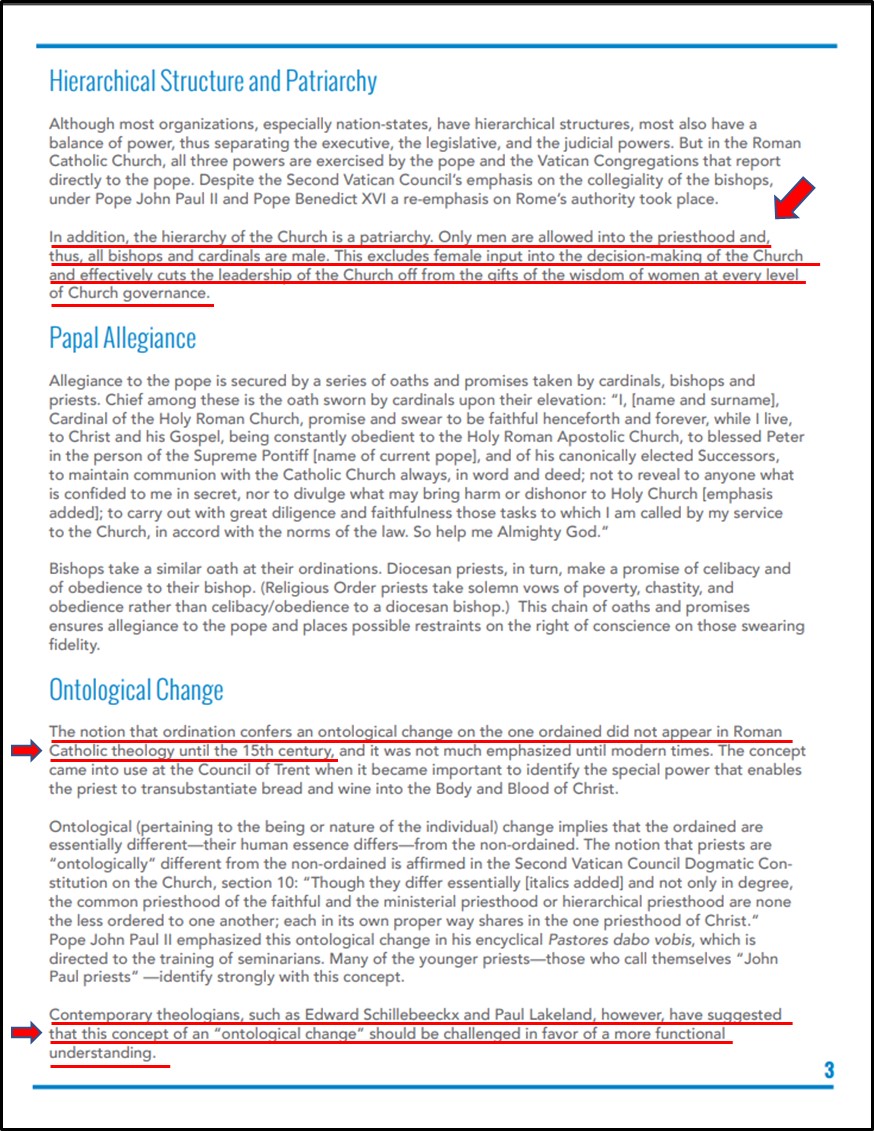
  • Sets up a negative comparison between nations with a balance of power and the hierarchy of the Church, asserting that “Despite the Second Vatican Council’s emphasis on the collegiality of the bishops, under Pope John Paul II and Pope Benedict XVI a re-emphasis on Rome’s authority took place.”
  • Decries the “patriarchy” of the Church, claiming “Only men are allowed into the priesthood and, thus, all bishops and cardinals are male. This excludes female input into the decision-making of the Church and effectively cuts the leadership of the Church off from the gifts of the wisdom of women at every level of Church governance.
  • After stating that the “notion” that ordination confers an ontological change is primarily of modern origin, it goes on to imply that there is legitimate disagreement with this DOGMATIC TEACHING because “contemporary theologians…have suggested that this concept of an ‘ontological change’ should be challenged in favor of a more functional understanding.” 
BridgeDialogues Second Module
The second module’s reading is nothing but professor Massimo Faggiolli’s presentation at the 2018 VOTF Conference. This presentation purports to be about the theology of the laity, but almost immediately devolves into a screed against Pope St. Pius X’s fight against the modernist heresy.  Faggiolli then launches into outright and blatant heretical teaching about the development of the hierarchical structure of the Church. Remember, this is being presented by the AUSCP as solid reading material for unsuspecting parishioners!
Examples:
  • Faggioli calls the fight against the heresy of Modernism, “the anti-modernist crisis, which is the most serious intellectual catastrophe in the Catholic Church…” (p. 3)
  • Faggioli blatently directly contradict Church teaching that Christ gave his Church a hierarchical constitution from the beginning, and closely mirrors the condemned proposition outlined in Lamentabili Sane. (p. 3) with these two statements, “The third, especially the 3rd and early 4th centuries, is the beginning of a hierarchical organization in the Catholic Church.” and “The third phase is the so-called Imperial Church, when the Church becomes much more hierarchical, in some sense because it mirrors the empire. When you relate to the empire, you become more imperial, right?
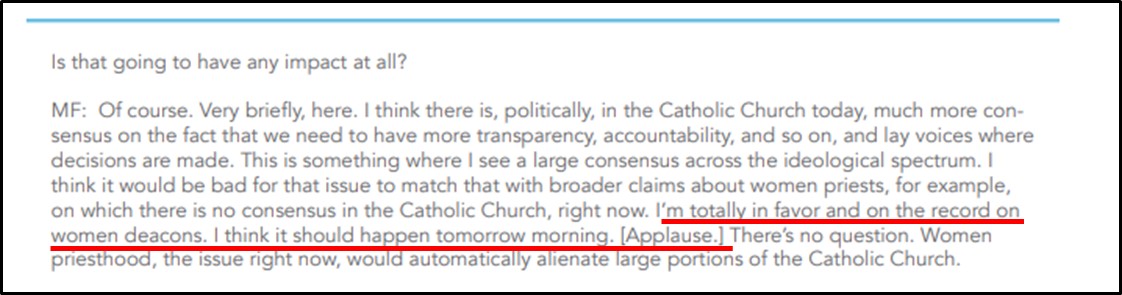
  • Faggioli states that women should be ordained as deaconesses. (p. 9) And while he doesn’t outright call for the ordination of women as priests, he simply states that a female priesthood would “automatically alienate large portions of the Catholic Church” at this time.
BridgeDialogues Third Module
The third module is mainly a selection of quotes from Pope Francis discussing clericalism. Pope Francis does not define clericalism in these quotes, and it is disingenuous for this module to assume that Pope Francis’ definition of clericalism is the same as presented in these BridgeDialogues.
BridgeDialogues Fourth Module
The fourth BridgeDialogue module consists of the AUSCP’s recent white paper on clericalism and a section of discussion questions. Anecdotes of people’s experiences with “clericalism” from priests and bishops are peppered throughout the text. Some of these anecdotes represent very real abuses of power or true clericalism. However, a good number of these stories representing “clericalism” are simply traditional and orthodox behavior. The white paper states:
The undercutting of pastoral service may yield another debilitating form of clericalism, one that directs itself against other priests. Adherence to protocols and rigid conformity has produced priests who consider it their duty to “correct” any priest they deem to be less than rigorous in upholding the rituals than he himself was taught.” (p. 20)
These three stories, for instance, are presented to the readers as clericalist abuses:
At his first Sunday Mass a new pastor told the congregation that he expected to be there for 30 years and there would be some immediate changes. If it’s not in the Missal it’s not being done—no deviations or even slight changes.” (p. 26)
A man came forward to receive Holy Communion. The priest placed the host in the communicant’s open hand. After noticing who it was and remembering that he was in a marriage “outside the church,” the priest snatched back the host from the communicant’s hand. Some parishioners left the parish because of the priest’s behavior.” (p. 26)
The Archbishop of a large metropolitan diocese observed that some of the newly ordained were saying their first Mass in Latin rather than in English. He became even more alarmed when he saw a glossy photo of a soon-to-be ordained seminarian, who had put on a cassock, cape, cane, and biretta for the photo. The bishop called the seminarian and told him not to dress that way again and to stop distributing such photos. The Archbishop now worries about what underlies the seminarian’s behavior.” (p. 21)
The white paper even accuses lay people of clericalism for following tradition:
Unfortunately, clericalism also infects some of the solutions proposed to mitigate the Church’s problems today. Some clerics—and lay people too—believe that following rules, policing rituals, and clearing out those who do not share the same vision of Church as theirs will somehow restore its ‘holiness.’” (p. 25)
Beyond this, and far worse, is that the white paper teaches that Jesus only started a movement of servant missionary disciples, not to be called rabbi or father, and empowered them to heal “at times.” (p. 23) It was only later that a hierarchy came into existence as well as the sacramental notion of the priesthood:
Unfortunately, in the centuries following the Letter to the Hebrews, the tradition of Jewish Temple priesthood and that of Rome’s pagan temple priesthoods co-opted the Scriptural understanding of the Risen Jesus as a priest according to the order of Melchizedek. Over a three-century span of time, the elders of the missionary disciples that Jesus sent forth came to be seen as a special caste of priests and overseers.
Their special status was enhanced when the Emperor Constantine legalized Christianity. Then, when a later emperor declared Christianity to be the official religion of the Empire, the status of bishops and priests grew even more exalted. They became “clerics”—recognized dignitaries with civic and imperial authority.
The choices made to adopt imperial trappings may have served the early Church’s needs. It no doubt helped continue the spread of Christianity. But over time this clerical status, initiated for civic and imperial purposes, had a predictable human result. Many of the clerics started behaving like persons “lording it over” those who were not clerics in both church and society. Ultimately, the specialness of priests and bishops became not only part of civil law but also, in 12th century Church teaching, was ratified by the sacrament of Holy Orders. By the year 1200, the Christian Church consisted of two distinct groups: the clergy, and those who were not—the “laity.” Clerics secured control over the community, the assembly of God’s people.” (p. 24)
This again flies in the face of the Church teaching that Christ gave his Church a hierarchical constitution from the beginning, and closely mirrors the condemned proposition outlined in Lamentabili Sane above.
BridgeDialogues “Responsibilities and Rights of Laity”
Finally, in the BridgeDialogues’ final section, we get our clearest heretical statement, as if the authors know the reader is now prepared to accept it after the more subtle influences in the previous modules.
In its earliest days, the Church had no clergy, no laity, simply a community of believers.” And thus, the program of AUSCP, VOTF and FutureChurch is laid bare. With the constant drum beat that we need to return to the ways of the early church we can see that they are seeking an outright revolution against the hierarchy and sacrament of Holy Orders as instituted by Christ! 
The fifth section goes on:
Gradually, however, our increasingly structured Church focused in official documents, century after century, on the development and rights of hierarchical offices. The laity, when they were described at all, mostly were described as recipients of whatever actions their pastors and bishops took. This imbalance continued until the Second Vatican Council renewed the focus on the entire People of God.
Bear in mind that this is not a mere flash-in-the pan endeavor.  The BridgeDialogues are being brought to parishes by AUSCP priests and their lay supporters.  In fact, laymen are being encouraged to:
  • Organize more BridgeDialogues
  • Join your parish council
  • Express the concerns of the AUSCP to your bishops and urge the reform of seminary education following the AUSCP model
  • Promote the discussion of women deacons
Everything about these supposed dialogue sessions on clericalism are nothing short of the beginnings of open rebellion within the Church.  AUSCP and its allies are attempting to overthrow the Church’s entire structure, remaking the Church in their own image and likeness.  But just as Korah, Dathan and Abiram were swallowed whole into the bowels of Hell, these disaffected heretics will no doubt meet a similar fate if they do not reverse course, now.
This joint program by the AUSCP, VOTF and FutureChurch is a very real and present danger to the Church and may very well be coming soon to a parish near you. We urge you to first be vigilant and on guard for this program and secondly be pro-active and share this information with your parish and your diocese in the hope that they will not allow these false dialogues to take place in your area.