
From Fr Alban Butler's Lives of the Saints:
The king, whose wrath was more and more kindled, called together his ministers and the judges of his empire, in order to deliberate what new cruel death could be invented for the chastisement of so notorious an offender. After a long consultation the council came to a resolution, that, unless the pretended criminal renounced Christ he should be hung on the rack, and his limbs cut off one after another, joint by joint. The sentence was no sooner made public but the whole city flocked to see his uncommon execution, and the Christians, falling prostrate on the ground, poured forth their prayers to God for the martyr’s perseverance, who had been carried out from the court without delay to the place of execution. When he was arrived there he begged a moment’s respite, and, turning his face towards the east, fell on his knees, and, lifting up his eyes to heaven, prayed with great fervor. After waiting some time the executioners approached the intrepid servant of Christ, and displayed their naked cimeters and other frightful weapons and instruments before his eyes; then they took hold of his hand, and violently stretched out his arm; and in that posture explained to him the cruel death he was just going to suffer, and pressed him to avert so terrible a punishment by obeying the king. His birth, and the high rank which he had held in the empire, the flower of his age, and the comeliness and majesty of his person, moved the whole multitude of spectators to tears at the sight. The heathens conjured him with the most passionate and moving expressions and gestures to dissemble his religion only for the present time, saying he might immediately return to it again. The martyr answered them, “This death, which appeared to them to wear so dreadful a face, was very little for the purchase of eternal life.” Then, turning to the executioners, he said, “Why stand ye idle looking on? Why begin ye not your work?” They therefore cut off his right thumb. Upon which he prayed thus aloud: “O Saviour of Christians, receive a branch of the tree. It will putrefy, but will bud again, and, as I am assured, will be clothed with glory.” The judge, who had been appointed by the king to oversee the execution, burst into tears at this spectacle, and all the people that were present did the same, and many cried out to the martyr, “It is enough that you have lost thus much for the sake of religion. Suffer not your most tender body thus to be cut piecemeal, and destroyed. You have riches: bestow part of them on the poor for the good of your soul; but die not in this manner.” St. James answered, “The vine dies in winter, yet revives in spring; and shall not the body when cut down sprout up again?” When his first finger was cut off, he cried out, “My heart hath rejoiced in the Lord; and my soul hath exulted in his salvation.3 Receive, O Lord, another branch.” Here the joy of his heart seemed sensibly to overcome the pain he suffered, and appeared visibly in his countenance. At the lopping off every finger he exulted and thanked God afresh. After the loss of the fingers of his right hand, and again after those of his left, he was conjured by the judges to conform, and save himself. To whom he meekly answered, “He is not worthy of God, who, after putting his hand to the plough, shall look back.” The great toe of his right foot was next cut off, and followed by the rest; then the little toe of the left foot, and all the others after it. At the loss of each part the martyr repeated the praises of God, exulting as at a subject of fresh joy. When his fingers and toes were lopped off, he cheerfully said to the executioners, “Now the boughs are gone, cut down the trunk. Do not pity me; for my heart hath rejoiced in the Lord, and my soul is lifted up to him who loveth the humble and the little ones.” Then his right foot, after that his left foot: next the right, then he left hand were cut off. The right arm and the left: then the right, and after that the left leg felt the knife. While he lay weltering in his own blood, his thighs were torn from the hips. Lying a naked trunk, and having already lost half his body, he still continued to pray and praise God with cheerfulness, till a guard, by severing his head from his body, completed his martyrdom. This was executed on the 27th of November, in the year of our Lord 421, the second of king Vararanes. The Christians offered a considerable sum of money for the martyr’s relics, but were not allowed to redeem them. However, they afterwards watched an opportunity, and carried them off by stealth. They found them in twenty-eight different pieces, and put them with the trunk into a chest or urn, together with the congealed blood, and that which had been received in linen cloths. But part of the blood had been sucked up by the sun, and its rays were so strongly dyed therewith as to unge the sacred limbs of the martyr, upon which they darted, with a red color. The author of these acts, who was an eye-witness, adds, “We all, supplaint implored the aid of the blessed James.” The faithful buried his remains in a place unknown to the heathens. The triumph of this illustrious penitent and martyr has, in all succeeding ages, been most renowned in the churches of the Persians, Syrians, Coptes, Greeks, and Latins. See his genuine Chaldaic Acts in Steph. Assemani, Acta Mart. Orient, t. 1, p. 237. The Greek translation, copied by Metaphrastes, &c., has been interpolated See likewise the learned Jos. Assemani, Bibl. Orient, pp. 181 and 402 Also in Calendaria Univ. t. 5, p. 387, and Orsi,1. 27, n. 6, t. 12, p. 9.
From the East:
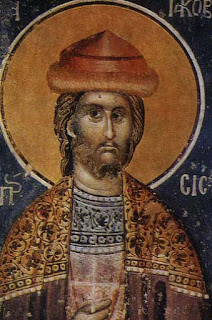
The Holy Great Martyr James the Persian (the Sawn-Asunder) was born in the fourth century into a pious Christian family, both wealthy and illustrious. His wife was also a Christian, and the couple raised their children in piety, inspiring in them a love for prayer and the Holy Scriptures. James occupied a high position at the court of the Persian emperor Izdegerd (399-420) and his successor Barakhranes (420-438). But on one of the military campaigns James, seduced by the emperor’s beneficence, was afraid to acknowledge himself a Christian, and so he offered sacrifice to idols with the emperor.
Learning of this, James’ mother and wife wrote him a letter, in which they rebuked him and urged him to repent. Receiving the letter, James realized the gravity of his sin. Faced with the horror of being cut off not only from his family, but also from God Himself, he began to weep loudly, imploring the Lord for forgiveness.
His fellow-soldiers, hearing him pray to the Lord Jesus Christ, reported this to the emperor. Under interrogation, Saint James bravely confessed his faith in the one True God. No amount of urging by the emperor could make him renounce Christ. The emperor then ordered the saint to be put to death.
They began to cut off his fingers and his toes one by one, then his hands and his feet, and then his arms and legs. During the prolonged torture, Saint James offered prayers of thanksgiving to the Lord, Who had granted him the possibility of redemption from his sins by enduring these terrible torments. Finally, the martyr was beheaded. Christians gathered up the pieces of his body and buried them with great reverence.
Troparion — Tone 4
You astounded all, long-suffering James, by enduring horrible tortures with great patience. / As the evil assembly performed the slaughter, / you uttered prayers of thanksgiving to the Lord. / Through your sufferings you received your crown, / and came to the throne of the heavenly King, Christ God. / Entreat Him to save our souls!
Kontakion — Tone 2
You listened to your faithful wife / and contemplated the judgment of God, holy James; / you despised the threats and commands of the Persians, / accepting the cutting of your body as though you were a vine. / Therefore you were revealed as a martyr worthy of honor.

No comments:
Post a Comment
Comments are subject to deletion if they are not germane. I have no problem with a bit of colourful language, but blasphemy or depraved profanity will not be allowed. Attacks on the Catholic Faith will not be tolerated. Comments will be deleted that are republican (Yanks! Note the lower case 'r'!), attacks on the legitimacy of Pope Leo XIV as the Vicar of Christ, the legitimacy of the House of Windsor or of the claims of the Elder Line of the House of France, or attacks on the legitimacy of any of the currently ruling Houses of Europe.