"Subtitled “A Tale of Affection in Youth and Age,” Belloc believed that this late novel was the one work of fiction with which he could feel satisfied."
From The Imaginative Conservative
By Joseph Pearce
As a novelist, Hilaire Belloc was prolific though not always particularly adept. The one notable exception is his “Belinda” of 1928. Subtitled “A Tale of Affection in Youth and Age,” Belloc believed that this late novel was the one work of fiction with which he could feel satisfied.
Hilaire Belloc was one of a rare breed which, today, might be considered an endangered species. He was what was called a man of letters; a man who refused to be pigeonholed, who refused to be labeled, who refused to be restricted by any sphere of speciality. Mercifully, he lived in an age in which the mania for specialization had not yet triumphed; an age in which it was not yet necessary to kowtow before the “experts” on any given subject; an age which had not yet suffered the disintegration caused by the compartmentalization of the academic disciplines into self-imposed excommunication from the wider world of academe; an age in which philosophers still knew theology, and in which historians still knew philosophy. He lived in an intellectually wealthier and healthier age.
Belloc was a Catholic apologist and an historian; a travel writer and a cultural critic; a political polemicist and an economic theorist. Above all, however, he was one of the greatest literary figures of the twentieth century whose poetry and poetic prose mark him as one of the greatest writers of his age.
As a poet, Belloc ranks alongside the finest of the twentieth century, at least when he is writing at his best. For sheer rumbustiousness, few other poets can match the riotous invective of “Lines to a Don”, Belloc’s vituperative riposte to the don “who dared attack my Chesterton”; for sheer indefatigable vigour, there is the romp and stomp of “The End of the Road”; for a doom-laden sense of “the ruines of time”, even the knell of Thomas Gray might kneel before the toll of Belloc’s “Ha’nacker Mill”; for the mystical sense of the exile of life, there is the Yeatsian yearning betwixt faith and faerie that Belloc evokes in “Twelfth Night”; for sheer ingenuity of metre and scansion, the regularly beating drum of most of his contemporaries is silenced by the hip, hop, clap of Belloc’s scintillating “Tarantella”.
As a novelist, Belloc was prolific though not always particularly adept. Most of his excursions into fiction were political satires bogged down by stolid prose and stagnant storylines. In his own estimation, his novels were not as memorable as the illustrations by G.K. Chesterton with which they were adorned. The one notable exception, Belinda (1928), fulfilled his potential as a novelist which had hitherto been frustrated. Subtitled “A Tale of Affection in Youth and Age”, Belloc believed that this late novel was the one work of fiction with which he could feel satisfied.
One suspects that Belloc’s Belinda was inspired by the woman of the same name in Alexander Pope’s The Rape of the Lock (1717). Both works are high burlesques in which the epic gravitas of the Greek gods are parodied with the ludicrous levitas of bathos. Belloc’s approach is much more nuanced and understated than Pope’s, however. Pope peoples his plot with a panoply of diminutive sylphs, pint-sized gods and goddesses which parody the Greek pantheon. By contrast, Belloc’s placing of Venus and her son in the story is allusively suggestive, even elusive. The goddess is not named and her ethereal presence reminds us of the haunting appearance of Pan, “the piper at the gates of dawn”, in Kenneth Grahame’s Wind in the Willows. She seems oddly out of place and yet her presence places everything else in the story in a new light. It is Belloc’s way of playfully parodying the Romantic novels of love, courtship and marriage of the previous century. Perhaps he had Maria Edgeworth’s Belinda in mind, a novel published in 1801, in which the eponymous heroine struggles with the pangs of true love, suffering the hardships of being misunderstood, before finally attaining the husband of her dreams and living happily ever after. It would be wrong, however, to imply that Belloc is holding such romantic fiction up for scorn. His own Belinda is so gentle a parody of the Romantic genre, so sympathetic a pastiche, that it’s almost a tribute to it, even as it is having fun with it.
Certainly Belinda displays a delicacy and lightness of touch that is missing from the ponderous plod of his earlier satirical novels. It also exhales an exuberance of fun and frivolity that is rare in his later work. Seldom, in the wake of his wife’s death in 1914 and the death of his son on active service with the Royal Flying Corps four years later, had Belloc reproduced the humour which had been one of the most attractive characteristics of his earlier work. Belinda emerges, therefore, as a breath of freshness amidst the sombre propriety of much of Belloc’s later work. It is, however, much more than that. “Of all Belloc’s works in prose Belinda is the most perfect, the most original, the most timeless, and therefore perhaps the most secure,” wrote Robert Speaight, Belloc’s biographer. He continued by stating that it was “also the most difficult to define”:
If we call it ‘pastiche’, we realize at once that we have employed too light and artificial a word. Artificial in a sense it is, and no one could describe it as heavy; but deep feeling underlies the artifice and the humour has the weight of Belloc’s own gravitas. The book grinds no axe and proves no point. It is a gratuitous, disinterested and quite impersonal essay in romantic irony. Small in scale and purposely conventional in subject, it still leaves an impression of grandeur; fine, not finicky; hard as a diamond and delicate as wrought iron.
If, as Speaight maintains, Belinda can be called an essay in romantic irony, there is an amusing irony in the fact that it appears to contradict what Belloc had written in his essay “On Irony” almost twenty years earlier. “Irony is a sword, and must be used as a sword,” he had written. In Belinda irony is not wielded as a weapon, but flourished like a feather. It is not used to bludgeon its victim senseless, but to tickle him with an affectionate sensibility. It is not an irony that is iron-shod and hardened by its own heartlessness, but one that is fleet of foot and on a flight of fancy. Belinda is for Belloc what The Man who was Thursday is for Chesterton; it is the one literary achievement in fiction that assures him a place amongst the great novelists of his day.
__________
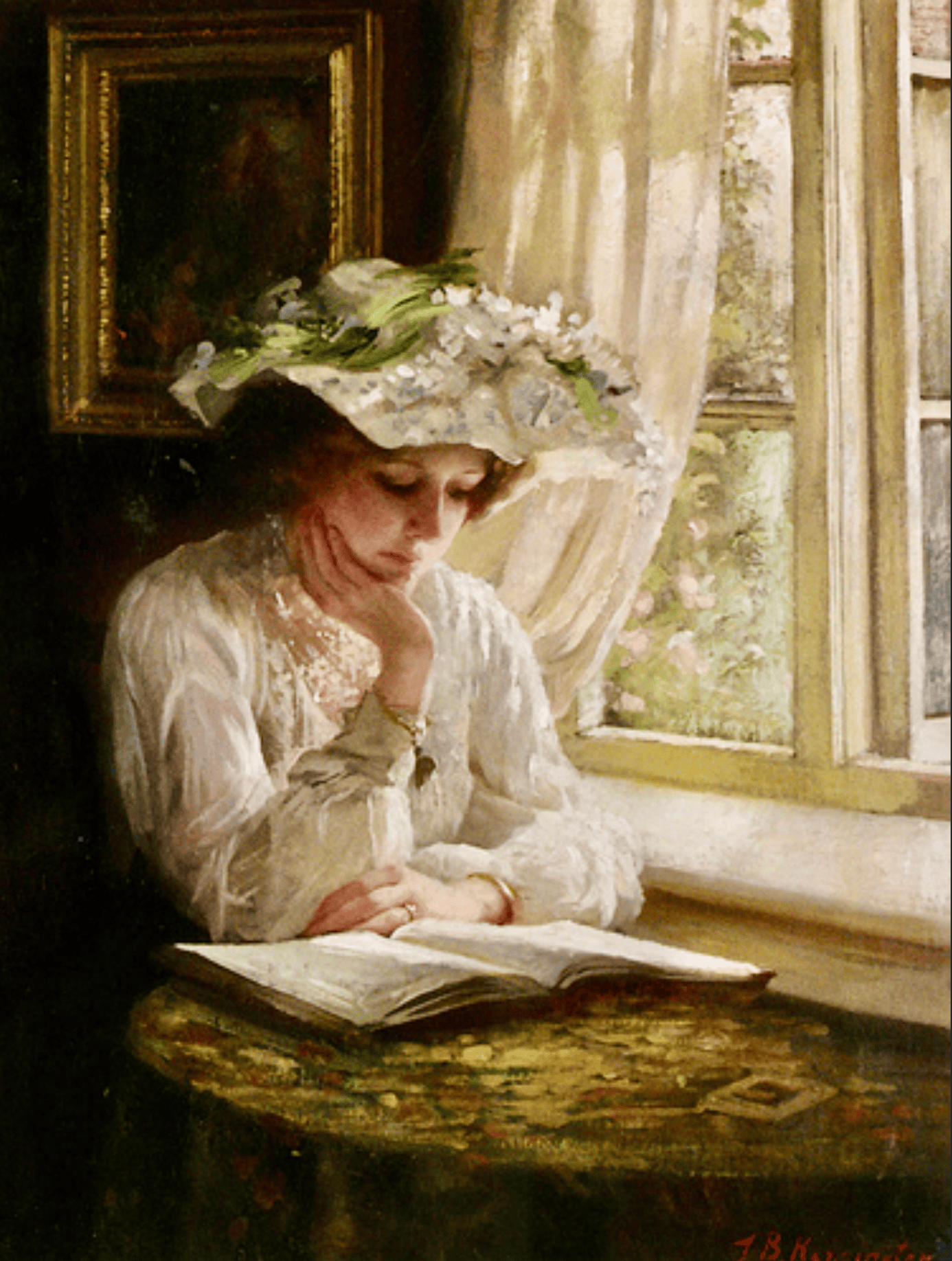
The featured image is “Lady Reading by a Window” (c. 1900), by Thomas Benjamin Kennington, and is in the public domain, courtesy of Wikimedia Commons.

No comments:
Post a Comment
Comments are subject to deletion if they are not germane. I have no problem with a bit of colourful language, but blasphemy or depraved profanity will not be allowed. Attacks on the Catholic Faith will not be tolerated. Comments will be deleted that are republican (Yanks! Note the lower case 'r'!), attacks on the legitimacy of Pope Leo XIV as the Vicar of Christ, the legitimacy of the House of Windsor or of the claims of the Elder Line of the House of France, or attacks on the legitimacy of any of the currently ruling Houses of Europe.