Woke "took its power from the long tradition of Western versions of the “progressive” totalitarian impulse that justifies itself with ideological lies."
From The Imaginative Conservative
By David Deavel, PhD
America, Daniel Mahoney writes, “remains a largely if only partially free country, though markedly less so than even in the recent past.” The danger we face is a declining understanding and assumption of the classical, biblical, and Christian categories of reality that ward off the insanity of an anti-human “Second Reality.”
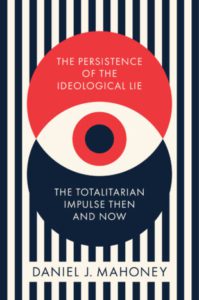
The Persistence of the Ideological Lie: The Totalitarian Impulse Then and Now, by Daniel J. Mahoney (159 pages, Encounter, 2025)
 The recent electoral triumphs and near triumphs of Democratic Socialists of America (DSA) candidates and those aligned have shown that, as far left as the Democratic Party seems to have lurched, it seems likely the lurching will continue until morale improves. That is true even if Democratic politicians such as New York Representative Alexandria Ocasio-Cortez are now referring to “Woke 1” as a kind of humorously extreme (“Woke 1 was crazy!”) phase that we can all laugh at as we enter a new era of ostensibly balanced sanity called “Woke 2.”
For those who are awake but not woke, this strategy of pretending that the “progressive” social terrors of the last decade were merely the high-spirited hijinks of really good people who took a good thing too far must be resisted. If allowed to flourish, a Woke 2 will be every bit as destructive as the first iteration. Most likely more so. That is because the extremism of wokeness was not solely derived from the kind of faddishness that causes young people to take up hula hoops, hackey sacks, and squishy toys. It took its power from the long tradition of Western versions of the “progressive” totalitarian impulse that justifies itself with ideological lies.
Daniel J. Mahoney, an emeritus professor of politics at Assumption College and newly appointed chair in American Thought at the Heritage Foundation, has long been a student of both the best and the worst that Western political thought has on offer. His work on great artists, thinkers, and statesmen including Solzhenitsyn, Churchill, Bertrand de Jouvenel, Raymond Aron, and De Gaulle has illuminated both the extreme evils they faced and the prudence, wisdom, and courage on which they drew to identify and attempt to lead Western countries back to truth, sanity, and a rightly understood freedom.
In his latest book, The Persistence of the Ideological Lie, published in 2025, Professor Mahoney proposes to “provide nothing less than a full-throated defense of moral and political sanity against the latest eruptions of ideological mendacity in our time.” This project is needed precisely because of the “renewed virulence,” less than four decades after the 1989 rejection of Communist totalitarianism, of the “‘ideological’ project to replace the only human condition we know with a utopian ‘Second Reality’ oblivious to—indeed at war with—the deepest wellsprings of human nature and God’s creation.”
In short, when the DSA and the otherwise woke say they want communism (and they do say that), we must believe them.
America, Professor Mahoney writes, “remains a largely if only partially free country, though markedly less so than even in the recent past.” The danger we face is a declining understanding and assumption of the classical, biblical, and Christian categories of reality that ward off the insanity of this anti-human “Second Reality.” Thus, his dual purpose of giving us both a critique of this grand illusion and an outline of moral and political sanity.
Professor Mahoney’s early chapters are a diagnosis of the “woke despotism” of our times, complete with its language games, division of the population into “suspect groups” who become the exclusive “locus of evil,” its stylized hierarchies of race, sex, and “gender,” and the most powerful state move toward totalitarianism during the supposed crisis of Covid. He correctly notes that one of the greatest conduits for this renewed danger was Barack Obama’s repeated denial of the compatibility of democracy and absolute truth. Rather than incompatibility, a healthy democratic polity must be founded on the conviction that the great argument concerns how to live together in such a way as to meet the demands of the stern and unbending reality of our being—which is indeed an absolute truth. Indeed, a later chapter explains the deep connection between relativism and totalitarianism. In short, the denial of truth does not rid human nature of the search for it—especially in the moral realm. Denial of moral truths “does not abolish moral phenomena as much as distort them or cause them to live a diminished and zombie-like existence.”
Hence the extreme pseudo-moralism of those who propose radically different and frankly bizarre rules of the moral road as they are formulated by those craning their necks backward at radicals of the last couple centuries and toward the mirror image of today’s fads. The middle section of the volume looks at the intellectual roots and modern iterations of the left’s insanities. Different chapters take on Postcolonialism, Jacobinism, Marxism, the pure negation of the Russian Revolutionary tradition, and the new racialism of the 1619 Project and its proponents. In each chapter, Professor Mahoney both diagnoses and prescribes sources to understand these movements. As with many of his recent books, this one is light on the scholarly apparatus of footnotes and endnotes but includes a brief annotated bibliography at the end of each chapter to explore both the original ideological liars and their modern heirs.
Throughout The Persistence of the Ideological Lie, Professor Mahoney prescribes not only intellectual sources for understanding but the proper dispositions, virtues, and emphases needed to keep the United States from tilting into the abyss of ideological unreality and destruction. Taking aim at those who tend to call themselves classical liberals, he denies that the language of a “propositional nation” can suffice to renew the wellsprings of civic health. To rest on such a thin ground is to do a disservice to what we are: “a territorial democracy, with a history that is uniquely our own and with borders that demarcate us as a self-governing nation.” The propositions that sustain us do not hang in the air as abstractions. They can only be fully understood and lived with a knowledge of our religion, culture, and history.
We must be courageous and moderate, but the moderation must be real. Professor Mahoney believes that our Ruling Class’s strategy has been to demand a “fanaticism of the center.” This purported centrism is really not centrism at all. Instead, it is a “faux moderation that succumbs, in whole or in part, to woke nostrums in order to have a seat at the progressivist table.”
There are perils, however, even for those who have avoided the other errors. Professor Mahoney addresses “the so-called New Right” (nomenclature that has been used several times already in American history) with the challenge to reject “the urge to latch on to something superficially new, vital, and exciting at the expense of jettisoning the classical and Christian wisdom of old.” Nietzsche is not peachy, we might say, even if his “fierce poetic eloquence” in denouncing desiccated Christianity and liberalism is appealing.
We have resources to respond to our moment in the ancient and biblical heritage, in the modern sages such as Tocqueville and Voegelin, and, practically, in the American Founders whose practical wisdom built something extraordinary—even were it to disappear today. Furthermore, we have a great many witnesses about how to respond to the totalitarian ideas and movements. Like the late Fr. James Schall, Professor Mahoney finishes his own book with a list of “Ten Essential Books for Understanding and Overcoming the Ideological Lie.” Burke, Voegelin, Dostoevsky, and Solzhenitsyn join modern witnesses and theoreticians such as Ryszard Legutko, Nigel Biggar, and Joshua Mitchell.
In the end, “Woke 2” is no different from “Woke 1.” And, neither is anything but a gateway to darker totalitarian ends. Even if we avoid them, however, the task of keeping rightly ordered liberty and societal health is a difficult one. The ideological lie can take many forms. The Persistence of the Ideological Lie gives us a brief (159 page) catechism on how they masquerade as angels of light. More importantly, this book shines a light on the necessity of truth to maintain and revive the good society. It is an outline of intellectual, moral, and political sanity by which we might see more clearly the whole.
__________
The featured image is courtesy of Pixabay.

No comments:
Post a Comment
Comments are subject to deletion if they are not germane. I have no problem with a bit of colourful language, but blasphemy or depraved profanity will not be allowed. Attacks on the Catholic Faith will not be tolerated. Comments will be deleted that are republican (Yanks! Note the lower case 'r'!), attacks on the legitimacy of Pope Leo XIV as the Vicar of Christ, the legitimacy of the House of Windsor or of the claims of the Elder Line of the House of France, or attacks on the legitimacy of any of the currently ruling Houses of Europe.