"[T]hose of us who rejoice in the beauty of language and the brilliance of great poetry cannot help but marvel at Alexander Pope’s telling of the tale of Troy."
From The Imaginative Conservative
By Joseph Pearce
No doubt, we can continue to argue about which is the best translation of “The Iliad.” However, those of us who rejoice in the beauty of language and the brilliance of great poetry cannot help but marvel at Alexander Pope’s telling of the tale of Troy.
It was the best of times, it was the worst of times.
 The opening words of Charles Dickens’ novel, A Tale of Two Cities, refer to the late-eighteenth century in England and France in the years prior to, and leading up to, the French Revolution. In truth, there was not much that could be described as the best of times in either nation during the late eighteenth century.
France was by this time ripe for revolution. Deist and atheist intellectuals, such as Diderot, D’Alembert and Rousseau, were at the forefront of the cynical attack on Christian faith, as was Voltaire, one of the most brilliant men of the century. England was in the grip of new philosophies, which questioned the nature and the very existence of God. The Anglican Church, established 250 years earlier to do the bidding of the king, was a lacklustre presence in the culture, while the Catholic Church, after 250 years of relentless persecution, was the weakest it would ever be in terms of the numbers of practicing Catholics.
The eighteenth century would also be a time of inspirational drought, the decline of culture going hand in hand with the decline in religious belief. The previous century had been alive with the works of Shakespeare, Donne, Herbert, Crashaw, Milton and Dryden; the following century would be graced with the Romantic Poets and with the golden age of the novel. By comparison, the eighteenth century has little to recommend it.
There are two great writers, however, who represent the best of this worst of times, both of whom are worth celebrating and both of whom are in need of elevation to their rightful place amongst the illustrissimi of English letters. These are Jonathan Swift and Alexander Pope.
Jonathan Swift, author of Gulliver’s Travels, was a champion and defender of tradition in an age of accelerating change. Specifically, in the ongoing “Quarrel of the Ancients and the Moderns” which had been raging in France and then in England throughout the seventeenth century, Swift was a resolute proponent of the position of the Ancients. Along with his friend, Alexander Pope, he represents the satirical reaction against scientolatry (the idolization of science as having all the necessary answers that human society needs) and chronological snobbery (the supercilious and arrogant dismissal of the past as being inexorably inferior to the present and the future). This is especially true of Swift’s satirical commentary on contemporary culture in Gulliver’s Travels.
Swift creates Gulliver as the caricature of a stereotypical “modern” in order to satirize and ultimately lampoon the follies of the Enlightenment and its modernism and scientism. Gulliver’s very name is a phonetic melding of the word “gull”, which means a dupe or credulous person, and the word “traveller”. Gulliver is the archetypal gullible traveler!
In the midst of the madness caused by Gulliver’s gullibility, Swift dexterously slips in the presence of sanity in the character of Don Pedro, who rescues Gulliver and brings him home to England for the final time. Don Pedro, a Catholic Christian, serves as the representative of a real human person and, therefore, as the antidote to the extremes of the Hobbesian and Cartesian understanding of man which had so confused Gulliver. It is the common sense and Christian charity of this representative of humanity which Gulliver should seek to imitate and emulate, not theoretical and abstract idealism. Gulliver does not learn the lesson which Don Pedro’s presence and example teach but surely the reader is meant to do so.
Alexander Pope is rightly remembered for his satirical poetry, The Rape of the Lock and The Dunciad, which exposed the follies of his contemporaries, and also for his philosophical poem, An Essay on Man, which sought to “vindicate the ways of God to Man”. Yet his greatest and perhaps most neglected achievement is his masterful translation and rendition of Homer’s Iliad. This is hardly ever read these days because of the availability of modern translations, which sacrifice poetic beauty on the altar of prosaic literalism. Twentieth-century translations by Richmond Lattimore, Robert Fitzgerald and others might understandably be praised by classicists for their fidelity to Homer’s Greek, but those of us who rejoice in the beauty of language and the brilliance of great poetry cannot help but marvel at Pope’s telling of the tale of Troy. The heroic couplet favoured by Pope might not be a poetic form known to the classical world but it is perfectly suited for narrative verse and especially for narrative verse on an epic scale. Compare, for instance, Lattimore’s translation of the opening lines of The Iliad with Pope’s:
Sing, goddess, the anger of Peleus’ son Achilleus
and its devastation, which put pains thousandfold upon the Achaians… (Lattimore)
Achilles’ wrath, to Greece the direful spring
Of woes unnumber’d, heavenly goddess, sing… (Pope)
Pope’s poetic rendering of the epic demands to be declaimed out loud so that the music of the words, the symmetry of the rhyme, and the rhythm of the iambic pentameter can sing with Homer’s and Pope’s heavenly Muse.
The argument against reading Pope’s translation instead of more modern translations was summed up lucidly and eloquently by Pope’s contemporary, Richard Bentley, a great classical scholar: “It is a pretty poem, Mr. Pope, but you must not call it Homer.” On the other hand, another great scholar of the eighteenth century, Samuel Johnson, acclaimed Pope’s Iliad as “a performance which no age or nation could hope to equal”.
As for which side we should take, and which translation we should read, it might be best to defer to some lines by T.S. Eliot as a means of understanding the choice we are facing.
Between the potency
And the existence
Between the essence
And the descent
Falls the Shadow.
An inevitable and unavoidable shadow falls over every translation of a text from one language to another. Between the potency of the original and the existence of the translation, the shadow descends. But there are two types of shadow that can fall. The first obscures the literal meaning by the use of poetic license; the second obscures the poetic beauty by the insistence on literal fidelity. A good translation does not sacrifice beauty to truth, nor truth to beauty; it conveys the beauty of the original work without sacrificing the truth of the literal meaning.
No doubt, we can continue to argue about which is the best translation of The Iliad. There is, however, no doubt that Alexander Pope’s magnificent telling of Homer’s epic is one of the greatest epic poems in the English language, irrespective of its merits as a translation. May it be praised and may Alexander Pope be praised. He was indubitably one of the best writers in the worst of times, as was his friend Jonathan Swift. May they both be celebrated in our own worst of times for the beauty and wisdom of their words.
_________
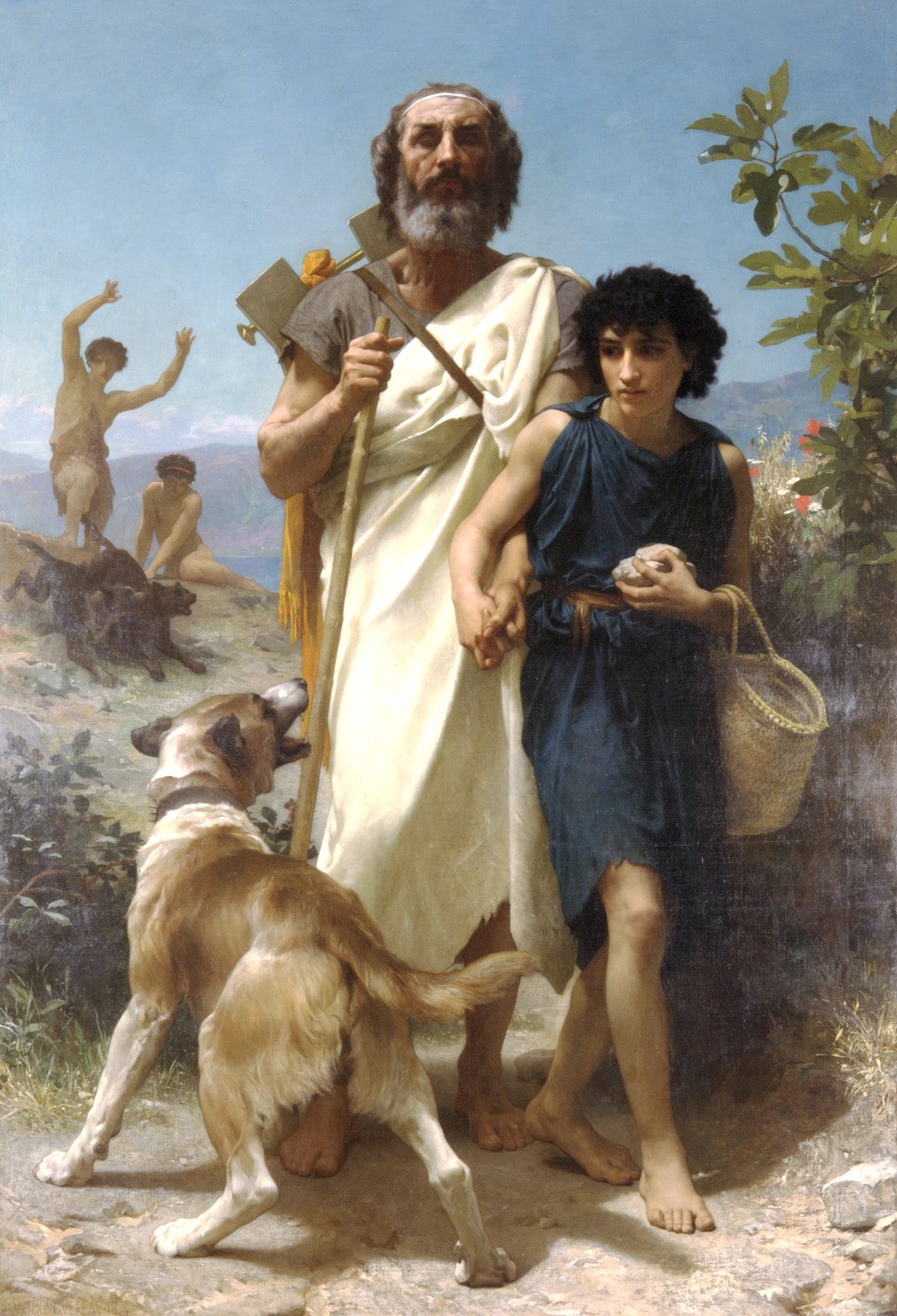
The featured image is “Homer and His Guide” (1874), by William-Adolphe Bouguereau, and is in the public domain, courtesy of Wikimedia Commons.

No comments:
Post a Comment
Comments are subject to deletion if they are not germane. I have no problem with a bit of colourful language, but blasphemy or depraved profanity will not be allowed. Attacks on the Catholic Faith will not be tolerated. Comments will be deleted that are republican (Yanks! Note the lower case 'r'!), attacks on the legitimacy of Pope Leo XIV as the Vicar of Christ, the legitimacy of the House of Windsor or of the claims of the Elder Line of the House of France, or attacks on the legitimacy of any of the currently ruling Houses of Europe.